'From crisis management to stability': Pashinyan unveils new government programme






Armenia’s 2026–2031 government programme
The Armenian government has approved its programme for 2026-2031. Prime Minister Nikol Pashinyan said it marked a shift from crisis management to stability. Looking back on his eight years as prime minister, he said the coronavirus pandemic, followed by the war and the post-war situation, had forced the government to operate in crisis-management mode. Now that Armenia and Azerbaijan have established peace, the government can “return to the unfinished part of the agenda of the 2018 Velvet Revolution”.
The new programme focuses on stability, he said. Pashinyan stressed that it rests entirely on the concept of “Real Armenia” and the principles underpinning the establishment of the Fourth Republic.
In 2025, the ruling Civil Contract party announced a new strategic goal: establishing the Fourth Republic of Armenia.
The party congress unanimously adopted a declaration to this effect. According to the document, the Fourth Republic “will be based on the concept of preserving the internationally recognised sovereign territory of the Republic of Armenia, covering 29,743 sq km, in accordance with the 1991 Alma-Ata Declaration”. The declaration says the party reached this decision after analysing the history of the Third Republic.
The Third Republic refers to the present-day Republic of Armenia, which declared independence following a nationwide referendum in 1991. The First Republic refers to the republic proclaimed on 28 May 1918. Accordingly, Soviet Armenia is considered the Second Republic.
“Following the 7 June 2026 election, the ideology of ‘Real Armenia’ won. This means it has become the official ideology. Armenia is therefore entering the stage of its history that we call the Fourth Republic. We must continue and give new momentum to democratic, anti-corruption, economic and public administration reforms,” the prime minister stressed.
- Armenia approves new government as Pashinyan promises appointments based on merit
- Armenia’s new parliament holds first session as opposition, as expected, makes its presence felt
- Final election results in Armenia: Pashinyan’s party wins majority
Government plans for the next five years
According to the new programme, the Armenian government will pursue the following goals in 2026-2031:
- strengthening and further institutionalising the peace established between Armenia and Azerbaijan;
- maintaining and further developing a favourable security environment around Armenia, in particular by normalising and developing relations with countries in the region and deepening existing partnerships beyond it;
- unblocking Armenia through the Crossroads of Peace project and the “Trump Route” (TRIPP) transit programme;
- liberalising the visa regime with the EU for Armenian citizens;
- deepening democratic, anti-corruption, economic and public administration reforms.
With whom does Yerevan plan to deepen partnerships under its “balanced foreign policy”?
In 2026-2031, the Armenian government will pursue a “balanced and proportionate” foreign policy.
“It has proved effective in stabilising Armenia’s external environment. Regionalisation plays a key role in foreign policy, whose goal is to ensure conditions in which Armenia can not only live without external support, but do so comfortably,” the document says.
Based on this approach, the government places particular importance on further developing relations with Georgia, Iran, Turkey and Azerbaijan. The government has outlined the following steps for each neighbouring country:
Georgia
Yerevan will continue implementing the measures set out in the Declaration on Establishing a Strategic Partnership between Armenia and Georgia. This will create new mutually beneficial opportunities for political, trade, economic, energy and transport cooperation, as well as regional and joint infrastructure projects.
Iran
Armenia will continue energy cooperation with Iran, develop cross-border infrastructure and expand transport routes through Iran, including North-South and Persian Gulf-Black Sea corridors.
Turkey
The Armenian government will continue efforts to establish diplomatic relations with Turkey, open the Armenian-Turkish border and put at least two modern border crossing points into operation. It also plans to restore and expand transport, energy and digital infrastructure, as well as bilateral and multilateral trade.
Azerbaijan
The government plans to continue efforts to sign and ratify a peace agreement and carry out work on the delimitation and demarcation of the state border. Contacts between civil society and business communities in the two countries will continue, helping to establish bilateral trade.
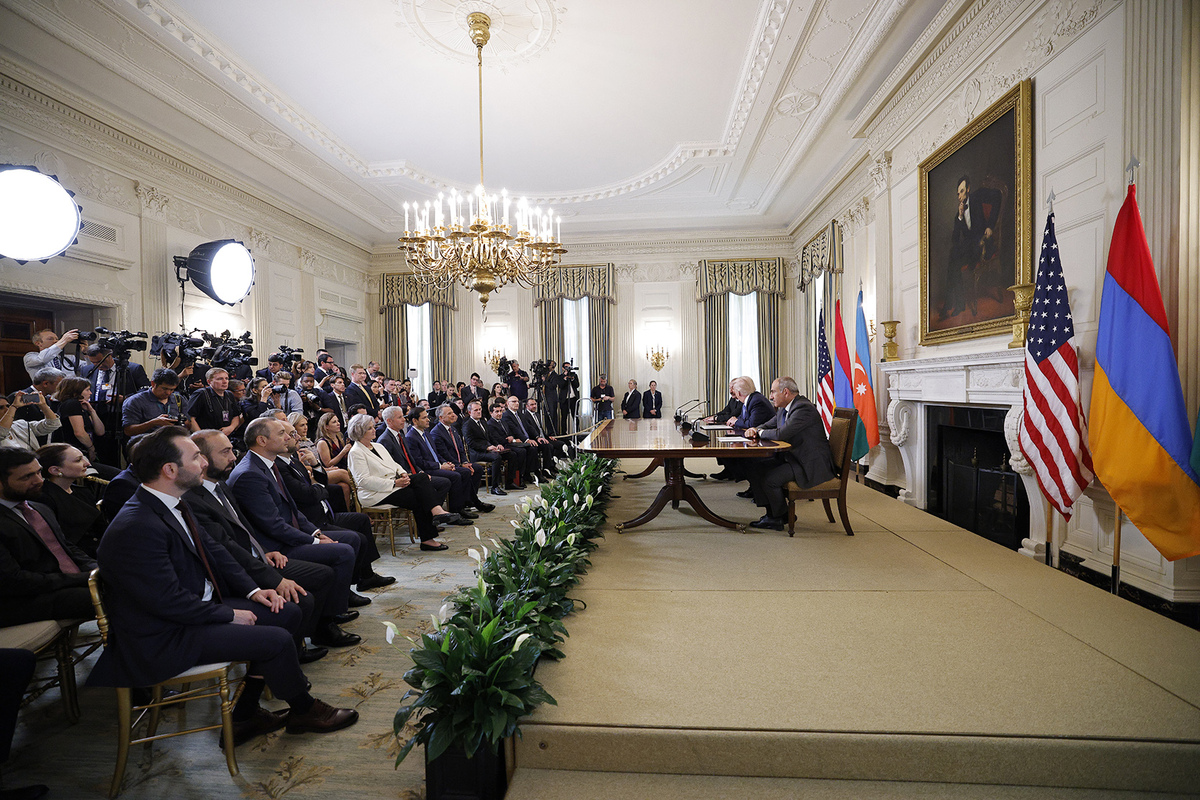
The foreign policy priorities specifically include deepening strategic partnerships with the European Union, the US, France and China. With Russia, Armenia plans to “transform and deepen its partnership”.
Against the backdrop of tensions over the ban on Armenian food and other exports to Russia and the Eurasian Economic Union (EAEU), which Russia leads, the programme says:
“Work will continue to ensure the full and uninterrupted exercise of the EAEU’s fundamental freedoms — the free movement of labour, services, goods and capital — as well as to develop relations with member and observer states.”
Regarding relations with the European Union, the programme stresses that Armenia will continue working to meet standards in democracy and the rule of law, as well as in the economic, financial and other spheres.
Armenia intends to deepen its partnership with the United States further. Cooperation will continue based on the principles set out in the Strategic Partnership Charter and bilateral memorandums of understanding.
“The TRIPP project, the ‘Trump Route’, will be implemented, at least in terms of operating energy and railway infrastructure, while integrating Armenia into major regional infrastructure projects,” the programme says.

Armenia’s 2026–2031 government programme