Hajj in Soviet Azerbaijan — fifth article by historian Jamil Hasanli






Hajj in Soviet Azerbaijan
Following reforms in the 1950s, Soviet authorities began allowing a limited number of Muslims to perform the Hajj in the early 1960s. However, the Soviet Council for Religious Affairs believed that sending individuals to Mecca did not serve the interests of the Soviet state, arguing that pilgrims often stepped up religious activity after returning home.
At the same time, the council’s chairman, Alexei Puzin, stressed that sending illiterate pilgrims to Mecca also did not serve Soviet propaganda goals.
Nevertheless, of the nine candidates nominated in 1960 by the Azerbaijani republican commissioner for religious affairs and the Muslim Spiritual Directorate for a pilgrimage to Mecca, eight were illiterate. They included Ibrahim Yakhshibeyov from Nardaran, Mammadaga Mammadov from Buzovna, Gasymali Gasymov from Kurdakhani, mullah Murad Mammadali oghlu from Zabrat, Ramazan Gojayev from the village of Talalar in the Balakan district, Zaly Rustamov from Nardaran, Muslim Jabrailov from the settlement of Bina and Ali Akberov. Only Kamal Bakharov from the village of Ilisu in the Gakh district was semi-literate.
On 7 May 1962, Moscow sent a group of 14 pilgrims from the Muslim republics of the USSR to Mecca via Cairo. Some members of the group cooperated with the KGB.
Two pilgrims came from Azerbaijan. One was Iman Allahverenov, who served at the Shah Abbas Mosque in Kirovabad, now Ganja. The other was an oil worker. After returning from the pilgrimage, Allahverenov filed a detailed report with the republican commissioner for religious affairs on 25 June.
Jamil Hasanli is a prominent Azerbaijani historian, professor and doctor of historical sciences.
He is publishing a series of articles titled “Religion in Soviet Azerbaijan: Between Allah and the KGB” on his Facebook page.
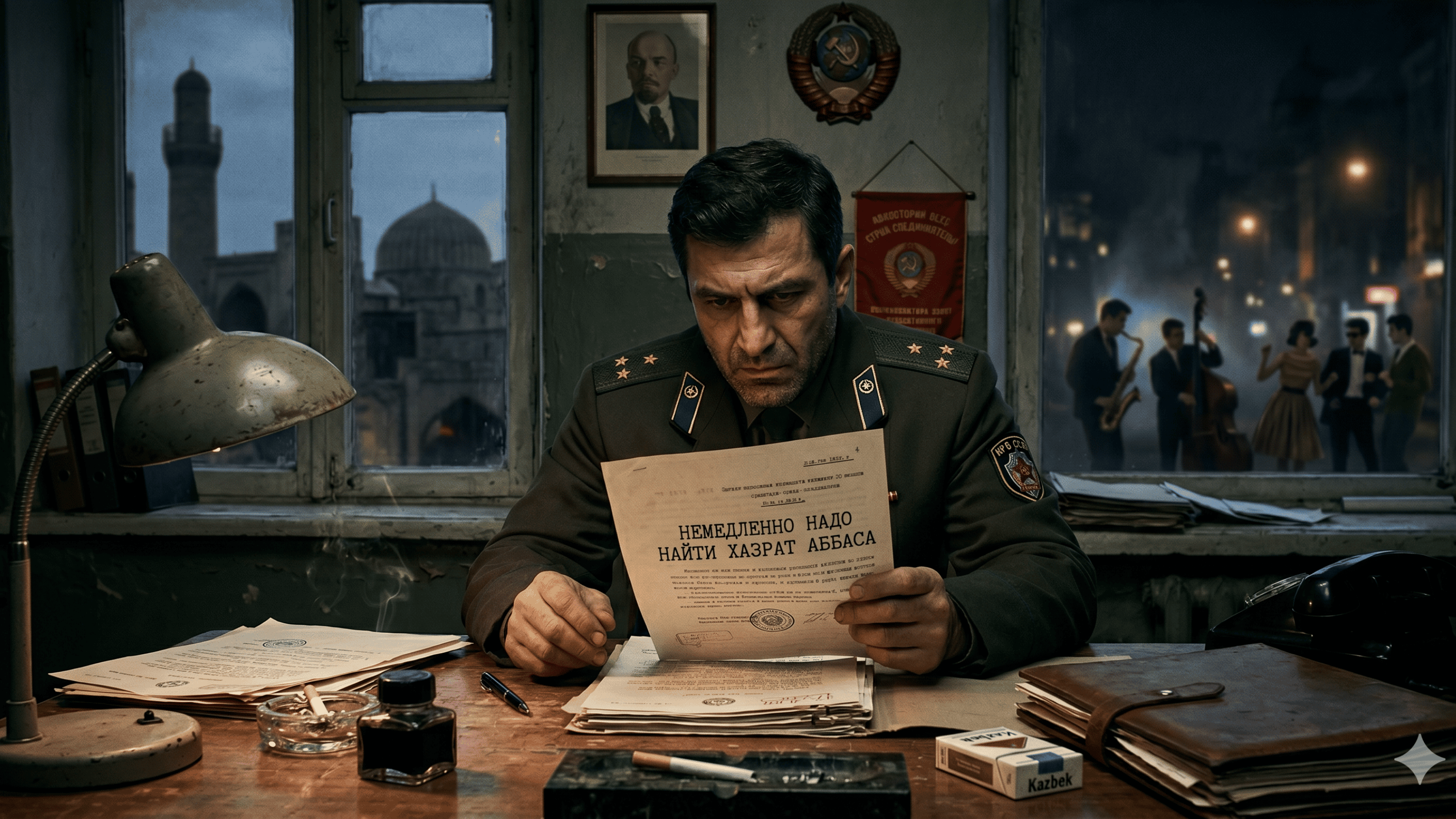
In his report, Iman Allahverenov described the Hajj rituals carried out between 9 and 19 May, meetings in Mecca, a post-pilgrimage trip to Lebanon, visits to Beirut and Tripoli, and other matters. These included encounters with emigrants from Central Asia and Tatarstan living in Saudi Arabia, who asked the pilgrims to deliver letters and gifts to relatives back home.
He wrote:
“In Mecca, an elderly Turkish man we did not know approached us and said during conversation that he was from Turkey, had a higher education and worked in agriculture. He then asked why, despite the fact that 40 million Muslims lived in the USSR, only 14 people had come on the Hajj. He added that, according to rumours, collective farm property was being stolen in the Soviet Union. We understood that this person could not be trusted, so we did not answer him and walked away.”
The report suggests that, in the early 1960s, the Soviet state organised pilgrimages to Mecca for a limited number of believers primarily for ideological reasons rather than out of concern for Islam.
In 1964, the USSR sent 16 people on the Hajj, including two from Azerbaijan. According to a Soviet Council of Ministers decree issued on 14 February 1964, the candidacies of Abbasgulu Aydemirov, chairman of the executive body of the Taza Pir Mosque, and Mammadkazim Huseynov, a senior technician at Azizbekovneft, received approval from the Azerbaijani branch of the KGB before their trip to Mecca.
Unlike in previous years, Moscow instructed officials that the Central Committee of the Azerbaijani Communist Party had to approve every pilgrim travelling on the Hajj. Officials also had to send those decisions to the department overseeing diplomatic personnel and foreign economic bodies within the CPSU Central Committee.
After officials prepared the necessary documents, the pilgrims travelled from Moscow to Mecca on 17 April along the route Moscow-Cairo-Khartoum-Jeddah.
After returning from the pilgrimage, Abbasgulu Aydemirov prepared a detailed report for the commissioner for religious affairs. In the report, he sharply criticised the head of the Soviet delegation, Ismail Sattiyev, accusing him of misappropriating funds allocated for the pilgrims.

Aydemirov wrote:
“According to the rules of the Hajj, every pilgrim must sacrifice a sheep in Mina. Otherwise, the pilgrimage is not considered valid. Sattiyev did not give the pilgrims money to buy sheep. Huseynov and I sold our watches and bought a sheep for the ritual sacrifice. The fact that pilgrims from the USSR did not perform the sacrifice left a poor impression on pilgrims from other countries.”
For his part, Ismail Sattiyev informed the Soviet Council for Religious Affairs that Aydemirov had walked barefoot around the Kaaba. Aydemirov later explained:
“Walking barefoot around the Kaaba seven times is part of the pilgrimage ritual, and all pilgrims do it.”
Alongside this explanation, Azerbaijan’s commissioner for religious affairs, Musa Shamseddinsky, sent Aydemirov’s report on the pilgrimage to Mecca to the chairman of the Soviet Council for Religious Affairs, Alexei Puzin.
At the same time, Soviet intelligence services closely monitored the growing role of Mecca and Medina as major destinations for Muslims worldwide. According to KGB experts, Saudi Arabia and the United Arab Republic were using this influence for political purposes. Soviet authorities developed various plans aimed at breaking what they saw as those countries’ monopoly over Muslim pilgrimage. Through Islamic organisations in Africa that maintained close ties with Moscow, the USSR sought to include itself in global Muslim pilgrimage routes.
In the early 1960s, amid growing religious interest in Soviet Azerbaijan, the Central Committee of the Azerbaijani Communist Party adopted a resolution on 19 November 1963 aimed at intensifying anti-religious campaigns.
Under the decision, authorities organised month-long courses to train atheist educators for rural areas. The party’s Central Committee bureau approved both the lecture topics and the list of lecturers.
On 21 January 1964, Soviet Azerbaijan held a large republican conference titled “On the Propaganda of Scientific Atheism and Measures to Improve It”. Authorities organised the event in line with a CPSU Central Committee Secretariat resolution adopted on 2 January 1964 “On Measures to Strengthen Atheist Education Among the Population”.
Around 800 people attended the conference, including ideology secretaries from city and district party committees, agricultural production associations, heads of culture and education departments, officials from state cinema bodies, and senior representatives of the Central Committee, Council of Ministers and Supreme Soviet responsible for ideological affairs.
The main speech came from Hasay Vezirov, secretary of the Azerbaijani Communist Party Central Committee for ideology.
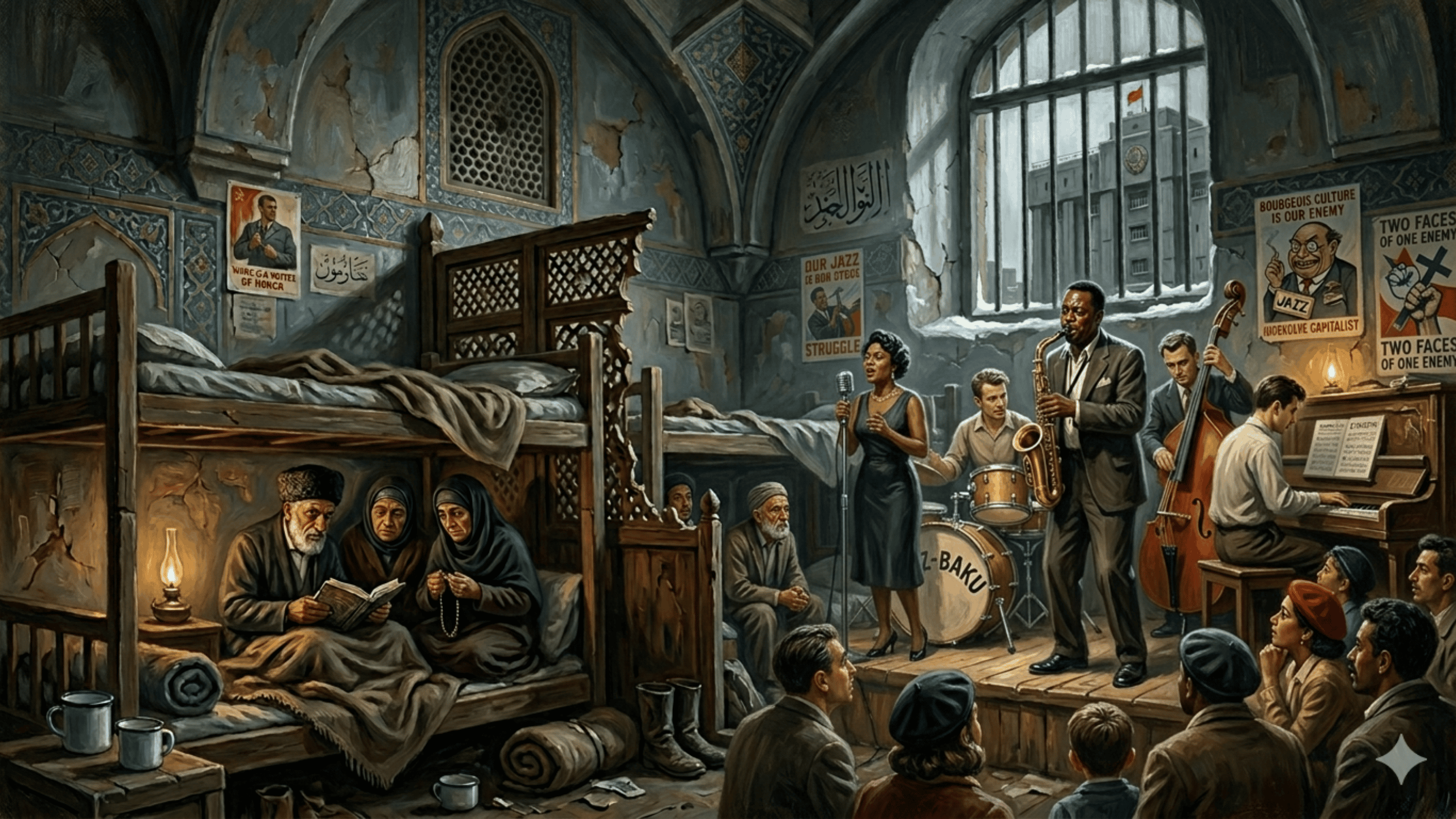
After 14 participants spoke on the report, Hasay Vezirov, secretary of the Central Committee, delivered the closing remarks. He stated:
“At present, the party attaches enormous importance to the atheist education of working people. The party wants to restore an offensive spirit in atheist education and ensure that the struggle against religious ideology is carried out systematically, continuously and through every available means… We must clearly understand that there can be no reconciliation with religious ideology, religion or religious remnants. We must conduct active propaganda and agitation.”
At the same time, Vezirov acknowledged that the law allowed religious activity within certain limits. He used this to explain why 23 mosques still operated in the republic and why 72 people officially held permission to conduct religious activity.
Speaking about Muharram rituals performed in mosques, he added:
“They say people inflict wounds on themselves, and we turn a blind eye to it. Someone becomes a standard-bearer, and we turn a blind eye to it, and so on. We must ensure that they stop harming themselves. In general, registered mosques must remain under a certain degree of control. We should strive to ensure that believers visit registered mosques as rarely as possible or stop going there altogether.”
Addressing the number of mosques and mullahs, Vezirov said:
“We have only 30 mullahs. The state has authorised them to conduct religious ceremonies. Six of them have religious education, while four received higher education in Iran and Iraq. However, the leadership of the Muslim Spiritual Directorate is concerned. Since these mullahs are already over 60 years old, the question arises: what will happen to the mosques after they die?”
With this rhetorical question, the republican conference of atheists came to an end.
Soon after the conference, on 2 July 1964, Hasay Vezirov sent a detailed report to the CPSU Central Committee outlining measures taken to strengthen atheist education among the population.
After listing measures implemented in the republic following the June 1963 plenum of the CPSU Central Committee, particularly after the Secretariat resolution of 2 January 1964, he focused on actions directed against what officials described as the “reactionary Islamic custom” of Muharram.
Vezirov noted that between February and June 1964 atheist lecturers delivered 8,157 lectures and discussions targeting religious practices and beliefs. He also highlighted the publication of 45 books and brochures on scientific atheism, the intensification of anti-religious campaigns in the press, and the launch on republican television of programmes titled “The Atheist Tribune” and “The Atheist Screen”.
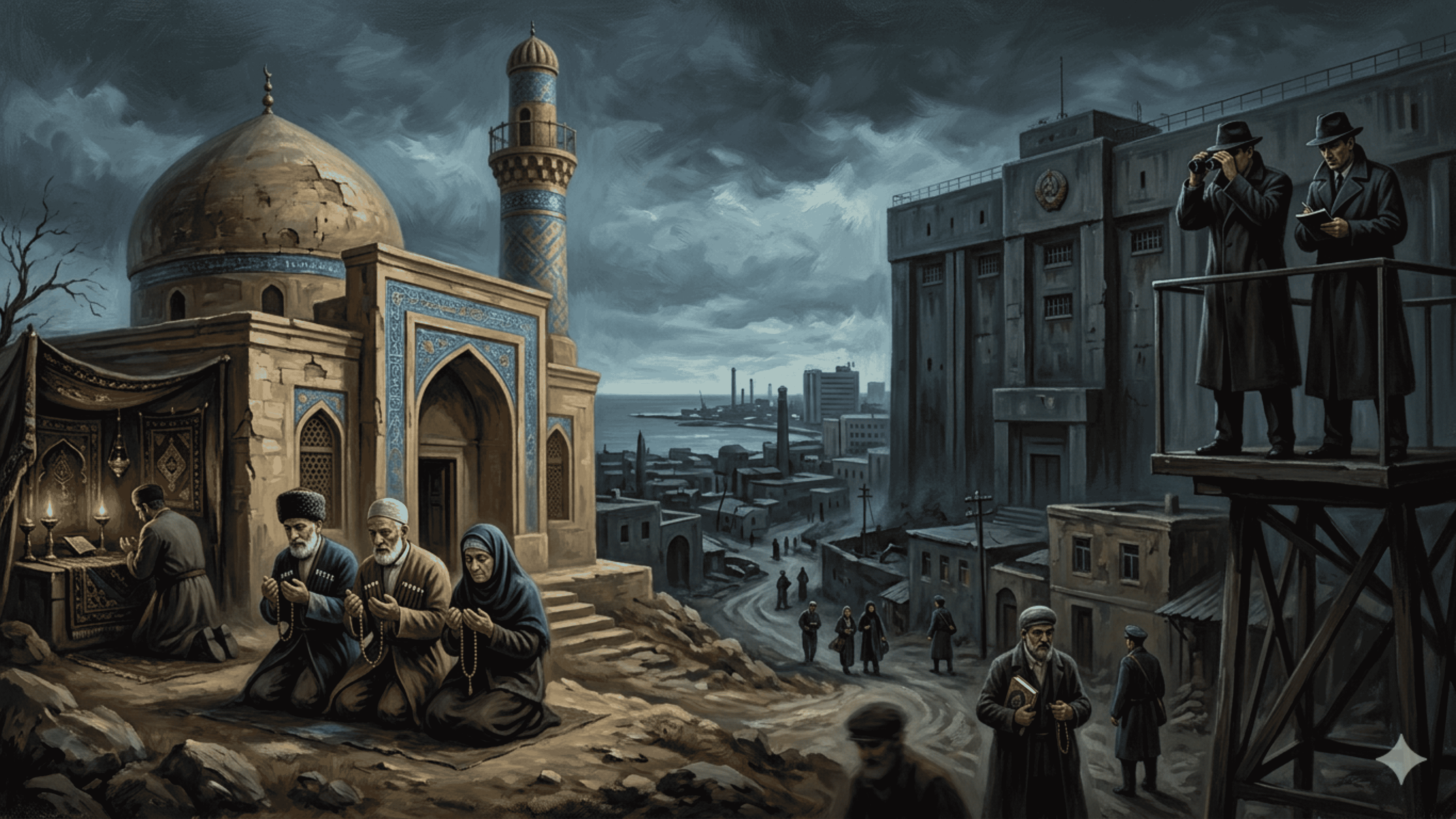
However, the 8,157 lectures delivered by atheist speakers in cities, districts and villages across the republic produced little effect. During one meeting with atheist lecturers, First Secretary of the Central Committee Veli Akhundov said they travelled to rural areas, gathered elderly people in local clubs and delivered lectures to them, yet every time they mentioned the Prophet Muhammad, listeners began reciting salawat prayers.
As a result, during Ashura in April 1968, more than 15,000 believers gathered at the Goy Imam Mosque in Kirovabad, now Ganja. The figure was three to four times higher than a decade earlier.
After the death of Sheikh ul-Islam Mirmohsun Hakimzade in 1967, the Muslim Spiritual Directorate remained without a leader for some time. In 1968, however, a congress of Transcaucasian Muslims elected 83-year-old Aliaga Suleymanzade as chairman of the directorate. He had served for nearly 20 years as akhund of the Taza Pir Mosque and had received higher religious education in Mashhad and Najaf between 1911 and 1919.
After the removal of Nikita Khrushchev from power in autumn 1964, anti-religious campaigns in the Soviet Union somewhat eased. Khrushchev viewed religion as a serious obstacle to the communism he believed was “visible on the horizon”.
Even after Khrushchev, however, atheist propaganda and the persecution of religion continued in the USSR. The difference was that while Russian Molokans had played the role of Yazid in clandestine and semi-legal shabih religious performances in southern Azerbaijan during the 1950s, by the second half of the 1960s Soviet authorities had already prepared their own “national cadres of Yazid”.

Hajj in Soviet Azerbaijan