Georgian civil society statement: "Russia has begun annexing the occupied territories"






Russia’s annexation of Georgian territories
“There is a risk that Moscow intends to use the Georgian territories it occupies to strengthen its waning influence in the South Caucasus,” Georgian civil society representatives said in a statement calling on international partners to pay close attention to what they describe as an ongoing process of annexation in the Tskhinvali region (South Ossetia) and Abkhazia.
The signatories argue that Russia’s actions pose a threat to Georgia’s sovereignty and regional stability.
- Russia tightens financial control over South Ossetia, starting with president’s resignation
- Opinion: ‘Abkhazia has no plans to join Russia’
- Georgia’s spy hunt: who is targeted and why?
The appeal is addressed to the United Nations, the European Union, the European Union Monitoring Mission in Georgia (EUMM), the OSCE, NATO, and Georgia’s international partner countries.
The open letter has been signed by 56 people, including former defense ministers and state ministers, former ambassadors, senior diplomats, conflict and security experts, major generals, and professors.
Full text of the statement
We, the undersigned representatives of Georgian civil society, strongly condemn the ongoing process of de facto annexation of Georgia’s occupied regions of Abkhazia and Tskhinvali (South Ossetia) by the Russian Federation. The evolving dynamics of Russia’s actions pose a direct threat to Georgia’s sovereignty and regional stability.
The accumulation of developments in recent years demonstrates that the Russian Federation is implementing a policy of gradual annexation of Georgia’s occupied territories, manifested in the following alarming trends:
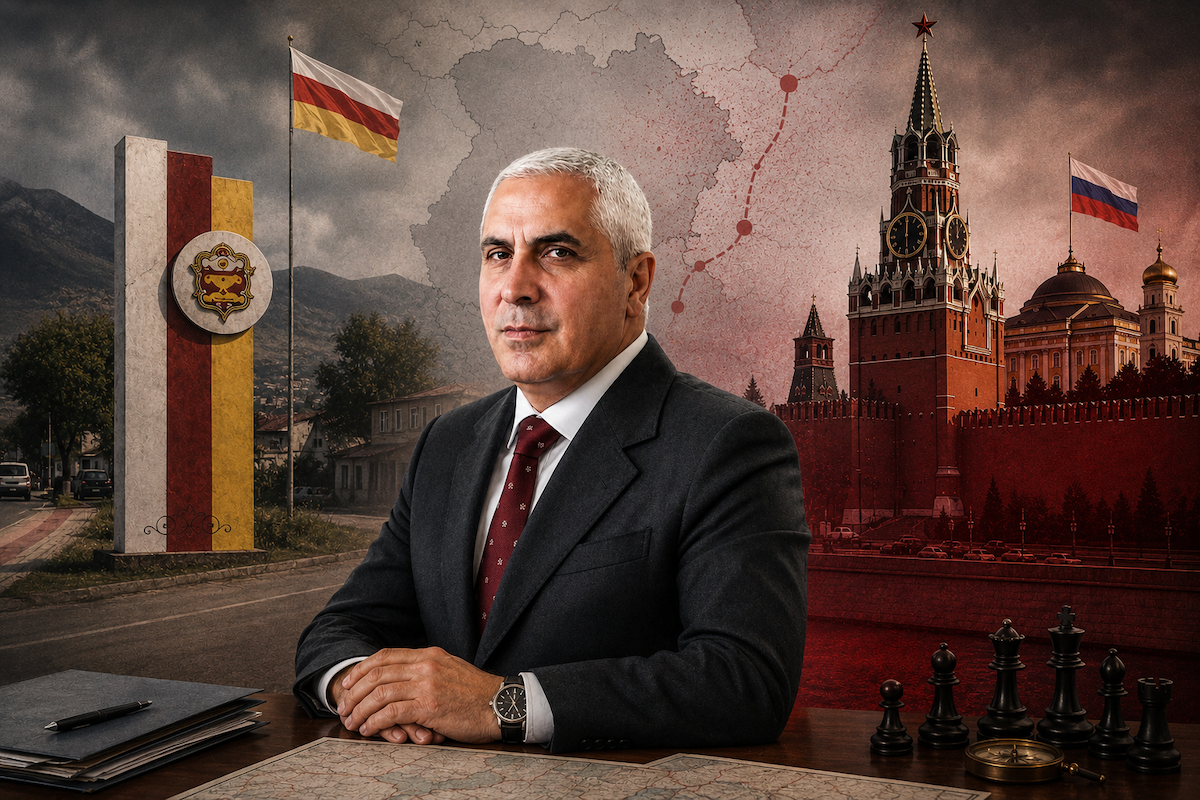
On 9 May 2026, in Moscow, the signing of the so-called “Agreement on Deepening Allied Cooperation” between the President of the Russian Federation, Vladimir Putin, and the de facto leader of occupied Tskhinvali, Alan Gagloev, represents a new dimension of de facto annexation.
The agreement effectively enables the integration of the local governance system into Russia’s political and legal framework by granting the de facto authorities’ powers to appoint Russian citizens to key “political” positions, creating a “legal basis” for the transfer of property and natural resources into the ownership of Russian citizens, and further deepening the functional integration of the occupied region’s socio-economic and infrastructural systems into the Russian Federation.
Furthermore, the appointment of Russian high-ranking official Marat Kambolov as the so-called “Prime Minister” of occupied Tskhinvali, and the transfer of executive “authority” through subsequent administrative reshuffles, constitutes a significant step toward the dismantling of even the formal characteristics of local proxy governance.
This development effectively signals the transition from indirect control through proxy structures to open and direct administrative absorption of the occupied region into the governance system of the Russian Federation.
The processes of de facto annexation are also intensifying in occupied Abkhazia, where, through legislative “harmonisation” with the Russian Federation and the opening of the real estate market to Russian capital, Moscow is advancing the legal and economic absorption of the region.
The overall coordination of these processes is reportedly led by the Moscow-based curator Sergei Kiriyenko, operating from the highest echelons of the Presidential Administration of the Russian Federation.
Particularly alarming is the transformation of the Ochamchire port into a military foothold of the Russian Black Sea Fleet, as well as the recurring threats directed at Tbilisi, which collectively pose a direct risk to Black Sea security.
These developments are taking place against the backdrop of Russia’s large-scale military aggression against Ukraine and a concurrent weakening of Russian influence in the South Caucasus. There is a high risk that Moscow may seek to compensate for its reduced regional leverage by further exploiting the occupied territories of Georgia.
Russia’s demand that Tbilisi sign the so-called ‘non-use of force agreement’ with the de facto authorities of the occupied regions, rather than with the actual party to the conflict – the Russian Federation, represents an attempt to consolidate its influence over Georgia’s entire territory and to further entrench the occupied regions within its sphere of control.
It should be underlined that Georgia has repeatedly and unilaterally undertaken commitments on the non-use of force, including at the international level, thereby exposing the political and provocative nature of such demands.
We call upon international organizations and partner states to:
- Reaffirm their strong and consistent support for the sovereignty and territorial integrity of Georgia within its internationally recognized borders;
- Condemn at the international level Russia’s aggressive rhetoric and steps aimed at de facto annexation;
- Consider the introduction of targeted sanctions against individuals directly involved in illegal annexation and militarization processes in Georgia’s occupied territories;
- Further strengthen the policy of non-recognition of the so-called “independence” of the occupied regions;
- Enhance support for the development of Georgia’s civilian resilience and capabilities to respond to hybrid threats.
We believe that timely and coordinated actions by Georgia’s partners are essential in order to ensure that the Russian Federation pays a high political and economic price for its aggression against neighbouring countries, as well as for acts of ethnic cleansing and gross violations of the principles of international law.
The Georgian civil society remains firmly committed to the de-occupation of the country, the peaceful resolution of the conflict, and Georgia’s European and Euro-Atlantic future.
News in Georgia