No examination of evidence: day nine of hearings in Georgia’s case to ban opposition parties


Georgia party ban trial: Day 9
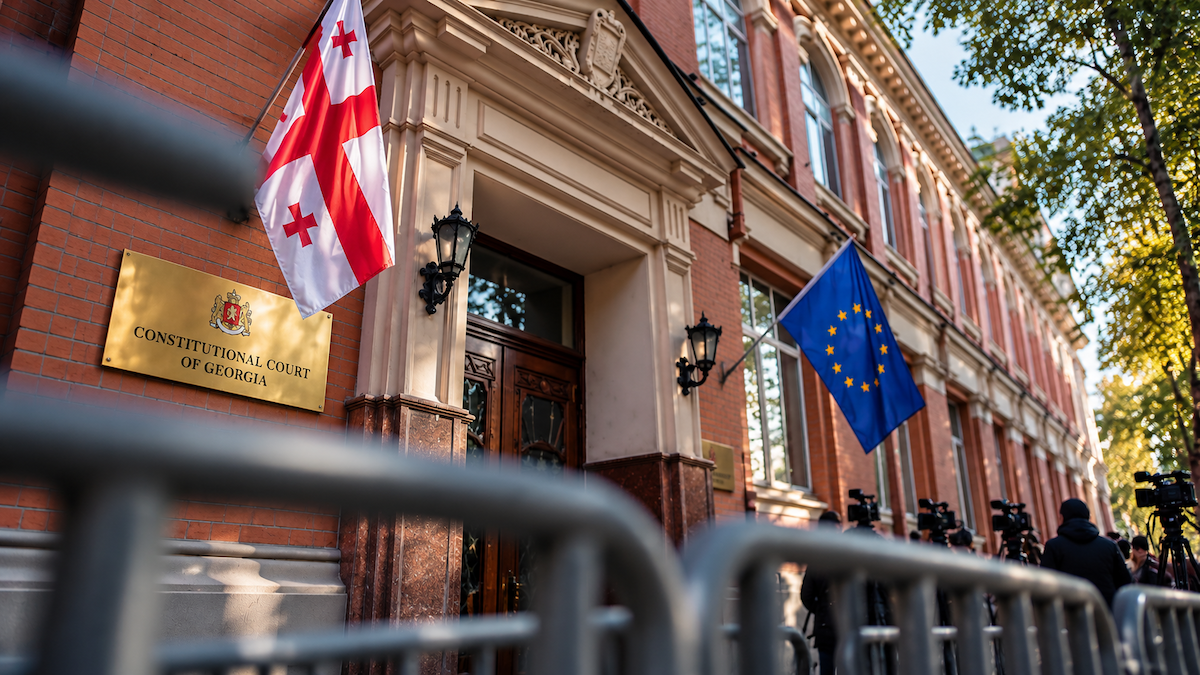
On 10 November, Georgia’s Constitutional Court continued hearings in the case concerning a possible ban on opposition parties. The court had scheduled a question-and-answer session. However, before questioning began, opposition representatives submitted two motions, one of which concerned the examination of evidence.
The motion triggered serious disagreements. Heated arguments repeatedly broke out during the discussion, and Constitutional Court Chairman Judge Revaz Nadaraya lost his composure several times.
- ‘Like a black cat in a dark room’: Georgia’s opposition ban case enters sixth day of hearings
- ‘Gossip, myths and manipulation’ – fifth day of hearings on banning opposition parties held in Georgia
- Billionaire Ivanishvili won’t testify in Georgia opposition ban case. Constitutional Court, day four
Ultimately, the court rejected one of the two motions submitted by the opposition and granted the other only in part. The opposition considered the way the court handled the second motion tantamount to rejecting it.
Once the court had dealt with the motions, the question-and-answer session began. The first questions went to the claimant, the ruling Georgian Dream party.
As at previous hearings, Judge Nadaraya again threatened to have representatives of the respondents removed from the courtroom. He also continued to deny some opposition representatives the opportunity to speak.
Georgia’s Constitutional Court is hearing a case that could lead to a ban on opposition parties. The case sets a precedent. Eighty-eight MPs from the ruling Georgian Dream party filed the application. They are seeking to have five opposition groups declared unconstitutional: Unity – National Movement, Coalition for Change, Lelo – Strong Georgia, Gakharia for Georgia and the Federalists.
Georgian Dream argues that these parties have violated Article 23 of the Constitution, which prohibits political parties that seek to overthrow or forcibly change the country’s constitutional order. The ruling party cites their refusal to recognise the legitimacy of the current government as one of its arguments. The application also accuses them of attempting to overthrow the government.
The application also accuses Unity – National Movement of undermining the country’s independence and territorial integrity. It argues that the party bears responsibility for the war with Russia in August 2008. The case relies mainly on the findings of a temporary parliamentary investigative commission. The respondents reject the allegations.
What happened during the unusually heated court hearing on 10 November? Our report from the courtroom.
“Give us a chance to defend ourselves”: Lelo files motion on the examination of evidence
At the start of the hearing, Levan Samushia, one of the leaders of the opposition Lelo party, asked the judges to examine the evidence before moving on to the questioning stage.
The evidence includes written documents, video recordings and other material in the case file that the court may rely on when reaching its decision.
- “Don’t like it? Too bad”: third day of Constitutional Court hearings on opposition ban in Georgia
- Georgia opposition party ban case: Day two of court proceedings
- Court begins hearing case to ban opposition parties in Georgia: first-day developments
Samushia supported his motion by citing the Organic Law on the Constitutional Court and the court’s rules of procedure. He sought to convince the judges that the law provides for a separate stage of examining evidence, which must take place before the question-and-answer session.
Under Article 20, paragraph 6 of the Constitutional Court’s rules of procedure, “after examining the evidence, the presiding judge gives the parties the right to question each other”.
“Put simply, they are trying to suppress political parties. That is exactly what is happening here from a legal point of view,” Samushia told the full bench of judges.
He urged the court not to skip this crucial stage, invoking the principles of a fair trial and the binding requirements of the law.
Other opposition parties backed Samushia’s motion, saying they had also planned to make a similar request.
From the outset, Constitutional Court Judge Revaz Nadaraya did his utmost to portray the motion as unfounded.
“So you want to start by examining the documents attached to the case file? Open all of them?” the judge asked.
“Yes,” Samushia replied.
“Criminal procedure law works differently here,” Judge Nadaraya insisted, showing no intention of backing down.
He was referring to the inquisitorial principle, arguing that, unlike in ordinary courts, the parties in the Constitutional Court do not have the exclusive right or responsibility to obtain or request evidence. The court itself plays the leading role in this process.
“The adversarial principle has not been abolished along with the inquisitorial principle,” Nika Gvaramia, one of the leaders of the Coalition for Change, interjected from his seat. “We must not skip this stage.”
“Are you suggesting that we open and watch every link? View programmes lasting half an hour or more?” Judge Nadaraya asked again. [*Georgian Dream’s application relies primarily on the findings of the parliamentary investigative commission, but it also includes numerous links. You can see how many by following this link – JAMnews.]
“The claimant should specify the exact minute and second in each programme. That way, we can save the court’s time,” Samushia insisted, sticking firmly to his position.
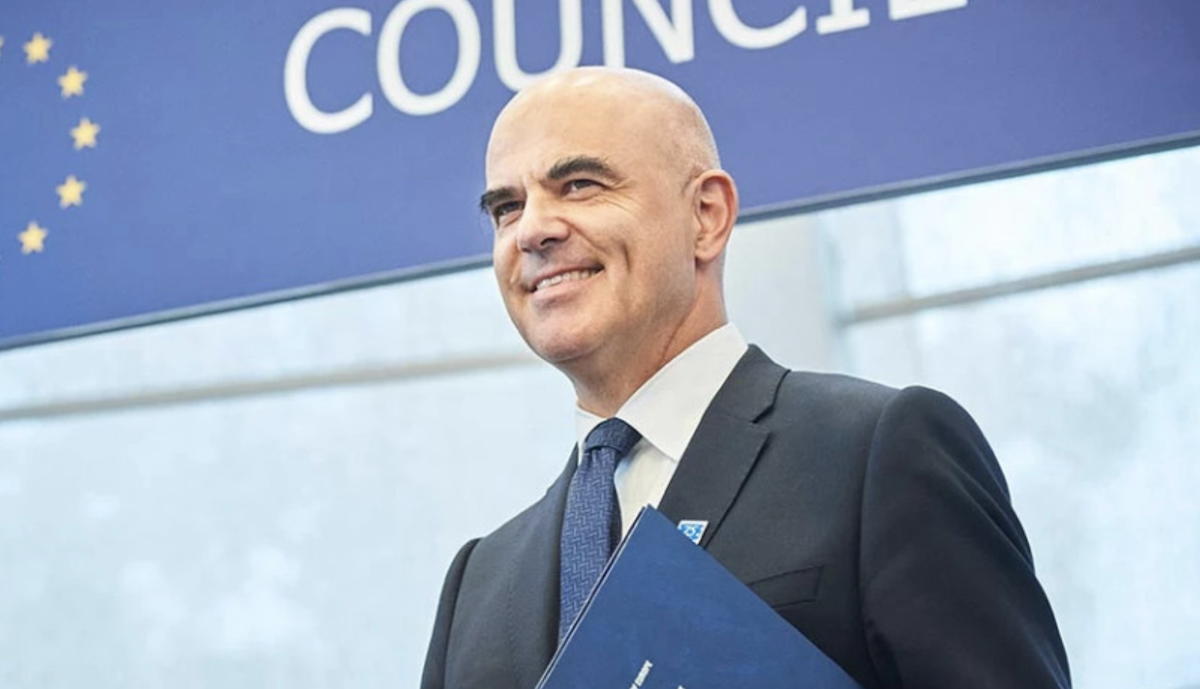
“What do I have to do with the events of 7 November? I was a first-year student” – Berdia Sichinava
Berdia Sichinava, a representative of the party founded by former prime minister Giorgi Gakharia, who previously served in Georgian Dream, also joined the discussion.
He pointed to what he described as the absurdity of holding him accountable and scrutinising him over cases in which he himself, as a prosecutor, had brought charges against the previous government.
“Take the case of Nora Kvitsiani, for example, which the investigative commission’s report mentions. Are the accusations directed at me, Berdia Sichinava? I was the prosecutor who issued a ruling in 2016 recognising that Nora Kvitsiani’s rights had been violated. I took part in the proceedings that ultimately led to her acquittal.”
He also referred to the case of Sulkhan Molashvili:
“I would like to know whether the case of Sulkhan Molashvili concerns me too. I was the prosecutor who recognised his family as victims and returned their country house to them.”
One of the main arguments in Georgian Dream’s application is that the United National Movement introduced systematic torture and inhuman treatment in penitentiary institutions while in power, and that the party should therefore face a ban. The application cites several high-profile cases from the previous administration, including those of Nora Kvitsiani and Sulkhan Molashvili. However, Georgian Dream does not specify which evidence relates to each individual. Instead, it claims that all the evidence applies equally to everyone named in the case.
Sulkhan Molashvili was the former head of the Chamber of Control. Authorities arrested him in 2004, and he later said that he had suffered torture and inhuman treatment. Nora Kvitsiani was arrested after a special operation in the Kodori Gorge in 2006. Her arrest and prosecution formed part of wider concerns about repressive measures against opponents of the government then in power.
“What do I have to do with the events of 7 November? I was a first-year student,” Berdia Sichinava asked. [The application accuses the United National Movement of violently dispersing a protest on 7 November – JAMnews.]
“So what are we supposed to do now – read out the court rulings as well?” Revaz Nadaraya asked, seizing on a new argument and pointing out that the parliamentary commission’s report referred to specific court decisions.
“The court cannot base its decision on this report [by the parliamentary commission]. It could, however, rely on the facts presented in it – although those facts would still require further examination,” Gvaramia said. He reminded the judges that the report came from a temporary parliamentary investigative commission and represented a document containing political assessments.
“How dare you speak to me like that? I will file a motion to recuse you” – Gvaramia confronts judge
The discussion dragged on and repeatedly descended into heated arguments.
“Suppose I want to examine the records of my own questioning. How am I supposed to know whether you will rely on that testimony when reaching your final decision? How can I find that out without examining it together with you?” Gvaramia asked.
He also reminded the judge of previous motions that the court had rejected, pointing out that they concerned legal issues. [Since the start of the proceedings, the defence has submitted around 14 motions. The court has granted only one, and even then only in part – JAMnews.]
Judge Nadaraya grew angry and repeatedly interrupted Gvaramia.
“If we are going to argue, we will get nowhere. You have your procedural rights, and I have mine. I know them perfectly well. Please let me finish,” Gvaramia said.
“You seem to think you have the right to do whatever you please. That is simply not the case,” the judge replied.
“What tone are you using with me?! What makes you think you have the right to speak to me like that?! I will file a motion to recuse you. Please do not interrupt me!” Gvaramia exclaimed, no longer concealing his anger.
“Stick to the substance of the motion. There is no need to bring up what we have or have not granted in the past,” Nadaraya said sharply.
“It is not for you to decide what I can talk about!” Gvaramia retorted.
“It is precisely my job to decide that. Either you comply with the court’s instructions or…” The presiding judge left the sentence unfinished.
“I am explaining the grounds for my motion. Let me speak! You cannot conduct the proceedings in such a one-sided manner!” Nika Gvaramia insisted.
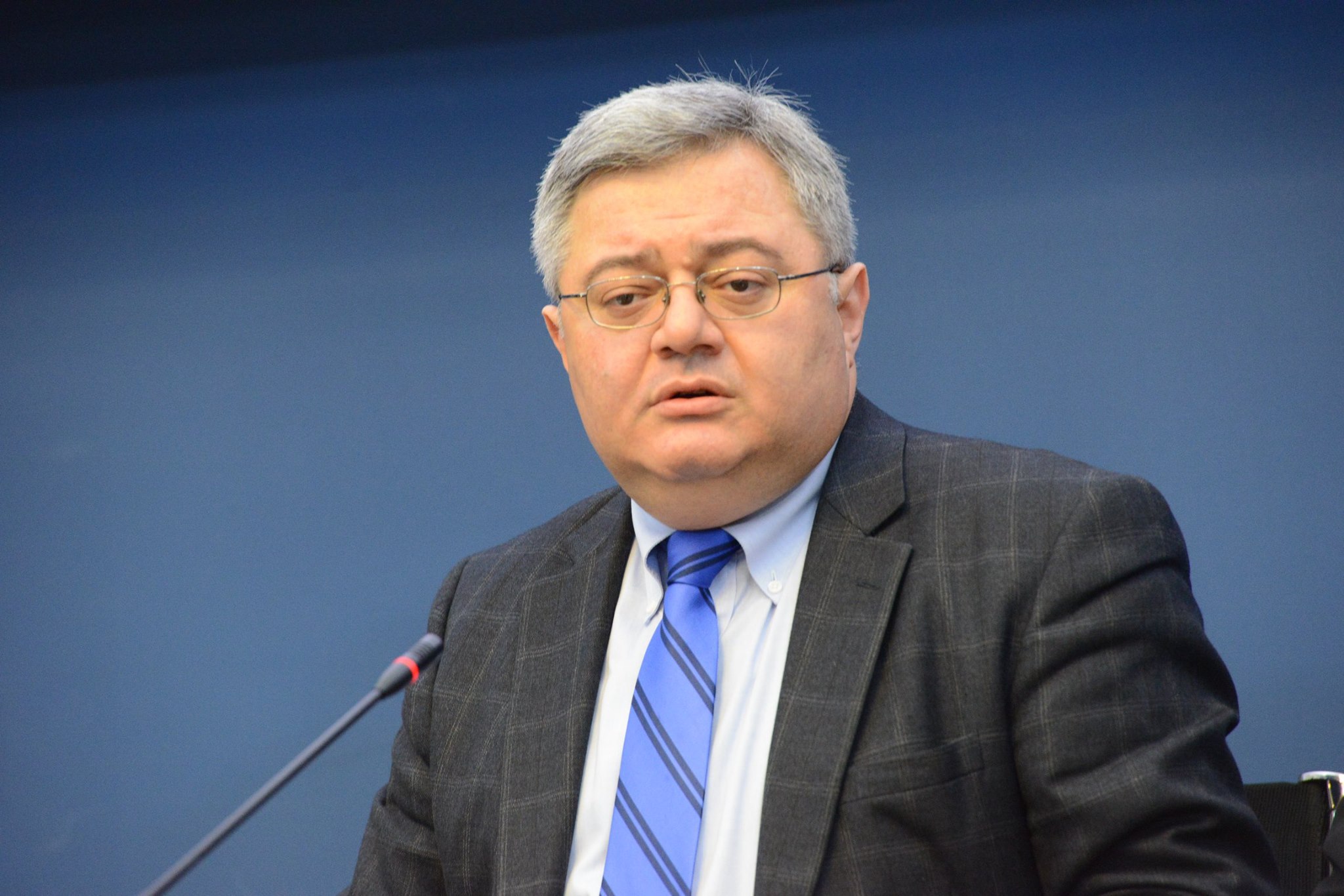
“Maya, would you like my seat?” Judge Nadaraya asks Maya Kopaleishvili
Constitutional Court Judge Revaz Nadaraya lost his temper again when Maya Kopaleishvili, an ally of Nika Gvaramia, tried to join the discussion. Kopaleishvili is a former Constitutional Court judge who frequently highlights cases in which judges have breached procedural rules.
Speaking from her seat, Kopaleishvili tried to explain why examining the evidence was important.
“Ms Kopaleishvili, perhaps I should give you my seat? Why are you speaking? Did you ask for permission to speak? Do you have some special privileges?” Judge Nadaraya asked sternly.
“I don’t have any, but apparently you do,” Kopaleishvili replied.
The judge did not allow Maya Kopaleishvili to put forward her arguments. Throughout the hearing, the presiding judge was particularly harsh towards her and repeatedly threatened to have her removed from the courtroom. He accused her of trying to discredit the court.
“There seems to have been a misunderstanding” – Eva Gotsiridze
“It seems there has been a misunderstanding,” Judge Eva Gotsiridze said, trying to make herself heard above the noise and defuse the tension. She explained that the examination of evidence actually formed part of the question-and-answer stage.
“For example, during cross-examination, you can ask: ‘What evidence supports the allegation that you are guilty?’” she suggested to the opposing side.
Gotsiridze repeated the argument that the Constitutional Court chairman had made several times. She noted that the court could not, for instance, check each of the 1,005 links listed in the footnotes to the application. She cited this figure as an example, although the actual number of links in the footnotes is indeed very large.
She also recalled another argument raised by a fellow judge: some of the evidence consisted of court rulings, and “you are hardly going to ask us to review those as well”.
“Then why does the examination of evidence stage exist at all? Why do other cases include it?” Nika Gvaramia asked Gotsiridze.
In response, Eva Gotsiridze said that lawmakers could not have anticipated exactly how proceedings before the Constitutional Court would unfold in practice when they drafted the legislation. She again stressed that the examination of evidence was “woven into the question-and-answer stage, particularly when the parties question each other”.
Maya Kopaleishvili also wanted to respond to this clarification. However, the presiding judge once again refused to let her speak.
“You are not allowing me to comment on this motion. That is wrong,” Kopaleishvili told Judge Nadaraya.
“Yes, yes, that’s right! Absolutely right! Enough has been said already,” the judge replied.
“Do you know what this tells us? It tells us that the court… is afraid,” Kopaleishvili retorted.
“Ms Kopaleishvili, this is the second time you have said that someone is afraid. I will have you removed from the courtroom! Out!” the judge snapped.
“Mr Chairman, are you trying to intimidate me now? Do I look like someone who can be intimidated?” Kopaleishvili replied, refusing to back down.
“No, no – I have absolutely no such intention,” the judge replied. But he still did not give her the floor.
No separate stage for examining evidence: the court’s ruling on the motion
After the heated exchanges, the panel of judges withdrew to deliberate. The half-hour they had requested stretched into an hour.
“Granted in part,” the judges announced when they returned to the courtroom. They explained that they would consider any evidence whose relevance to the case became disputed. However, they would not hold a separate stage devoted exclusively to examining evidence.
“The panel reached a unanimous decision,” Judge Nadaraya stressed.
“A legal absurdity”: the court rejects the opposition’s second motion
Before Nadaraya, who appeared pleased with the decision, could resume the hearing, Nika Gvaramia asked to speak and submit a second motion.
He proposed that, if the court upheld the application, it should delay enforcement of its ruling by at least one month. All the opposition parties joined the motion.
Gvaramia explained that this period would allow the parties to apply to the European Court of Human Rights for interim measures.
“Mr Gvaramia, you spoke for so long and presented so many arguments that you could write a separate article about them. These issues require examination and analysis. In my view, we cannot decide this today. It would be irresponsible. Let us leave these motions without consideration: rejecting them or granting them would be equally irresponsible,” Constitutional Court Judge Eva Gotsiridze replied.
“What kind of research would that require? If I had proposed something that called for setting up an entire scientific institute to resolve a single question, then, well, I am not quite that ambitious,” Gvaramia retorted.
Representatives of the ruling party opposed the motion. Archil Gorduladze argued that granting it would amount to prejudging the court’s final verdict.
“If the court grants this motion, it will effectively announce in advance that it intends to set a specific deadline – ‘X’ or ‘Y’ – for enforcing its decision. Nothing like this exists in legal practice,” Gorduladze said.
“If anything truly has no precedent in legal practice, it is banning five different political parties in a single court case,” Gvaramia replied.
The court rejected this motion too. Despite Eva Gotsiridze’s comment, the full bench reached its decision immediately, without even withdrawing to deliberate.
“Granting this motion has no constitutional or legal basis. It would be a legal absurdity,” Revaz Nadaraya said, stressing that “the full bench is unanimous in its position”.
He explained that the court could decide whether to delay enforcement in its final ruling, so there was no need for a preliminary decision.
Where does the state end and the ruling party begin? The question-and-answer session
After the court had dealt with the motions, the question-and-answer session began. Judge Vasil Roinishvili asked the first questions.
He asked Archil Gorduladze to clarify where the boundary between the state and the ruling party lay, and to explain how far a political party should be held responsible for government decisions and actions.
Gorduladze said that the state and the party were not the same thing. However, he argued that a party bears responsibility for the laws and political course that its representatives help shape. He cited the foreign agents law as an example, noting that Georgian Dream had still secured a mandate from voters in the election despite passing it.
Roinishvili raised an argument put forward by the opposition: responsibility for criminal acts should rest with the individual officials involved, not with the political party itself. Gorduladze replied that human rights violations under the United National Movement government had not been isolated incidents. He said an entire system had encouraged criminal behaviour and protected those responsible.
Judge Eva Gotsiridze then took over the questioning. She asked Gorduladze to clarify whether a party should be held responsible for failing to distance itself from its leaders’ actions or for failing to respond appropriately to their behaviour.
She also noted that most of the people mentioned in the case had faced criminal charges only after the change of government. The opposition regarded this as a leading question.
Gotsiridze also asked about the meaning of the term “constitutional order”. She wanted to know whether Euro-Atlantic integration, enshrined in Article 78 of the Constitution, could be considered an integral part of the constitutional order, and whether violating this provision could provide grounds for banning a political party.
Giorgi Kakhiani, another representative of Georgian Dream, replied that the court should interpret Article 78 alongside other constitutional provisions. Tornike Cheishvili, meanwhile, described it as a transitional provision designed to achieve a temporary goal.
The judge then asked: if the government violates Article 78, does that amount to a breach of the constitutional order? And could it justify banning a political party? The question prompted laughter in the courtroom.
Gotsiridze raised several more issues, including the circumstances in which a party could be required to distance itself from the actions of its own leaders. She postponed hearing the answers until the following day.
“The decision has already been made – they are just trying to dress it up nicely”: reactions after the hearing
After the hearing, Georgian Dream accused the opposition of turning the proceedings into a performance.
“They are trying to turn a legal process into something resembling a televised debate or show. They know perfectly well that their unconstitutional actions have absolutely no legal basis. They are trying to achieve their goals through demagoguery alone,” Archil Gorduladze said.
The opposition, meanwhile, focused on the question of examining evidence.
“The way the court is handling the evidence raises serious questions. I do not know how it intends to resolve this situation. Essentially, it has simply skipped an entire stage of the proceedings. This is completely unacceptable and does not comply with the law,” Nika Gvaramia said after the hearing.
He added that the decision to ban the parties had effectively already been made: “Now they are just trying to make the whole thing look respectable – rather like trying to make a corpse look presentable.”
“The Constitutional Court operates under the inquisitorial principle: it must examine all the evidence, including material that the parties themselves have not submitted but which is necessary for a well-founded decision. However, the court must examine this evidence during the proceedings, with the parties present, rather than behind closed doors in the judges’ deliberation room,” former judge Maya Kopaleishvili wrote on social media after the court refused to let her speak during the hearing.
During the hearing itself, she had warned the judge that if he refused to let her speak in court, she would present her arguments publicly on Facebook.
In her view, the court should have prepared better for a case involving a ban on political parties. “The court could have included a special section in its rules of procedure, for example, setting out how it should examine evidence.”
Berdia Sichinava said the proceedings had only made the court’s alleged bias more apparent. He added that the judges’ haste to reach a decision had also become unmistakable.
“Of course, there can be no other conclusion. This is a fundamental issue. A case of such importance to the country cannot proceed without examining the evidence. I am certain that the question-and-answer session will make it even clearer that this is all nothing but a bluff.”
The court will resume hearings on the application on 11 November. Further sessions are also scheduled for 12 and 13 November.
The Constitutional Court in Batumi began hearing the case to ban political parties on 21 October. The stage at which the parties presented their explanations and arguments has already concluded.
Last week, the court took a 10-day break to mark its 30th anniversary. The judges celebrated the occasion alongside senior representatives of the Georgian Dream party.
Georgia party ban trial: Day 9