“Gossip, myths and manipulation” - fifth day of hearings on banning opposition parties held in Georgia


Georgia opposition ban trial
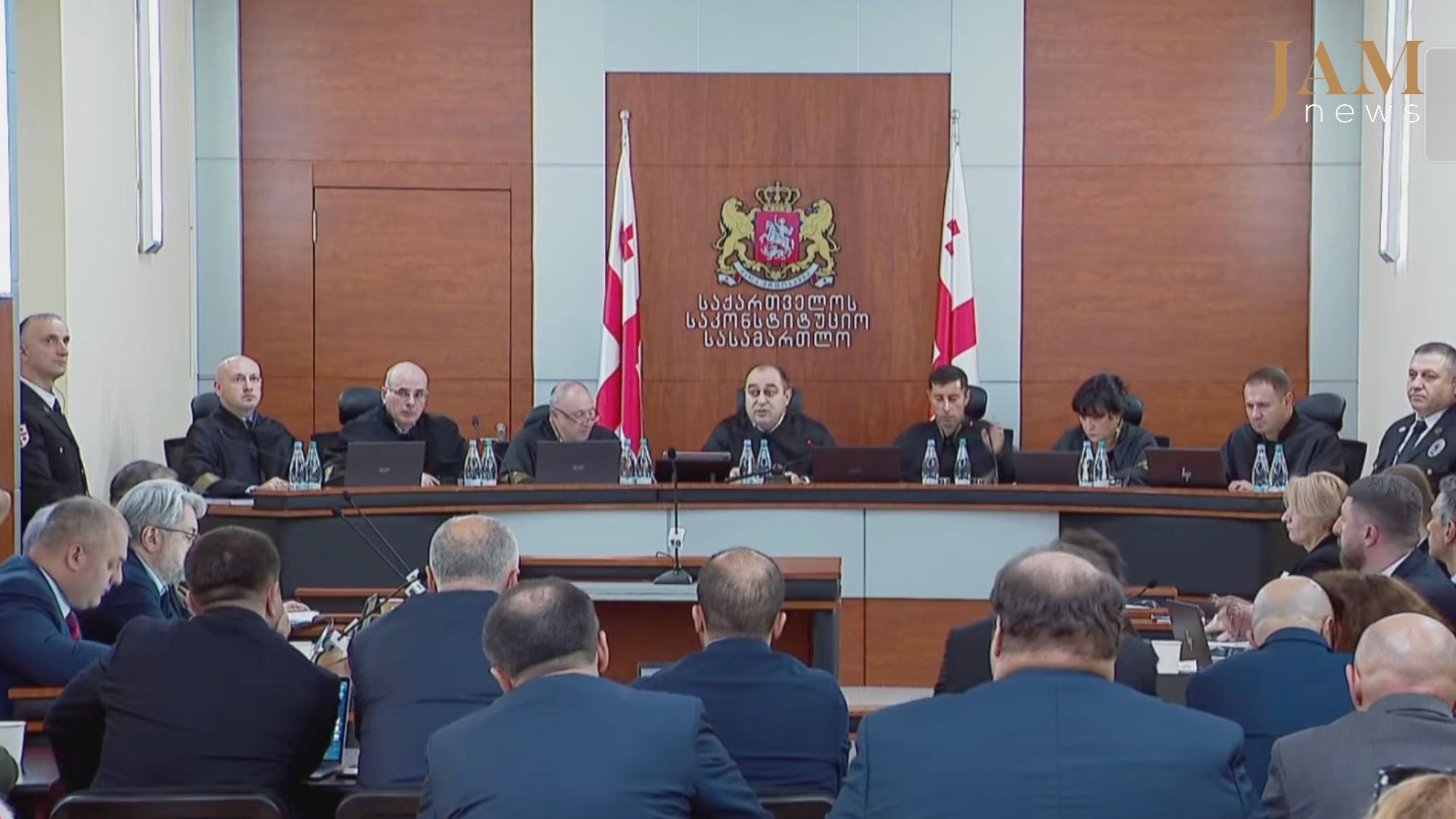
On 27 October, Georgia’s Constitutional Court held the fifth day of hearings on the merits of a lawsuit filed by the ruling Georgian Dream party seeking to ban five opposition parties. At this stage, the court is hearing arguments from the parties involved in the case.
The lawsuit names the United National Movement, Coalition for Change, Lelo – Strong Georgia, Gakharia for Georgia and the Federalists. Georgian Dream argues that these parties have violated Article 23 of the Constitution, which prohibits political parties whose aims include overthrowing or forcibly changing the country’s constitutional order. One of the arguments is that the parties refuse to recognise the legitimacy of the current authorities. The lawsuit also accuses them of organising attempts to overthrow the government.
The United National Movement faces additional accusations of undermining Georgia’s independence and violating its territorial integrity. The lawsuit holds the party responsible for the August 2008 war with Russia over South Ossetia, when it was in power.
All five opposition parties reject the accusations. Hearings are scheduled to continue through 30 October. The court must deliver its final ruling by 24 June 2027.
At the 27 October hearing, three representatives of the United National Movement appeared before the court: Ana Tsitlidze, Levan Bezhashvili and Alika Kuprava.
Ana Tsitlidze spoke for the longest time. She criticised the legal grounds for the lawsuit and the evidence presented, and questioned the judges’ impartiality. She argued that the case was politically motivated and that banning the parties would restrict political pluralism.
- Proposed ban on five opposition parties in Georgia: what’s happening and why
- Billionaire Ivanishvili won’t testify in Georgia opposition ban case. Constitutional Court, day four
- “Don’t like it? Too bad”: third day of Constitutional Court hearings on opposition ban in Georgia
Tsitlidze spoke at length about high-profile criminal cases from the period when the United National Movement was in power in Georgia. She also addressed corruption allegations, relations with international partners and the events of the August 2008 war.
Whenever she mentioned a particular official by name, the presiding judge urged her to be more restrained and interrupted her speech.
With these statements, one of the parties defending itself in the case, the United National Movement, concluded its presentation to the court.
At the end of their speeches, none of the party’s representatives used the standard legal phrase: “I ask the court to dismiss the claim.” Instead, each speaker ended by appealing to the judges’ conscience.
The judges seemed to find it extremely difficult to hide their irritation at this unusual conclusion.
On 28 October, the Constitutional Court will begin hearing arguments from representatives of the Coalition for Change. They have announced in advance that they have prepared an extensive set of documents and will need a full day to present their case.
Below are the main points from the 27 October hearing.
Ana Tsitlidze: “Political gossip, myths and manipulation”
Ana Tsitlidze said the court must draw a clear line between the state’s legitimate powers and the use of constitutional procedures to target political opponents. In her view, the lawsuit filed by the ruling Georgian Dream party lacks legal grounds and amounts to nothing more than “political gossip, myths and manipulation”.
Tsitlidze said she was not trying to shield the United National Movement from responsibility for its political or legal record. On the contrary, she was ready to discuss every decision the party had made in the past, including those that were difficult to defend.
However, she argued that Georgian Dream’s lawsuit had no legal basis and relied on a selective interpretation of historical events.
“If maintaining a critical attitude towards the government and questioning the legitimacy of elections can become grounds for banning a party, then political pluralism in Georgia is over and the country has become a one-party dictatorship.”
Judge interrupts Tsitlidze: “How can you say that a man was killed?”
When the discussion turned to the circumstances surrounding the death of Nugzar Putkaradze, a Batumi City Council member who died in November 2021, presiding judge Revaz Nadaraia interrupted Ana Tsitlidze.
Putkaradze represented the United National Movement in Batumi City Council, in the Ajara region. He died of a heart attack. A few days before his death, his party said that representatives of the ruling party had been putting him under “unbearable pressure”.
“There is concrete evidence that Georgian Dream put pressure on him. This evidence has been made public. Nugzar Putkaradze was offered $100,000 to betray the National Movement and switch sides to Georgian Dream. In the end, he suffered a heart attack and died,” Tsitlidze said.
“How can you say such a thing? Think about your words! This is a very serious allegation. How can you make such statements from the podium in a courtroom? On what grounds are you claiming that a man was killed?” Judge Nadaraia asked.
“But the entire argument put forward by the parliamentary investigative commission, which prepared a report for this court, was based precisely on the claim that the National Movement had allegedly killed people as part of systematic crimes,” Tsitlidze replied.
Tsitlidze on controversial actions by the United National Movement in power and double standards
Ana Tsitlidze recalled several high-profile cases from the previous government’s time in office, including the Aprasidze family case, the case of Roin Shavadze, the murder of Sandro Girgvliani and the death of Yuri Vazagashvili.
She argued that the possible crimes of individuals should not automatically be grounds for banning an entire political party.
Speaking about the case of Roin Shavadze, Tsitlidze said she also had questions about it.
Shavadze was a former military officer who fought in the August 2008 war with Russia. He was arrested in Batumi on 24 August 2008, shortly after the war, and later killed. The case involved allegations of torture and extrajudicial killing. The circumstances remain the subject of political and legal disputes.
“The Roin Shavadze case was a problem for the United National Movement. I myself support reopening the investigation.
“But how can this case be used as grounds for banning the National Movement when the lead investigator was Resan Kontselidze, who later became a Georgian Dream MP? Moreover, the deputy prosecutor at the time was Vasil Roinishvili, who is now a Constitutional Court judge,” Tsitlidze said.
Turning to the Sandro Girgvliani case, Tsitlidze pointed out that the presiding judge was Levan Murusidze, who was later appointed as a judge for life by Georgian Dream.
In January 2006, when the United National Movement was in power, Sandro Girgvliani, a young man, and his friend were abducted and brutally beaten by people linked to senior Interior Ministry officials following a dispute at a cafe in Tbilisi. Girgvliani later died from his injuries.
Four former senior officials were convicted in the case. However, their subsequent pardons and early releases sparked public outrage.
“Georgian Dream divides the careers of judges Murusidze and Chinchaladze into two periods. Their work before 2012, when Georgian Dream came to power, is portrayed as criminal because it helps build the case for banning the opposition. Yet the same judges’ work after 2012 is presented as a model of integrity and independence. This is a double standard, and such double standards undermine the very concept of justice,” Tsitlidze said.
In her view, Georgian Dream’s use of past misconduct within the judicial system as grounds for banning a political party is contradictory, especially since people who continue to work within that same system are not being held to the same standard.
Tsitlidze on Zurab Adeishvili and former officials from his circle now sitting in judgment on the opposition
Ana Tsitlidze noted that Zurab Adeishvili, a senior official under the United National Movement government, is mentioned 25 times in Georgian Dream’s constitutional lawsuit.
Adeishvili was an influential figure in President Mikheil Saakashvili’s administration. He served as Georgia’s chief prosecutor from 2004 to 2008 and as justice minister from 2008 to 2012.
The plaintiffs argue that his actions were so systematic and unconstitutional that the entire party should be banned.
Tsitlidze said she had never met Adeishvili in person. However, Constitutional Court judge Vasil Roinishvili knew him well: when Adeishvili was justice minister, Roinishvili served as deputy chief prosecutor.
Tsitlidze challenged the judges with the following question:
“How can someone be banned from political activity on the basis of the actions of a person they have never even met, while a former senior official from that very same system is now allowed to sit on the court and take part in constitutional justice?”
Tsitlidze on fake prison videos, planted drugs and weapons, and violations of privacy
Ana Tsitlidze cited criminal cases from the period when Georgian Dream was already in power. These included staged prison videos and cases involving drugs and weapons allegedly planted on people.
She noted that well-known figures Tamaz Elizbarashvili and Lado Bedukadze had spoken about prison footage being staged.
On the issue of drugs and weapons being planted, she recalled the December 2024 arrest of Giorgi Akhobadze, an active participant in pro-European protests. Akhobadze was charged with acquiring and possessing drugs. He was later acquitted, and the court ordered his immediate release in the courtroom.
Tsitlidze also raised the issue of violations of privacy.
One of the arguments in the lawsuit is that the United National Movement committed systematic crimes by distributing recordings of people’s private lives while in power. Tsitlidze argued that those responsible for publishing private recordings of journalists and politicians during Georgian Dream’s time in office should also be held accountable.
Tsitlidze: UNM accused of corruption as Georgian Dream officials jailed for corruption
Ana Tsitlidze noted that the plaintiffs accuse the United National Movement of corruption, despite serious questions surrounding senior officials from the ruling Georgian Dream party itself.
She cited the cases of former Prime Minister Irakli Garibashvili, former State Security Service chief Grigol Liluashvili and former Defence Minister Juansher Burchuladze, all of whom have been convicted of corruption.
Given these cases involving members of their own party, Tsitlidze said, it was unclear why the plaintiffs believed the United National Movement should be banned over individual cases of corruption within its ranks.
Georgia’s international partners and sanctions
Tsitlidze criticised the argument that the opposition had worked with international partners to persuade them to impose sanctions on Georgia’s current authorities.
She said that engaging with international partners was a normal part of political activity, while decisions on sanctions were made by the partners themselves.
Tsitlidze’s closing words to the judges “The choice of which path to take is yours”
“I am not asking you to dismiss this lawsuit. Georgia’s history has never been one-dimensional. We have had people like Antsukhelidze and Sergo Ordzhonikidze, Ilia and Berbichashvili. The choice of which path to take is yours,” Ana Tsitlidze concluded.
“Would it not have been better to simply state, instead of making rhetorical remarks…” the presiding judge began, cutting himself off mid-sentence as he tried to hide his irritation. “You are asking the court to dismiss the lawsuit, are you not?”
“We are not asking for anything” Tsitlidze replied.
Levan Bezhashvili “The rule of law must not fall with those in power”
The speeches by the two other United National Movement representatives, Levan Bezhashvili and Alika Kuprava, were relatively brief.
“Today, you are deciding not only the fate of political parties, but also whether the Constitution will remain a check on government power in Georgia or become entirely dependent on the will of those who hold that power,” Levan Bezhashvili told the Constitutional Court judges.
“History does not remember who held more power at any given moment. It remembers what people did with that power. Your decision will be judged by whether you defended the rule of law at the moment when it was most difficult to do so. A party may be defeated, a politician may leave office, but the rule of law must not fall with those in power,” Bezhashvili stressed.
Reactions to the hearing
Badri Japaridze, one of the leaders of Lelo – Strong Georgia, told journalists that when it was his party’s turn to speak, its representatives would use every legal means available to expose what he called Georgian Dream’s real aim: to eliminate the opposition in the country.
Maia Kopaleishvili, a member of the Coalition for Change, told journalists that Georgian Dream had presented nothing but hearsay in its lawsuit.
“The hearings of the parliamentary temporary investigative commission, which form the basis of the lawsuit, are built on gossip and cannot provide sufficient grounds to accuse a political party of unconstitutional activity,” Kopaleishvili said.
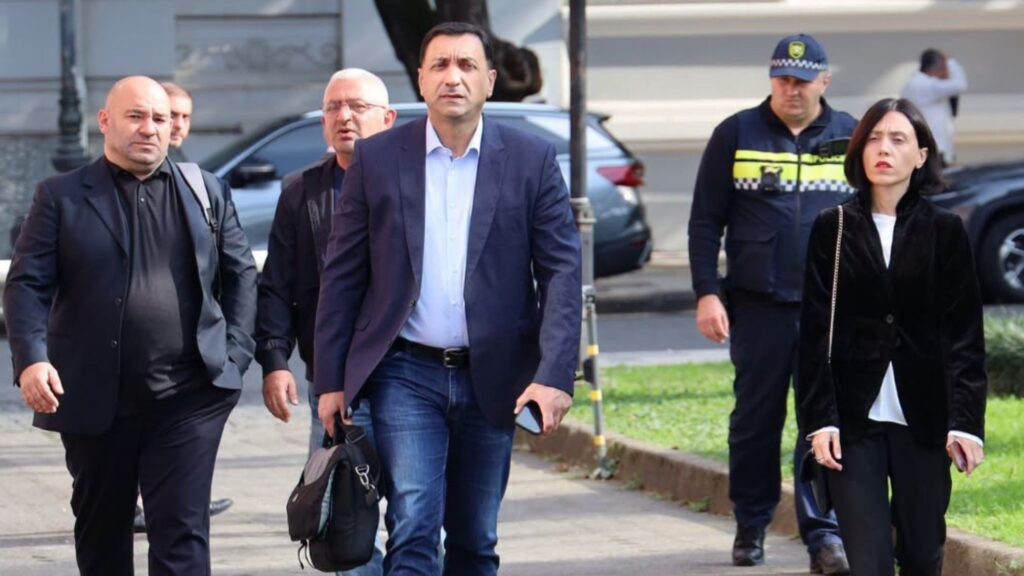
Representatives of the United National Movement who addressed the court. Photo: Batumelebi, 27 October, Batumi.
News in Georgia
Georgia opposition ban trial