Former head of Armenia’s State Revenue Committee arrested after appearing in court on stretcher






Former Armenian revenue chief in court on stretcher
In Armenia, the arrest of former State Revenue Committee chairman Gagik Khachatryan has sparked widespread debate. He faces charges of accepting a particularly large bribe and money laundering. The Anti-Corruption Court is also considering cases seeking to confiscate allegedly illicitly acquired property from Khachatryan and people linked to him, including his sons.
However, the video that his lawyers shared on social media, rather than the charges against Khachatryan, has caused the biggest public outcry. The footage shows National Security Service officers carrying the 71-year-old Khachatryan, who is groaning in pain, from a bed onto a stretcher during his arrest. His lawyers said they consider the law enforcement officers’ actions equivalent to torture.
Human rights defenders and civil society representatives have also condemned the actions. They said authorities handled the transport of a person with serious health problems “improperly”, causing him physical suffering.
“No legal procedure or procedural necessity can justify violating human dignity,” experts from the NGO Disability Rights Agenda said.
- What Pashinyan and Putin agreed in Bishkek amid peak tensions in relations
- Armenia’s new parliament: balance of power, tools of government and opposition’s dead end
- ‘From crisis management to stability’: Pashinyan unveils new government programme
What is Khachatryan accused of: all known details
The Investigative Committee said the previous day that investigators had carried out searches at the homes of the former head of the State Revenue Committee and his son as part of a case involving particularly large-scale bribery and money laundering. They also searched the offices and branches of more than 20 companies linked to them. Shortly afterwards, reports emerged that authorities had arrested Gagik Khachatryan for two months.
According to the case file, Khachatryan faces charges of:
- accepting a particularly large bribe from the directors of Progress Armenia and Local Developers,
- misappropriating 174 million 581 thousand drams ($482,000) in state funds during the reconstruction of the Dilijan training centre,
- illegally transferring property belonging to a local university, worth 208 million 908 thousand drams ($577,000),
- and laundering particularly large sums of money. The charge concerns concealing 151 million 126 thousand drams ($417,000) of illegally obtained funds.
Meanwhile, the Anti-Corruption Court is hearing a case seeking the confiscation of allegedly illicitly acquired property. The Prosecutor General’s Office is seeking to confiscate from Khachatryan and people linked to him:
- 193 properties, including properties in Yerevan’s most expensive central district,
- 89 properties in Kotayk Province,
- stakes in 29 legal entities,
- 14 movable assets,
- bonds worth $1,451,074,
- a bank deposit of $147,210,
- claims arising from loans worth approximately $23.1 million, 409.8 million drams (more than $1 million) and €9,800, and
- 7 billion 761 million drams ($49 million).
Defence lawyers and prosecutors disagree over the defendant’s health
The Prosecutor General’s Office says it conducted a forensic medical examination.
“Khachatryan has no health problems that could prevent him from taking part in any procedural actions as part of the criminal proceedings,” the experts concluded.
However, his defence team takes the opposite view.
Lawyer Yerevan Sargsyan told reporters that in June, authorities also took Khachatryan to the investigative body and then to court on a stretcher. At the time, however, the court found that his detention could pose health risks.
“They waited so long until they got the [forensic medical] conclusion they wanted. How they did it is known to them. And now they have organised the arrest in the same way again,” Sargsyan stressed.
Ombudsman’s office examines the case
On 2 September, a day after the lawyers published the video, the Human Rights Defender’s Office issued a statement. It said that the ombudsman had initiated an urgent examination of the case. A team of experts has already gone to the penitentiary to speak with Khachatryan and monitor respect for his rights.
The ombudsman’s office has also asked the relevant authorities for explanations to establish all the circumstances. After it completes the investigation and reviews its findings, the Human Rights Defender will present its position.
Comments
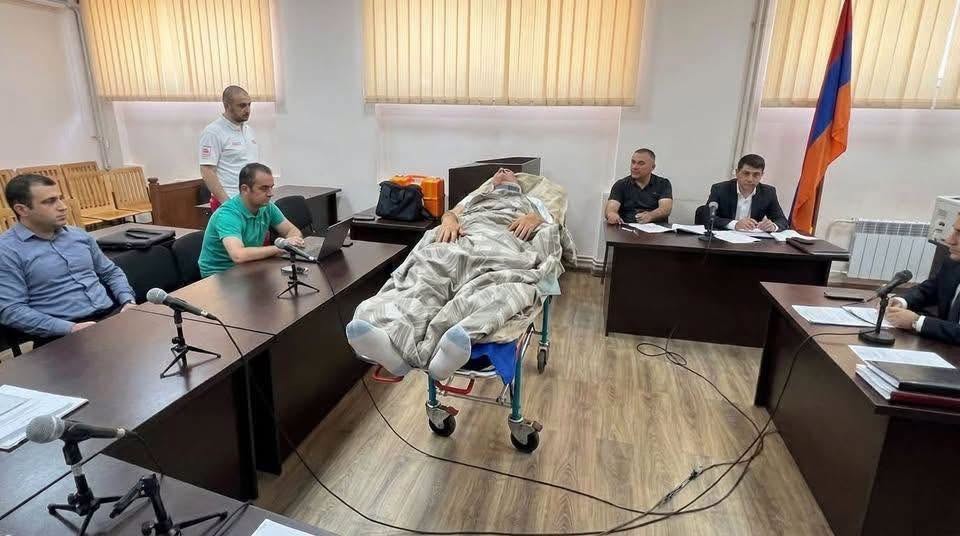
Human rights defender Zaruhi Hovhannisyan believes that the published photograph of the defendant on a stretcher in the courtroom is “not simply a sad scene”. In her view, the situation raises questions about the state’s attitude towards human rights:
“The photograph shows a 71-year-old man with serious health problems lying on a stretcher, completely covered, in the middle of a courtroom. People involved in the proceedings, tables, microphones and documents surround him. On one side stands the entire institutional machinery of criminal justice, organised by the state. On the other stands a person whom the system completely ignores.
The issue is not to make people feel sorry for the man lying on that stretcher, or to discuss why he ended up in court, what case he faces or how many charges he faces. The issue is that this is an extremely dangerous picture. When the state becomes accustomed to subordinating human dignity to a judicial process, it puts not only one person’s rights at risk but also the boundary that should prevent the state from gaining unlimited power over an individual. Human dignity and the prohibition of torture limit the state’s power over a person.”
The NGO Disability Rights Agenda also issued a statement about the videos that Gagik Khachatryan’s lawyers circulated:
“According to the defence, doctors diagnosed Gagik Khachatryan with spinal stenosis in 2015 and implanted special devices in his cervical spine. The footage also shows him in a semi-conscious state while people were moving him.”
The organisation’s experts believe the authorities should structure the court proceedings in a way that prevents harm to a person’s health or humiliating conditions. Appropriate specialists should accompany people with limited mobility at all times. Medical professionals should supervise their movement and authorities should provide the necessary technical equipment.
“Regardless of the nature of the charges or his former position, humanitarian principles and safeguards for physical integrity must remain unchanged,” the statement says.
The organisation called on law enforcement agencies to take the following steps during further procedural actions:
- rely only on impartial professional assessments,
- provide the necessary medical care,
- prevent any actions that cause a person unnecessary physical pain.
Former Armenian revenue chief in court on stretcher