Horrific discovery at cemetery renews debate over fate of stray dogs in Georgia


Journalists and animal rights activists have discovered burial pits in Georgia’s capital Tbilisi, containing dozens of dead dogs dumped and covered with soil. Activists suspect the animals were healthy strays taken from the city streets. Judging by the condition of the bodies, veterinarians believe the dogs suffered greatly before they died.
The disturbing footage sparked widespread outrage on social media. Animal rights activists have called for an immediate investigation. A large protest took place in Tbilisi on the evening of 1 November. The city authorities deny accusations that they killed healthy dogs, dismiss them as a deliberate disinformation campaign and threaten criminal charges against activists who opened the burial pits without permission.
Nevertheless, Georgia’s Interior Ministry has launched an investigation under Article 259 of the Criminal Code, which concerns animal cruelty.
- Rabies quarantine introduced in two regions of Georgia
- “Don’t pass the ‘foreign agents’ bill; Georgia’s homeless animals will be left helpless.” – Animal rights activists
What do we know so far about the dog burial pits discovered in Tbilisi? Why do animal rights activists distrust the city authorities and municipal services? And why has Georgia been unable to solve its stray animal problem for years?
Night-time trips to Veli Cemetery
Under cover of darkness, a white minibus leaves Tbilisi’s municipal animal shelter. Someone has removed the shelter’s logo from the vehicle. The minibus soon stops at Veli Cemetery on the outskirts of the Georgian capital. The engine keeps running, but the driver switches off the headlights.
Two people get out. They wear the shelter’s uniform and latex gloves. In complete darkness, lit only by the moon, they take the bodies of dogs out of the vehicle and dump them into pits that someone has dug in advance.

This continues over several nights. On one occasion, the workers dump seven dogs into a pit, while an eighth falls beside the vehicle. Despite the darkness, the footage clearly shows a man wearing gloves dragging the animal towards the burial site.
On the third night, the makeshift grave is already full of dogs’ bodies, and the workers begin covering it with soil. They do this in darkness too, switching on the vehicle’s headlights only occasionally to check their progress.
These images come from a report that TV Pirveli broadcast on 31 October. It documents alleged cruelty towards stray animals in Tbilisi. Someone filmed the footage with a hidden camera over several nights.
According to the programme’s journalists, people regularly remove dozens of dead dogs from Tbilisi’s municipal animal shelter without permission and bury them in specially dug deep pits at the cemetery. Citing their sources, the journalists also report that the shelter has a quarantine area where staff euthanise healthy animals picked up from the streets.
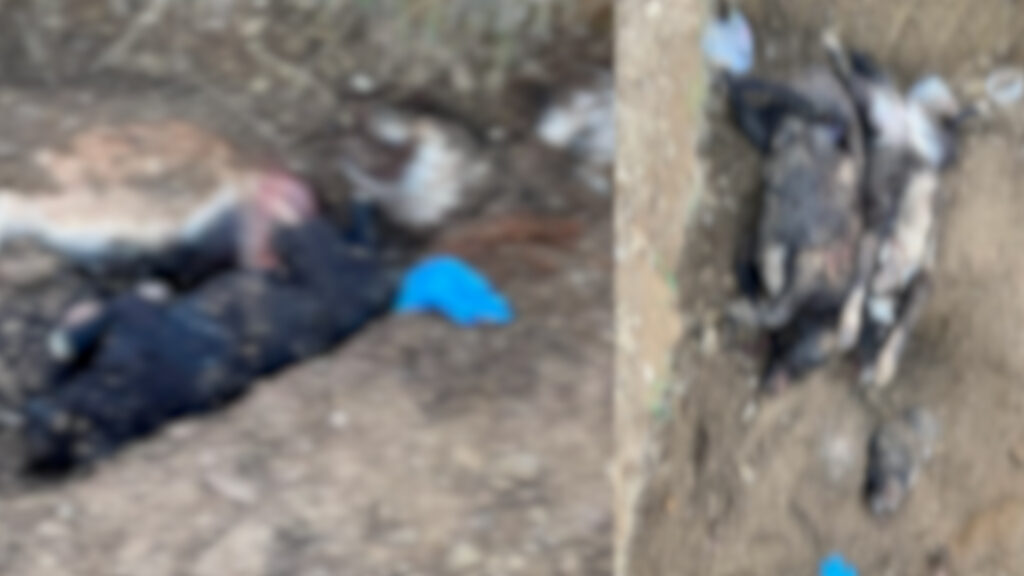
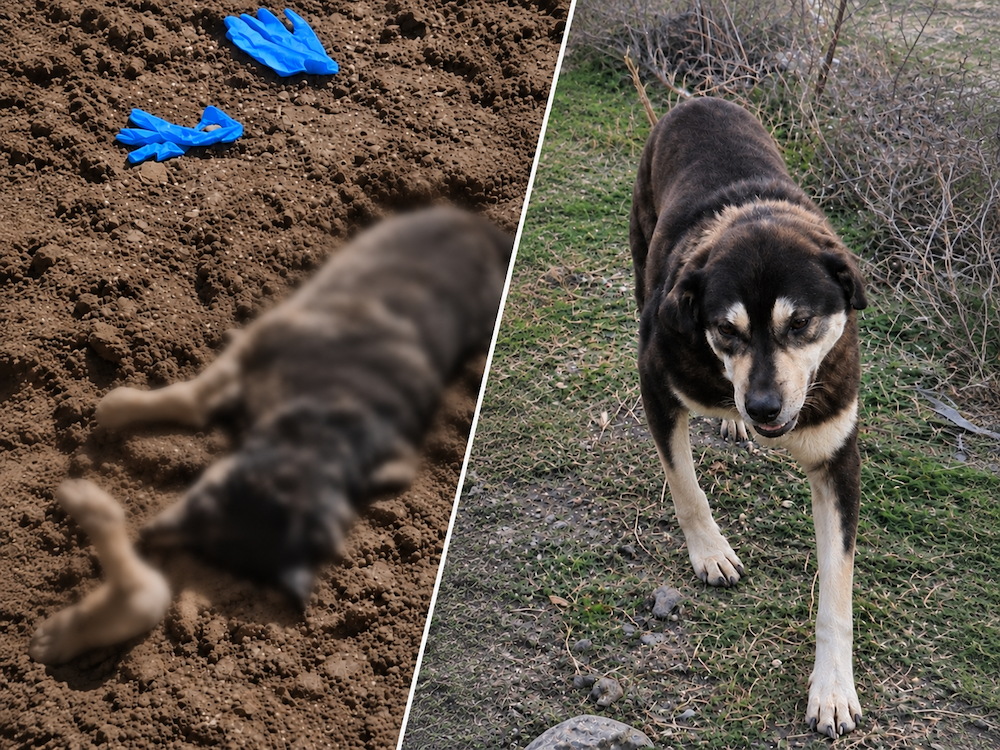
Even before the report aired, shortly after the channel announced it, animal rights activists discovered additional burial sites near Veli Cemetery. They filmed and circulated even more disturbing footage. It shows graves filled with dogs whose eyes bulge and bodies appear twisted (JAMnews warning: the footage at this link is extremely distressing.)
The activists called the police to the site. Police representatives told TV Pirveli that they would investigate the matter step by step and report their findings.
Animal rights activists’ demands
After the story came to light, animal rights activists drew up a petition, calling on the prosecutor’s office to launch an immediate investigation. The petition’s authors point to an increasing number of suspicious cases in which dogs have disappeared across Georgia. They want investigators to examine the burial site at Veli Cemetery, exhume the remains and commission an independent veterinary and forensic examination to establish when and how the animals died.
The activists also urge prosecutors to check the microchips and other identification marks on stray animals, compare reports from members of the public about missing dogs with the remains found at the cemetery, and examine the shelter’s veterinary records on euthanasia and its accounts of drugs used for the procedure.
In their view, investigators must establish who ordered the animals’ burial, the legal grounds for removing their bodies and whether the burial process complied with the law. The petition’s authors stress that the public has the right to know how many animals died, under what circumstances and whether official statistics reflect the true scale of the situation.
Tbilisi City Hall denies killing animals
The Animal Monitoring Agency, which operates under Tbilisi City Hall, denies the allegations. In an official statement, the agency says that “the footage broadcast by TV Pirveli shows a procedure permitted by law”.
The agency claims that the burial site at Veli Cemetery holds the remains of dogs that died in Tbilisi for various reasons, including illness, road accidents and other incidents, as well as natural causes.
“Across the capital, hundreds of animals die through euthanasia every year, while thousands die of natural causes,” the agency says in its statement.
It categorically denies allegations of mass, deliberate killings, insisting that the information circulated by journalists and activists amounts to disinformation intended to discredit the Animal Monitoring Agency and damage its reputation.
Tbilisi City Hall also says that unauthorised exhumations and the removal of remains violate the law, risk biological contamination and pose a threat to public health. On these grounds, the city authorities have threatened activists with criminal liability.
“We have already asked law enforcement agencies to investigate acts of vandalism committed by a particular group and take appropriate legal action,” City Hall said.
Signs of torture on the animals’ bodies
Animal rights activists question the agency’s claims that the dogs found at Veli Cemetery died of natural causes or were humanely euthanised. Activist Keso Baramidze, who has had dozens of animals euthanised when it was genuinely necessary, says dogs usually retain a peaceful expression after euthanasia.
“Sadly, dozens of animals have fallen asleep in my arms. Not one of them had an expression like the dogs found in the burial pits. They all simply looked as though they were sleeping. That is why the procedure is called ‘putting to sleep’,” she says in a social media post.
Baramidze outlines several possible causes of muscle tension and facial distortion in animals after death. These include:
- Mechanical asphyxiation (strangulation) with a rope or wire, as well as burying an animal alive or while it still shows signs of life. This can deprive it of oxygen and cause severe agony;
- Improperly administered chemical euthanasia – using drugs that cause muscle paralysis or other toxic substances without adequate anaesthesia. In such cases, the animal may die while still conscious;
- Severe physical trauma or electric shock – a powerful blow to the head or neck, or exposure to an electric current, which can cause severe muscle spasms and body tension.
“With any of these methods, when a dog dies amid extreme stress, fear, struggle and muscle exhaustion, its reserves of adenosine triphosphate (ATP) are depleted almost immediately. This causes rigor mortis to set in very early, almost instantly, within the first 10–20 minutes.
“Since rigor mortis always begins in the facial and jaw muscles, any grimace caused during the animal’s death throes becomes ‘frozen’. Even while the body remains warm, the face stays contorted,” Baramidze writes, citing scientific sources from abroad.
Protests and investigation
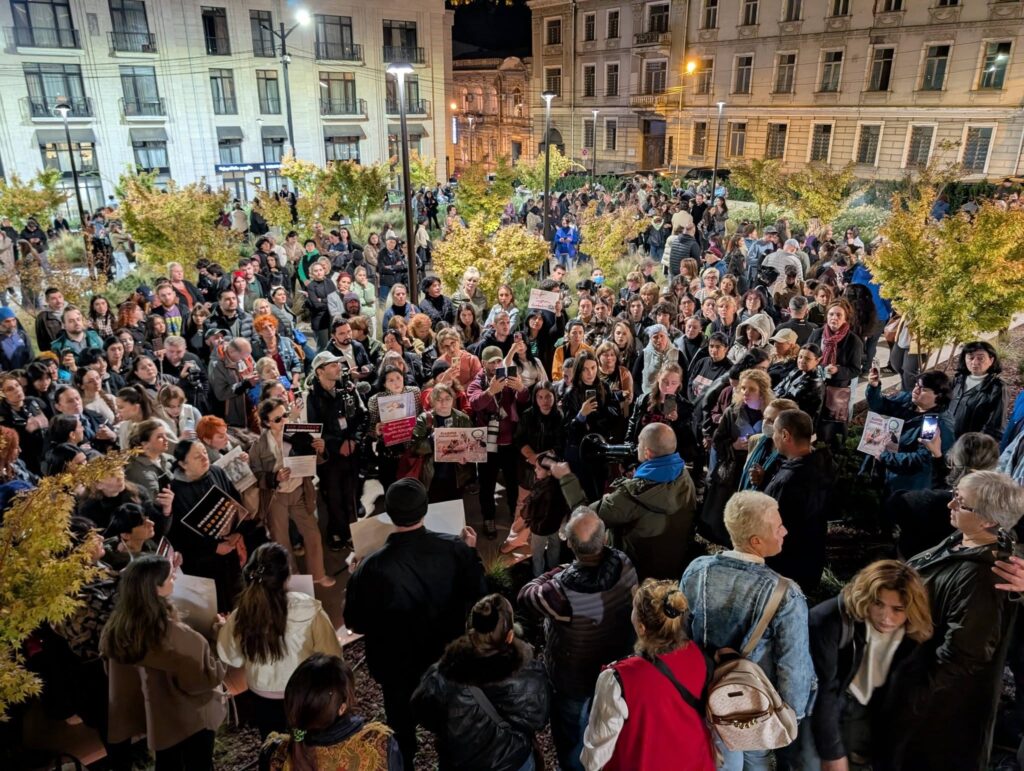
On Sunday, 1 November, the day after the report aired, animal rights activists staged a protest outside the government chancellery in Tbilisi. “We demand answers. Punish the officials responsible,” they called.
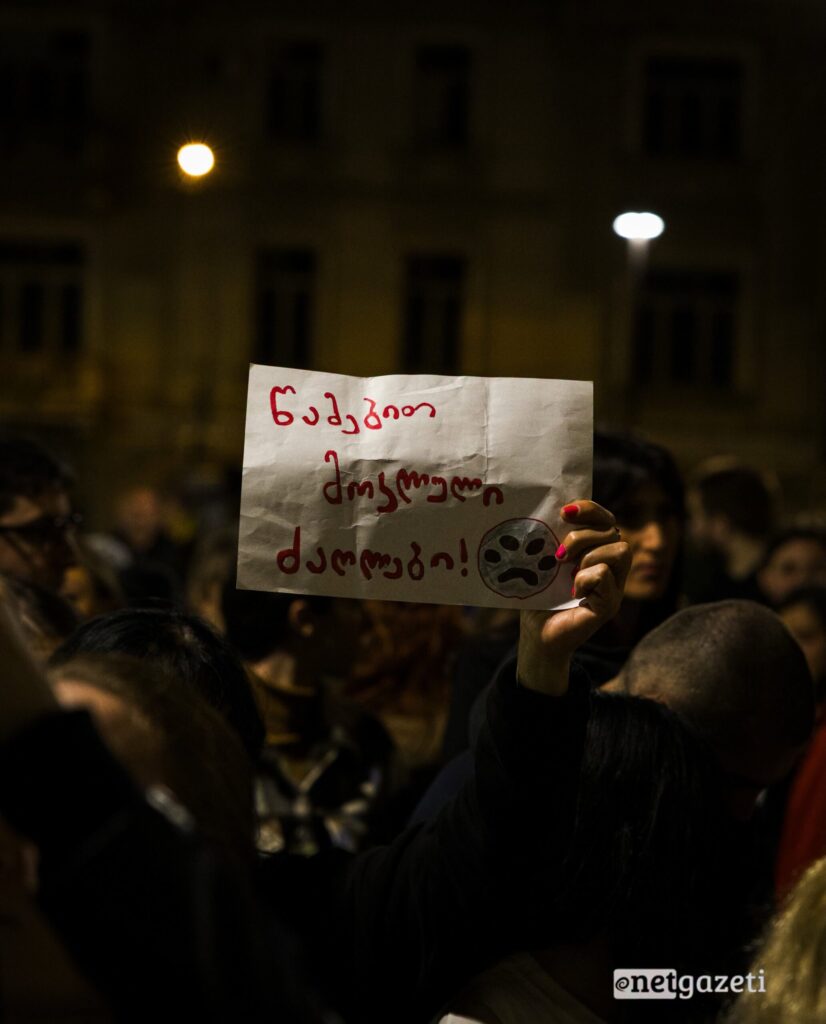
“Dogs tortured to death”, “Where have you taken the dogs?”, “I speak for those without a voice” read the banners held by protesters, including both activists and ordinary animal lovers. Many brought their pets to the demonstration.
“What we have been saying for several months has now been confirmed. They are continuing to exterminate stray dogs instead of sterilising and vaccinating them in an effort to reduce their numbers. I hope society will now become more active. Because if there aren’t enough of us, they will obviously not stop,” said Lasha Chkhartishvili, one of the protest organisers.
That same evening, Georgia’s Interior Ministry announced that it had opened an investigation under Article 259 of the Criminal Code, which covers torture, cruel treatment and other forms of violence against animals.
Not an isolated incident, but a pattern
This is not the first case, nor the first footage to emerge showing alleged cruelty towards stray animals in Georgia.
In mid-October, a video filmed on a mobile phone at the municipal animal shelter in the town of Gori spread across social media. It showed a filthy enclosure measuring just five to seven square metres, with a damp floor and crammed with dozens of puppies. Many of the animals looked extremely thin and malnourished.
The following day, volunteers rescued the puppies from the enclosures, set up temporary shelters for them and began treating them. Social media users also launched a fundraising campaign to help the puppies and the people who had taken them in.
Earlier, in April 2026, disturbing footage from Gori also emerged, apparently showing animals being burned at a crematorium. However, the Gori shelter insisted that it had cremated dead dogs or amputated body parts.
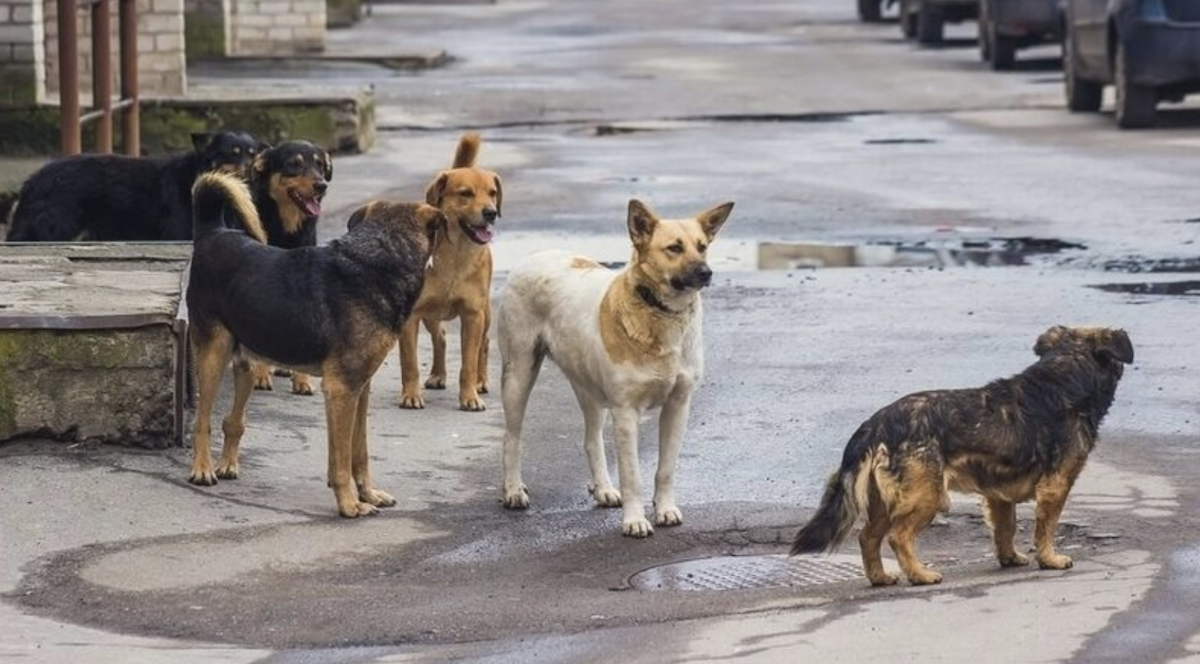
Stray animals on the streets have long been a serious problem in Georgia. The streets are full of stray dogs, some of which are aggressive and pose a danger to passers-by. Yet no one knows exactly how many homeless animals live in the country. Georgia has never maintained comprehensive statistics on their numbers. Animal rights activists estimate that the population could reach hundreds of thousands.
Georgia has been running a new stray animal population management programme for the past two years. In theory, it should reduce the number of stray dogs through humane methods. However, animal rights activists suspect that the authorities are trying to solve the problem through straightforward extermination. They say dogs have been disappearing from the streets in large numbers since the programme began.
JAMnews reported on the situation in May 2026, when activists across Georgia raised the alarm over dogs taken from the streets and then reported missing. Some of the animals had been cared for by specific individuals, vaccinated, sterilised and identified.
The World Organisation for Animal Health recommends the CNVR method – Collect, Neuter, Vaccinate and Return – in its guidelines for managing stray dog populations. When properly implemented, this approach can gradually reduce the number of animals without resorting to mass killing.
Activists in Georgia also regard this as the best approach. None of them wants packs of stray dogs roaming the streets. But they insist that the authorities must tackle the problem humanely. The footage that has emerged in recent weeks has raised growing questions about the conduct of government agencies and strengthened suspicions that the authorities intend to reduce the stray animal population by killing the dogs.