Opinion: 'China gets more from Georgia than Georgia gets from China'






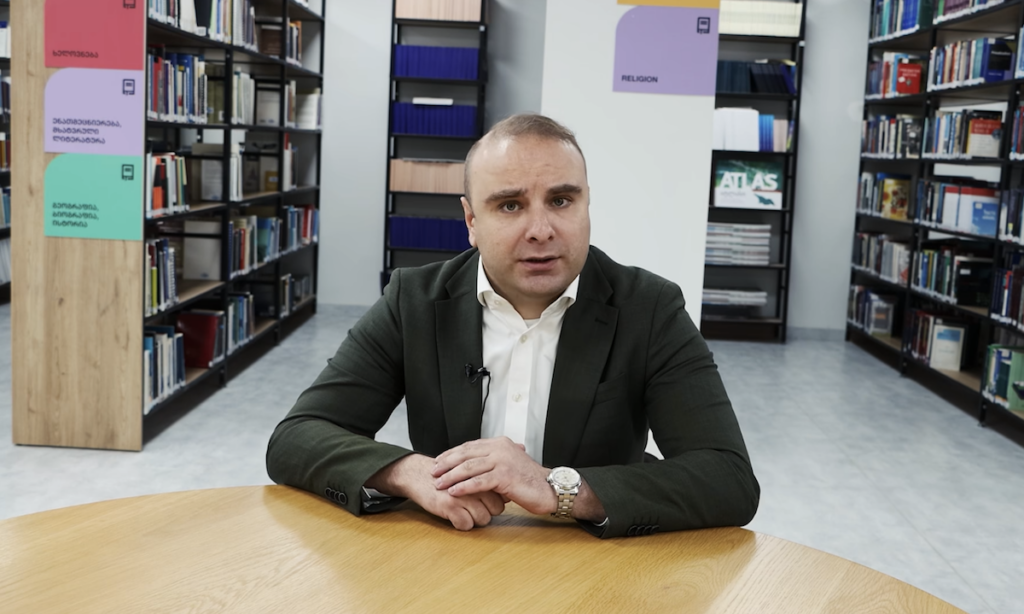
The head of the GIPA Policy Studies Centre at the Georgian Institute of Public Affairs, conflict analyst Giorgi Koberidze, says Georgia should draw a clear distinction between its economic and political relations with China. In his view, economic cooperation with China is important. However, he argues that Tbilisi does not receive the benefits that a strategic partnership should imply in political terms.
According to Koberidze, the current model resembles a situation in which Georgia serves China’s interests, while receiving no visible political support or security guarantees in return.
Giorgi Koberidze made the remarks in an interview with Netgazeti.
“Economic cooperation and political imbalance”
According to Giorgi Koberidze, developing economic ties with China is both natural and necessary, as China is one of the world’s leading economic powers and holds competitive advantages across many sectors.
However, he argues that the situation changes when the relationship moves into the political sphere.
Koberidze says political partnership involves more than trade relations.
“It also requires support on issues such as territorial integrity, human rights, anti-corruption policies and security. This is where the biggest questions arise, because China does not demonstrate clear support for Georgia’s primary national interest – its territorial integrity,” Koberidze says.
Does Georgian Dream see China as an alternative to the West?
Koberidze believes the Georgian authorities view China as an alternative strategic partner to the West. According to him, China does not treat the level of democracy, human rights standards or anti-corruption efforts in partner countries as decisive factors. That approach makes cooperation easier for governments that face criticism from Western countries.
In the conflict analyst’s view, the interests of the ruling Georgian Dream party stem from these circumstances.
“China does not have the kind of strong and clearly defined interest in Georgia that the United States had in the 2000s. Washington’s interests in Georgia were expressed very clearly. China’s approach is different. It sees Georgia as another country that contributes to its broader political and economic influence, but not as a strategic priority in the way the Georgian authorities try to portray it,” he says.

What does strategic partnership actually mean?
According to Koberidze, a strategic partnership should rest on mutual obligations and shared interests. In his view, territorial integrity remains Georgia’s most important national issue, and a strategic partner should demonstrate support on that front.
However, he argues that China does not support UN resolutions concerning the return of Georgian refugees, does not exert pressure on Russia and does not make political statements that would demonstrate the level of support expected from a strategic partner.
At the same time, Koberidze notes that Georgia offers China important transit routes and infrastructure projects. In return, he says, Tbilisi receives neither comparable political backing nor significant economic benefits.
Why wine, tourism and visa-free travel are not enough
Koberidze argues that exports of Georgian wine to China, growing tourist flows and visa-free travel are all positive developments in themselves. However, he says they do not prove the existence of a strategic partnership.
“You can describe relations as strategic only when both sides support each other on fundamental issues and take concrete steps to protect their shared interests,” the analyst says.

‘I respect China’s reasons’
In the interview, Koberidze draws particular attention to a statement by Georgian Prime Minister Irakli Kobakhidze, who said that he “respects the reasons” why Beijing does not support Georgia’s UN resolutions.
Koberidze argues that China is not a small country whose policies others can easily dictate. In his view, Beijing has enough influence to exert pressure even on Russia. However, he says China does not consider Georgia important enough to do so.
According to Koberidze, this reality shows that Georgia’s significance to China remains limited, regardless of how often the two countries describe each other as strategic partners.
Could the non-recognition policy suffer?
Koberidze argues that Western support for the policy of non-recognition of Abkhazia and South Ossetia does not directly depend on the Georgian government’s relations with China. However, he believes the problem could emerge in another area.
“If support for Georgia’s territorial integrity ceases to be a priority for Georgia itself, then Russia effectively receives a broader carte blanche. I am also referring to the issue of annexation. The process may not stop at occupation and could evolve into annexation. Russia could eventually place the direct incorporation of these territories on the agenda.
Of course, the West would protest and say that such a move is unacceptable. But if we fail to secure meaningful support that translates into military or economic assistance, which Georgia needs so badly, that is where the real loss will occur.
No one forbids relations with China, and no one says such relations are inherently wrong. The problem arises when you become indifferent to your own territorial integrity and, in order to justify a strategic partnership with China, say: ‘I respect China’s reasons.’
In that case, the West may logically conclude that you would also ‘understand’ annexation, and the discussion would end there. If your own territorial integrity no longer concerns you, it will cease to be a priority for the West or anyone else. That is the problem we face at the level of political rhetoric,” Koberidze says.
‘It is impossible to pursue both a Western and an authoritarian political course at the same time’
Koberidze argues that economic cooperation with China is fully compatible with Western integration. Politically, however, he believes the situation is becoming increasingly complicated.
According to him, the modern international system no longer operates solely on the basis of economic interests. Countries increasingly have to choose between competing geopolitical blocs.
Koberidze says authoritarian states expect loyalty from their partners and ultimately seek to draw them into their sphere of influence.
In this context, he argues that it is difficult to imagine Georgia simultaneously maintaining a course towards Western integration while pursuing closer political ties with authoritarian states.
America’s attention and China’s influence
Koberidze also points out that policymakers in Washington have already begun examining China’s growing influence in Georgia.
In his view, this does not yet mean that the United States has made any final decisions. However, it does indicate that Georgia’s relationship with China is gradually attracting greater attention from American security policymakers.
He says one aspect deserves particular attention: the Georgian authorities announced a comprehensive strategic partnership with China at a time when relations with the West had already deteriorated significantly.
‘This looks more like a party relationship than a state one’
At the end of the interview, Giorgi Koberidze argues that the current situation serves the interests of a political party more than the strategic interests of the state.
In his view, Georgia has not gained significant political benefits from its relationship with China, while the authorities use their ties with Beijing to strengthen their own legitimacy.
“All of this looks more like a strategic relationship between political parties than one between states, because Georgia has not gained any real benefits from its political relations with China,” Giorgi Koberidze says.
Georgia-China relations