Black rain over the Black Sea: How the Russian city of Tuapse is struggling to cope with the consequences of Ukrainian attacks






The oil disaster in Tuapse
Ukrainian drones have been striking oil infrastructure facilities across multiple regions of Russia — a reality that has become part of everyday life in Russian cities against the backdrop of Russia’s continuing invasion of Ukraine. The strikes, widely viewed as part of Ukraine’s retaliatory campaign, have caused large-scale destruction, massive fires and, in many cases, civilian casualties. One of the cities whose oil infrastructure became a target of drone attacks this spring was Tuapse. Read the Media Network report on what is happening in Tuapse — and how local residents are trying to minimize the environmental consequences of attacks on the city’s oil refinery.
Smoke Over the Refinery
Tuapse is a small city on Russia’s Black Sea coast — at once a seaside resort and a port town. Nearly a third of its territory is occupied by an oil refinery that has been targeted by drones four times over the past two weeks. Such attacks are typically accompanied by explosions, massive fires and serious environmental consequences for both the city and the surrounding region. They also often leave civilians dead.
The first strike on the city came on April 16. Residents awoke in the middle of the night to air-raid sirens and later heard explosions. Two people were killed: a 28-year-old woman and a 14-year-old girl.

It soon became clear that the oil depot was on fire — by morning, a thick column of black smoke had risen above the facility. Authorities were slow to issue official statements, limiting themselves to advising residents to stay indoors and keep their windows shut, while insisting that “the concentration of harmful substances in the air does not exceed permissible levels.”
Local residents, however, painted a different picture on social media: fuel oil washing ashore and spreading across the sea, birds coated in petroleum products, dead dolphins and what many described as “black rain.”
Drones struck the oil depot again on April 20 and April 28, and once more on May 1. At least one person was killed in the later attacks, dozens of residential buildings and other structures were damaged, and many residents came to believe that their city and the surrounding coastline were facing an environmental disaster.
Large slicks of petroleum products floating near Tuapse were clearly visible in satellite imagery. Officials issued upbeat reports about cleanup operations, but residents writing on social media described a far more chaotic scene, saying emergency crews lacked proper equipment and were working without respirators.“Outdated equipment that should have been retired long ago, rescue crews of three or four people instead of six, and not even showers or hot water at the unit. You can see it all for yourself if you go to the city beach, across from the children’s park — three or four emergency workers scooping petroleum residue out of the water with buckets,” one social media user wrote after watching cleanup crews work on a beach in Tuapse.
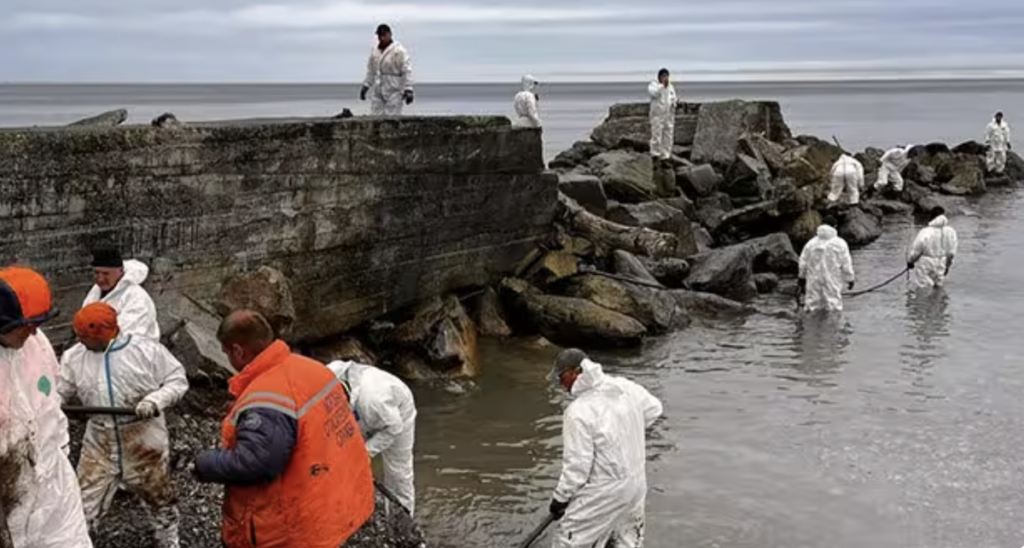
Authorities sought to reassure residents that the situation in Tuapse was not as severe as it appeared. Official statements described only a “minor” deterioration in air quality and “localized” pollution in the sea. Residents responded with accounts of the pervasive smell of smoke that seeped through closed windows, along with photos and videos showing patches of contamination drifting from Tuapse toward other coastal communities. Recent satellite images suggest that oil slicks are still floating in the waters around the city.
Video: Fire at the Oil Depot
Soybeans, corn, birds and dogs
Environmental experts are warning of potentially severe consequences for agriculture. Contaminated rainfall could threaten crops such as wheat, corn and soybeans — staples of the Krasnodar region, which has found itself at the center of the pollution.
In an interview with the independent outlet Kavkazsky Uzel, a Russian scientist speaking on condition of anonymity said birds were among the most vulnerable forms of wildlife affected by the contamination:
“Even a few drops of oil on a bird’s feathers disrupt its water balance and thermal insulation, leading to hypothermia and death. Contamination of the wing tips or tail, for example, increases a bird’s energy expenditure during flight by roughly 22 percent, while contamination of the sides or abdomen raises it by about 45 percent.
“In addition, when birds clean their feathers, they inevitably ingest petroleum products, causing damage to internal organs and often death. There are also long-term consequences — reduced reproductive success, the loss of nesting sites and changes in migration routes. In other words, entire populations can suffer severe damage,” the scientist explained.
Not only wildlife has been affected, but also stray dogs and cats living on the streets. Volunteers have set up a special aid center where injured animals are brought and treated.According to activists, volunteers rescue up to 15 dogs a day that would otherwise die without assistance. At the center, animals are washed, contaminated patches of fur are clipped, and their coats are carefully cleaned and combed.
After treatment, some dogs are returned to their original locations, while those in need of further care are sent to veterinary clinics. The center operates entirely on volunteer support.
“Subterranean rooms” as makeshift shelters
Beyond environmental concerns, residents of Tuapse are also troubled by a shortage of air-raid shelters. Russia has been at war in Ukraine for five years, and Ukraine has increasingly responded with destructive drone attacks. Yet residents of Russian cities, including Tuapse, often say they do not know where to take cover during such strikes.In some cases, so-called “subterranean rooms” are presented as substitutes for proper shelters, though locals describe them as inadequate and poorly prepared for emergencies.
In early May, the administration of the Tuapse district published on its official website a list of “subterranean rooms and other underground structures” across the area. The inventory includes 186 addresses, specifying the size of each basement, the number of entrances, and the estimated number of people each could accommodate.
Locals have met the list with skepticism. According to residents, many of the basements serve only as a nominal substitute for real shelters capable of withstanding drone attacks — some are not deep enough, others lack ventilation entirely, and in some cases the ceilings are so low that an adult cannot stand upright. Several of the listed spaces, residents say, are simply locked and inaccessible.
Diana Petriashvili, Media Network, based on reporting by Kavkazsky Uzel
The oil disaster in Tuapse
exchange