Putin speaks on fuel crisis for the first time. What doesn’t match the facts in his interview






Putin Comments on the Fuel Crisis
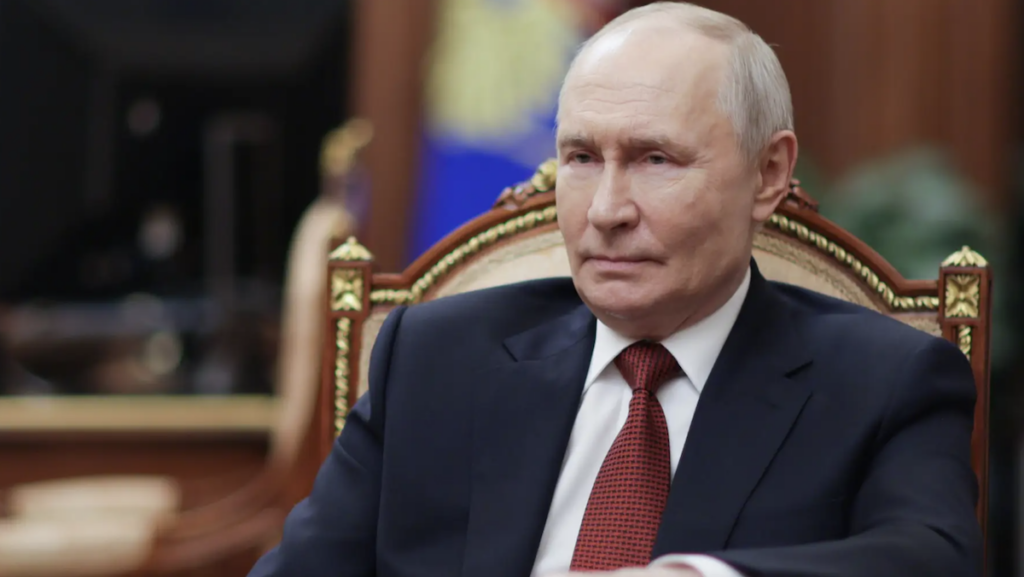
President Vladimir Putin gave an interview to propagandist Pavel Zarubin in which he commented on the fuel crisis, the consequences of Ukrainian strikes on oil refineries, the effectiveness of Russian air defenses, the situation on the front line, and prospects for negotiations with Ukraine.
A transcript of the interview was published on the Kremlin’s website and on Zarubin’s Telegram channel. Journalist Farida Rustamova noted that Putin appeared to read from a teleprompter, squinting and looking to the side.
According to his account, in just 25 minutes Vladimir Putin commented on Russia’s fuel crisis, Ukrainian strikes on oil refineries, failures in air defense, and the situation on the front line. He described fuel shortages as “not critical,” called the restoration of refineries “rapid,” and claimed battlefield successes that independent assessments say do not correspond to available data.
The outlet Novaya Gazeta Europe compared his statements with data from DeepState, the Institute for the Study of War (ISW), Reuters, and its own investigations.
Fuel crisis: The problem appears far broader than the kremlin acknowledges
Vladimir Putin said that Ukrainian strikes had created a “certain shortage” of fuel in Crimea and Sevastopol, but described the situation as “not critical.”
In practice, however, the fuel crisis has extended far beyond annexed Crimea, affecting much of Russia itself. According to estimates by Novaya Gazeta Europe, restrictions on fuel sales or signs of shortages have been recorded in at least 78 Russian regions as well as in occupied territories.
Military forces are still being prioritized in fuel supplies, but experts warn that by August or September the shortage could begin to affect the Russian army as well, due to continued strikes on oil refineries and fuel depots.
Refineries: Repairs will take months
Putin claims that damaged oil refineries are being restored quickly and that the system has “a significant margin of resilience.”
In reality, however, 16 Russian oil refineries—responsible for roughly 40 percent of the country’s oil refining capacity and gasoline production—have been fully or partially shut down following Ukrainian strikes.
The Moscow refinery, in particular, suffered significant damage and completely halted operations after attacks on June 16 and 18. According to Reuters, repairs are expected to take at least six months, and in the worst case could stretch into 2027.
Against this backdrop, gasoline production has fallen by roughly 25 percent compared with last year. The domestic fuel deficit is estimated at around 20 percent, while fuel prices continue to rise.
Air defense: Problems even acknowledged by Putin
The President of Russia said the country must accelerate production of modern air defense systems, while stressing that the necessary systems already exist.
According to military analysts, Ukrainian strikes have exposed limited effectiveness in Russia’s air defense network, including in the Moscow region.
During recent attacks, long-range detection systems reportedly failed to identify incoming drones in time, while short-range systems operated under abnormal conditions. Experts also note that some heat-seeking missile guidance systems may have locked onto hotter infrastructure targets rather than the drones themselves.
The use of small arms against drones—frequently observed in Moscow—is also described by specialists as largely ineffective.
Negotiations: Putin speaks of a crisis in the Ukrainian armed forces, analysts aay otherwise
Putin said that Ukraine had allegedly proposed a mutual halt to long-range strikes and a limitation of hostilities to four Ukrainian regions. He claimed that Kyiv was motivated by a “catastrophic shortage of manpower.”
However, assessments by the Institute for the Study of War (ISW) suggest that the Russian offensive in spring and summer 2026 has slowed significantly. Over recent months, Ukraine has managed to stabilize the front line, while the pace of Russian advances has reportedly fallen to roughly 8 percent of last year’s level.
Military and political analyst Oleksandr Kovalenko of the “Information Resistance” group described Putin’s statements as “a set of false claims and disinformation.” According to him, Russian forces are facing serious supply challenges, while Ukraine is steadily increasing pressure on Russian logistics.
Similar conclusions were reached by The Economist, which described the expected Russian spring offensive as a failure and noted that Ukraine had, for the first time in nearly three years, regained the initiative.
Frontline situation: Putin’s figures diverge from analysts’ assessments
Putin claimed that Russian forces were positioned roughly 10 kilometers from Sumy, several kilometers from the western outskirts of Kupiansk, and had nearly encircled a Ukrainian grouping near the Oskil River. He also said Russian troops had made significant advances in the areas of Lyman, Sloviansk, and Kostiantynivka.
However, data from the DeepState project and assessments by Ukrainian military analysts differ significantly from these claims.
Sumy
According to DeepState, Russian positions are located about 18 kilometers from Sumy. Over the past year, the front line in this sector has remained largely unchanged.
Military analyst Oleksandr Kovalenko said there is no immediate threat to the city, and that Russian forces are achieving only limited tactical gains in the border area.
Kupiansk
DeepState maps indicate that Russian units are at least six kilometers from the western outskirts of Kupiansk, which remains under Ukrainian control.
Kovalenko noted that Russian authorities have repeatedly claimed to have captured Kupiansk, but these statements have not been independently confirmed.
Alleged encirclement of Ukrainian forces
Putin referred to the “Old Oskol River,” which does not exist; he was likely referring to the Oskil River.
Claims that a 5,000-strong Ukrainian grouping had been encircled in the area are also rejected by analysts, who say there is no evidence of any such encirclement.
Lyman, Sloviansk and Kostiantynivka
According to analyst Oleksandr Kovalenko, Russian units are conducting localized operations in the Lyman area, but most of the city remains under Ukrainian control or within contested “gray zones.”
Reports of Russian forces reaching Mykolaivka and reducing the distance to Sloviansk to around eight kilometers are also described as inaccurate; the actual distances are roughly twice as large.
Claims that Russia controls 96 percent of Kostiantynivka are likewise unverified. Ukrainian assessments suggest that Russian units have entered some districts in small groups, but most of the city remains under Ukrainian control.
exchange