Top stories in Azerbaijan, Armenia, and Georgia from June 1-5 June, 2026
 Live
Live




-
Friday, June 5, Armenia
-
Friday, June 5, Georgia
-
Thursday, June 4, Armenia
-
Thursday, June 4, Georgia
-
Wednesday, June 3, Armenia
-
Wednesday, June 3, Georgia
-
Tuesday, June 2, Azerbaijan
-
Tuesday, June 2, Georgia
-
Tuesday, June 2, Armenia
-
Monday, 1 June, Armenia. Armenia–Russia relations have become a key issue in the election campaign ahead of the parliamentary elections
-
Monday, 1 June, Azerbaijan. 274 companies from 44 countries take part in Baku Energy Week
-
Monday, 1 June, Georgia. Khvicha Kvaratskhelia has been named UEFA Champions League Player of the Season
-
Top stories in Azerbaijan, Armenia, and Georgia from 25-29 May, 2026

-
Friday, June 5, Armenia
● Armenia’s election campaign is entering its final stretch in an increasingly tense – and at times theatrical – atmosphere. The latest televised debate on Public TV, this time featuring party leaders and prime ministerial candidates, quickly turned chaotic. National Progress party leader Hayk Marutyan walked out shortly after the programme began, dismissing the format as “ineffective.” A candidate from the “Against All” movement arrived wearing a Spider-Man mask before dramatically removing it and urging fellow participants to “take off their masks.” Meanwhile, Unity Wings prime ministerial candidate Arman Tatoyan brought valerian drops to the studio and offered them to Prime Minister Nikol Pashinyan.
● Foreign policy and Armenia’s geopolitical future once again dominated the debate. Amid continuing arguments over the country’s security alignment, Prime Minister Nikol Pashinyan said Armenia could eventually leave the Russia-led Collective Security Treaty Organisation (CSTO).
Responding to Narek Karapetyan, leader of the Strong Armenia bloc, who questioned Armenia’s “frozen” participation in the alliance, Pashinyan replied sharply: “So we’ll leave the CSTO. Are you trying to scare us? Neither you nor your uncle will decide that. We’ll decide and leave if necessary.” He also insisted Armenia’s security should be determined in Yerevan, not abroad, adding: “We will not allow [Belarus president] Lukashenko to become our guarantor again.”
● Against this backdrop, Yerevan continues to deepen cooperation with the West. Armenia and the United States have completed the signing process for the TRIPP agreement, with Foreign Minister Ararat Mirzoyan confirming that the document – previously signed remotely by him and US Secretary of State Marco Rubio – is now fully finalised and ready for ratification. Armenia’s foreign ministry earlier published the framework agreement on strategic cooperation under TRIPP, a US-backed initiative Armenian authorities see as key to diversifying the country’s economy and transport links.
● Mirzoyan also sought to reassure the public over Armenia’s peace process with Azerbaijan. In an interview with Armenia TV, the foreign minister said the peace agreement had already been initialled and rests on mutual recognition of territorial integrity under the Alma-Ata Declaration. He rejected opposition calls for external guarantors, arguing that the strongest guarantee of any agreement is mutual benefit. According to Mirzoyan, outside mediators often pursue their own interests; as an example of failed guarantees, he pointed to Russia’s role as one of Ukraine’s security guarantors.
● Brussels is meanwhile signalling stronger support for Armenia as tensions with Moscow grow. In a phone call with Nikol Pashinyan, European Commission President Ursula von der Leyen confirmed preparations for a support package worth more than €50m in immediate financial assistance, alongside measures aimed at expanding export opportunities for Armenian goods, including agricultural and floriculture products. The two sides also agreed to establish a joint Armenia–EU working group to coordinate ongoing programmes and discuss new areas of cooperation.
● European Commissioner for Enlargement Marta Kos reinforced that message shortly after the Pashinyan–von der Leyen call, saying the EU intends to help Armenia withstand economic pressure from Russia. “Europe stands in solidarity with Armenia in the face of the economic coercion by Russia,” Kos wrote on X, adding that financial aid and trade measures would help mitigate the impact of restrictions.
● EU Ambassador to Armenia Vassilis Maragos also said Brussels was prepared to expand support for Armenian producers and exporters. According to Maragos, the EU, member states and trade bodies are working on new mechanisms to help Armenian businesses access alternative markets amid restrictions imposed by Russia, as part of broader efforts to diversify Armenia’s economy.
● Moscow, however, continues to warn Yerevan about the consequences of its geopolitical choices. Russian Deputy Prime Minister Alexei Overchuk said the treaty governing the Eurasian Economic Union (EAEU) contains no legal mechanism for suspending or ending membership, adding that possible legal options would be studied by December.
● Russian Foreign Minister Sergei Lavrov has again framed Armenia’s future as a choice between the European Union and the EAEU. In an interview with Izvestia, Lavrov said Armenia was facing the familiar “either-or” dilemma, arguing that by adopting legislation aimed at launching EU accession efforts, Yerevan had itself “posed the question directly.”
Similar warnings came from Russian Security Council deputy secretary Alexei Shevtsov, who claimed Armenia was following Ukraine’s path of 2013–2014 and said the country “should think carefully to avoid repeating what happened in Ukraine.”
● Despite the increasingly sharp rhetoric, Moscow continues to offer itself as a mediator in the Armenia–Azerbaijan peace process. Russian Deputy Foreign Minister Mikhail Galuzin said Russia remains ready to host the signing of a peace treaty between the two countries and assist with reopening transport routes and addressing humanitarian issues.
● Armenia’s Court of Appeal has eased restrictions on Archbishop Bagrat Galstanyan, replacing his detention with house arrest. One of the leaders of the anti-government Sacred Struggle movement, Galstanyan has been in custody since June 2025. Investigators accuse him and his associates of plotting terrorist acts and attempting to seize power.
● As political polarisation intensifies ahead of the 7 June parliamentary election, Republic Party leader Aram Sargsyan warned that the vote would determine not only who governs Armenia, but also the country’s future sovereignty. He argued that if pro-Kremlin forces prevail again, Armenia risks “turning into a [Russian] province,” with future political struggle potentially taking on a “national liberation” character.
● Armenia’s Investigative Committee said it had carried out around 50 searches as part of a vote-buying investigation. Criminal proceedings have been launched against 37 individuals, while 25 suspects have been detained.
● International observers are arriving in Armenia ahead of the parliamentary election. A 22-member delegation from the Parliamentary Assembly of the Council of Europe (PACE) will visit the country from 5–8 June, joining monitors from the OSCE Parliamentary Assembly, the European Parliament and ODIHR.
● Amid an increasingly tense campaign, rumours have spread that opposition-minded citizens returning to Armenia are being discouraged from voting. Bright Armenia party leader Edmon Marukyan claimed that military police officers at Yerevan airport had begun issuing reserve training summonses to arriving citizens. The defence ministry rejected any political motive, saying military police were acting within the law to assist military commissariats with conscription records and reservist mobilisation procedures.
● Russia continues to send goods to Armenia via Azerbaijan. On 4 June, shipments of wheat, barley and fertiliser were dispatched by rail in transit through Azerbaijani territory.
● Families of missing persons will continue receiving monthly state assistance of 300,000 drams – roughly $780
-
Friday, June 5, Georgia
● Georgia’s government has finally agreed to begin work on providing expensive treatment for children with Duchenne muscular dystrophy, following weeks of round-the-clock protests by parents outside the government administration building.
Prime Minister Irakli Kobakhidze said that, after meetings with affected families, the authorities had decided to establish a special working group to oversee the procurement of specific medications. The group will include representatives from the Health Ministry as well as parents.
According to Kobakhidze, work will initially focus on two of the four drugs requested by families, with final decisions depending in part on the terms offered by pharmaceutical companies. Parents described the talks as “a victory of a dignified struggle”.
Until recently, the government had refused to fund the treatments, citing concerns over insufficient research and possible side effects, while parents repeatedly sought — unsuccessfully — a direct meeting with the prime minister.
***Duchenne muscular dystrophy is one of the most severe genetic diseases affecting children, primarily boys. Without treatment, it progressively leads to the loss of mobility, serious heart and lung complications, and a life expectancy averaging around 20 years. Around 100 people are registered with the diagnosis in Georgia, most of them children. A public solidarity campaign previously raised more than 2 million lari (about $730,000) to support affected families.
● “Georgia is not a schoolchild who can be held back for summer remedial lessons and told to improve” – Prime Minister Irakli Kobakhidze used the phrase to respond sharply to recent comments by US Secretary of State Marco Rubio, who said Washington hoped to see a change in the Georgian government’s “behaviour”.
Kobakhidze again blamed the previous US administration for damaging bilateral ties, accusing it of putting pressure on Tbilisi and demanding steps that, he claimed, would have created “grave risks” for the country. He did not specify what those demands were.
The prime minister nevertheless said Georgia remained interested in restoring its strategic partnership with Washington, insisting future relations should be based on “fairness” and mutual respect.
● Georgia’s Interior Ministry said police had seized 148 cryptocurrency mining devices in the highland municipality of Mestia, in the Samegrelo–Zemo Svaneti region.
Investigators say the equipment was found across six separate locations where locals allegedly used electricity illegally to generate cryptocurrency and earn illicit income. The case is being investigated under legislation covering violations of energy consumption rules, which carries a sentence of up to three years in prison.
Svaneti has long been considered one of Georgia’s centres for underground crypto mining, partly due to relatively cheap electricity and weak oversight of energy consumption.
● Georgia’s legislative process is becoming increasingly “personalised” and is being used to consolidate power and restrict political opponents, according to a new report by the Georgian Young Lawyers’ Association (GYLA).
The watchdog says parliament adopted 304 legislative amendments through fast-track procedures between April 2024 and February 2026. According to the report, many changes – from the controversial “foreign agents” law to recent amendments affecting grant legislation – were pushed through with limited public discussion and aimed at curbing protests and weakening independent institutions.
The organisation says legislative activity accelerated significantly after the disputed 2024 parliamentary election, with tougher penalties introduced for protest-related offences and major reforms to the civil service system, which critics say made politically motivated dismissals easier.
The government rejects such accusations, insisting the reforms are intended to strengthen governance and public order.
● Georgia will not take part in an expert-level meeting of the “3+3” regional platform due to be held in St Petersburg on 5 June, after Moscow announced the gathering.
Georgia’s Foreign Ministry said the country’s position on the format “has long been known” and remains unchanged: “Georgia has never participated in meetings held within this framework.”
Earlier, Russian Foreign Ministry spokeswoman Maria Zakharova said the first expert meeting of the 3+3 platform – involving Georgia, Armenia and Azerbaijan, alongside Russia, Turkey and Iran – would take place on the sidelines of the St Petersburg International Economic Forum.
The format was proposed after the 2020 Nagorno-Karabakh war as a regional cooperation mechanism excluding Western involvement. However, Tbilisi has consistently refused to join, citing Russia’s continued occupation of Abkhazia and South Ossetia.
● The new head of the Georgian Orthodox Church, Patriarch Shio III, will conduct his first mass baptism of children on 7 June at the Holy Trinity Cathedral (Sameba) in Tbilisi, continuing one of the best-known traditions established by his predecessor, Catholicos-Patriarch Ilia II.
The initiative, launched in 2008, aimed to support larger families symbolically, with Ilia II becoming the godfather of every third and subsequent child born to married Orthodox families. Over nearly two decades, he conducted 72 mass baptisms and became godfather to more than 50,000 children.
Shio III will now preside over the 73rd mass baptism ceremony.
● Moscow has reacted to the arrest in Georgia of Gulbaat Rtskhiladze, a pro-Russian activist charged with espionage.
Russian Foreign Ministry spokeswoman Maria Zakharova said Moscow “could not remain unconcerned” about the fate of a man who, she said, had spent years openly advocating for the normalisation of Russian-Georgian relations.
Zakharova described Rtskhiladze as someone involved in preserving shared historical memory, including efforts to identify Second World War casualties and restore monuments. She also noted that he cares for a seriously ill elderly father.
The Russian diplomat further pointed to the timing of the arrest, noting that it came shortly after Rtskhiladze announced a project to monitor alleged “Russophobia” in Georgia, suggesting that “certain forces” may be interested in concealing manifestations of xenophobia.
At the same time, Zakharova stressed that Moscow respected Georgia’s sovereignty and legal system, while expressing hope that the Georgian authorities would “look into the matter”.
Rtskhiladze was arrested by Georgia’s State Security Service on 30 May on espionage charges. Investigators allege that he simultaneously cooperated with the intelligence services of two foreign states and conducted parallel intelligence activities. He faces up to 12 years in prison if convicted. The case has been classified, and authorities have not disclosed which countries he is accused of spying for.
-
Thursday, June 4, Armenia
● “Armenia will not trade its independence for strawberries,” Foreign Minister Ararat Mirzoyan said, commenting on Russia’s restrictions on Armenian exports. Over the past few days, Moscow has blocked imports of a range of Armenian goods – from berries, fruit and vegetables to mineral water, flowers and other products – officially citing sanitary concerns.
In Yerevan, however, many view the measures as politically motivated, linked to Armenia’s efforts to deepen ties with the United States and the European Union. Mirzoyan nevertheless stressed that Armenia expects to resolve the dispute with Russia “in a constructive and partnership-based atmosphere” through working-level discussions.
● Economy Minister Gevorg Papoyan said the government will launch a support package for greenhouse exporters following Russia’s import restrictions on Armenian goods. The state will subsidise exports of tomatoes, peppers, strawberries and flowers, while also reimbursing customs duties on fresh fruit, vegetables and flowers exported to EU countries. The measures are intended to help producers whose access to the Russian market has effectively been disrupted by the latest restrictions imposed by Russia’s agricultural watchdog.
● Russian Security Council Secretary Sergei Shoigu warned of potential economic costs for Armenia if ties with Moscow continue to deteriorate. He said a decline in Russian tourism could cost Armenia up to $1.5bn, while restrictions on agricultural exports could lead to losses of more than $700m, noting that over 96% of Armenian agricultural exports traditionally go to Russia. Shoigu also warned that if Armenia were to leave the Eurasian Economic Union (EAEU), the price of Russian gas could rise three- to fourfold.
● Former president Robert Kocharyan, now the prime ministerial candidate of the opposition Armenia bloc, again argued in favour of reopening the railway through Abkhazia, saying it would significantly strengthen Yerevan’s hand in negotiations with Azerbaijan. Speaking to Armenia TV, Kocharyan said the route should be viewed separately from the US-backed connectivity project TRIPP. He recalled discussing the proposal with then-Georgian president Eduard Shevardnadze in the early 2000s. “He was not against it, but said: ‘If you can reach an agreement with the Abkhazians,’” Kocharyan said, adding that the idea was effectively frozen after Mikheil Saakashvili came to power in Georgia. According to the former president, reopening the route would benefit all regional players.
● Armenia’s Central Electoral Commission said ballot printing has been completed for the parliamentary elections on 7 June. According to CEC spokesperson Seda Ghukasyan, a total of 47.3 million ballots have been printed for all parties and alliances participating in the vote. Each political force received 2.63 million ballots, based on the country’s 2.5 million registered voters, plus a reserve of up to 5%.
● Armenia hosted its first defence industry, innovation and engineering exhibition, bringing together companies and specialists from the country’s growing military-tech sector.
● Armenian law enforcement agencies said they had uncovered another alleged drug trafficking scheme operating through Telegram. Four people have been detained on suspicion of organising an online narcotics distribution network, according to investigators.
● Opposition businessman and leader of the Prosperous Armenia party Gagik Tsarukyan has filed a lawsuit against Prime Minister Nikol Pashinyan. According to Armenia’s Datalex judicial platform, Tsarukyan is demanding a retraction of remarks made by Pashinyan on 28 May, when the prime minister described him as a “criminal”, “spy”, “agent”, someone who had made a “criminal deal” and “robbed the Armenian people”. Tsarukyan is seeking 9 million drams (around $23,000) in damages — 3 million drams ($7,700) for insult and 6 million drams ($15,400) for defamation.
● Russian Foreign Ministry spokesperson Maria Zakharova said that “Armenia must be saved by its own citizens”, who she said would have to choose “in favour of their country” in the upcoming parliamentary elections. Speaking at the St Petersburg International Economic Forum, Zakharova criticised newly signed agreements between Yerevan and Washington, arguing that the US acts primarily in its own interests. Commenting on Armenia’s efforts to deepen ties with the EU while remaining in the EAEU, she compared Yerevan’s position to that of a passenger unable to decide which destination they are flying to while trying to check in for multiple flights at once.
● Armenia’s Investigative Committee has opened a criminal case into alleged vote-buying involving Russian-based blogger Mika Badalyan. Few details of the investigation have been made public so far.
● Prime Minister Nikol Pashinyan said he plans to travel to Moscow after the 7 June parliamentary elections for talks with President Vladimir Putin. According to Pashinyan, Putin called him on 1 June to wish him a happy birthday, but the two leaders also discussed bilateral issues and agreed to meet again. “After the elections, I will travel again, we will meet and resolve all current issues,” Pashinyan said, referring in part to Armenia’s role in the EAEU and broader Armenia–Russia relations.
● Armenia’s deputy prime minister and Iran’s ambassador discussed expanding cooperation in energy, logistics and trade.
● Turkish President Recep Tayyip Erdogan and Armenian Prime Minister Nikol Pashinyan discussed the normalisation of relations and regional issues during a phone call. Both sides said they welcomed increased engagement, highlighting Turkish Vice President Cevdet Yilmaz’s recent visit to Yerevan for the European Political Community summit, the launch of procedures for direct trade between Armenia and Turkey, and the opening of the Akhalkalaki–Kars railway route for Armenian imports and exports.
● A new artistic lighting system has been completed at the Zvartnots historical and cultural reserve. Specialists worked on the project for nearly three years. The total cost amounted to 26.2 million drams (about $67,000).
-
Thursday, June 4, Georgia
● US Secretary of State Marco Rubio says Washington hopes to see a shift in Tbilisi’s course following recent contacts with the Georgian authorities. Speaking in the US House of Representatives in response to Republican Congressman Joe Wilson – one of the fiercest critics of Georgia’s ruling Georgian Dream party – Rubio acknowledged that developments in Georgia had long been a source of concern for Washington. Wilson described the current government as a “pro-Iranian regime backed by the Chinese Communist Party” and claimed it posed a threat to US interests in the region. “You’re right. Everything you described has already been a concern for us,” Rubio said, adding that recent communication with Tbilisi had produced “some positive signals”.
According to Rubio, Georgian officials themselves had asked “what it would take to improve relations with the United States”, and Washington now hopes to see “a change in trajectory — not only in our relationship with Georgia, but also in their behaviour”.
● Commenting on US-Georgian relations, the Georgian PM once again blamed the previous US administration for the current crisis. Irakli Kobakhidze argued that White House policy between 2020 and 2024 had “damaged” ties with Georgia by encouraging opposition parties to boycott parliament after disputed elections.
He also said it would represent a “continuation of injustice” if Washington demanded that the Georgian government withdraw its request to the Constitutional Court seeking a ban on opposition parties.
At the same time, Kobakhidze described last week’s meeting with a visiting US State Department delegation in Tbilisi as “very interesting”, saying discussions had focused on “specific issues” and confirming that dialogue with Washington would continue.
● Former Georgian president Mikheil Saakashvili, currently in prison, has published an appeal to Armenian voters ahead of Armenia’s parliamentary election on 7 June, calling it a “historic” vote that will determine the country’s future. In a Facebook post written from detention, Saakashvili described Armenia as “an island of freedom” for many Georgians and a democratic success story against what he called the backdrop of “dictatorship” in Georgia.
“You are freeing yourselves from the Russian yoke; we are witnessing Armenia’s rapid rapprochement with Europe and America,” he wrote, adding that many Georgians now travel to Yerevan “for a breath of freedom”.
Saakashvili also weighed in on Armenia’s political contest, framing it as a choice between Prime Minister Nikol Pashinyan and opposition businessman Samvel Karapetyan, whom he described as “the Armenian Ivanishvili” – a reference to billionaire Bidzina Ivanishvili, the founder of Georgia’s ruling Georgian Dream party. “You are choosing not only between Pashinyan and Karapetyan, but between the past and the future, slavery and freedom, war and peace,” the former president wrote, urging Armenians to “make the right choice”.
● After several jailed participants in the 4 October 2025 protests agreed to plea deals, Prime Minister Kobakhidze urged other defendants to follow suit. “It would be very good if other prisoners followed this example – including through confession, repentance and appeals to the president for clemency,” he said, effectively signalling that authorities may consider pardons for those who admit guilt and express remorse.
The case stems from unrest following local elections on 4 October, which parts of the opposition boycotted, describing them as illegitimate. Mass protests later took place in central Tbilisi, with demonstrators calling for the “peaceful removal of the government”. Clashes broke out after a group of protesters attempted to push towards the presidential residence on Atoneli Street. Seven defendants linked to one episode — the attempted storming of the residence — admitted guilt and expressed remorse in exchange for suspended three-year sentences, allowing them to avoid prison and likely be released soon.
Other defendants, however, continue to insist on their innocence, arguing they are being pressured to confess to crimes they say they did not commit.
● There has been a new development in the dispute over treatment for children with Duchenne muscular dystrophy. After weeks of protests by parents demanding state funding for costly innovative medicines, Prime Minister Kobakhidze met families of patients for the first time. Following the meeting, he said both sides had exchanged information and agreed to hold further talks soon, focusing on concrete solutions. “We hope that together we will find a way to resolve this issue. Above all, we must act in the interests of the children,” the prime minister said.
● The Health Ministry, however, has already signalled that a quick resolution is unlikely. Health Minister Mikheil Sarjveladze said officials are assessing four different medications, each at varying stages of approval, scientific evaluation and readiness for use. “There are fewer questions regarding two of the medicines, and significantly more regarding others,” the minister said after meeting parents. Any decision, he added, would need to be based on a “detailed analysis” to ensure the treatment is genuinely effective for patients.
-
Wednesday, June 3, Armenia
● Speaking at a congressional hearing, US Secretary of State Marco Rubio said Washington had reason to believe Moscow wanted Armenian Prime Minister Nikol Pashinyan to lose the upcoming election amid deepening US-Armenia ties. “I think there is evidence that the Russian Federation wants the current prime minister of Armenia to lose the election because of the developing relationship with the United States,” Rubio said. He stressed, however, that the US was “not interfering in Armenia’s sovereignty” and sought a relationship based “not only on peace, but on mutually beneficial cooperation.”
The remarks come as tensions between Yerevan and Moscow continue to mount – from disputes over Armenia’s place in the Moscow-led Eurasian Economic Union to Russia’s tightening restrictions on Armenian exports.
● As trade pressure from Russia intensifies, Armenian officials are increasingly talking up alternative export routes. Economy Minister Gevorg Papoyan said produce effectively shut out of the Russian market following new restrictions by Russia’s agricultural watchdog could instead be redirected to the EU. He described the shift as “entirely realistic”, arguing that Armenian fruit and vegetables already meet high European standards through Global GAP certification. “This is exactly the kind of produce sold in European supermarkets,” he said, while acknowledging that logistics and transport costs remain the main obstacle. The government has so far declined to disclose specific destinations, with Pashinyan saying new markets would be announced only once negotiations are complete.
● Pashinyan, meanwhile, has sought to turn the export crisis into a political argument for his broader foreign policy course. Addressing supporters, he declared: “We will replace dependence on a few with dependence on many,” framing peace as the defining issue of the upcoming election. Responding to concerns over Armenia’s position in the EAEU and Russia’s trade restrictions, he said the government would compensate exporters if barriers proved “unfair”. “People are being pressured to abandon the peace agenda because one truck carrying peppers was delayed at the border. We will become the owners of those peppers ourselves, the government will pay for them, and you will become the owners of peace,” the prime minister said. At the same time, he made clear that businesses exporting substandard products should not expect blanket support, saying authorities would instead help modernise production.
● The European Union is allocating €2.2m to help Armenia prepare for possible visa liberalisation. The funding will support reforms in border management, document security and law enforcement.
● Against the backdrop of cautious political normalisation, Turkey and Armenia are testing the waters of economic cooperation. One of the first large-scale business-to-business meetings between Turkish and Armenian entrepreneurs took place in the Turkish city of Kars. Organisers said the aim was to establish sustainable commercial ties and encourage joint projects. Participants voiced hope that economic engagement could become a practical tool for building trust between the two neighbours.
● US geopolitical intelligence firm Stratfor says warming ties between Armenia and Turkey could reduce Yerevan’s dependence on Russia – but only to a point. Analysts argue that Moscow’s enduring influence in the region is likely to constrain any major shift. The report notes that attempts to normalise ties accelerated after Azerbaijan established full control over Karabakh.
● Pashinyan has floated the possibility of a territorial exchange as part of negotiations over the Armenian exclave of Artsvashen. The prime minister said Armenia and Azerbaijan must decide whether border delimitation is about “hurting one another” or leaving future generations “a country with a proper cadastral document”. “Our duty is to leave our children a country that already exists, clearly documented and defined,” he said, adding that Armenia’s security would continue to rest on strengthening defence capabilities.
Artsvashen – an Armenian exclave inside Azerbaijan – has been under Baku’s control since 1992, following the first Karabakh war. The fate of enclaves on both sides of the border remains one of the most sensitive unresolved issues in ongoing border talks between Yerevan and Baku.
● Armenia’s election campaign is becoming increasingly tense. Footage circulated online appeared to show members of the opposition bloc Strong Armenia being attacked in the town of Masis, including female activists. The bloc claims supporters of the ruling Civil Contract party were behind the assault. Several people were hospitalised.
● Armenia’s Anti-Corruption Committee carried out searches at offices linked to the opposition Armenia bloc, including in Ashtarak, as well as at the home of MP and senior Dashnaktsutyun figure Ashot Simonyan. Opposition lawmaker Ishkhan Saghatelyan accused the authorities of trying to disrupt campaign operations and influence voters, calling on international observers to respond.
● Pressure is also mounting around the political network of billionaire businessman Samvel Karapetyan, who backs the Strong Armenia bloc. A court returned Karapetyan’s Armenian passport, allowing him to vote in the parliamentary election on 7 June. (He remains under house arrest on charges of publicly calling for the seizure of power.)
At the same time, prosecutors opened a criminal case against his ally Alik Aleksanyan, a member of Strong Armenia’s governing council, accusing him of large-scale money laundering and covert vote-buying. A pre-recorded Facebook video released after his detention showed Aleksanyan saying: “If you are seeing this video, it means I have either been detained or arrested — all of this is the result of this government’s fear, weakness and helplessness.”
● Armenia could eventually be linked to the Baku–Tbilisi–Kars railway, according to Georgian Prime Minister Irakli Kobakhidze. “We are ready to deepen our partnership with our Armenian friends as much as possible, including in the development of transit functions,” Kobakhidze told journalists following the official reopening of the upgraded rail line.
● Russia continues to expand restrictions on Armenian agricultural imports. From 3 June, Russia’s agricultural watchdog introduced temporary bans on apples, pears, aubergines, potatoes and dried fruit from Armenia, as well as their transit to EAEU member states. Officials said the measures were due to the absence of reliable mechanisms to verify the origin and destination of quarantined goods.
● Police in Armavir carried out searches at 20 locations, seizing ammunition, air rifles, a gas pistol and narcotics, according to Armenia’s Interior Ministry. Few details of the investigation have so far been made public.
● The foreign ministers of Armenia and Latvia discussed “hybrid threats” and Armenia-EU cooperation during a phone call. Armenian Foreign Minister Ararat Mirzoyan and his Latvian counterpart Baiba Braže exchanged views on strategic cooperation with the EU and ways to counter actions targeting democratic processes.
● South Caucasus Railway announced the launch of seasonal passenger services to Batumi and Lake Sevan, just in time for the summer season.
● And, in a rare break from Armenia’s increasingly political news cycle, Yerevan Zoo introduced several new residents: a young lion named Zeus, blesbok antelopes exhibited in Armenia for the first time, famously grumpy-looking Pallas’s cats, and Caucasian lynxes recently moved into a larger enclosure.
-
Wednesday, June 3, Georgia
● A court has handed down new sentences in one of Georgia’s most high-profile criminal cases in recent years – the killing of 28-year-old teacher Giga Avaliani, who died after a brutal assault by teenagers in Tbilisi in autumn 2025.
Tbilisi City Court sentenced juvenile defendant Demetre Chikovani to nine years and nine months in prison, while Ani Naskidashvili received five years and three months. Chikovani was convicted of preparing a group assault intended to cause grievous bodily harm, while Naskidashvili was found guilty of failing to report the preparation and commission of a particularly serious crime.
Prosecutors say the attack was premeditated: a group of teenagers allegedly first attempted
to ambush Avaliani near an educational centre in Tbilisi’s Temka district before carrying out the assault two days later. Avaliani died 23 days afterwards without regaining consciousness. Several other juveniles have already been convicted in the case, while another teenager was sentenced this week to three years in prison for giving false testimony.
● Amid ongoing concerns over media freedom in Georgia, the Adjara Public Broadcaster has dismissed 14 employees, citing “reorganisation”. Those laid off include presenters, editors and journalists known for critical reporting and tough questioning of government officials. Several of the dismissed staff say the decision was politically motivated and linked to editorial independence.
The Georgian Charter of Journalistic Ethics described the move as “unfair and unjustified”, warning that it appeared to be an attempt to purge critical voices from the regional media landscape. The broadcaster’s newly appointed director, Irakli Kikvadze, said the cuts were linked to infrastructure challenges and the closure of several programmes.
● Legal proceedings also continue against protesters involved in demonstrations following Georgia’s disputed local elections on 4 October 2025, when much of the opposition and its supporters boycotted the vote and gathered in central Tbilisi calling for the “peaceful overthrow” of the government. Seven defendants accused in the case surrounding an attempted storming of the presidential residence have agreed plea deals, admitted guilt and expressed remorse. In return, prosecutors offered suspended three-year sentences, allowing them to avoid prison and secure release in the near future. Not all defendants, however, are willing to settle: several continue to insist on their innocence, arguing they are being pressured to confess to crimes they did not commit.
● Prime Minister Irakli Kobakhidze accused the previous US administration of encouraging Georgia’s opposition to boycott parliament after the 2020 and 2024 elections, while describing Washington’s current approach as more constructive.
Commenting on a recent visit by a US State Department delegation, Kobakhidze said American officials had stressed the importance of opposition parties taking up their parliamentary mandates and participating in legislative work. According to him, external influence was a key factor behind the opposition’s refusal to enter parliament after the 2024 elections. “Three of the four parties that crossed the threshold did not enter parliament. This was directly encouraged by the previous [US] administration and by European bureaucracy,” he said. Kobakhidze added that Tbilisi hoped to reset ties with Washington: “What injustice damaged can only be repaired through a fair approach and relations based on mutual respect.”
● Kobakhidze also launched a sharp attack on Germany’s ambassador to Georgia, Peter Fischer, accusing him of having “lost his bearings” after comments made in an interview with Radio Free Europe/Radio Liberty about Georgian attitudes toward EU membership. Fischer had argued that some Georgians viewed European integration as the country’s only viable future, saying: “I don’t want to be Russian, Turkish, Iranian or Azerbaijani — perhaps being only together with Armenia is not enough.” Kobakhidze dismissed the remarks as “regrettable” and “unserious”. “He speaks about friendly nations and peoples, but ultimately mentions them in a negative context,” the prime minister said.
● The US Embassy in Tbilisi thanked Georgia’s Prosecutor General’s Office and law enforcement agencies following the arrest of several individuals accused of fraud linked to illegal migration to the United States and document forgery. The embassy said the operation was the result of “months of close law enforcement cooperation between the United States and Georgia”.
Prosecutors say two criminal groups were uncovered in a joint operation with embassy security officials. One allegedly helped 366 Georgian citizens seek asylum in the US by fabricating stories of political persecution or discrimination based on sexual orientation, while also selling forged supporting documents. A second group is accused of producing falsified documents for US visa applications, some of which were later revoked after irregularities were identified. Nine people have been charged and face up to nine years in prison.
● A 43-year-old woman was shot dead in the western Georgian village of Zana. Police have detained the godfather of her child as the main suspect after arresting him at his home, where officers also seized the suspected murder weapon – a hunting rifle. The motive remains unclear to both the victim’s relatives and the suspect’s family. The woman is survived by three underage children.
-
Tuesday, June 2, Azerbaijan
● Baku Energy Week is underway, bringing together 274 companies from 44 countries. Running from June 1–3, the event opened with the 31st Baku Energy Forum, where President Ilham Aliyev highlighted Azerbaijan’s growing role as an energy hub. He said Central Asian oil is already reaching international markets via Azerbaijan, while state energy company SOCAR now has more than 30 million tonnes of refining capacity. Following the acquisition of Italiana Petroli, Azerbaijan’s refining capacity in the Mediterranean has increased from 13 million to 23 million tonnes. Aliyev said the country’s gas reserves are sufficient for at least a century and stressed that, while Azerbaijan does not urgently need alternative electricity sources, it is continuing to invest heavily in renewables and create favourable conditions for investors.
● US President Donald Trump has linked regional energy cooperation to the Armenia-Azerbaijan peace process. In a message to participants of Baku Energy Week, Trump said regional energy integration was one of the key outcomes of the peace summit held in Washington on August 8, 2025, attended by President Ilham Aliyev and Armenian Prime Minister Nikol Pashinyan. He added that the US administration expects productive discussions on Armenia-Azerbaijan peace later this month.
● Azerbaijan signed energy and investment agreements worth an estimated $7.5 billion during Baku Energy Week. Azerbaijan’s Economy Ministry and SOCAR announced a series of agreements and memorandums with partners from the United States, Turkey, Serbia, San Marino and France. Among the key deals: a US-Azerbaijan framework agreement on critical minerals and rare earth supply chains; a long-term agreement to supply Turkish markets with gas from the Absheron field; a partnership with Serbia’s EPS to develop a gas-fired power plant in Niš; and cooperation agreements with Shell, Chevron, JP Morgan, Apollo Global Management and US energy company Comstock Resources. SOCAR also signed an agreement to begin gas exports to San Marino later this year.
● President Ilham Aliyev met a visiting US delegation led by Caleb Orr, Assistant Secretary of State for Economic and Business Affairs. According to Azerbaijani officials, Orr conveyed greetings from President Trump and the US Secretary of State, saying Trump’s message to Baku Energy Week reflected the importance Washington attaches to the forum and bilateral cooperation.
● The first Azerbaijan–US Economic Dialogue will take place today as part of Baku Energy Week. Ahead of the talks, Azerbaijani ministries held meetings with Caleb Orr and Sonata Coulter, the US co-chair of the bilateral strategic working group. Discussions reportedly focused on expanding the Middle Corridor transport route, developing the proposed Zangezur Corridor and the possible participation of American companies in regional transport and infrastructure projects.
● Azerbaijan is exploring partnerships with US companies to build a data centre. Minister of Digital Development and Transport Rashad Nabiyev said he discussed cooperation opportunities with US government agencies and businesses during meetings with the visiting American delegation.
● Energy ministers from D-8 member states held their first ministerial meeting in Baku. The gathering concluded with the adoption of the Baku Declaration on energy cooperation. The D-8 grouping includes Bangladesh, Egypt, Indonesia, Iran, Malaysia, Nigeria, Pakistan, Turkey and Azerbaijan.
● Ukraine has offered Azerbaijan access to Europe’s largest underground gas storage facilities. Speaking at the Baku Energy Forum, Ukrainian Energy Minister Denys Shmyhal said Ukraine’s storage capacity totals around 30 billion cubic metres and could help support Azerbaijani gas exports to Europe. He said Ukraine had already become part of the renewed Trans-Balkan energy route and that initial test deliveries of Azerbaijani gas demonstrated that the corridor was “becoming a reality”.
● The upgraded Baku–Tbilisi–Kars railway will officially reopen today in Georgia. Officials from Azerbaijan, Georgia and Turkey are expected to attend a ceremony in the southern Georgian town of Akhalkalaki. The railway links Azerbaijan to Turkey via Georgia and is considered one of the most efficient overland trade routes connecting China and Central Asia to Europe. Modernisation works were formally completed following agreements signed during Georgian Prime Minister Irakli Kobakhidze’s visit to Baku in May.
● An Azerbaijani government delegation has begun a three-day visit to Belarus. Led by Deputy Prime Minister Samir Sharifov, the delegation is expected to participate in a session of the bilateral intergovernmental commission on trade and economic cooperation, alongside a series of high-level meetings.
-
Tuesday, June 2, Georgia
● The US has outlined conditions for resetting relations with Georgia. According to the US Embassy in Tbilisi, Washington is ready for “constructive, forward-looking relations” based on “mutual respect, shared interests and honest dialogue.” However, the US stressed that a long-term strategic partnership requires a “stable domestic political environment” and meaningful opposition participation. “A functioning democracy requires a political opposition that engages with state institutions,” the statement said.
● Georgia’s fifth president, Salome Zourabichvili, says the country faces a choice: “save itself or submit to dictatorship.” Speaking at an international forum in Oslo, she said Georgia had recently been seen as a “beacon of democracy” and a model of reform in the region, before experiencing what she described as a “capture of democracy and the state.
According to Zourabichvili, the judiciary is under one-party control, restrictive laws targeting media and civil society are being rushed through parliament, and peaceful protest is increasingly criminalised. “Today, you can be fined or detained simply for standing on the pavement,” she said, calling developments in Georgia “a classic Russian playbook.”
● A new Interior Ministry unit tasked with monitoring public communication has begun operating in Georgia. The department, created to combat “hate speech, abusive campaigns and aggressive communication,” will employ ten staff and be headed by Interior Ministry lawyer Tamta Kimbarishvili. Her name has previously surfaced in public controversy after a citizen was fined over a Facebook comment addressed to her that a court deemed offensive.
State Minister for Coordination of Law Enforcement Agencies Mamuka Mdinaradze insisted the unit would not “monitor Facebook feeds” or target specific political groups. Instead, he said, its work would be based on citizen complaints and monitoring of open sources. “There will be precedent-setting decisions so people understand where the line lies between unacceptable and permissible behaviour,” he said.
● Critics say the new initiative is another sign of shrinking free speech and warn of growing self-censorship. Political analyst Paata Zakareishvili argued that the government is not aiming for mass punishments but rather a “chilling effect.” According to him, a few high-profile cases would be enough to make people “start censoring themselves.” He also linked the launch of the new unit to election preparations and an effort by the ruling party to minimise criticism.
● A Tbilisi court has remanded pro-Russian activist Gulbaat Rtskhiladze in custody after his arrest on espionage charges. Detained by the State Security Service (SSG) on May 30, Rtskhiladze is accused of cooperating with the intelligence services of two foreign states. The case materials remain classified, and he denies wrongdoing.
In a parallel case, the court also ordered the pre-trial detention of journalist Irakli Chikhladze, who faces similar espionage charges. The SSG claims he coordinated an intelligence network and passed information to a foreign intelligence service. Chikhladze’s lawyer said prosecutors failed to explain what classified information his client had allegedly transferred or how state interests had been harmed. According to the defence, the journalist is “shocked by the accusations.”
● Georgia, Azerbaijan and Turkey are officially launching the upgraded Baku–Tbilisi–Kars railway. The transport corridor links Azerbaijan through Georgia to Turkey and onward to European routes. The key Georgian section — the Marabda–Kartsakhi railway in the country’s south leading to the Turkish border — spans 180 km, of which 153 km have been rehabilitated and 27 km newly built to European standards. Tbilisi says the project will strengthen the South Caucasus’ transit role, diversify freight routes between Europe and Asia, and increase annual cargo capacity to up to five million tonnes.
● The Georgian government has announced a crackdown on illegal cryptocurrency mining in the mountainous Svaneti region, where residents traditionally do not pay for electricity. Authorities say crypto mining in Mestia municipality has overloaded the energy system, caused power outages — particularly in winter — and damaged local businesses and tourism. The first step will be the installation of electricity meters across the region.
● Georgia has recorded its first case of dengue fever. According to Ivane Chkhaidze, medical director of the Iashvili Central Children’s Hospital, one infection was confirmed last week. No further details have been released, including whether the case was imported. Dengue is spread through mosquito bites and typically causes high fever, severe headaches, and muscle and joint pain.
● Authorities are investigating the death of an eight-year-old boy in the Kvemo Kartli region. The Interior Ministry says the child’s 43-year-old mother has been detained on suspicion of aggravated murder, an offence punishable by 16 years to life imprisonment. Local media report that the boy died in hospital after suffering stab wounds. Reports also suggest the woman may have had mental health problems.
● On International Children’s Day, the rights group Partnership for Human Rights (PHR) said that laws protecting children’s lives, education and safety in Georgia “too often remain only on paper.”
-
Tuesday, June 2, Armenia
● Russia’s Security Council Deputy Chairman Dmitry Medvedev sharply criticised Armenian Prime Minister Nikol Pashinyan after he dismissed calls for a referendum on whether Armenia should prioritise future EU membership over continued participation in the Eurasian Economic Union (EAEU). In a post on the Max messaging platform, Medvedev wrote: “Comrade Nikol has taken the dangerous path of Comrade Trotsky,” accusing Pashinyan of adopting Leon Trotsky’s famous formula: “Neither war nor peace, but disband the army.”
The remarks came after Pashinyan said during a Facebook livestream on 1 June that holding such a referendum now would be “illogical,” arguing that the choice remains theoretical at this stage. He said Armenia would continue working within the EAEU “until a choice between the EAEU and the EU becomes inevitable” and suggested revisiting the issue only if Yerevan formally applies for EU membership or moves closer to candidate status. Until then, he said, Armenia would continue to work within the bloc “calmly, peacefully, without nerves and without disputes,” adding that the country still has untapped potential in the EAEU.
His comments followed a joint statement by Russian President Vladimir Putin and other EAEU leaders in late May effectively urging Armenia to choose between European integration and membership in the Russia-led bloc.
● Russia’s ambassador to Armenia, Sergey Kopyrkin, is currently in Moscow for consultations, Russian Foreign Ministry spokeswoman Maria Zakharova said. Russian media had earlier reported that Kopyrkin was summoned amid Armenia’s deepening ties with the European Union and growing tensions in Armenian-Russian relations.
● As debate over Armenia’s geopolitical direction intensifies, questions of energy diversification have resurfaced. Khachatur Sukiasyan, an MP from the ruling Civil Contract party, said Armenia has received proposals for gas supplies at prices lower than those currently paid by consumers. He stressed that the offer does not involve Azerbaijan, but rather an unnamed “third country”. “A third country has expressed readiness to sell gas, and these processes are underway. I was told this informally, in a friendly way,” Sukiasyan said, adding that he had not heard about it from Armenian authorities.
● At the same time, Yerevan is seeking to redirect exports toward new markets. Economy Minister Gevorg Papoyan, currently on leave, said the government is preparing new support schemes for agricultural exports to the European Union and the Middle East, including compensation for transport costs, customs duties and certain intellectual property-related expenses. According to Papoyan, Armenian exports to the EU have already doubled since the start of the year, with authorities aiming to increase them four- or fivefold by year’s end.
Those efforts come as Russia introduces fresh trade restrictions. From 2 June, Russia’s agricultural watchdog Rosselkhoznadzor imposed limits on imports of Armenian stone fruits — including cherries, apricots, plums, peaches and nectarines — as well as grapes. Transit of these products to other EAEU member states has also been restricted pending what Russian authorities described as a new mechanism to ensure product safety.
● With parliamentary elections approaching, Armenia’s domestic political climate is also heating up. The Anti-Corruption Committee said it is investigating alleged vote-buying linked to the opposition bloc Strong Armenia. Investigators claim representatives of the bloc, together with others, organised the travel of Armenian citizens living abroad back to Armenia in exchange for voting in parliamentary elections. Raids have been carried out, including at the party’s office in Yerevan’s Ajapnyak district, and several people have been detained. Prosecutors are seeking arrests in connection with the case.
● Meanwhile, Pashinyan announced the launch of Armenia’s first “artificial intelligence factory”. According to the prime minister, the facility in the village of Gagarin, built with $70 million in investment, has already begun operations. He also said a second AI factory is expected to open in Hrazdan later in June, with projected investments of up to $5 billion.
● On 1 June, members of the youth wing of the Armenian Revolutionary Federation (Dashnaktsutyun) staged a protest outside the government building in Yerevan, timed to coincide with Pashinyan’s birthday. Protesters brought symbolic “gifts” for the prime minister, including books in Turkish, in an apparent criticism of his government’s efforts to normalise relations with Turkey.
● Protests are also continuing over the arrest of Arthur Osipyan, head of the Revolutionary Party of Artsakh, who was detained after a verbal confrontation with Pashinyan during an election campaign event in May. Public figure Gegham Hovhannisyan has launched an open-ended sit-in demanding Osipyan’s release. Osipyan himself had earlier begun a hunger strike and said he would end it only if the prime minister apologises.
● Czech newspaper Lidové noviny has highlighted the nomination of Ruben Vardanyan – the former state minister of the self-proclaimed Nagorno-Karabakh Republic, currently detained in Baku – for the 2026 Václav Havel Human Rights Prize. The paper noted that “the fate of nearly two dozen Armenian detainees held in Azerbaijan after the events in Nagorno-Karabakh remains largely absent from international attention, despite claims by rights groups that the cases are politically motivated”.
● Meanwhile, a new shipment of Russian wheat and fertilisers will be sent to Armenia via Azerbaijan, underscoring the region’s continued economic interdependence despite ongoing political frictions.
-
Monday, 1 June, Armenia. Armenia–Russia relations have become a key issue in the election campaign ahead of the parliamentary elections
● Armenia–Russia relations have become a key issue in the election campaign ahead of the country’s crucial parliamentary elections on June 7. Representatives of opposition parties, most of whom have a pro-Russian reputation, are making high-profile promises. “Give me one day and we will resolve the problems with Russia,” said Gagik Tsarukyan. David Ananyan, a parliamentary candidate from the Unity Wings party, said: “You can raise issues with Russia, but you cannot quarrel and then immediately walk away like an offended daughter-in-law.”
● Armenia’s authorities continue to say they will choose between the European Union and the Russia-led Eurasian Economic Union (EAEU) “only when the time comes.” At the same time, threats continue to come from Moscow to end preferential gas supplies (or halt them altogether), along with warnings drawing comparisons to the “pre-war situation in Ukraine.” Deputy Prime Minister Mher Grigoryan told Russian media that Armenia is not considering leaving the EAEU. “When the issue becomes a real question for us, then we will conduct stress tests if necessary. Right now, we are simply not considering such a scenario,” Grigoryan said.
● Prime Minister Nikol Pashinyan said: “The U.S. Secretary of State and Armenia’s foreign minister recently signed an agreement on the implementation of the TRIPP transit project. This means a greater role for Armenia. International partners have stated that Armenia is located on the shortest route between West and East. This route passes through Shirak, Lori and Tavush. This means that in the near future we will open a railway not only in the southern direction but also in the northern direction. We will connect the two railway branches (Ijevan–Hrazdan and Vanadzor–Gyumri) and obtain the shortest railway route. International investors are also proposing to build a new toll road through Shirak, Lori and Tavush.”
● “We have no doubt that Prime Minister Nikol Pashinyan will attempt to rig the elections. But he will not be able to do so completely,” said Russian dollar billionaire and prime ministerial candidate Samvel Karapetyan, who is under house arrest in Yerevan on charges of calling for the overthrow of state authority in Armenia. Karapetyan has been nominated as a candidate for prime minister in the event that his Strong Armenia party wins the parliamentary elections. He urged voters not to believe that Pashinyan is “an all-powerful man, a kind of political monster to whom everything is subject.”
● Samvel Karapetyan has filed a lawsuit against National Assembly Speaker Alen Simonyan, demanding that he “retract defamatory statements and pay compensation.” Karapetyan considers defamatory a May 19 post by Simonyan that said: “Law enforcement agencies should assess how lawful it is for an employee of the intelligence service of another foreign state to create a political party in Armenia and enter politics.” Karapetyan is seeking 6 million drams (about $16,000) in compensation.
● Catholicos of All Armenians Karekin II issued an appeal ahead of the upcoming elections. “My patriarchal guidance to everyone without exception is to participate in Sunday’s elections with a high awareness of the interests of the nation and the homeland, with a vision of a bright future and responsibility before future generations, so that law may prevail in our country, human rights and dignity may be respected, justice and truth, love, harmony and mutual respect may reign, putting aside all malice, deceit, hypocrisy, envy and slander.”
● The organization Independent Observer has filed a lawsuit in the administrative court against Prime Minister Pashinyan’s wife, Anna Hakobyan, and her My Step Foundation, which is associated with the ruling Civil Contract party and Nikol Pashinyan. The organization alleges that Hakobyan violated the ban on charitable activities during the election period in 15 separate instances.
Photo by Naira Babayan
-
Monday, 1 June, Azerbaijan. 274 companies from 44 countries take part in Baku Energy Week
● Baku Energy Week is taking place from June 1–3. Participation has been confirmed by 274 companies from 44 countries. The event is traditionally organized by Azerbaijan’s Ministry of Energy and the state oil company SOCAR and includes three main events:
- • Caspian Oil & Gas – the 31st International Caspian Oil and Gas Exhibition;
- • Caspian Power – the 14th Caspian International Clean Energy Exhibition;
- • The 31st Baku Energy Forum.
● The first U.S.–Azerbaijan Economic Dialogue will be held tomorrow in Baku as part of Baku Energy Week. According to the U.S. Embassy, the event is being organized by Azerbaijan’s Ministry of Economy and the U.S. State Department under the Strategic Partnership Charter. A special session is planned for the business communities of both countries, and cooperation agreements and commercial contracts are expected to be signed.
● British Minister of State for Defence Procurement and Industry, Vernon Coaker, said: “Azerbaijan is an important partner of the United Kingdom in security and diplomacy. Britain welcomes and highly values the continued efforts of President Ilham Aliyev aimed at achieving lasting peace in the region.” Speaking at an official reception in London marking the 108th anniversary of Azerbaijan’s independence, Coaker also recalled his visit to Azerbaijan in December last year and said that meetings with President Ilham Aliyev and other officials had given fresh momentum to bilateral relations, including cooperation in the field of defence.
● Azerbaijan’s 2026–2030 state program for the development of agricultural, fisheries and aquaculture production and processing is aimed at creating a unified value chain in the agricultural sector. Production, storage, sorting, packaging, processing, logistics and certification are expected to operate as a single system, making it possible to clearly identify the added value generated at each stage. The program seeks to increase both the volume and quality of output through more efficient use of land and water resources and higher productivity. Key priorities include the development of large-scale farms, expansion of irrigation capacity, adoption of new technologies and digitalization, which is expected to increase from the current 55% to 100%.
● Azerbaijani football clubs finished the UEFA season with a combined coefficient of 22.937, ahead of Armenia and Georgia. England topped the ranking with a coefficient of 119.519.
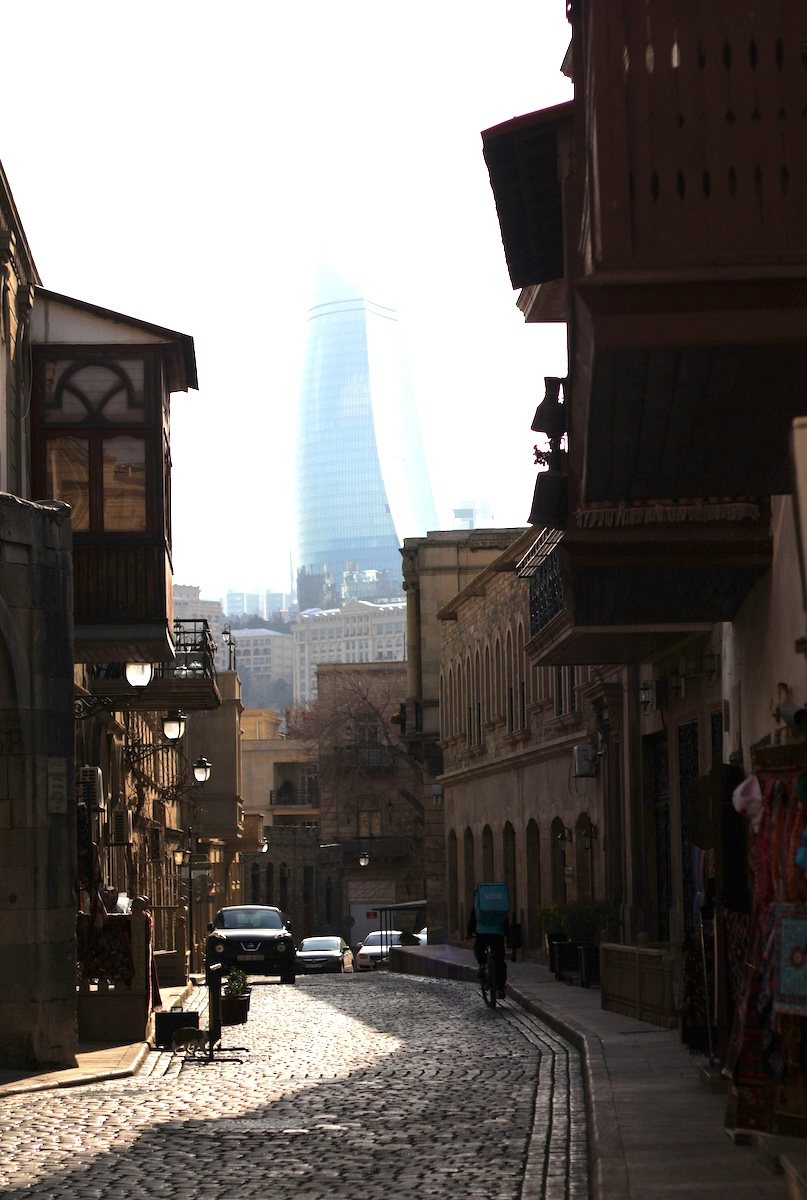
● The “Cultural Map of Karabakh” festival has opened in Baku’s historic Inner City, Icherisheher. The festival features an exhibition, concerts, presentations of national cuisine and master classes.
Photo by Daniel Silva
-
Monday, 1 June, Georgia. Khvicha Kvaratskhelia has been named UEFA Champions League Player of the Season
● Pro-Russian activist Gulbaat Rtskhiladze and well-known journalist Irakli Chikhladze, arrested on espionage charges, deny any wrongdoing. Their lawyers have described the developments as absurd and say the two cases are unrelated. More details here.
● Irakli Chikhladze’s daughter, Ana Chikhladze, has called the charges fabricated. According to his lawyer, the case materials contain no factual evidence of actions against Georgia’s interests, and the documents “do not even mention Georgia by name.”
● Gulbaat Rtskhiladze links his arrest to his public activities and the creation of the “Council for Monitoring Russophobia in Georgia.” His lawyer says it is possible that Rtskhiladze is accused of spying for Russia.
● The U.S. Embassy has released a statement by U.S. State Department representatives Charles Yockey and Peter Andreoli following their visit to Georgia and meeting with the Catholicos-Patriarch on May 27. The meeting was also attended by accompanying officials and U.S. Chargé d’Affaires in Georgia Alan Purcell. According to the statement, the discussion focused on compassion and mercy as Christian virtues and emphasized the Church’s historic mission to serve as a voice of reconciliation for the people. The delegation expressed hope that the Church would continue this mission of strengthening national unity with renewed spirit.
● Midfielder Khvicha Kvaratskhelia of Paris Saint-Germain and the Georgia national team has been named UEFA Champions League Player of the Season. On May 30, he won the Champions League with PSG for the second consecutive time. Over 16 matches in the tournament, Kvaratskhelia scored 10 goals and provided seven assists. The 25-year-old has played for PSG since 2025.
● New military and official ranks and awards have been announced. Interior Minister Sulkhan Tamazashvili has been awarded the highest special rank of Police Major General. Prosecutor General Giorgi Gvarakidze has been granted the highest special rank of State Counsellor of Justice. The head of the Border Police has received the highest special rank of Border Police Major General, while the director of the Tbilisi Police Department has been awarded the rank of Major General.
● Prime Minister Irakli Kobakhidze thanked police officers for their service and said the Interior Ministry had prevented several coup attempts in recent years.
● By decision of the organization “Together Against Duchenne Muscular Dystrophy,” patients dependent on artificial ventilation or suffering from severe accompanying genetic disorders will receive a one-time payment of 10,000 lari (about $3,000) by June 10.

-
Top stories in Azerbaijan, Armenia, and Georgia from 25-29 May, 2026