Former Georgian police officer alleges abuses, pressure and misconduct






Interview with a former police officer in Georgia
In the programme “Accents” on the MISMINE YouTube channel, former senior police officer and reserve lieutenant colonel Giorgi Iremashvili made serious allegations about Georgia’s law enforcement system.
He spoke about covert phone surveillance, monitoring of political and public figures, the gathering of compromising material, links between police and criminal groups, and cases where, he said, the state could have prevented crimes but failed to do so.
Iremashvili says phone surveillance in Georgia is not just an isolated illegal practice. In his view, it is one of the main tools of the law enforcement system — a mechanism for gathering information, exerting influence, recruitment and political control.
He says the system took different forms under different governments. But in his view, under Georgian Dream it became broader and less restrained.
Who is Giorgi Iremashvili?
Giorgi Iremashvili worked at Georgia’s Interior Ministry from 2002, rising from a rank-and-file officer to deputy head of a department.
Iremashvili says he served in nearly all major divisions of the ministry, including operational services, intelligence, anti-narcotics and organised crime units, criminal police, as well as the general inspectorate and emergency management structures.

Iremashvili says he knows the system from the inside. He draws on that experience to explain how phone surveillance works, the role of prosecutors, how information moves up the chain of command, and how details of private life can be used as leverage.
Iremashvili left the system in 2021 after far-right groups violently attacked LGBT activists during the “March of Dignity” on 5 July. He says the final straw was not only the violence against journalists, but also what he saw as the police’s inability or unwillingness to arrest those insulting officers in front of cameras.
Iremashvili is now based in a European country. The interview was conducted remotely.
Iremashvili on the break-up of the ‘March of Dignity‘
Iremashvili says law enforcement officers understood that the violence on 5 July 2021 did not erupt spontaneously. He argues persecution on that scale, and coordinated movement to specific addresses, could not have happened without prior organisation.
“What happened that day was clear to every police officer,” he says. “Everyone understood what had happened and who organised it. People of that kind, with that mindset, would not have gathered there by chance and begun targeting specific addresses.”
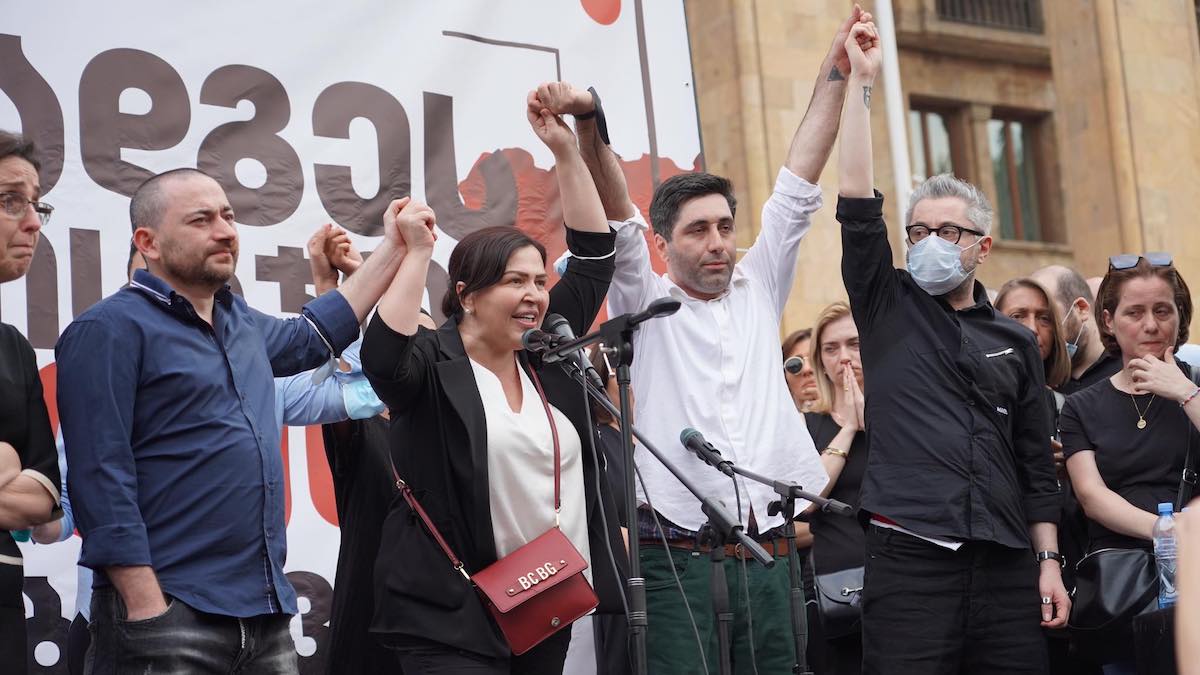
Iremashvili says that day convinced him the police no longer functioned as an institution bound by law in responding to violence.
In the programme, he recalls a moment when, he says, the city’s patrol police chief was struck from behind, but officers did not react.
“After seeing that footage, I realised the police were finished.”
Iremashvili on the Operational-Technical Agency
A large part of the programme focuses on the so-called Operational-Technical Agency, specifically the covert phone surveillance system.
Iremashvili says that under Eduard Shevardnadze, the Interior Ministry had limited resources and surveillance capabilities were basic. It mainly involved landlines, and in some cases required physical tapping of phone lines.
He says a more sophisticated system emerged after the Rose Revolution. During that period, surveillance formally required court approval. Police would apply through prosecutors, who would petition the court, and a judge could authorise surveillance for three months.
Even then, Iremashvili says, the system was flawed, because prosecutors and courts operated, in his view, within the same power structure and almost always approved police requests. But a formal legal framework still existed.
“Of course, this was not normal and it was not right. It was not justified, but a legal basis existed.”
Although Georgian Dream had promised to end phone tapping, Iremashvili says the opposite happened.
“After Georgian Dream came to power, a system that was formally legal, but unhealthy in practice, turned into a more dangerous, informal and uncontrolled mechanism.”
What changed after 2012
Much of the interview focuses on what happened after the change of government in 2012.
He recalls Georgian Dream came to power promising to end covert surveillance and illegal wiretapping. The destruction of old recordings was also carried out publicly.
But Iremashvili says the system was never dismantled. Instead, he says, it was split in two. One part remained formally legal. The other became informal, where tapping a number no longer required court approval.
“What did they actually do? They effectively created an alternative version of the Operational-Technical Agency.”
He says the old system remained in place, with surveillance activated by court order. Alongside it, a new practice emerged in which approval from a superior was enough.
“No orders were needed. You simply activated a number with your superior’s consent.”
Iremashvili says the practice was initially presented as a temporary measure. After Georgian Dream came to power, an amnesty freed many prisoners, including dangerous criminals. The authorities argued this could push up crime and police needed fast operational intelligence, which they obtained through phone surveillance.
But what was meant to be temporary became permanent, he says, and evolved into a tool of political, social and personal control.
“As you know, nothing is more permanent than the temporary. The practice became entrenched”.
What do the State Security Service and Interior Ministry monitor?
In the interview, Iremashvili draws a distinction between the roles of the Interior Ministry and the State Security Service of Georgia. He says the Interior Ministry mainly dealt with criminal cases, while the security service focused on political figures and monitored public figures, journalists, clergy, experts, school principals, university rectors and other influential groups.
The former police officer says political or otherwise sensitive information gathered by the Interior Ministry was then passed to the State Security Service. In the end, he says, information collected by different agencies fed into a single intelligence network.
Iremashvili describes the process as technically structured in a simple way: an operator listens to a call, notes important details by hand, then prepares a typed report on a computer, which is passed to senior officials. Those reports are then circulated according to instructions.
He says the end product was what were known as “SSG files”, containing records of conversations involving clergy, journalists, politicians and various public figures.
One number means more than one person
Iremashvili says tapping one phone number does not mean monitoring only one person. If the security services listen to one individual, they also hear everyone that person speaks to. That, he says, is how an entire network is built.
“You speak to around five or six people during the day. That means the services are also listening to everyone on the other end of those calls.”
He says one operator can effectively monitor about 20 numbers, though in practice the figure was often much higher. In some cases, he says, a single operator monitored as many as 100 numbers.
He also describes the psychological side of surveillance. According to Iremashvili, an operator can end up living someone else’s life for months. They know who that person talks to, where they go, what they buy, what messages they receive and which shops they visit.
“You are, in effect, living the lives of the people you monitor.”
Private information as leverage
One of the most sensitive parts of the interview concerns how personal information can be used as leverage. Iremashvili says the State Security Service of Georgia was particularly interested in details of people’s private lives, because they could be used for recruitment or pressure.
“A favourite focus since Soviet times, since the days of the KGB, has been details of private life.”
He says if intercepted conversations suggested someone had an intimate relationship, involvement in corruption or other information that could cause public damage, the surveillance could intensify. Cameras would be installed and compromising material collected.
Iremashvili says this did not always take the form of direct blackmail. Under Georgian Dream, he says, another model was often used. People were told compromising material existed, but it would not be made public if they cooperated. Rather than being threatened, they could be offered advancement — status, a high salary, a career or other privileges.
“Let’s cooperate, and in return I won’t publish compromising information. On the contrary, you could end up in an important position. If you are a journalist or an expert… I can offer significant advantages, and you can have a good life.”
Iremashvili describes this as a system of control based not on fear, but on transaction. He says it is more effective because a person feels not only like a victim, but also a beneficiary of the system.
When compromising material stops working
Iremashvili says there were cases where recruitment attempts failed. He points to the period of nightclub raids and the White Noise Movement campaign, when, he says, young people were offered cooperation in return for private material not being made public.
He recalls one young man being shown compromising material and responding with ridicule.
“He laughed and said: ‘I can put it online myself.’”
Iremashvili says this came as a shock to officers shaped by an older Soviet-era security mindset. For them, private life was a source of shame and a means of control. For a younger generation, he says, such things were no longer necessarily seen as compromising.
When compromising material stops working
Iremashvili says there were cases when attempts to recruit people did not work. He points to the period of nightclub raids and the White Noise Movement campaign, when, he says, young people were offered cooperation in exchange for keeping personal material out of the public eye.
He recalls one young man being shown compromising material and responding with mockery.
“He laughed and said: ‘I can put it online myself.’”
Iremashvili says that shocked officers shaped by an older Soviet-era security mindset. For them, private life was a source of shame and a means of control. For a younger generation, he says, such things were not necessarily compromising.
Those watched most are often ‘their own’
In the programme, Iremashvili says government supporters and people close to the system are often watched even more closely than opposition figures. He says this reflects fear that insiders could defect.
“They take it especially badly when one of their own goes over to the other side.”
He says that in the case of an opposition politician, surveillance may cover not only the politician, but also a driver, bodyguard, relatives and party colleagues. But, in his view, the greater priority is controlling people inside the system or close to it.
He recalls one case when, he says, about 30 people from his circle were involved in monitoring a journalist from the pro-government broadcaster Imedi. That meant listening not only to the journalist, but also to people close to him.
Iremashvili says this allows the system to learn even the smallest details of daily life — when a person wakes up, who they speak to, what they say at home, and how that information travels up through workplaces and official structures.
Where does the information go?
Iremashvili says important information was passed up through the State Security Service of Georgia. Some of it, he says, reached Anzor Chubinidze, who was seen as close to Bidzina Ivanishvili.
The former police officer says personal and political information ultimately reached the highest informal centre of power.
‘The human factor’
Iremashvili says surveillance reports should not always be treated as accurate. He describes how operators may alter, add or leave out details, or frame information in ways they believe superiors want to hear.
“Every day a boss says: ‘Have you got anything? I can’t believe he said nothing’… A tired employee may end up writing something untrue.”
According to Iremashvili, superiors rarely check whether conversations have been reported accurately. If the information is not considered important, no one usually goes back to the recording to verify what was actually said.
Hotels, hidden cameras and covert recording
Iremashvili describes in detail how meetings in hotels can be secretly recorded. He says if intercepted calls show two people of interest are due to meet at a hotel, the room can be prepared in advance.
“In every major hotel chain, security staff are always in contact.”
He says such arrangements are often coordinated with hotel security, whose staff are frequently former law enforcement officers or have ties to the system. Senior management may not know the details, he says, but security teams cooperate.
“Specialists need five minutes — two men walk in and install everything needed for surveillance.”
Surveillance abroad and the Alasania case
In the programme, host Eka Kvesitadze recalls the circulation in 2016 of videos showing the private lives of women politicians and journalists. Iremashvili says the campaign had a political purpose and was designed to discredit a specific political group.
The discussion also touched on the party of former defence minister Irakli Alasania. Iremashvili says that after 2012 the government wanted to keep track of all groups that were part of the coalition, or could later emerge as independent political centres.
“All these people, of course, from the very beginning — whether they came to power in 2012 or not — kept everyone under control.”
Iremashvili says opposition figures and other politically sensitive individuals were also monitored abroad. He says they were watched to see where they went, who they met and whether compromising material could be gathered.
“They are interested in what any opposition figure does in the evenings when travelling to Brussels or Strasbourg for work meetings.”
He says such surveillance may involve foreign intelligence contacts, people linked to embassies or other state channels.
Which platforms can be monitored?
One practical question raised in the programme concerns apps. Which channels are safest for communication — WhatsApp, Signal or others?
Iremashvili says the easiest communications to monitor are those that run directly through a mobile network — ordinary calls and text messages. Intercepting them, he says, does not require access to an additional app.
He says this goes beyond the content of calls. Text messages and automated notifications can reveal a person’s movements, behaviour and sometimes even financial activity. A bank alert or message from a shop, for example, may show where someone is, what transaction they made and when.
He says mobile tower data can also be used to establish a person’s location and who they may be with. If several people under watch appear within range of the same cell tower, that may suggest to the system that they have met.
As for encrypted apps such as WhatsApp and Signal, Iremashvili says their content is harder to intercept directly. He describes Signal as especially secure. But, he says, the issue is not the app itself — it is the device. If a phone, iPad or laptop has been compromised, the choice of app matters far less.
In that case, he says, the real target is the device. If special software has been installed on it, the system may be able to see what a user types, who they call, what they search for, what videos they watch and what appears on screen.
Iremashvili says it may take only a few minutes for a device to leave its owner’s sight. At an airport, border crossing or government office, someone may be asked to hand over a phone, iPad or laptop. During that time, he says, software could be installed to monitor activity.
He outlines several possible scenarios. In one, a traveller at an airport is told to leave baggage or a device temporarily. In another, someone entering a government building is asked to place a phone in secure storage because devices are not allowed inside. If such a process is arranged in advance and a technician is on site, he says, compromising a device can take only minutes.
For that reason, he argues, secure apps cannot protect someone if the device itself has been compromised. Signal may be a safer platform, but if a phone is already under surveillance, a message may be read before — or as — a user types it.
So, he says, the real question is not only what platform someone uses, but how secure their device is, and how much access the system may have to it, directly or remotely.
Pegasus and the Belarus experience
Iremashvili says the system has access to expensive spyware, including Pegasus. In his view, money is not spared on such tools.
“Those who think Pegasus is too expensive and no one would pay for it are deeply mistaken.”
Iremashvili also speaks of contacts with Belarus’s security system and says Georgian law enforcement has, over the years, drawn on Belarusian and Russian experience.
“They have borrowed methods from the Belarusian and Russian KGB. They spare no money on this kind of spyware.”
He says tools such as Pegasus are not used against everyone because they are expensive. But in his view, the system would not rule out using such resources against key figures.
The Niko Kvaratskhelia case — could the killing have been prevented?
The final major part of the programme focuses on the killing of Niko Kvaratskhelia. Host Eka Kvesitadze says her conversation with Iremashvili raised the question of whether Kvaratskhelia could have been saved if law enforcement had acted differently. She was referring to the fact that those suspected of ordering the killing were likely under surveillance and their communications may have been monitored.
In that context, Iremashvili recalled the case of the Kakulia brothers, well-known criminal figures. He says that years ago, when he worked in the Vake-Saburtalo district, law enforcement already had information about their injuries, their movements and the criminal networks around them.

He says one of the brothers arrived in Georgia on a Russian passport, carried out acts of violence and returned to Russia. Iremashvili says police had video footage, operational intelligence and grounds to take interest in them, but prosecutors did not consider the evidence sufficient for an arrest.

Iremashvili says prosecutors at the time demanded an unusually high standard of proof, which he says looks deeply suspicious and suggests criminals were being protected.
“They wanted far stricter standards than those used today to arrest protesters or others… otherwise the Kakulias would have been caught.”
He says that even if law enforcement was not allowed to arrest the Kakulia brothers, they could at least have been barred from entering the country, since they travelled on Russian passports.
The discussion raises a broader question: was it incompetence, negligence or something more serious? Iremashvili does not offer a definitive answer, but points to several factors — personnel changes, inexperienced new leadership, a loss of institutional memory and possible links between police and criminal groups.
He says when the old Vake-Saburtalo team was replaced, knowledge of the area’s criminal landscape disappeared with it. New managers needed time to understand that environment. But, he says, the system often ignores rank-and-file officers who actually know what is happening.
“There is a belief that when a new boss arrives, wisdom descends from heaven.”
In his view, that management culture is one of the main problems in law enforcement. A new official arrives convinced he already knows everything, ignores the experience of long-serving officers, and important information gets lost in the process.
At the same time, Iremashvili says that before Kvaratskhelia’s killing, people linked to the case — and who should have been under police scrutiny — were regularly meeting, moving around and gathering in the same places. In his view, all of that should have raised red flags.
The Kakulia brothers, Vake and criminal networks
Iremashvili describes events in Tbilisi’s Vake district in 2013 and 2014, when, he says, an amnesty was followed by a rise in shootings, injuries and street violence. He says law enforcement knew who was connected to whom, who was involved in violent conflicts and who was seeking influence.
He says a circle gradually formed around the Kakulia brothers that included the children of wealthy and influential families. Iremashvili also describes a pattern in which criminal groups befriend the children of rich families and then use access to their resources.
“They befriend the son of some wealthy businessman, pretending to be his ‘brother’… and then gradually buy cars, weapons and so on with his father’s money.”
Iremashvili says such groups were well known to law enforcement. In his view, the problem was not a lack of information, but a lack of response.
He names several figures from that circle, including the Kakulia brothers, Busa Zhvania, Roiniko Metreveli, grandson of Roin Metreveli, as well as the children of businessman Chkhaidze and Jincharadze.
Crime statistics and the system’s logic
Iremashvili also points to what he sees as another problem in law enforcement — the way crime statistics drive the system. He says that at the end of each month and year, agencies try to “adjust” the numbers. Cases left over from the previous reporting period often fall by the wayside.
“The month ends, those cases are forgotten, a new month begins, and with it new statistics.”
In his view, a functioning system should have dedicated units dealing with old unsolved cases. In Georgia, he says, an investigator may be assigned hundreds of cases.
“Each investigator is given 500 or 600 cases. How do you imagine that working?”
Interview with a former police officer in Georgia