Work-life balance for women in Armenia: how to create family-friendly working conditions






Family-friendly workplaces in Armenia
In Armenia, 48% of women participate in the labour market, compared with 71% of men. Experts attribute much of this gap to the disproportionate burden of family care responsibilities. Those responsibilities often push women aged 25 to 39 out of the workforce.
Women often receive little recognition for housework and for caring for children and adult family members, even though these tasks consume a significant share of their time. Women perform 67% of all unpaid work in Armenia. They spend more than 58 hours a week on such work.
Women also face the difficult choice between career and family far more often than men. Economists describe this phenomenon as the “motherhood penalty”.
- Equality day: 52% of Armenian women unemployed, never intended to work
- How victims of domestic abuse in Yerevan receive help, revealed through personal stories
- Will new quotas ensure better female representation in Armenia’s municipal governments?
An organisation that created family-friendly working conditions for women with children
“Our records manager, Ms Alvard, has a tradition. Whenever she hires a young woman, she says: ‘I will send you on maternity leave.’ She says it jokingly, but then she really does process the maternity leave paperwork. She keeps her word,” says Tatevik Yapunjyan, an employee at the National Centre for Educational Technologies.
Over the past year, female employees at the organisation have given birth to five children. Two young mothers chose to work remotely, while three others opted to take maternity leave, confident that their jobs would remain open for them.
“The birth of my daughter coincided with my appointment as Armenia’s coordinator for the pan-European eTwinning programme. On the one hand, I wanted to enjoy spending time with my child. On the other, I knew my responsibilities at home would increase. During that period, flexibility from management became especially important to me. After discussions with my employer, we agreed that I would work remotely. That allowed me to fully enjoy motherhood while staying connected to my work,” Tatevik says.
She argues that financial stability is equally important for women who decide to have children. Remote work, she says, helps address that challenge as well.
“In general, employers need to support their staff. That creates an atmosphere of mutual understanding. Both the employer and the employee benefit. Support can take many forms. It can mean respectful treatment, flexible working hours or the option to work remotely, with the focus on results rather than physical presence. In that environment, employees become more committed. During motherhood in particular, this kind of attitude from an employer provides not only professional support but also moral support,” Tatevik says.
Artak Poghosyan, director of the National Centre for Educational Technologies, argues that creating a family-friendly workplace is not only a matter of social responsibility but also a strategic decision:
“Human resources are one of our greatest assets. This approach helps us significantly reduce the loss of valuable staff. A family-friendly environment gives employees a sense of belonging and confidence that their employer respects their rights.
Some people have worked here for more than 20 years. Some women have taken maternity leave three times during their careers with us. It is very important for us that each of them knows we are waiting for her return and does not view maternity leave as lost time.
In some cases, employees return from maternity leave, complete additional training and move into more senior positions. We have always followed policies that respond to employees’ needs. Those policies proved their effectiveness during the COVID-19 pandemic. Traditional working models collapsed in many places, but we navigated that period without major difficulties,” Poghosyan says.
According to him, flexible working hours, hybrid working arrangements, additional paid leave and parental leave for fathers represent the minimum steps needed to create a family-friendly working environment. Armenian labour legislation also guarantees these measures.
Poghosyan says the National Centre for Educational Technologies encourages lifelong learning, self-education and professional development among its staff.
“Every employee knows that we support the development of their skills and abilities. Whenever opportunities for retraining or professional development arise, including abroad, we encourage and support participation. I believe this is a very important factor for young professionals when choosing where to work.”
In 2025, Armenia held its first selection of employers that create family-friendly working conditions. Organisers awarded successful employers a special certificate recognising their achievements in this area.
The National Centre for Educational Technologies became the only state institution to receive the certificate.

What does it mean to be a family-friendly employer?
An organisation qualifies as family-friendly when its policies and internal rules allow employees to balance work and family life without undue stress. For example, employees can maintain their jobs and income while caring for a family member who needs support.
Key features of a family-friendly workplace include:
- flexible working arrangements;
- paid leave and personal days;
- support for employees who need to care for a child or another family member;
- measures that promote wellbeing and career development.
Although family-friendly workplaces benefit everyone, they are particularly important for women. Employers need to take into account women’s reproductive role, as well as the fact that women carry out most household responsibilities.
In addition, women provide most of the care for children, people with disabilities and family members who require assistance.

Why does this approach benefit employers?
In recent years, researchers around the world have examined the impact of family-friendly workplaces. In 2019, for example, Deloitte conducted a global survey of:
- 13,000 millennials across 42 countries;
- 3,000 members of Generation Z across 10 countries.
Millennials, or Generation Y, are people born after 1981. They came of age around the turn of the millennium and are widely seen as a generation deeply connected to digital technologies.
Generation Z generally includes those born from the mid-1990s to the early 2010s. Researchers often describe them as the first truly digital generation, having grown up with smartphones and constant internet access. Anthropologists say their defining characteristics include a blurred line between online and offline life, a preference for short-form information and a strong focus on self-expression.
The survey found that:
- 19% of Generation Z respondents and 22% of millennials planned to change jobs in the coming years because of poor work-life balance and a lack of flexibility;
- 27% of Generation Z respondents and 28% of millennials planned to leave their jobs because they considered training and development opportunities inadequate;
- 33% of Generation Z respondents and 35% of millennials intended to resign because of limited career advancement opportunities.
Other studies have shown that paid parental leave can influence an employee’s choice of employer. According to the research, 76% of workers consider paid parental leave an important factor when evaluating job opportunities.
Women who take paid parental leave are also far more likely to return to work. One study found that women with access to paid leave were 93% more likely to return to their jobs within a year of giving birth than women who did not receive such support.
Family-friendly policies can also generate significant savings for employers. For example, when Google extended its paid maternity leave programme from 12 weeks to 18 weeks, the rate at which women left the company after maternity leave fell by 50%.
The company introduced the change at a time when replacing employees typically cost employers between 15% and 30% of a worker’s annual salary, depending on the position.

What is the state’s interest?
Research by the World Bank shows that more than half of working-age women in Armenia do not participate in the labour market. Childcare and family care responsibilities account for much of this gap.
On average, working women earn 25–30% less than men who perform the same jobs. At the same time, 68% of women have higher education qualifications. These figures come from Armenia’s Statistical Committee.
As a result of this inequality, Armenia loses an estimated 4–6% of its GDP.
Another study suggests that if women carried a smaller share of family care responsibilities and worked in their professional fields, the country’s GDP growth potential could increase by as much as 30%.
In recent years, state institutions appear to have recognised the importance of women’s untapped economic potential and have begun introducing more family-friendly policies. Authorities have pursued some of these changes through amendments to labour legislation.
In 2021, fathers gained the right to take leave following the birth of a child. For now, however, the measure provides only five days of paid leave.
The government also plans to introduce “parental hours” and more flexible working arrangements in the near future.
Under the proposed “parental hour” scheme, parents with children under the age of 12 would be able to use part of their working time to take their children to school or kindergarten and pick them up afterwards. Depending on the number of children, parents could spend between 30 minutes and one hour away from work. They would continue to receive their salary during that time.
In addition, employees and employers would be able to agree on flexible working hours through a written agreement. Under such arrangements, both sides could determine the start and end of the working day by mutual consent. The total number of working hours per week would remain unchanged.
Waiting for the law to pass
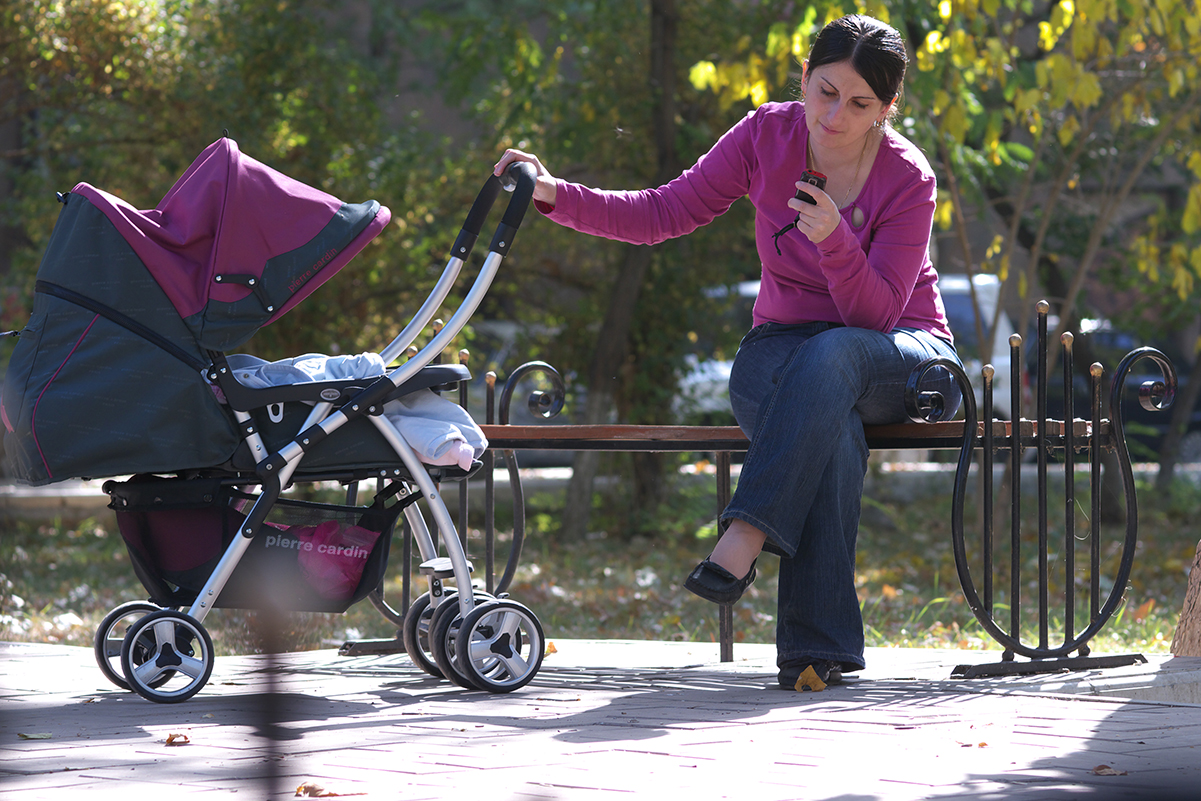
Tatevik’s daughter is now six months old. She will not return to work for some time, but she already worries about what comes next. She does not want to leave her child alone for long periods.
Tatevik hopes parliament will soon approve the proposed amendments to the Labour Code. If lawmakers pass the changes, hiring a nanny will no longer be the only option.
“If parliament approves these amendments, I am sure many women will be able to use their time more effectively by working according to schedules agreed with their employers. Believe me, no one manages time and budgets better than women with young children.
If these changes take effect, balancing family life and work will become easier. Of course, they represent only a small step when you consider overcrowded kindergartens and the shortage of nursery places. But I hope people will discuss those issues as well. Otherwise, many women will continue to face a choice between family and personal development,” she says.

Family-friendly workplaces in Armenia