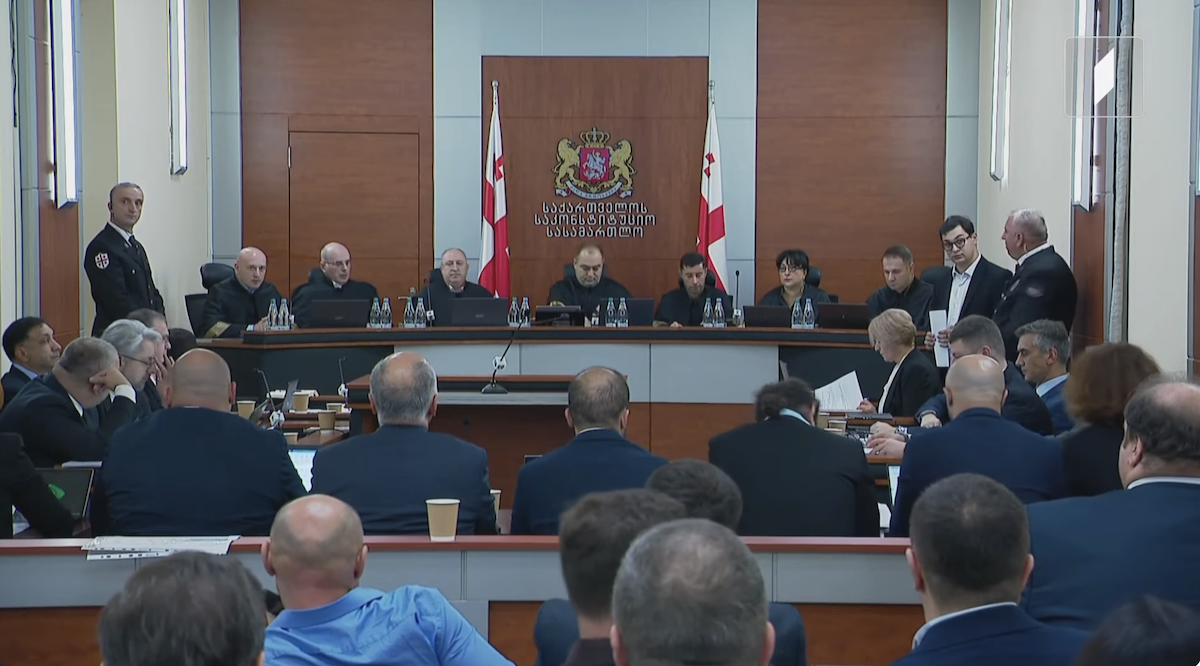
New NDAA bill calls for US assessment of Russian and Chinese intelligence networks in Georgia






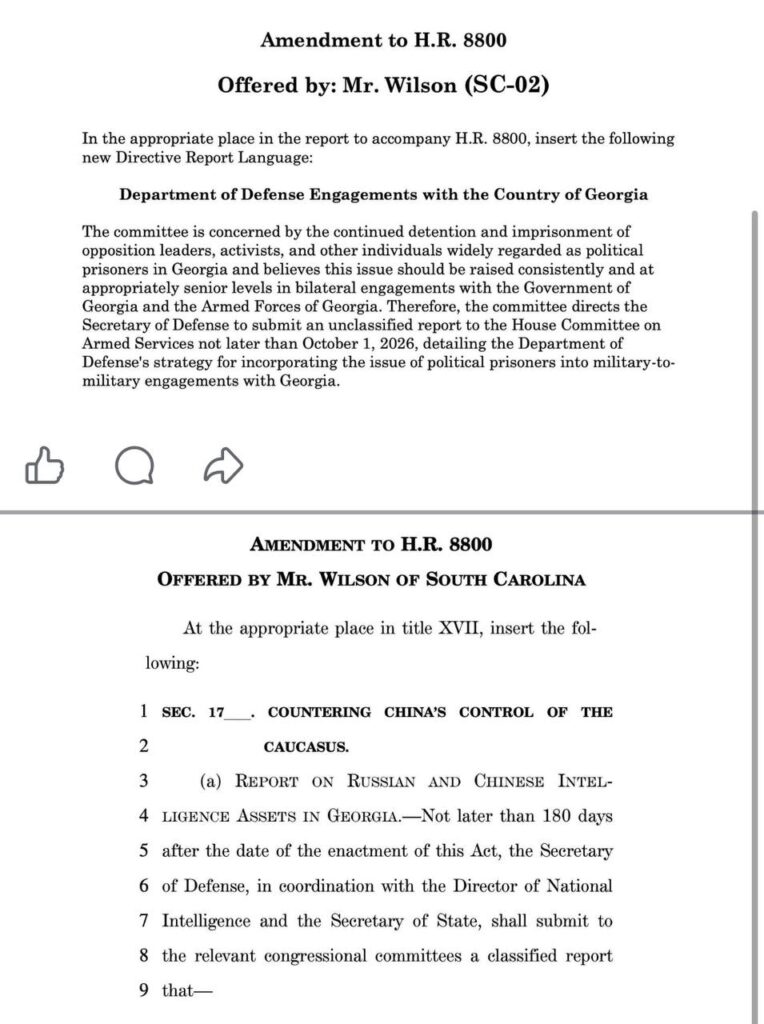
The new draft of the National Defense Authorization Act (NDAA), introduced in the US House of Representatives, calls for the United States to produce a classified assessment of Russian and Chinese intelligence networks operating in Georgia.
The bill’s authors also point to the arrests of opposition leaders, activists and other individuals in Georgia. They argue that human rights concerns are becoming an increasingly important part of the US security cooperation agenda.
The bill would also require the Pentagon to prepare a report on how the United States should raise the issue of political prisoners in Georgia during military and defence contacts.
The legislation would instruct the State Department to develop a five-year strategy assessing the future of US-Georgia relations, the scope of potential US assistance and Georgia’s commitment to closer economic integration with the West.
According to analysts, the bill reflects growing interest in Congress both in Georgia’s political trajectory and in China’s expanding influence in the Caucasus.
Comment
According to international relations expert Eka Akobia, the temporary delay surrounding the MEGOBARI Act has prompted US lawmakers to pursue an alternative legislative route by incorporating some security-related assessments into the annual National Defense Authorization Act (NDAA).
Akobia argues that, amid a temporary pause in efforts to advance high-profile independent sanctions mechanisms against the ruling Georgian Dream party, Congress has shifted towards a framework that embeds assessments of Georgia’s security environment and political situation directly into the NDAA.
According to her, lawmakers view this approach as a more stable process and one that is less vulnerable to political obstruction.

International relations expert Eka Akobia argues that recent developments suggest US lawmakers have shifted part of the agenda previously associated with the MEGOBARI Act into the National Defense Authorization Act (NDAA).
“This development has several implications.
First, it requires the Director of National Intelligence and the Pentagon to assess how deeply Russian and Chinese intelligence networks have penetrated Georgia’s defence and security institutions. The original NDAA amendment for 2026 used stronger language. The current version is somewhat softer, which increases its chances of final adoption.
The independent bill stalled in the Senate because of opposition from two senators and corporate lobbyists. By inserting this provision into the NDAA, lawmakers are effectively forcing the White House and the Pentagon to maintain active oversight of developments in Georgia without the risk of an individual Senate blockade.
The amendment also introduces a degree of conditionality into future US military assistance to Georgia by linking security cooperation to human rights concerns. Until now, Washington’s response to democratic backsliding in Georgia largely consisted of statements from the State Department. Through the NDAA mechanism, Congress is now signalling that future military cooperation, joint exercises and US defence assistance will become legally linked to how Tbilisi treats political prisoners and to its relations with America’s principal geopolitical rivals.
The markup stage represents final approval by the House Armed Services Committee, of which Congressman Joe Wilson is an influential member. At committee level, the text has already been approved and is no longer subject to amendment, removal or replacement.
The directive requires the State Department to submit a public report and strategy outlining the conditions that will govern future bilateral military cooperation. As the text explicitly states, the issue of political prisoners will form part of those conditions. The committee has requested the strategy by 1 October 2026, the first day of the 2027 fiscal year. This means that, once NDAA 2027 is approved, the Department of Defense and the State Department will begin gathering information and conducting assessments well before October 2026. That process will form the basis of the future Georgia strategy.
These developments demonstrate how short-sighted and inappropriate it was for Georgian Dream to mock Joe Wilson.
They also confirm what I have repeatedly said in television interviews: once a process of this scale begins in relation to Georgia, such as the MEGOBARI Act, the process itself means that the country has attracted attention — and not in a positive way. It cannot overcome that reality without self-reflection, self-criticism and a departure from confrontational policies.
Although Georgian Dream portrayed the blockage of the MEGOBARI Act in the Senate as a success, that move triggered a response and led lawmakers, under Wilson’s leadership, to initiate mechanisms that could prove even more consequential.
The bill still faces a long path before becoming law. Lobbying efforts and business interests could produce the same outcome as last year’s NDAA. However, the risks are lower because the provision is narrower in scope. It does not demand immediate action. It only requires information gathering and an intelligence assessment.
Given the current geopolitical environment, it is clear that the United States remains interested in cooperating with Georgia in certain areas, particularly defence. At the same time, that cooperation should not overshadow concerns about human rights violations and governance failures in the country. In this sense, Joe Wilson’s latest initiative serves as a lifeline for those whose rights have been violated, especially political prisoners who have spent nearly two years in detention without obtaining justice.
The bill must still pass the House of Representatives, go through the Senate version and then enter the conference process, where lawmakers reconcile the two texts. The language could change at that stage. However, a powerful political signal has already been sent. Any rational observer should recognise that.”

Background
On 6 May 2025, the US House of Representatives passed the MEGOBARI Act, a bill that would require the US president to impose sanctions on individuals deemed responsible for undermining Georgia’s security and stability. The measures include visa restrictions and asset freezes.
On 6 September, The Hill reported that Senator Markwayne Mullin had persuaded Senate Majority Leader John Thune to remove the MEGOBARI Act from the National Defense Authorization Act (NDAA) package. Earlier in the year, Mullin had also blocked an effort to fast-track the bill through the Senate.
Mullin is no longer serving in the Senate. President Donald Trump has nominated him to serve as Secretary of Homeland Security.
What the new NDAA bill says about Georgia