'Take off your hijab and come into class': what is happening in Azerbaijan’s schools?


The hijab ban in Azerbaijan’s schools
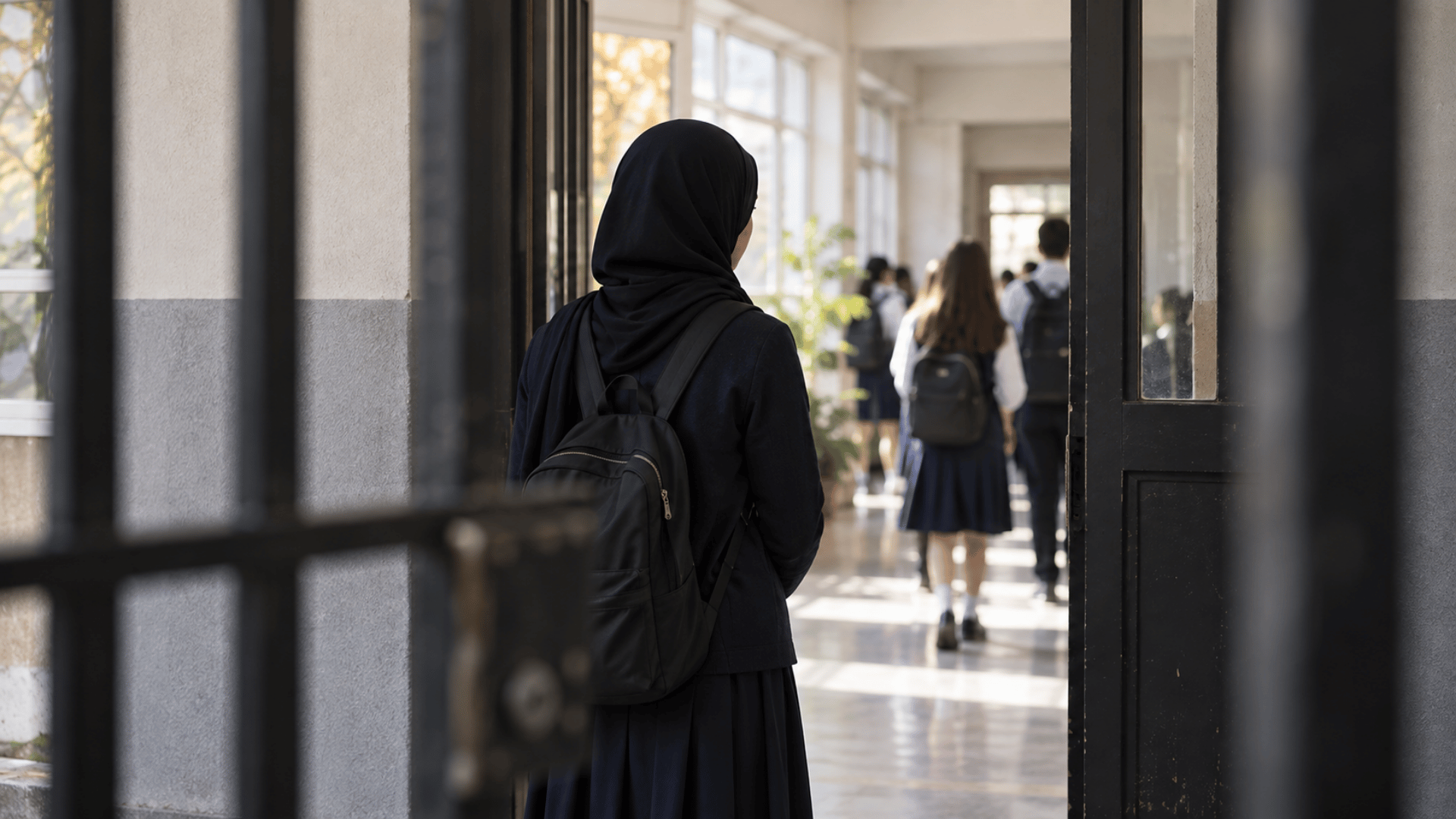
In Azerbaijan’s schools, a ban on wearing the hijab has led to female students being barred from classes, demands for female teachers to remove their headscarves and protests.
On 12 October, the Interior Ministry announced the arrest of 37 people in connection with incidents over compliance with school uniform rules.
The authorities justify the restrictions by citing the need for a uniform school dress code and secular education. However, the consequences for students barred from classes are tangible: they must give up religious clothing to attend lessons.
At the heart of the dispute is the question of how the state exercises its authority to set school dress code requirements and how these restrictions undermine children’s right to education.
Schoolchildren show solidarity with classmates who wear hijabs
Videos shared today from several settlements in Baku show schoolchildren gathering at school entrances. Some of the girls are wearing hijabs. Students at School No. 322 are protesting the ban on wearing hijabs and demanding that the girls be allowed to attend classes.
A video published on 9 October and filmed outside School No. 69 in Baku shows schoolchildren refusing to go to lessons in solidarity with their classmates who wear hijabs.
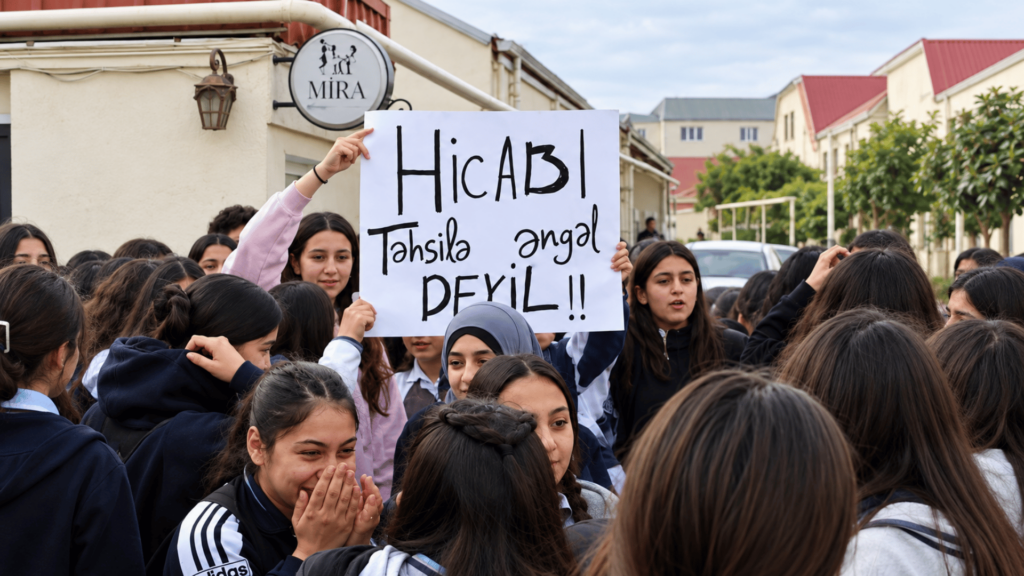
Protest outside School No. 69 in Baku’s Balakhany settlement: “The hijab does not prevent anyone from getting an education.”
Schoolchildren have also staged protests at a school in the village of Mollaoba, in the Masally district.
A video shared from School No. 9 in the Jalilabad district shows girls being barred from entering the building because they wear hijabs. In another video, published in the Baku settlement of Khokhmeli, parents warn that they will stop sending their sons to school as well.
Protesters are expressing their discontent in various ways: gathering outside schools, refusing to attend classes and calling for boycotts. But they all have the same demand: girls who wear hijabs must not be denied access to education.
While families face demands to change their religious practices, children bear the brunt of this confrontation.
From school uniform requirements to a ban
Cabinet of Ministers Resolution No. 309, adopted on 21 September, prohibits additional items of clothing that violate uniform school dress code requirements and contradict the principle of secular education.
Although the document does not explicitly mention the hijab, complaints from schools indicate that, in practice, the provision applies specifically to headscarves.
Barring female students who wear hijabs from classes effectively amounts to a ban on wearing this head covering.
When authorities present such measures solely as a way to enforce school uniform rules, the issue of restricting children’s access to education takes a back seat.
The amendments introduced by the resolution do not, however, explicitly provide for suspension from classes as a separate measure. This raises the question of what legal grounds school administrations rely on when adopting this practice.
On 9 October, the Baku City Education Department announced inspections to check whether students and teachers comply with clothing requirements. This suggests that the problem extends beyond decisions made by individual school administrations.
The question remains open as to who should ultimately ensure that children have access to education, and how.
Criminal proceedings launched against protesters
In a statement issued on 12 October, Azerbaijan’s Interior Ministry directly linked the detention of 37 people to events surrounding the introduction of uniform school dress code requirements.
Authorities have opened a criminal case under Article 233 of the Criminal Code, which provides for liability for organising actions that disrupt public order or actively participating in them.
The ministry accuses the detainees of provoking confrontations with education workers in Baku, damaging educational institutions and attempting to obstruct school operations and traffic.
However, the statement does not specify which schools sustained damage or what specific actions the detainees allegedly committed. It also does not disclose their names or ages.
The lack of this information raises serious questions, particularly against the backdrop of protests involving schoolchildren.
Are any of the detainees minors? On what grounds do law enforcement agencies distinguish between peaceful protest and the specific actions they accuse the detainees of committing?
The ministry says the measures are necessary to ensure the safety of students and teachers. However, opening a criminal case amid protests over the right to education could deter other families from taking part in similar demonstrations.
Parents demanding that schools allow their children to attend classes must now also consider the risks associated with participating in protests.
Aliyev’s remarks and the Iranian factor
On 2 October, speaking at the 8th congress of the New Azerbaijan Party, Ilham Aliyev placed particular emphasis on the role of education in safeguarding ideological security:
“Therefore, we must protect ourselves from ideological provocations. How? First and foremost, of course, through education.”
The president also criticised Azerbaijani-language media outlets operating in neighbouring countries. Although he did not explicitly mention Iran or the hijab in this part of his speech, some political commentators interpret his remarks as a signal directed against Iran’s religious influence in Azerbaijan.
Asif Narimanli, a political commentator close to the authorities, links the events surrounding the hijab ban to attempts by Iran at “political and ideological interference”. In this context, he refers to a religious gathering in Qom and a protest in Istanbul. Aygun Muradkhanli, a journalist at a pro-government media outlet, has also argued that religious groups opposing the ban have links to centres abroad.
This interpretation risks pushing demands to allow female students who wear hijabs to attend classes into the background, as debate over foreign influence takes centre stage.
Parents’ rights and the state’s obligations
Article 18 of the International Covenant on Civil and Political Rights enshrines parents’ right to ensure the religious and moral education of their children in accordance with their own beliefs.
Experts point out that articles 5 and 14 of the Convention on the Rights of the Child also recognise the role of parents in raising their children and guiding their development.
The secular nature of education does not negate a family’s right to provide religious education for its children. Many in society believe that the authorities enforcing these restrictions should explain exactly how wearing a headscarf disrupts the learning process.
Teachers risk losing their jobs
Following the approval on 6 October of separate dress code requirements for teachers, reports emerged of pressure on teachers who wear hijabs. Teachers told Toplum TV that some schools in Sumgayit were demanding that they remove their hijabs or submit letters of resignation.
Journalist Arzu Abdulla reported a similar situation at School No. 90 in the Ramana settlement.
Requiring them to submit letters of resignation can create the impression that they are ending their employment voluntarily.
Some educators point out that teachers’ dress ultimately seems to matter more than their professionalism and experience.
Public opinion on the ban is divided.
Press Council chairman Rashad Majid defends the restrictions as necessary to protect the secular nature of the state and says he sees foreign influence behind the protests.
Jailed journalist Polad Aslanov, by contrast, announced a hunger strike to protest restrictions imposed on female students and teachers who wear hijabs.
Comments on a HamamTimes post about protests at a school in the Buzovna settlement also include claims that the protesters have links to Iran.
Other discussions express a view: some participants oppose children wearing hijabs but nevertheless believe that barring schoolchildren from classes for this reason is unacceptable.
Turkey’s reaction
On 3 October, protesters gathered outside Azerbaijan’s consulate in Istanbul in a demonstration. They demanded that the restrictions be lifted and called on the Turkish authorities to intervene.
However, on 7 October, Omer Celik, spokesperson for Turkey’s ruling Justice and Development Party (AKP), said that groups opposing Azerbaijan had no ties to either the party or the government.
Previous attempts to ban the hijab in schools
The current developments come against the backdrop of earlier protests against attempts to introduce similar restrictions, although those efforts were not backed by specific legislation at the time.
Protests against the hijab ban in Azerbaijan have previously led to arrests and criminal proceedings. On 6 May 2011, police intervened during a demonstration outside the Education Ministry, followed by arrests and the opening of a criminal case.
Abgul Suleymanov, known for taking part in protests against the hijab ban, was arrested that year and later sentenced to 11 years in prison on charges he denied.
In September this year, authorities placed him under administrative arrest for another 30 days. His family links the arrest to his posts about the hijab.
It is currently unknown how many girls across the country are missing school because of the new dress code restrictions, and how many teachers are at risk of losing their jobs.
The hijab ban in Azerbaijan’s schools