Moscow posters: Are radical nationalists acting independently of Kremlin in Azerbaijan row?






Protest at Azerbaijani embassy in Russia
On 27 August, at a time when independent political protests have become rare in Russia, a group of radical nationalists staged a protest outside Azerbaijan‘s diplomatic mission in Moscow. Participants put up three posters, filmed the action and posted the video on the group’s Telegram channel, which has tens of thousands of subscribers.
Although the protest was small, it raises a question: can radical nationalists in Russia, where public expressions of opposition are tightly restricted, intervene in relations between Baku and Moscow without the Kremlin’s knowledge?
There is no clear answer so far. The issue is not whether the Kremlin learned about the protest after the event, but what boundaries the authorities set for the activities of such groups.
There is no evidence that the protest was organised at the request of the Russian authorities. However, the fact that the same group has now targeted Azerbaijan for a second time, coupled with the authorities’ differing treatment of public expressions of political views, raises questions about whether such groups may receive preferential treatment.
What accusations appeared on the three posters?
According to Azerbaijan’s Foreign Ministry, the posters were placed not outside the main embassy building but in front of its guest house. The protest was covered by the Telegram channel Direct Action Z, which describes itself as an information resource of Eduard Limonov’s Other Russia party.
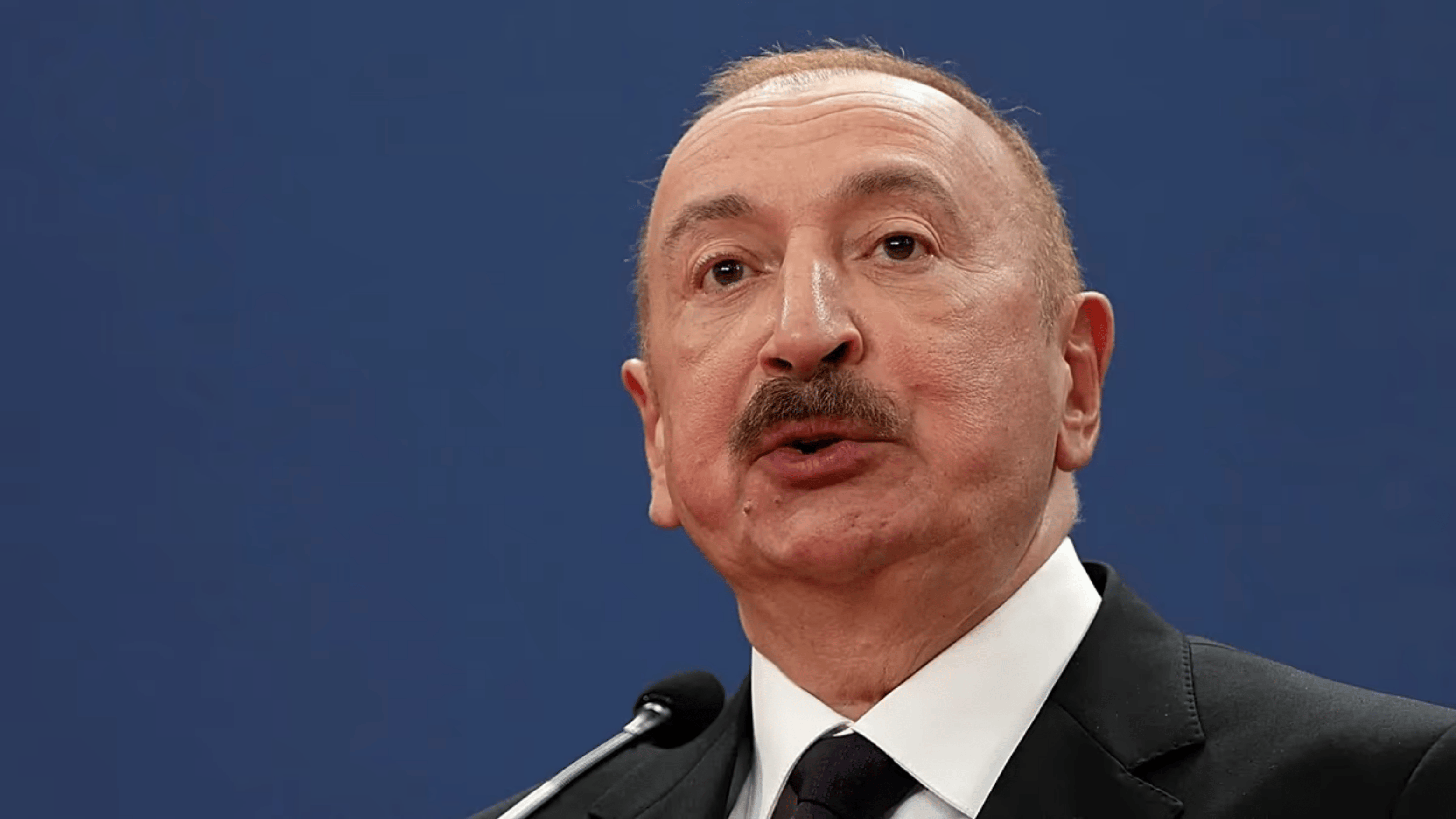
The posters accused Azerbaijan’s State Security Service of torture and President Ilham Aliyev of covering it up. They also carried the slogans “Russian blood is on your hands” and “Hands off Russian citizens”.
In a statement, the organisers portrayed the detention of eight Russian nationals in Azerbaijan, criminal proceedings against Ivan Knyazev, Semyon Uralov and Alexei Chadayev, Baku’s position on Ukraine and the deaths of Russian peacekeepers in Karabakh in 2023 as manifestations of a single “anti-Russian policy”. They also accused the Azerbaijani diaspora of running “shadow businesses”.
Azerbaijan’s Foreign Ministry described the incident as an “unacceptable provocation” and said it could be a continuation of what it alleges is a campaign against Azerbaijan by a number of Russian media outlets. Baku called on Moscow to investigate the incident and ensure the security of its diplomatic mission.
Azərbaycan Respublikasının Rusiya Federasiyasındakı Səfirliyinin qonaq evi qarşısında təxribatla bağlı açıqlama
— MFA Azerbaijan 🇦🇿 (@AzerbaijanMFA) August 27, 2026
⬇️⬇️⬇️https://t.co/YPLnFLJ4Mx
Statement on the provocation in front of the Guest House of the Embassy of the Republic of Azerbaijan in the Russian Federation… pic.twitter.com/D9TwDicyqr
Same group staged protest exactly one year ago
One detail that makes it difficult to dismiss the incident as a random street protest is the date. On 27 August 2025, three members of the same movement staged a protest outside the Azerbaijani consulate in St Petersburg. They were detained by police.
The accusations made at the time differed from those voiced now. The protesters opposed Baku’s alliance with Ankara, its support for Ukraine and Azerbaijan’s competition with Russia on the energy market. In the following months, individual pickets were also held outside the consulate under the slogan “Russophobia is a disease”.
The fact that the second protest took place exactly a year later gives the impression that it may be a continuation of the earlier campaign. However, the organisers did not say whether the date had been chosen deliberately.
Close to Kremlin or opposed to it?
The Other Russia of E. V. Limonov is an unregistered political organisation founded by former members of the National Bolshevik Party, which a Russian court designated as extremist and banned in 2007. Its ideology combines Russian nationalism, “Soviet nostalgia” and imperialist ideas.
Its members support Russia’s war against Ukraine, and some have fought on the Russian side. The movement’s Interbrigades unit has operated in Donbas since 2014. In this respect, the group’s foreign policy rhetoric does not contradict the Kremlin’s broader line.
However, this does not mean the organisation is directly controlled by the Kremlin. National Bolshevik activists have also protested against the Central Bank, Roskomnadzor and other state bodies. In October 2025, four members of the movement were detained during a protest outside the Central Bank. In February 2026, activists from the organisation placed a lock on the door of Roskomnadzor’s Moscow office before leaving the scene.
On 18 August, the Russian Foreign Ministry said that statements by Knyazev, Uralov and Chadayev did not reflect Moscow’s position towards Azerbaijan. In their latest statement on Azerbaijan, the National Bolsheviks, in turn, accused the Foreign Ministry of failing to defend the three men. The group claimed that the state was putting the interests of “foreign entities” above those of Russian citizens.
In other words, the protest was directed not only against Baku but also against Moscow’s own policy, which the organisers regard as “not tough enough”.
Question of preferential treatment
National Bolshevik activists themselves are also periodically detained and given administrative jail terms. It would therefore be an oversimplification to portray them as an untouchable group carrying out the Kremlin’s orders.
On the other hand, it is clear that political protests in Russia are not treated equally. According to the latest available data from OVD-Info, more than 20,000 detentions for expressing anti-war views were recorded between February 2022 and July 2025. At the same time, groups that support the war in Ukraine but call on the authorities to take a tougher line have been able to hold public events, raise donations and operate actively on social media.
The Counter Extremism Project, which researches extremist movements, describes the relationship between the Kremlin and the National Bolsheviks as an “uneasy alliance”: the group criticises the authorities and its members are periodically detained, but its activities in Ukraine and pro-war campaigning are generally treated with considerably greater tolerance.
This pattern does not prove that the protest outside Azerbaijan’s diplomatic mission was organised at the state’s behest. However, it once again raises the question of which protests the authorities immediately suppress and which they allow to proceed without intervention.
Defending rights or exerting ethnic pressure?
The situation of the Russian nationals detained in Azerbaijan continues to raise questions that remain unanswered. In footage released after their detention, some appeared to have visible signs of violence on their faces. There have also been reports that the psychological condition of convicted Russian national Dmitry Fedorov has deteriorated and that he has stopped recognising his relatives.
However, the National Bolsheviks’ statement goes beyond defending the rights of individual detainees. It combines human rights concerns with rhetoric about “Russian blood”, criticism of Azerbaijan’s support for Ukraine and accusations directed at the Azerbaijani diaspora as a whole.