Kremlin propaganda is knocking on Central Asia’s doors: the role of Ilan Shor in Kyrgyzstan






Based on material from Ziarul de Gardă
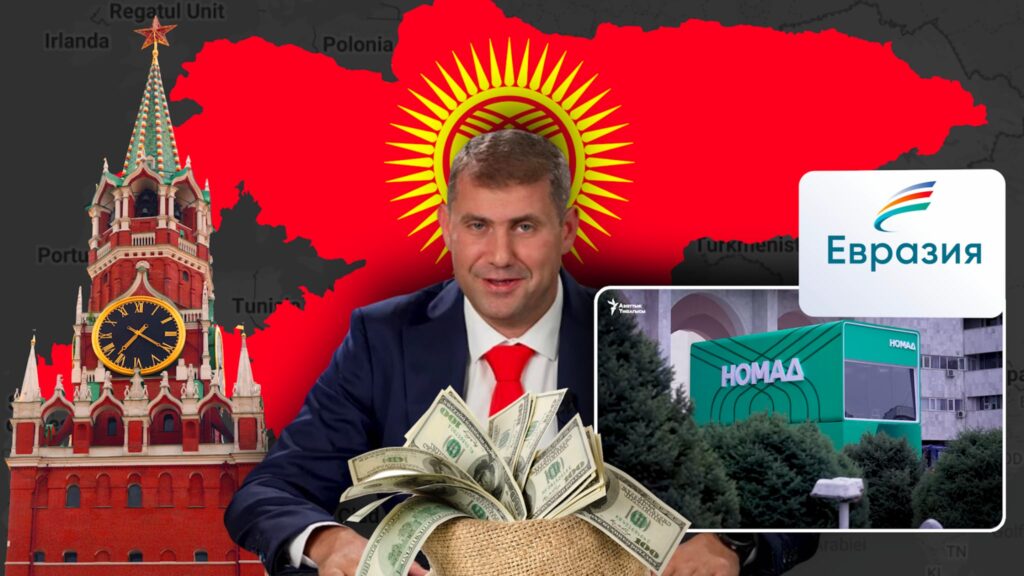
While the world’s attention is focused on the war in Ukraine, Central Asia is becoming one of the most favorable regions for the spread of Kremlin propaganda. In this murky media environment, an unexpected name is appearing more and more often—Ilan Shor, a fugitive oligarch from Moldova, convicted in the “billion-dollar theft” case and who first fled to Israel and then to Russia. He is increasingly becoming involved in questionable media projects not only in our country but also in other Commonwealth of Independent States countries.
Recently, the portal Meduza reported on the launch of a new TV channel in Kyrgyzstan called Nomad, which is linked to the propaganda channel RT (Russia Today), funded by the Kremlin, as well as to an organization controlled by fugitive oligarch Ilan Shor. According to Radio Azattyk, recruitment for the new channel was coordinated by editors who previously worked at the Kyrgyz branch of the Russian agency Sputnik.
The producer of the new channel is Anna Abakumova, a Russian citizen who previously worked in the RT media holding. Journalists at Nomad are trained at the “Eurasia” center—yes, the same center that organized trips and camps in Russia for Moldovan children, where they were exposed to pro-Kremlin narratives.
However, none of this would be possible without coordination with forces inside the country. Thus, in August 2025, the president of Kyrgyzstan, Sadyr Japarov, signed a controversial law requiring all media outlets to undergo official registration and limiting foreign ownership in them to a maximum of 35%. Critics warn that these rules could be used to restrict public debate and suppress critical voices.
Meanwhile, an active crackdown on independent journalists and media has begun through various methods. One example is Temirov Live, a YouTube channel created by investigative journalist Bolot Temirov. He exposed corruption among high-ranking officials but paid a high price for it: he was deported, and many of his colleagues were arrested.
In turn, Kloop, one of the largest investigative centers in Central Asia, is facing criminal cases, bans, threats, and attempts at discreditation. Journalists are under surveillance, they are being persecuted, and the website has become the target of numerous lawsuits and has been labeled “extremist.” This model closely resembles the Russian one, where independent media are accused of “extremism,” “defaming the state,” or are designated as “foreign agents.”
Radio Azattyk—the Kyrgyz branch of Radio Free Europe/Radio Liberty—has also become the target of lawsuits, bank account freezes, and restrictions under the pretext of spreading “fake news” and “destabilizing propaganda.”
All these pressures are not accidental—they allow alternative propaganda to spread without obstacles.
As surprising as it may sound, a key role in the spread of propaganda in Central Asia is played by a fugitive responsible for the largest banking fraud in the history of Moldova—Ilan Shor. But why does Moscow need Shor?
First, he has significant financial resources that are difficult to trace. In addition, the system created by Shor—a media and digital machine with TV channels, websites, and thousands of fake accounts—has long been operating in Moldova. Now this same model is being applied in Armenia, where political projects and media structures aligned with Moscow’s narratives are being supported. Moreover, Shor has already demonstrated his loyalty to the Kremlin: his parties and campaigns, funded from Russian sources, have consistently promoted anti-Western and pro-Russian rhetoric.
Today, Ilan Shor has become an active element in digital influence networks aligned with the Kremlin’s interests. The WatchDog.md community analyzed Facebook pages controlled by Shor and identified at least 146 active anonymous pages, along with hundreds more in reserve. WatchDog considers them part of a network of more than 2,167 pages, allegedly created by the Kremlin to influence political processes in Moldova and other European countries.
“These figures are only the tip of the iceberg,” WatchDog.md stated.
In addition, analysis by DFRLab showed that an advertising campaign funded by Ilan Shor on Meta (Facebook and Instagram) spread anti-EU messages and pro-Russian narratives aimed at undermining Moldova’s European integration.
In this context, a report by the Institute for Strategic Studies emphasized that Shor’s network cooperates with Russian subversive structures, using payments through Russian systems—Promsvyazbank (including “Mir” cards), transnational financing channels, or pilgrimages of clergy to Russia.
But Shor’s network is not limited to Facebook alone. An investigation by the BBC identified more than 90 TikTok accounts linked to pro-Kremlin campaigns. In turn, journalists from ZdG infiltrated networks organized by the former “Shor Party” and showed how citizens are recruited to participate in Russia-funded protests.
Another common element across all three countries—Moldova, Armenia, and Kyrgyzstan—is the organization “Eurasia,” which has been accused of involvement in election manipulation campaigns and pro-Kremlin geopolitical propaganda. Earlier, ZdG investigated how dozens of children from Moldova, through the “Eurasia” organization, ended up on holidays in a “re-education” camp for Ukrainian children.
Regarding the links between the organization “Eurasia” and Armenia, Radio Free Europe/Radio Liberty also reported that Armenian blogger close to Ilan Shor, Mika Badalyan, took part in an event organized by the “Eurasia” organization and in the creation of a pro-Eurasian network. Recently, Intelligence Online wrote that the NGO “Eurasia,” funded by Shor, is expanding its network in Armenia as well.
In addition, there is further evidence of links between Kyrgyz officials and both Moscow and Ilan Shor. According to The Insider, one of Kyrgyzstan’s central banks, Capital Bank of Central Asia, was accused of involvement in sanctions-evasion schemes connected to structures financed by Shor. This concerns not only propaganda but also a cross-border financial and information network.
Thus, Kyrgyzstan today represents a mirror of how the Kremlin exports its model of information control—quietly spreading through transnational networks and combining political interests, opaque financial resources, local cooperation, and a flexible media apparatus.