Georgian opposition figure investigated for 'treason' over comments on Abkhazia war






Giorgi Baramidze case
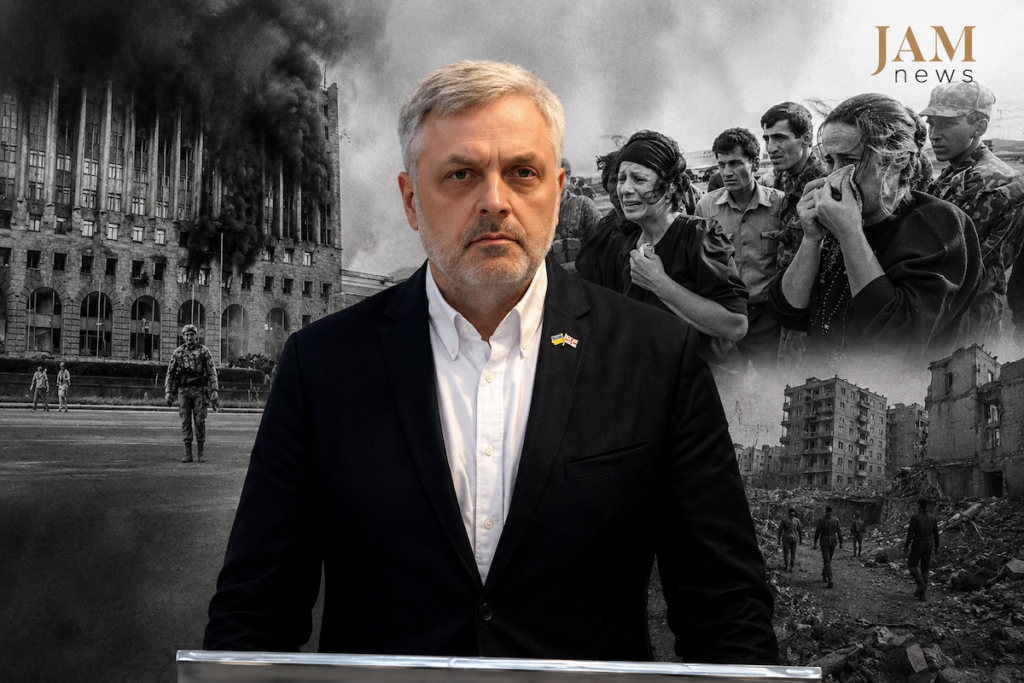
Georgia‘s Prosecutor’s Office has opened an investigation into comments by Giorgi Baramidze, one of the leaders of the United National Movement, about the war in Abkhazia. The case concerns charges of treason and actions that threaten state interests. The investigation focuses on his account of how prisoners of war were treated during the early stages of the conflict. Baramidze made the comments on a podcast, triggering a political backlash. The de facto authorities in Abkhazia have also reacted to his remarks.
What did Baramidze say?
Giorgi Baramidze, one of the leaders of the United National Movement, discussed the war in Abkhazia on Yago Khvichia’s “Birth of Georgia” programme.
Speaking about the exchange of prisoners, he said:
“We did not take prisoners, we had no prisoners, we executed them.”
The remark prompted a strong reaction from government officials. Baramidze later clarified several times what he meant.
He said he was referring to the early stages of the war, when the Georgian side did not yet have a regular and organised army. Baramidze later explained that people enraged by the deaths of their relatives in the fighting did not take enemy fighters prisoner.
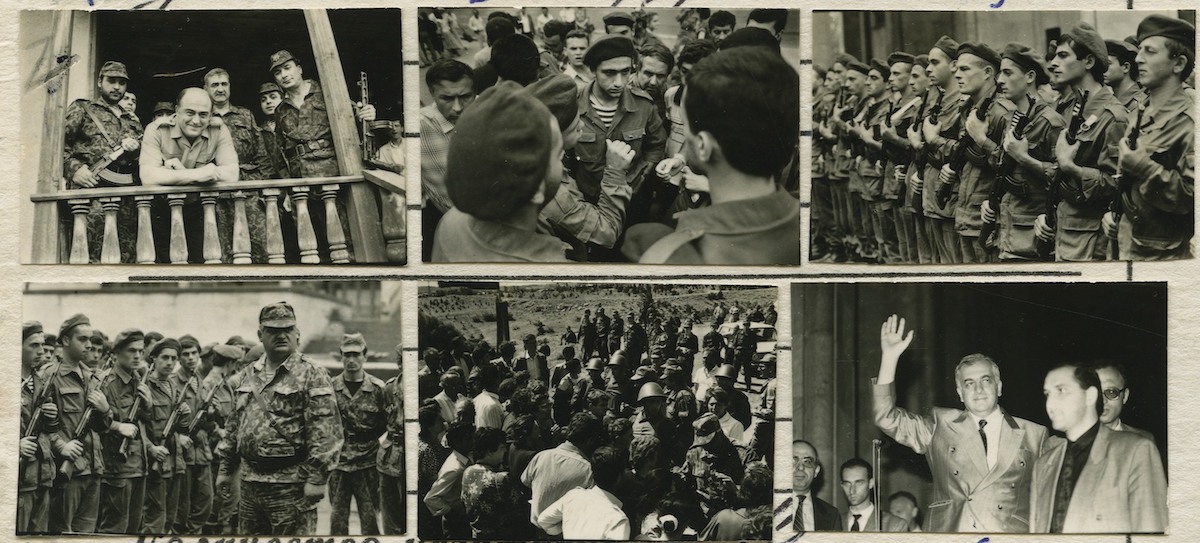
“At first, the situation was as follows: people who were enraged after their mothers, fathers and relatives had been killed did not take prisoners during the fighting but killed them instead. That is the bitter truth about the early stages of the war. I know this because I personally took part in prisoner exchanges,” Baramidze said.
According to him, the situation later changed. The Georgian side began taking prisoners, which made exchanges possible. Baramidze said that around 200 Georgian prisoners were eventually brought home as a result.
“My deputy and I could not have exchanged 200 Georgian prisoners if our side had not taken any prisoners at all,” he added.
Baramidze also denies that his comments were directed against the Georgian army or the state as a whole. He insists that he was referring specifically to the situation during the early stages of the war.
At the same time, he stressed Russia’s responsibility, saying that the Russian Federation acted as an aggressor and occupier in the wars of 1992–93 and 2008.
Why has the prosecutor’s office opened an investigation?
Georgia’s Prosecutor General’s Office opened the investigation at the request of the State Service of Veterans Affairs.
According to the agency, prosecutors are investigating the case under Articles 307¹ and 318 of the Criminal Code. The first concerns treason, while the second covers actions that threaten Georgia’s state interests.
The prosecutor’s office said:
“The investigation began following an appeal from the State Service of Veterans Affairs concerning comments made by Giorgi Baramidze, a member of the United National Movement. The case concerns his remarks about the war in Abkhazia and the prisoner exchange process, which he made on Yago Khvichia’s programme ‘Birth of Georgia’.”
As part of the investigation, prosecutors also summoned Koba Kobaladze, head of the State Service of Veterans Affairs, for questioning.
Baramidze sees the investigation as political persecution.
“The prosecutor’s office has opened a case against me for ‘betraying Georgia’! I am not afraid of your persecution, let alone your dirty propaganda!” he wrote on social media.
What does the government say?
Members of the Georgian Dream party do not consider Baramidze’s remarks simply an unfortunate choice of words. They argue that such statements could harm Georgia’s national interests and international standing.
Prime Minister Irakli Kobakhidze described Baramidze’s comments as morally unacceptable. As for the legal assessment, he said the relevant authorities should make that decision.
“As for the legal aspect, the relevant authorities will determine that, but from a moral standpoint, what this man said is simply disgusting,” Kobakhidze said.
Parliament Speaker Shalva Papuashvili linked Baramidze’s remarks to a broader political context. He said the opposition had previously promoted what he called a harmful narrative about Georgia’s 2008 war, and that the same was now happening with the war in Abkhazia.
Alexander Tabatadze, chairman of the parliamentary Defence and Security Committee, said Baramidze’s comments could damage Georgia’s international standing.
He argued that such remarks could be used against Georgia. Tabatadze also said the wording insulted veterans of the Abkhazia war and those who were killed in the fighting.
The opposition also criticises the remarks
Nika Gvaramia, one of the leaders of the Coalition for Change, said Baramidze’s comments were inaccurate. However, he argued that an incorrect statement did not amount to treason.
“What was said is not true… I don’t know where this story came from. In my view, the words got ahead of the meaning, and that is not good. But treason and a crime are different things, and this is not how they are committed,” Gvaramia said.
He said he had no doubts about Baramidze’s patriotism. He described the prosecutor’s investigation as political persecution.
Shalva Kereselidze, a representative of Gakharia for Georgia, called Baramidze’s remarks politically inappropriate and unworthy of a statesman.
“This is a statement unworthy of a statesman, and it is inappropriate both politically and from a human standpoint,” Kereselidze said.
The United National Movement, meanwhile, says the investigation is entirely politically motivated. The party also pointed out that Baramidze fought in the wars in Abkhazia and Ukraine.
“While the Kremlin regards Giorgi Baramidze as an enemy and persecutes him, the Georgian Dream government is accusing the same person of treason,” the party said in a statement.
Expert: “Baramidze’s account does not match the facts”
Conflict expert and former state minister Paata Zakareishvili has questioned the factual accuracy of Baramidze’s account.
Zakareishvili himself worked on prisoner exchanges during the Abkhazia war. He said Baramidze’s account differed so sharply from the realities of the time that he initially thought Baramidze was referring to a different war.
He also disputed Baramidze’s claim that he took part in the work of the prisoner exchange commission.
“Baramidze mentions this commission, but to be honest, he did not take part in its work,” Zakareishvili said.
He noted that documents exist detailing the commission’s work, but Baramidze’s name does not appear in them.
At the same time, Zakareishvili questioned the legal grounds for the investigation. In his view, false or exaggerated statements should not provide grounds for criminal prosecution.
“I still believe that Baramidze does not deserve punishment. I will do everything I can to prove that he was not a member of the commission. His comments are simply speculation, nothing more,” Zakareishvili said.
He also said he was ready to provide the prosecutor’s office with the information he has.
How the case moved beyond the domestic political conflict
The de facto Abkhaz foreign ministry has already responded to Baramidze’s remarks.
The ministry used his comments to reinforce its own historical narrative about the conflict. Its statement described the 1992–93 war as Georgia’s armed aggression against Abkhazia.
Sukhumi also criticised the investigation into Baramidze.
“It is clear that this criminal prosecution should serve as a warning to anyone prepared to speak openly about Georgia’s armed aggression and the crimes committed during it,” the statement said.
Giorgi Baramidze case