Armenia-Azerbaijan relations in crisis: domestic and external factors






Crisis in Armenia-Azerbaijan relations
The process of normalising relations between Armenia and Azerbaijan is facing a crisis. Armenian analysts attribute it to instability driven by a combination of regional and global factors. In their view, the absence of official mediators in the negotiations does not prevent the US, Russia and Iran from influencing the positions of Yerevan and Baku. Against this backdrop, competing narratives are hardening, with new claims over borders and cultural heritage.
The general turmoil of recent weeks has also affected civil society. Dialogue under the “Bridge of Peace” initiative has stalled. The Azerbaijani side asked to postpone a meeting between experts from the two countries, which was due to take place in Yerevan in the coming days, “until tensions subside”. Boris Navassardian, a political analyst and the initiative’s Armenian co-founder, announced the decision.
“We want these meetings to go ahead, not be postponed. The Armenian side believed that, in this acute situation, the two sides needed to meet, try to reach a mutual understanding and agree on the kind of atmosphere they wanted to foster in the media and public sphere. However, our colleagues from Azerbaijan apparently do not consider contact at this stage appropriate,” he said.
The Azerbaijani publication Minval Politika explained the cancellation by citing an “information campaign” against Azerbaijan by Armenia and what it described as an attempt by the Armenian authorities to interfere in Azerbaijan’s sovereignty. However, the publication provided no evidence to support these claims.
Tensions escalated after 150 diplomats from 58 countries, accredited inAzerbaijan, visited Karabakh.
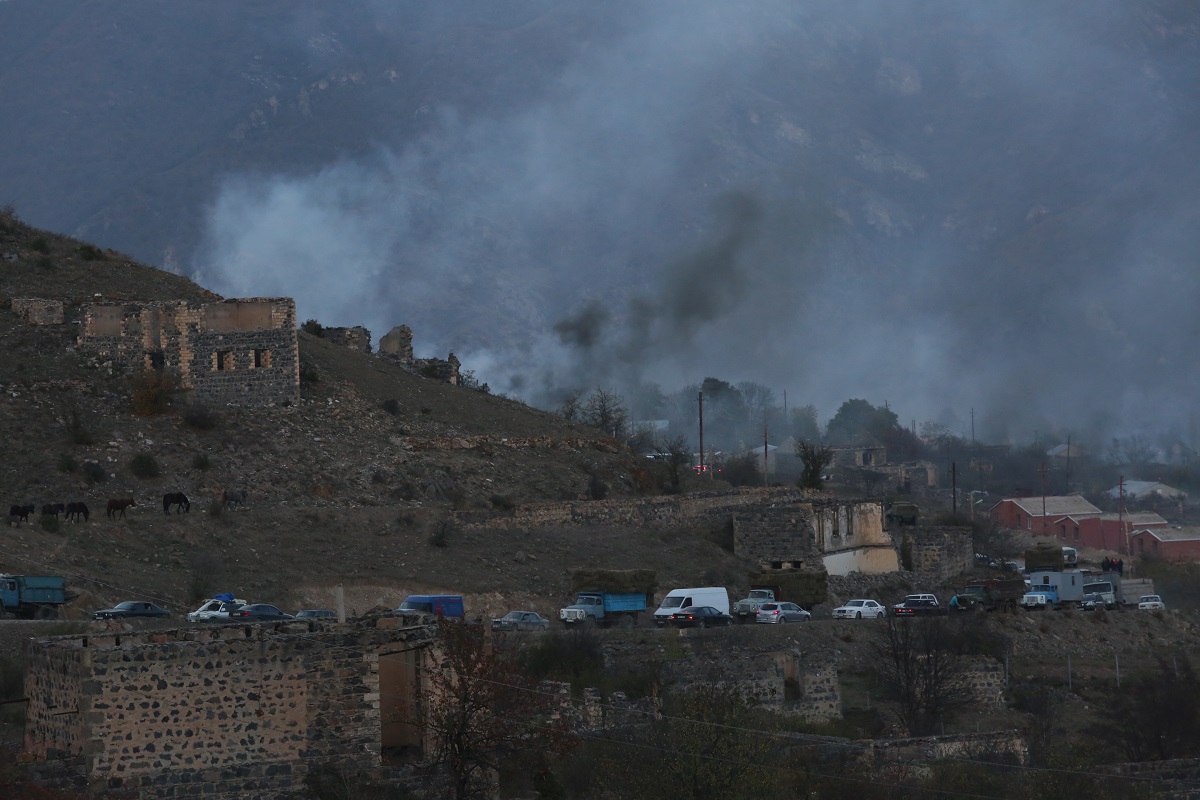
They toured the territory that the entire Armenian population left in 2023 and visited historical and cultural sites. Hikmet Hajiyev, an aide to Azerbaijan’s president, accompanied them. He showed the diplomats the Armenian monasteries of Gandzasar and Dadivank, claiming that they formed “an integral part of the ancient Caucasian Albanian Christian heritage”.
The “Bridge of Peace” initiative uses a Track 1.5 dialogue format. It complements official negotiations rather than replacing them.
As part of the process, experts, civil society representatives and media professionals held direct discussions and explored steps to prepare their societies for peace. The project has held four meetings so far: two in Armenia and two in Azerbaijan.
- ‘On security, we are in the same boat’: Armenian experts on visit to Azerbaijan
- ‘First economic deal since independence’: Azerbaijani petrol arrives in Armenia
- Pashinyan: ‘Peace means being able to travel between Armenia and Azerbaijan’
Commentary by political analyst Boris Navassardian
Radical narratives as a tool of pressure
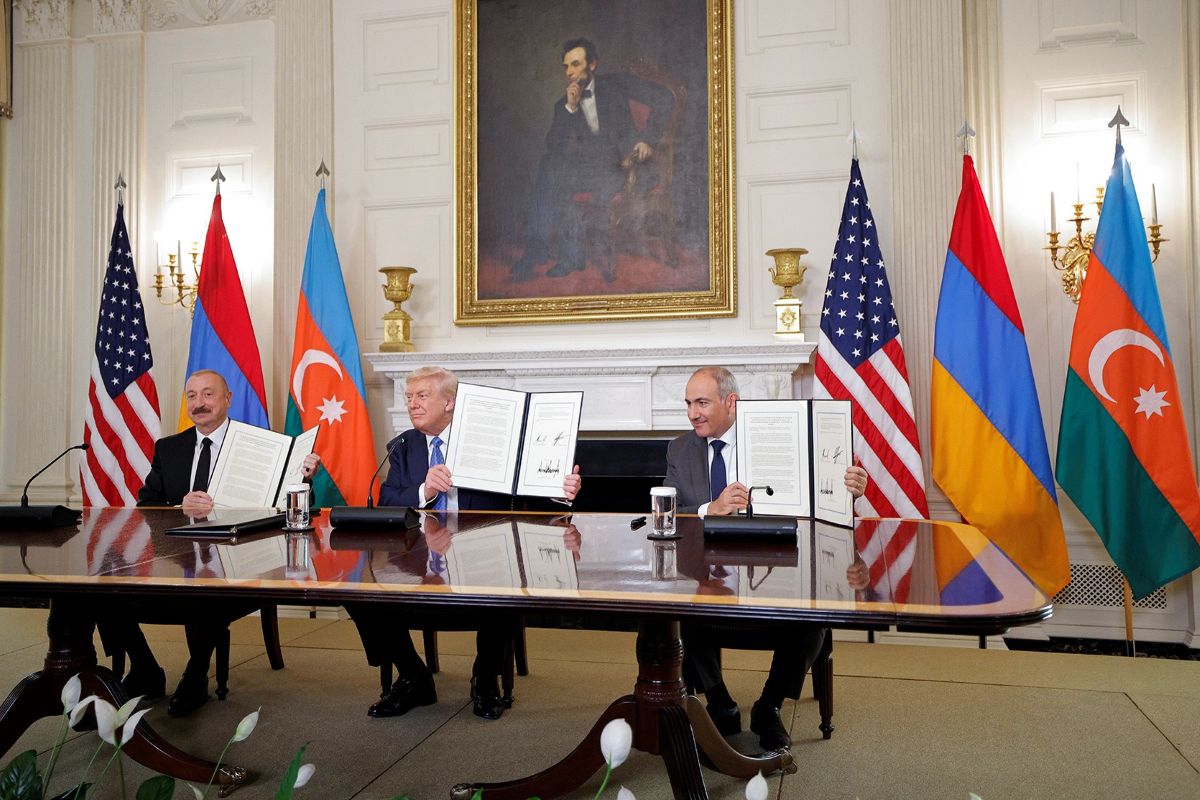
“The current situation is not an isolated incident but the result of deep-rooted problems in the normalisation process. Mutual expectations may not be met, or the parties may be moving away from the principles agreed at the meeting held in Washington on 8 August 2025 under the mediation of the US president. The reasons may relate to the unblocking of transport links, delimitation and the issue of enclaves, or Baku’s desire to reassess its relations with the US, the EU and Russia.
Neither side has a shared vision of the endgame.
Two approaches dominate in Azerbaijan. The first holds that the outcome of the 44-day war in Karabakh has not yet been fully realised, and that Baku should secure further advantages: a favourable settlement on the enclaves and special rights to use Armenia’s transport links.
The second approach is more radical. Some members of the expert community claim that Azerbaijan has a right to all of Armenia’s territory except for 10,000 square kilometres. This refers to maps of the Azerbaijan Democratic Republic from 1918–1920, which a delegation led by parliamentary speaker Alimardan Topchubashov took to the Paris Peace Conference at the time.
These views cannot be described as Baku’s official position, but neither are they marginal: a significant part of Azerbaijani society takes them seriously.
They may serve as a tool to pressure Yerevan into making smaller concessions. But the narrative is taking root in society. Given who is voicing these claims, they are unlikely to run counter to the position of Azerbaijan’s leadership. Rather, they form part of a narrative struggle and the negotiating process, in which psychological pressure serves as an element of diplomacy.
This factor cannot be dismissed. It must be taken seriously and countered effectively. The best solutions in this case are mutual recognition of territorial integrity, the establishment of interstate relations as set out in the initialled peace agreement, and the delimitation of borders while taking local residents’ interests into account.
Even when the issue involves socio-economic difficulties or the forced relocation of just a few hundred people, it affects the overall atmosphere. A constructive approach requires these factors to be taken into account.
There are also people in Armenia who build their political platforms around the idea of returning Nagorno-Karabakh and making claims against Azerbaijan. The situation there is not entirely smooth either. But Baku objectively has greater resources and influence than Yerevan. The authorities there are not under direct pressure from society, but they take public sentiment into account. That is why constructive approaches need to gain wider acceptance in Azerbaijan as well, not just in Armenia. This could influence diplomacy.”
External factors
“It is unclear how constructive approaches will work in practice. Recent weeks have shown that hopes of building relations between Baku and Yerevan independently of the external environment have not been fully realised.
Turbulence within the US, the conflict between Russia and Ukraine coupled with Moscow’s changing ambitions, and the situation in Iran all affect the Armenian-Azerbaijani process. Any changes have an impact on the course of normalisation. Today, domestic and external factors have become intertwined, creating instability. External powers influence the parties’ positions even though, according to official statements from Yerevan and Baku, there are no mediators in the negotiations.
US initiatives to develop cooperation with Armenia have provided a key economic and technological foundation for constructive relations. These include the TRIPP project [a transit route through Armenian territory linking Azerbaijan with its exclave of Nakhchivan] and the development of data centres in Armenia. However, the situation in the US itself, particularly the midterm congressional elections, could lead to a change in this policy.
If Washington’s positive pressure weakens, the parties may shift their focus to other factors.
We can see clear attempts by Russia, on the one hand, to threaten Armenia and obstruct the implementation of agreements, including TRIPP, and, on the other, to make favourable offers to Azerbaijan to preserve its influence in the region. Iran is also pursuing its own interests and signalling its intention to prevent TRIPP from going ahead under the US framework.
All these factors influence the positions of the two capitals. Although, de jure, none of the three countries mentioned is a mediator or a direct participant in the negotiations.”
The battle of narratives
“When assessing statements coming out of Baku, from the rhetoric of officials to remarks by public figures, we need to distinguish clearly between different levels. On the one hand, some former officials and experts have made direct territorial claims against Armenia. Yerevan must categorically reject this position and refuse to discuss it altogether.
On the other hand, there is the issue of ‘Western Azerbaijan’. Formally, it is framed not as a territorial claim but as the right of Azerbaijanis to return to the places where they lived before the conflict began in 1988–1990. This issue is not currently part of the official negotiating agenda, although advocates actively promote it in the public sphere.
If Baku attempts to formally include this idea in the negotiations, it would mark a departure from the principles agreed in August 2025 and pose a serious threat to the peace process.
For now, however, it remains at the level of a public movement. It is possible to coexist with this movement while trying to influence the balance of narratives within Azerbaijani society.
Another issue concerns statements by presidential aide Hikmet Hajiyev in Gandzasar, Nagorno-Karabakh, about cultural and historical heritage. We are witnessing a relatively new phenomenon: Baku is seeking to portray Christian monuments on its territory exclusively as part of the heritage of the modern Azerbaijani state.
One possible explanation is that Azerbaijan is trying to reshape its relations with the EU. An analysis of the difficulties in its dialogue with Brussels may have led Baku to conclude that the European Union is a political bloc rooted in Christian traditions. To improve its image, Azerbaijan needs to show that Christian culture is not alien to it. This may explain why Baku is so persistently promoting the narrative that Christian heritage in this territory belongs exclusively to Azerbaijan, while Armenia, which enjoys particular favour in Europe, has no connection to it.”
Separating the past from the present and the future
“Armenia should respond to these developments in a differentiated manner. At the official level, Yerevan should state clearly and consistently that Azerbaijan’s attempts to reshape narratives and change the external environment surrounding the negotiations to gain advantages are hindering normalisation. Armenian diplomacy must actively oppose these efforts.
At the academic and expert level, there is a need to demonstrate with evidence that Baku’s attempts to revise established views of cultural and historical heritage lack scientific credibility and are unfounded. Above all, these issues must not be allowed to become entangled with politics.
In the field of civil diplomacy, the guiding principle should be that genuine differences over interpretations of the past must not stand in the way of contact. Dialogue should focus on the present and the future, where the development of ties remains the only basis for ensuring regional stability.”
A frozen “bridge”
“Parliamentary elections in Armenia temporarily suspended civil society dialogue as attention shifted to domestic politics. However, after the elections, the parties came up against difficult issues that they had initially postponed. It was clearly impossible to reach an immediate agreement on matters such as the basic content of textbooks. But experts were ready to discuss removing elements of mutual insults from educational materials. At the very least, they managed to move towards an agreement on this level.
However, the general situation in recent weeks has effectively frozen dialogue under the “Bridge of Peace” initiative. The parties had to postpone discussions of sensitive issues until the initiative’s prospects become clearer.
Meanwhile, cooperation continues in other formats. In particular, the Yerevan and Baku press clubs, which are preparing to mark 30 years of cooperation, continue to produce joint programmes.
Armenian-Azerbaijani relations require movement in both directions. Communication at the civil society and expert levels lays the groundwork for a constructive official process. Agreements in the fields of communication and economics also directly influence public sentiment.
Progress in both directions must be intensive. The “Bridge of Peace” initiative would benefit greatly from the practical launch of economic projects. Any progress in this area makes civil society dialogue more effective. In turn, public attitudes influence the parties’ willingness to compromise. All sides must make an effort. This is the only way to preserve the positive climate that has taken shape in recent months.”
Crisis in Armenia-Azerbaijan relations