Tbilisi mayor considers restricting traffic in city


Possible traffic restrictions in Tbilisi
Tbilisi Mayor Kakha Kaladze has outlined several possible ways to tackle traffic congestion in the capital. These include restricting vehicle traffic, introducing an alternating-day driving system based on odd and even number plates, and charging drivers to enter certain parts of the city.
He said the growing number of cars was one of Tbilisi’s main problems. Infrastructure projects, such as building flyovers, would not be enough to solve it.
Kaladze did not say that the authorities had decided to introduce any of these measures. However, he noted that restrictions might be necessary to address the problem. In that case, the public would have the final say.
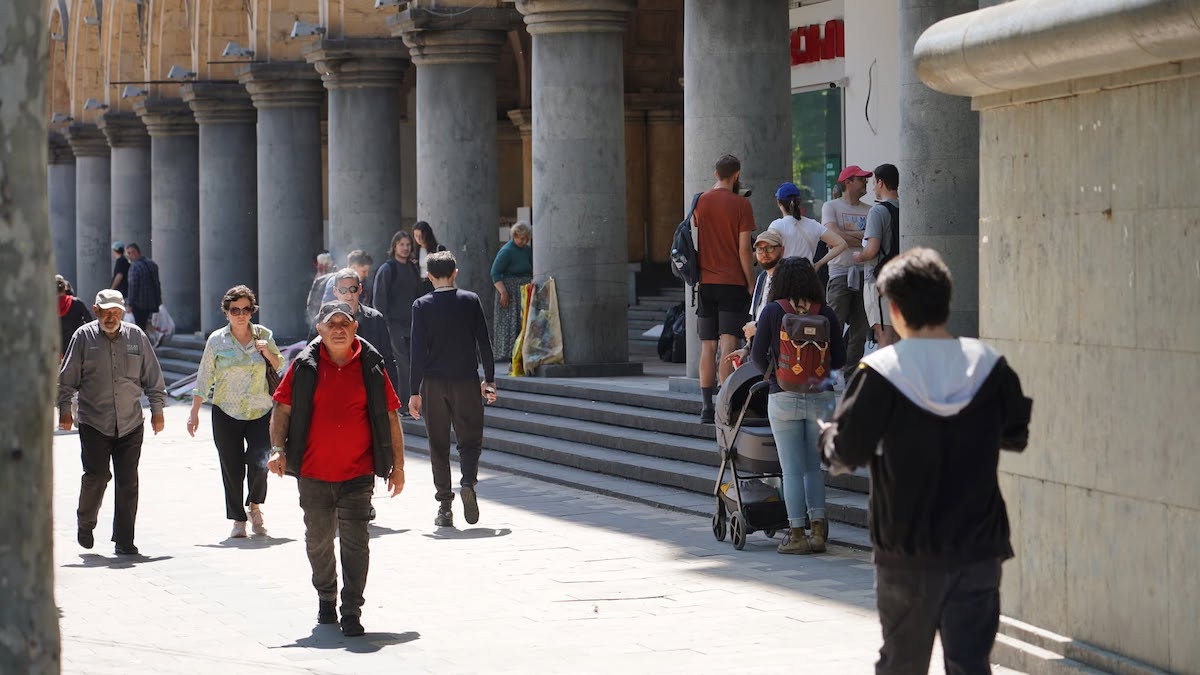
On 11 November, Kaladze told the pro-government Imedi TV channel that 900,000 vehicles had been on Tbilisi’s roads during peak hours.
He rejected claims that dedicated bus lanes were the main cause of traffic congestion. As an example, he cited Agmashenebeli Avenue, where traffic becomes almost impossible at certain times despite the absence of a dedicated public transport lane.
“The biggest problem is our dependence on cars and the sheer number of vehicles, not that the city government is doing nothing. There are specific solutions, just as there are in other countries,” Kaladze said.
Asked by the presenter whether the city could restrict traffic based on whether a vehicle’s number plate ends in an even or odd digit, the mayor described this as one possible option.
“If we want to solve this problem, we could agree on measures such as allowing only cars with number plates ending in an even or odd digit on certain days. Another option would be to install cameras in specific areas and introduce congestion charges, as many European cities have done,” the mayor said.
Kaladze said that although the public might find such decisions difficult to accept, residents themselves would need to play a part in addressing the situation.
“When we make a decision, it is important that everyone understands and accepts it. Society must be ready for it. The city authorities cannot simply do nothing while the problem persists. No — we must make a decision, and we will all have to make certain sacrifices,” Kaladze said.

Traffic congestion and growing pressure on the urban environment
Traffic congestion and overcrowded public transport have remained among Tbilisi’s main transport problems for many years. Rapid urban growth, the development of new residential neighbourhoods and heavy reliance on private cars are putting additional pressure on the existing transport infrastructure.
Didi Dighomi is Tbilisi’s fastest-growing residential district, followed by Navtlughi and Varketili. A study by Danish consultancy Ramboll, commissioned by Tbilisi City Hall, forecasts that Didi Dighomi’s population will at least double between 2022 and 2042.
The study’s authors identify the development of rail transport as one possible long-term solution to the district’s transport problems.
Against this backdrop, Tbilisi City Hall is working on a tram line project. On 7 September 2026, the municipality signed a design and construction contract with a consortium of Turkish companies, EYE Group. The project envisages a tram line connecting Didi Dighomi with Didube metro station. The contract is worth 287,654,321 lari (approximately $111,089,941), and the municipality expects construction to finish by 2030.
At the same time, in recent years, City Hall has introduced dedicated bus lanes on several major streets in the capital. The aim is to speed up public transport and reduce reliance on private cars. Some categories of taxi were subsequently also allowed to use these lanes.
The possible restrictions Kaladze mentioned suggest a shift towards a stricter transport policy aimed at curbing the growth in the number of cars in Tbilisi. However, the mayor has yet to specify when the measures might take effect or how the authorities plan to implement them.

Possible traffic restrictions in Tbilisi