Which sectors of Georgia’s economy are most dependent on Russia?


What does Georgia depend on Russia for?
Since the start of the war in Ukraine in 2022, remittances and other financial inflows from Russia to Georgia have risen sharply. Although these flows have declined somewhat in subsequent years, Georgia remains heavily dependent on Russia in several sectors.
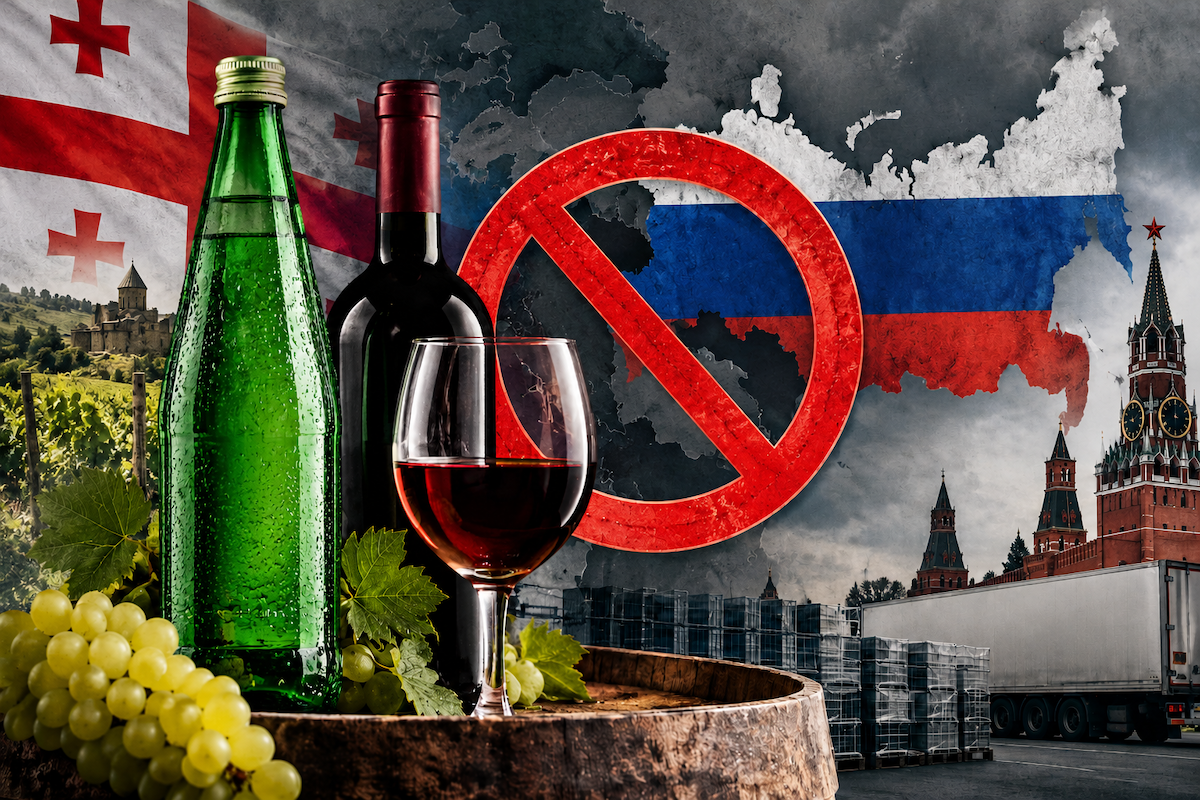
The Russian market remains particularly important for Georgian wine and other traditional export goods. Russia has also increased its share of Georgia’s natural gas supplies.
- Russia bans imports of several drinks from Georgia
- Month after Russia’s ban on Georgian drinks, Russian experts to inspect laboratories in Georgia: what are risks?
A study by BM.ge examines Russia’s influence on Georgia’s economy over the past five years. It covers data on foreign trade, foreign direct investment, remittances, tourism and the energy sector from 2021 to 2026.
This article provides a brief overview of the study’s main findings.
Revenue from Russia has fallen, but dependence remains
One of the key indicators in the study is the ratio of revenue from exports to Russia, tourism from Russia and remittances from Russia to Georgia’s nominal gross domestic product (GDP).
According to BM.ge’s calculations, in 2022 these three sources accounted for 14.4% of Georgia’s GDP. By 2025, the figure had fallen to 5% – below the 6.2% recorded in 2021.
The main reason for the decline was a sharp drop in remittances from Russia. In 2022, people and businesses transferred $2.07bn from Russia to Georgia. By 2025, the figure had fallen to $468m.
Moreover, between January and September 2026, remittances from Russia fell by a further 11.5% compared with the same period a year earlier, reaching $304.8m.
However, these figures do not necessarily mean that Georgia’s overall economic dependence on Russia has declined by the same margin. The indicator does not account for imports from Russia, dependence on energy supplies or other economic ties.
Trade: imports are rising, while traditional exports remain concentrated in the Russian market
Between 2021 and 2025, trade between Georgia and Russia increased.
In 2025, Georgia’s exports to Russia totalled $749.3m, while imports from Russia reached $1.94bn. Total trade turnover stood at $2.69bn. Imports were approximately 2.6 times higher than exports.
Over the same period, Russia’s share of Georgia’s total exports fell from 14.4% to 10.3%. However, the picture looks different when it comes to exports of locally produced goods: Russia’s share of these exports rose from 17.7% in 2021 to 20.8% in 2025.
This means Russia remains an important market for goods produced in Georgia. Dependence is particularly high for traditional export products.
In 2025, Russia accounted for around 64% of Georgia’s wine exports and 56% of its exports of spirits. In the first nine months of 2026, Georgia exported $119.8m worth of wine and $92.9m worth of spirits to Russia.
According to the study, such a high concentration in the Russian market leaves Georgian producers vulnerable to changes in demand and potential trade restrictions.
Energy: Russia’s share of gas supplies has increased
One of the sectors most visibly dependent on Russia is energy, particularly natural gas supplies.
Citing data from GNERC (the Georgian National Energy and Water Supply Regulatory Commission), BM.ge reports that Georgia imported 397 million cubic metres of natural gas from Russia in 2021. By 2025, the figure had risen to 886 million cubic metres. Over five years, gas imports from Russia increased 2.2-fold.
As a result, Russia’s share of Georgia’s gas supplies rose from 15.3% to 27.9%. Nevertheless, Azerbaijan remained by far the largest supplier in 2025, accounting for 71.7% of Georgia’s natural gas imports.

Russia is also an important supplier of oil and petroleum products to Georgia. A key factor in this area is the oil refinery in Kulevi, which began operations in October 2025. Initially, the facility processed Russian crude oil.
The European Union added the refinery to its sanctions list in July 2026, but postponed the restrictions until 25 January 2027. According to the company that owns the facility, the refinery stopped processing Russian oil on 23 August 2026 and switched to non-Russian crude.
As for electricity, Russia supplied 62.4% of Georgia’s electricity imports in 2025.
However, these figures need to be considered in context: a significant share of the electricity imported from Russia goes towards supplying occupied Abkhazia.
According to BM.ge, around 74.5% of the electricity Georgia imported from Russia in 2025 went to Abkhazia.
Tourism: visitor numbers and revenue tell different stories
Russia remains one of the main sources of tourists for Georgia.
In 2025, Russian citizens made 1.58 million visits to Georgia, an 11.1% increase on the previous year. Between January and September 2026, they made 1.31 million visits, 4.9% more than in the same period a year earlier.
However, Russia’s share of Georgia’s tourism revenue has declined.
In 2022, Russia accounted for 25.3% of revenue from international travel. By 2025, this figure had fallen to 14.8%.
Georgia earned a total of $4.69bn from international tourism in 2025, with Russian visitors contributing $694m.
The study also notes that trends in arrivals from other countries affect the overall number of tourist visits.
Therefore, an increase in visits by Russian citizens does not necessarily mean that Russia’s share of Georgia’s tourism revenue is also growing.

Investment: Russia’s share of foreign capital remains relatively small
Russia accounts for a relatively small share of Georgia’s total foreign direct investment (FDI), compared with other economic indicators.
In 2021, Russian FDI in Georgia totalled $87.7m. By 2023, it had risen to $131.2m, before reaching $109.5m in 2025.
At the same time, Russia’s share of Georgia’s total FDI fell from 6.8% in 2021 to 5.8% in 2025.
In the first half of 2026, most Russian investment went into the property and construction sectors.
According to data that BM.ge obtained from Georgia’s National Statistics Office, 71.8% of Russian investment – amounting to $26.7m – went into real estate.
What does the study show? The key findings
The analysis concludes that falling revenue from Russia does not provide a complete picture of Georgia’s economic dependence on its northern neighbour.
On the one hand, Russia’s share of remittances and tourism revenue has declined, as has its share of Georgia’s total exports.
On the other hand, Russia’s share of Georgia’s natural gas supplies has increased, while it remains the main export market for Georgian wine and other traditional products.
The study’s author also stresses the importance of reducing economic vulnerability.
According to BM.ge’s analysis, this requires diversifying export markets, finding alternative energy suppliers and steadily reducing Georgia’s economic dependence on Russia.
The study also serves as a reminder that economic relations with Russia are not merely a commercial matter. Previous embargoes on Georgian goods have shown that Moscow can restrict access to its market for political reasons.

What does Georgia depend on Russia for?