Putin Arrives in Beijing After Trump Visit. What Lies Behind the Rhetoric of ‘Unbreakable Friendship’?






Putin’s Visit to Beijing
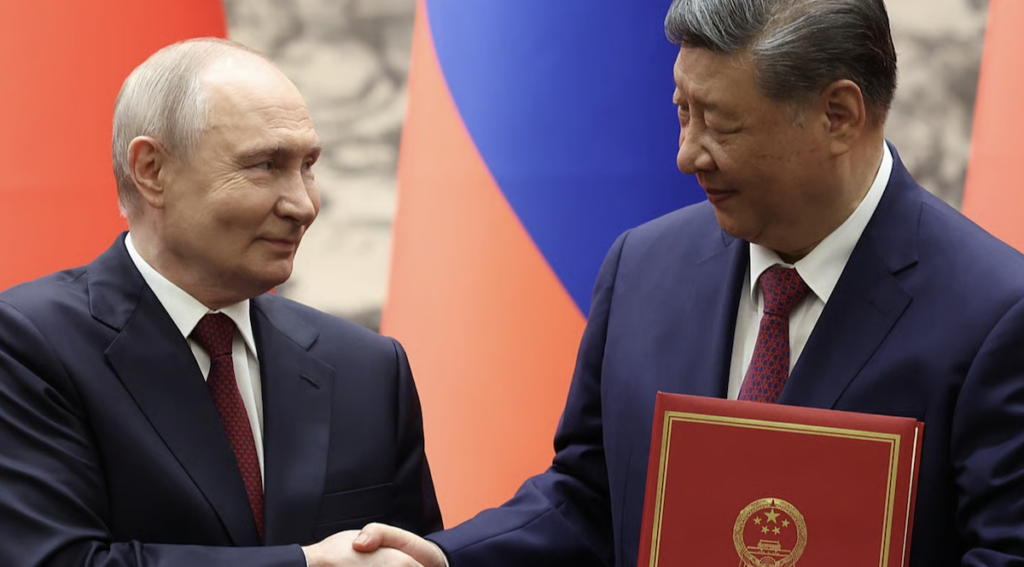
Russian President Vladimir Putin’s visit to Beijing on May 19–20 was marked by statements praising the “excellent relations” between Russia and China. Formally, the trip appeared productive: the two sides signed 42 documents. Yet no breakthrough decisions emerged. The key issue—the pricing of gas for the planned Power of Siberia 2 pipeline—remained unresolved.
For China, however, the visit carried significance not only in substance but also in symbolism. By hosting Donald Trump and Vladimir Putin within days of each other, Beijing sought to present itself as a center of global diplomacy—a power that both Washington and Moscow are compelled to engage with.
Based on reporting by Novaya Gazeta Europe
“Let friendship last forever”
Putin arrived in Beijing on the evening of May 19, just four days after Donald Trump’s departure. The U.S. president had been received by Chinese Vice President Han Zheng, while the Russian leader was met by Foreign Minister Wang Yi. Formally, Han ranks higher in China’s state protocol, but Wang carries greater political weight as a member of the Politburo of the Communist Party of China.
The ceremony followed a standard script: an honor guard, a military band, children waving flags, and banners reading “Welcome.” Yet both Moscow and Beijing had deliberately framed the visit as something more ceremonious.
Ahead of the trip, Putin recorded a video message to “dear Chinese friends,” speaking of the “unprecedented level” of bilateral relations and the “boundless potential” for their development. Russian state media amplified the narrative of an “unbreakable friendship” between the two nations. The state news agency RIA Novosti echoed comments from Chinese social media users in the spirit of: “May Chinese-Russian friendship last forever.”
Chinese official rhetoric was no less ceremonial. Global Times wrote that Russia and China, “standing shoulder to shoulder,” had achieved deep mutual trust and comprehensive cooperation. The Chinese Foreign Ministry said that friendship between the two countries would become “even more deeply rooted in the hearts of the people.”
A symbolic moment of this relationship was expected to be Putin’s meeting with Chinese engineer Peng Pai. According to Kremlin aide Yuri Ushakov, Putin met him as a child in 2000; he later studied in Moscow and now works for a major Chinese company.
During the talks, Xi Jinping and Vladimir Putin also spoke about the “rapprochement of the two peoples” and the “unshakable will” to deepen political and strategic cooperation.
Two delegations: Officials ersus corporations
The size of the Russian delegation was intended to signal the seriousness of the visit. According to Kremlin aide Yuri Ushakov, it included 39 people, among them 13 government ministers. Each participant was assigned separate meetings and specific responsibilities.
By contrast, the American delegation that visited Beijing on May 13–15 was smaller on the governmental side. Alongside Donald Trump, it included Secretary of State Marco Rubio, Defense Secretary Pete Hegseth, Treasury Secretary Scott Bessent, and U.S. Trade Representative Jamieson Greer. However, it was far more prominent in business terms: executives from Tesla, Nvidia, Apple, Boeing, BlackRock, Goldman Sachs, Citigroup, and other major corporations also traveled to Beijing.
The contrast highlights two different approaches. Russia brought a state-centered delegation. The United States combined political leadership with corporate power. China, in turn, received both in a way that underscored its own status as a potential global arbiter.
42 documents, but no breakthrough
An informal competition also unfolded around the results of the talks. After the meeting between Trump and Xi, no major public agreements were announced. Trump spoke about possible U.S. oil exports to China and increased Chinese purchases of American agricultural products, but these arrangements were not finalized. China’s pledge to buy 200 Boeing aircraft was also seen as only a partial success, falling short of market expectations of a 500-plane deal.
Analysts described the outcome of Trump’s visit as “a lot of pomp, a lot of symbolism, but little substance.”
The Kremlin had earlier announced around 40 documents for Putin’s trip. In the end, 42 were signed—more than at previous meetings. But the quantity did not translate into a breakthrough.
“Recycled” agreements and symbolic diplomacy
According to China expert Alexander Gabuev, Russian–Chinese summits have long relied on what he calls “floating thematic blocks”: many newly signed documents effectively supplement agreements that already exist. In practice, a significant share of these deals involve cooperation between state institutions, including propaganda and media agencies.
This time was no exception. For example, TASS and Xinhua agreed on media exchange tours: journalists from both countries will visit Russia’s “Golden Ring,” China’s Yangtze River Economic Belt, and the Greater Bay Area.
The documents covered industry, trade, transport, construction, education, film, and nuclear energy. Among them were agreements on phytosanitary requirements for Russian animal feed, the creation of a Russia–China University of Advanced Technologies, joint film production, and the expansion of the Zabaikalsk–Manzhouli railway link. More than a third of the documents were related to education and universities.
According to China expert Temur Umarov, most of these documents are memoranda rather than legally binding treaties. Their purpose, he argues, is largely declarative: to demonstrate that cooperation is “moving forward by leaps and bounds.”
Old formulas for a new world
Moscow placed particular emphasis on documents with ambitious titles: the “Joint Declaration on the Establishment of a Multipolar World and a New Type of International Relations” and the “Joint Statement on Further Strengthening Comprehensive Partnership and Strategic Cooperation.”
Yet the wording is not new. These formulations have been circulating from one statement to another for several years.
The declaration states that attempts by certain states to “unilaterally manage world affairs” and impose their interests have failed. It goes on to criticize “neo-colonial tendencies,” “hegemonism,” and “bloc confrontation.” The references are widely understood to be directed primarily at the United States and its allies, rather than at Russia or China.
Ukraine is addressed only in a single paragraph near the end of the larger document. Moscow and Beijing call for addressing the “root causes of the Ukrainian crisis,” while Russia praises China for its “objective and impartial position.” No substantive changes appear compared to statements issued since 2022.
Gas deadlock
No breakthrough was achieved on the planned “Power of Siberia 2” pipeline project. Last year, Putin and Xi agreed to increase gas supplies to China by 8 billion cubic meters via existing routes and signed a memorandum on building a new pipeline. In March, Chinese authorities for the first time included the project in their five-year economic development plan. But the question of pricing remains unresolved.
Beijing is insisting on terms close to domestic Russian prices—around $50 per thousand cubic meters. This is significantly below current rates. According to Bloomberg, China is expected to pay $258 per thousand cubic meters for Russian gas this year—more than 38 percent lower than the average price paid by the few remaining European buyers.
China is also seeking minimal purchase obligations under a “take-or-pay” principle. As Alexander Gabuev explains, Beijing would prefer to commit to only 10–20 billion cubic meters per year, leaving the remaining 30–40 billion as an optional volume, depending on market conditions and as a potential lever of pressure on other suppliers.
China’s negotiating position is strengthened by Russia’s limited alternatives after losing a significant share of the European market. Beijing is aware of this and is in no hurry to conclude a deal.
Temur Umarov argues that in the short term, Russia’s importance as an energy supplier to China has increased. However, China typically avoids making long-term commitments during moments of geopolitical crisis. Its strategy, he says, is to wait for conditions no worse than before the war in Iran—and ideally even more favorable.
Trade is growing, but the dependence is asymmetrical
During his visit, Putin emphasized that Russia–China trade turnover has long exceeded $200 billion, with payments conducted almost entirely in rubles and yuan.
But he did not mention the key imbalance. China accounts for more than one-third of Russia’s imports and over a quarter of its exports. For China, Russia plays a far smaller role: about 5 percent of imports and 3 percent of exports.
Russia mainly supplies China with oil, coal, and gas. According to the Centre for Research on Energy and Clean Air, since the start of the full-scale war in Ukraine, China has purchased more than €319 billion (about $372 billion) worth of Russian fossil fuels.
In return, China supplies Russia with electronics, machinery, and automobiles. Bloomberg has also reported that Russia imports more than 90 percent of sanction-restricted technologies through China. This flow of goods has helped Moscow expand domestic weapons production, including missiles and drones.
Hidden cooperation and the war in Ukraine
On the day the visit began, Reuters reported—citing European intelligence services—that China had helped Russia train military personnel for the war in Ukraine. According to the agency, around 200 Russian soldiers secretly underwent training in China and later returned to the battlefield. The training reportedly focused on drones, electronic warfare, army aviation, and armored unit tactics.
Publicly, the issue was barely addressed during the visit. Putin only said that he had discussed “pressing international issues” with Xi, without providing details.
The war in Ukraine was also not publicly discussed during Trump’s visit. However, Financial Times later reported, citing sources, that Xi had allegedly told Trump that Putin “may ultimately regret” his decision to start the war. Beijing denied the claim, calling the report “pure fabrication.”
China as a stage for all
Despite the lack of breakthrough agreements, Putin’s visit carried symbolic weight for China. By receiving Trump and Putin in close succession, Beijing presented itself as a country visited by competing centers of global power.
“Putin’s arrival right after Trump was partly coincidental, since the U.S. president’s visit was delayed due to the escalation of the war in Iran. It was not originally planned that way,” said Temur Umarov. “But overall, it worked out well, because China now appears as a country everyone is trying to reach, one after another, attempting to pull it in their direction.”
The message to Washington was clear: China is open to dialogue with the West, but it does not intend to abandon Russia or accept a world order shaped by Western rules.
Xi Jinping spoke of the “rejuvenation of the Chinese nation” and of China’s willingness to share development opportunities with Russia and other countries. He also warned that the world faces a return to the “law of the jungle” due to “unilateral actions and hegemony”—a clear reference to the United States.
Putin echoed this framing, saying that Russia and China “jointly stand for the defense of international law and the principles of the UN Charter.” Xi did not challenge the formulation, even though, in the context of Russia’s war against Ukraine, it appears at least contentious.
A similar logic extended to an episode involving Trump. On May 15, Xi took him for a walk in the gardens of Zhongnanhai, the compound where China’s leadership works. Trump asked whether Xi often receives foreign leaders there. “Very rarely,” Xi replied, adding: “For example, Putin has been here.”
Such balanced positioning could also make China a venue for a future meeting between Putin and Trump. The APEC summit is scheduled for November, and both leaders are expected to attend. The Kremlin has already signaled that a meeting on the sidelines cannot be ruled out.
exchange