Who runs Poland? Why the president and the government cannot agree


Political crisis in Poland
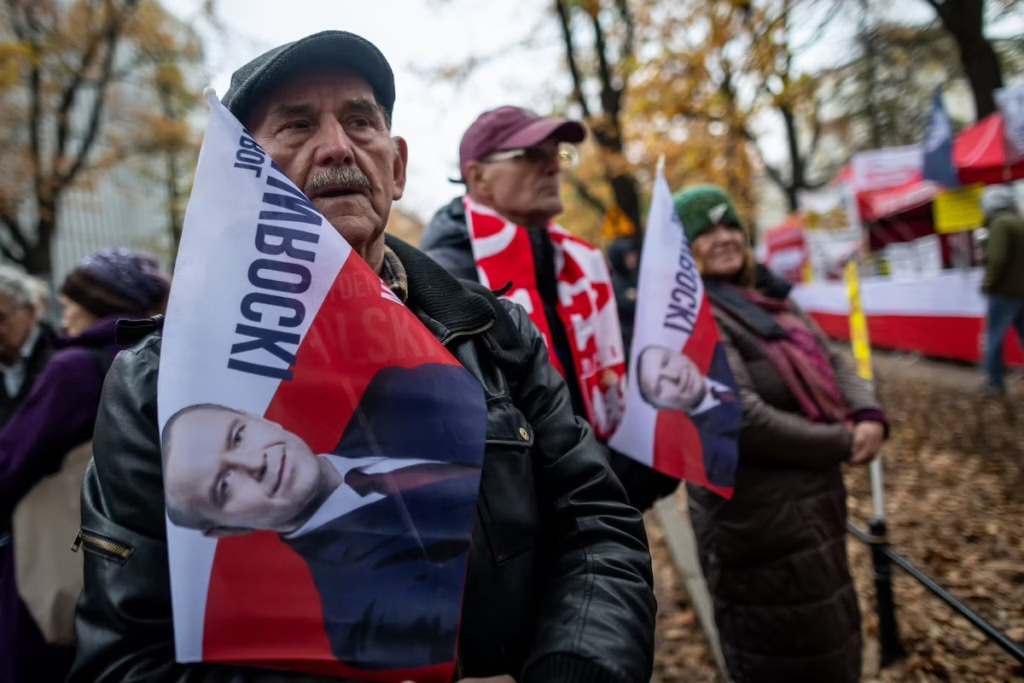
A sharp political crisis has erupted in Poland. The president and the government are accusing each other of violating the Constitution, while the opposition is speaking of a coup. What is happening in a country that has become one of the main immigration hubs in Central Europe, and should foreigners be worried about their future there?
What happened in Warsaw
On October 30, police appeared outside the building of Poland’s Constitutional Tribunal. Judges elected by the parliamentary majority but not sworn in by President Karol Nawrocki attempted to take up their duties. One of them, Anna Korwin-Piotrowska, announced the removal of the tribunal’s president, Bogdan Święczkowski, and his deputy.
The tribunal’s leadership refused to recognise the legality of what was happening. Opposition supporters gathered outside the building, and a standoff with police began.
President Nawrocki, who was on his way to Senegal for an official visit, turned his plane around and returned to Warsaw. He went to the tribunal building and accused the government of attempting to seize control of a state institution.
Prime Minister Donald Tusk, by contrast, said the government intended to ensure that the Constitutional Tribunal could operate independently and lawfully.
The events of October 30–31 were reported by Reuters and Euroradio.
The word “coup” has once again entered Poland’s political debate. But is this really an attempt to seize power?
“If we are to say that a coup took place on Friday, then we must also say that it began back in 2015, when the struggle over the Constitutional Tribunal started to move beyond legal boundaries,” says Michał Potocki, a political commentator for the Polish newspaper Dziennik Gazeta Prawna, in an interview with Euroradio.
In his view, the events of October 30 are simply the latest episode in a conflict that has been going on for eleven years.
Why politicians are fighting for control of the constitutional tribunal
Poland’s Constitutional Tribunal reviews whether laws comply with the Constitution. Its rulings can constrain the actions of parliament and the government, making control over the institution politically significant.
The current crisis began in 2015, when the conservative Law and Justice party (PiS) came to power. Its judicial reforms sparked protests at home and a confrontation with the European Union. European institutions accused the Polish authorities of undermining judicial independence.
In 2023, a coalition led by Donald Tusk took office. It pledged to restore the independence of the courts and reverse controversial decisions made by its predecessors. But delivering on those promises proved difficult: initially, its initiatives were blocked by President Andrzej Duda and, since 2025, by Karol Nawrocki, who is politically aligned with PiS.
As a result, different branches of government are challenging the legality of one another’s actions.
“At its core, this is a struggle for control of the Constitutional Tribunal, which can either help the government or obstruct its legislative agenda,” Potocki says.
The expert, however, does not consider either side beyond reproach.
“Both sides have violated the Constitution. Law and Justice did so more often and to a greater extent. But, unfortunately, the Civic Coalition has its own share of wrongdoing,” he notes.
Polish legal experts have also raised questions about the methods used by Tusk’s government. As The Guardian reports, constitutional law specialists are divided over the legality of the decision to remove the tribunal’s president. Some critics of PiS also consider the legal grounds for the move questionable.
Could the crisis paralyse the state?
Despite the dramatic events in Warsaw, Poland is not yet facing a breakdown of its system of government.
According to Potocki, the Constitutional Tribunal has effectively been unable to function normally for about two years. Nevertheless, the country’s other state institutions continue to operate.
The danger lies elsewhere: prolonged confrontation is eroding public trust in the courts, politicians and the state itself.
The Constitutional Tribunal is supposed to act as an independent arbiter, resolving disputes over the legality of government actions. But when judges and politicians themselves challenge one another’s authority, that mechanism ceases to function.
Potocki notes that some Polish political forces are calling for a complete overhaul of the tribunal and the appointment of a new panel of judges through compromise. So far, however, no agreement has been reached.
That is why the current conflict matters not only to Polish politicians but also to the millions of people who live in the country and depend on decisions made by its public institutions.
What the political crisis means for migrants
In recent years, Poland has become one of the main immigration destinations in Central Europe. Hundreds of thousands of foreigners live and work there, including people from Ukraine, Belarus, Georgia and other countries. They include migrant workers, students, people who have moved for family reasons, and refugees who cannot safely return to their home countries.
To varying degrees, all of them depend on Polish state institutions: they apply for residence and work permits, renew their documents and seek international protection. A prolonged conflict between branches of government is therefore bound to cause concern.
However, the political crisis does not mean that migration services will stop operating or that foreigners will automatically lose their right to reside in Poland.
“This will have no direct impact, because the Constitutional Tribunal does not deal with the legalisation of residence, Pole’s Cards or other issues faced by citizens of Belarus and other countries,” Michał Potocki explains in an interview with Euroradio.
At the same time, Poland’s migration system was already under considerable strain before the current crisis.
As Euroradio reported, Olga Dobrovolska, a lawyer at the Belarusian Solidarity Centre, said that more than 190,000 applications for legalisation of foreigners’ residence were awaiting consideration in the Mazovian Voivodeship alone. The situation is also particularly difficult in the Lower Silesian and Pomeranian Voivodeships. The introduction of the MOS electronic application system has so far failed to reduce the queues.
For refugees, these difficulties are compounded by the question of international protection. According to Dobrovolska, Polish authorities assess applications individually, examining whether a person would face danger if they returned to their home country. References to political events from previous years alone may not be sufficient.
There is no direct link between these problems and the events surrounding the Constitutional Tribunal. But, as Potocki points out, a constitutional oversight body that is not functioning properly limits the opportunities to seek systemic solutions to problems involving violations of rights.
The expert cites lengthy delays in processing residence applications as an example. When statutory deadlines are not met, a properly functioning Constitutional Tribunal could potentially examine whether such practices comply with constitutional guarantees.
When the legitimacy of the tribunal itself is being contested, however, it becomes much harder to use this mechanism.
The main risk for migrants, therefore, is not the immediate loss of their documents or legal status, but the weakening of the legal safeguards intended to protect their interests in dealings with the state.
Who benefits from the conflict?
The political crisis in Poland is being actively exploited by Russian and Belarusian state propaganda.
As Euroradio reported, the events surrounding the Constitutional Tribunal have provided an opportunity to claim that a coup is supposedly taking place in the country.
According to Potocki, the propaganda campaign has several objectives. Above all, it seeks to portray Poland as a country engulfed in chaos and undermine public trust in democratic institutions.
Belarusian propaganda is also using the conflict to challenge Poland’s right to criticise violations of democracy in Belarus.
Another objective is to deepen divisions between Poland’s political camps, including by exploiting disagreements over Ukraine and relations with the European Union.
However, Potocki stresses that the Polish government and the president remain broadly aligned on fundamental issues concerning Russia and the need to support Ukraine. Their differences are primarily about political approaches and individual decisions.
What happens next?
Experts do not expect the crisis to be resolved quickly.
Parliamentary elections are due to take place in Poland in 2027. The confrontation between the ruling coalition and PiS is already becoming part of the election campaign, leaving politicians with fewer and fewer incentives to compromise.
“Unfortunately, I do not see much chance of a compromise. Polarisation in Poland will only intensify,” Potocki predicts.
For foreigners living in Poland, this means, above all, keeping an eye on government and parliamentary decisions that directly determine the rules governing residence, employment and state assistance.
For now, there are no grounds to claim that the conflict surrounding the Constitutional Tribunal threatens migrants’ right to remain in the country.
But Poland’s crisis illustrates a broader problem: even in a democratic state, political confrontation can weaken institutions for a prolonged period, undermining the mechanisms that protect human rights. For migrants, particularly refugees whose status often depends heavily on decisions made by the authorities, this has very practical implications.
exchange