Court removes leaders of Coalition for Change from hearing on banning political parties in Georgia - day 10 recap


Georgia opposition ban trial
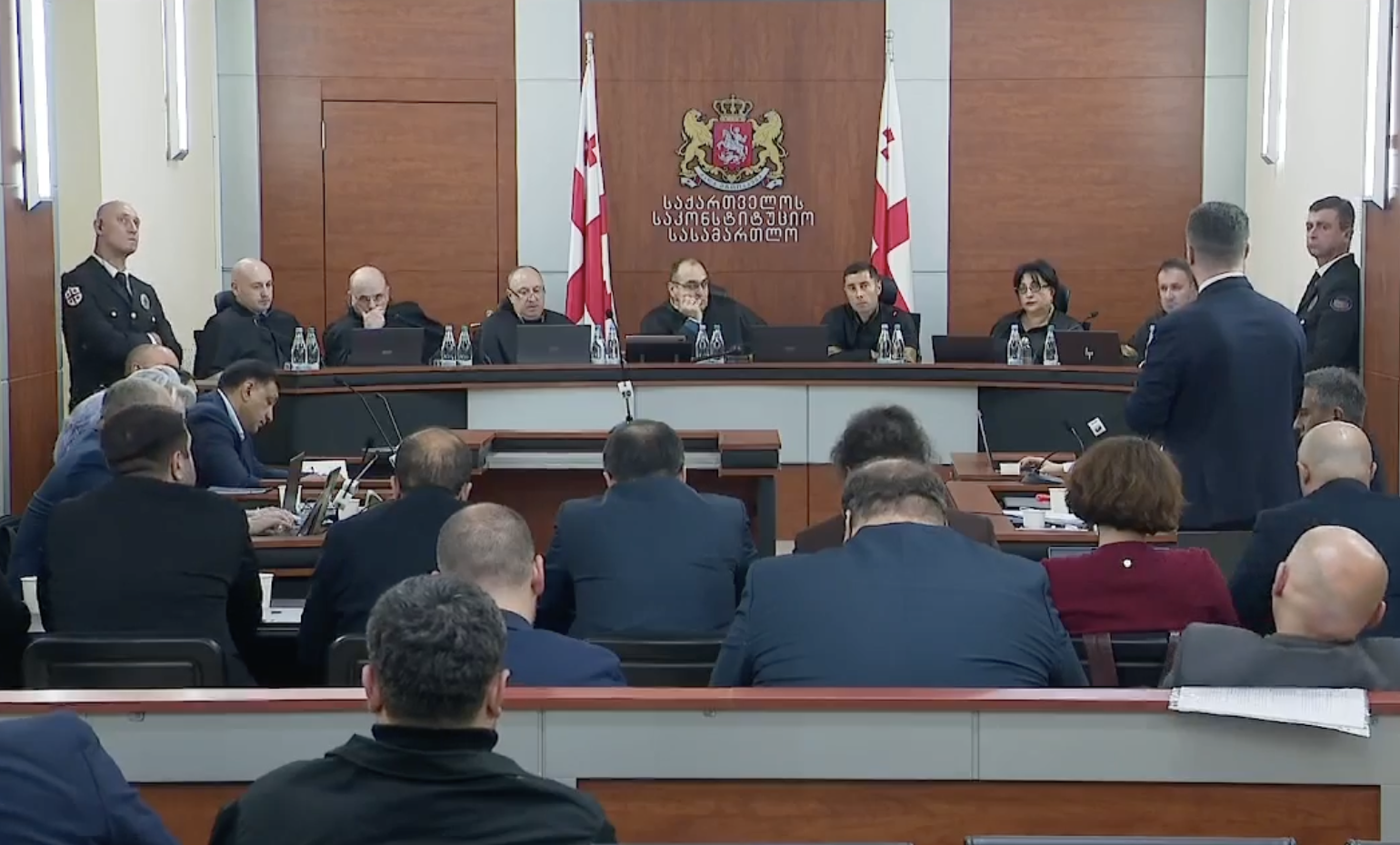
On 11 November, Georgia’s Constitutional Court held the tenth day of hearings on a lawsuit brought by ruling party Georgian Dream seeking to ban five opposition parties.
The hearing was at the question-and-answer stage, with judges questioning representatives of Georgian Dream, which brought the case.
Context. The case sets a precedent. The lawsuit was signed by 88 MPs from the ruling party. It seeks to ban five opposition groups: Unity – National Movement, Coalition for Change, Lelo – Strong Georgia, Gakharia for Georgia and the Federalists.
Georgian Dream argues that these parties have violated Article 23 of the Constitution, which prohibits political parties that seek to overthrow or forcibly change the country’s constitutional order. The ruling party cites their refusal to recognise the legitimacy of the current government as one of its arguments. The application also accuses them of attempting to overthrow the government.
The application also accuses Unity – National Movement of undermining the country’s independence and territorial integrity. The stated reason is the party’s alleged responsibility for the August 2008 war with Russia over South Ossetia, when the United National Movement was in power.
All five parties deny the allegations. The court must deliver its final ruling by 24 June 2027. A simple majority is required to uphold the lawsuit, meaning at least four of the seven judges must vote in favour.
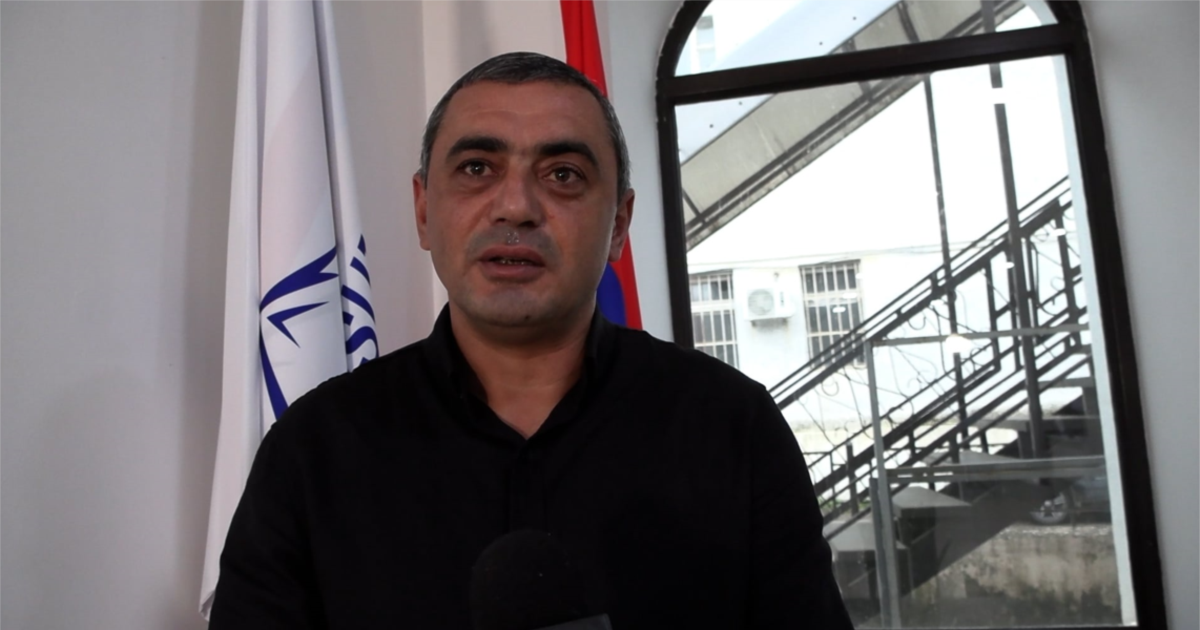
The main development on 11 November was the removal of Coalition for Change leaders Nika Gvaramia and Maia Kopaleishvili from the courtroom by Constitutional Court Chairman Revaz Nadaraia for arguing with the court and the plaintiffs.
Unless their request to be allowed back into the proceedings is granted, Gvaramia and Kopaleishvili will be barred from attending further hearings until the case is concluded.
Both have been among the most active representatives of the defendants. Kopaleishvili is a former Constitutional Court judge.
- Proposed ban on five opposition parties in Georgia: what’s happening and why
- Georgia opposition party ban case: coverage of all Constitutional Court hearings
- No examination of evidence: day nine of hearings in Georgia’s case to ban opposition parties
What led to Gvaramia and Kopaleishvili being removed
Judge Eva Gotsiridze asked the plaintiffs whether they had evidence that the opposition parties had taken part in or incited violence. In response, Georgian Dream MP Archil Gorduladze named Murtaz Zodelava and Paata Burchuladze. Both have been charged in connection with the events of 4 October 2025, when a group of activists attempted to storm the presidential palace.
Gorduladze said both men were linked to the United National Movement.
Nika Gvaramia objected: “Neither of them was a member of that party. If people were prosecuted simply because someone happened to be their former classmate, half of Georgia would be in prison – because all of you who have ruined this country were classmates!”
“As for those who have ruined it – well, here you all are!” Gorduladze retorted.
Gvaramia then asked whether being friends with someone meant belonging to the same political party: “If I acknowledge that someone is my friend, does that mean we are all conspirators plotting a coup?”
Constitutional Court Chairman Revaz Nadaraia deemed the exchange disruptive and ordered Gvaramia, followed by Kopaleishvili, to leave the courtroom.
Maia Kopaleishvili: “This is a show of force”
Kopaleishvili described her removal from the courtroom as a restriction on access to justice. “This was a deliberate act. It was an instruction from Georgian Dream,” she said. She then asked Nadaraia: “Why are you laughing? Have you already made your decision?”
Nadaraia replied that a formal request could be filed, adding that it was regrettable that Kopaleishvili did not know the law despite having worked at the Constitutional Court for 10 years.
“This is an insult,” Tengiz Tevzadze, another representative of Coalition for Change, told the presiding judge.
“Keep your colleague in check,” Nadaraia retorted.
Before those ordered to leave the courtroom departed, Nadaraia asked them: “For the past two days, have you deliberately been trying to get yourselves removed? Are you perhaps just trying to avoid answering questions?”
As she left, Kopaleishvili told the judges that they should be guardians of the Constitution, not people who restrict the rights of participants in legal proceedings. “This is a show of force,” she said.
She added that Georgian Dream would probably be pleased that the defendants would no longer be able to ask questions.
A day earlier, on 10 November, Nadaraia had repeatedly threatened to remove Kopaleishvili from the courtroom and accused her of trying to discredit the court.
Gvaramia, meanwhile, threatened to file a motion to have the presiding judge recused.
170 injured police officers and photographs on a laptop
The first point of contention during the day’s hearing concerned the evidence.
Judge Vasil Roinishvili asked the plaintiffs whether they had calculated the material damage caused to the state by the defendants, both domestically and internationally.
He cited problems related to visa regimes, critical international resolutions and cases of law enforcement officers being injured during mass unrest.
Gorduladze replied that around 170 law enforcement officers had been injured in November and December 2024 alone.
Opposition representatives demanded to know where this figure appeared as evidence in the lawsuit.
“Did we not agree to skip the examination of evidence, Mr Chairman?” Gvaramia asked sarcastically, referring to a decision taken the previous day.
“The court did not skip anything. Please do not exaggerate,” Nadaraia retorted.
Gorduladze then opened photographs of injured police officers on his work laptop and showed them to the court.
This triggered another verbal clash with Gvaramia. The presiding judge issued him a warning and threatened to remove him from the courtroom.
Giga Lemondzhava, another representative of Coalition for Change, also tried to speak. Nadaraia refused to give him the floor, saying: “Take your seat, or I will order you to be removed. I am not giving you the floor.”
The presiding judge explained that at the questioning stage, the parties were required to accept their opponents’ answers, even if they found them unsatisfactory.
Ana Buchukuri, a representative of the Gakharia for Georgia party, demanded that the court reprimand Gorduladze for making “offensive remarks” about the defendants.
- Opinion: If Georgia’s Constitutional Court bans opposition parties, Russia will use it against Georgia
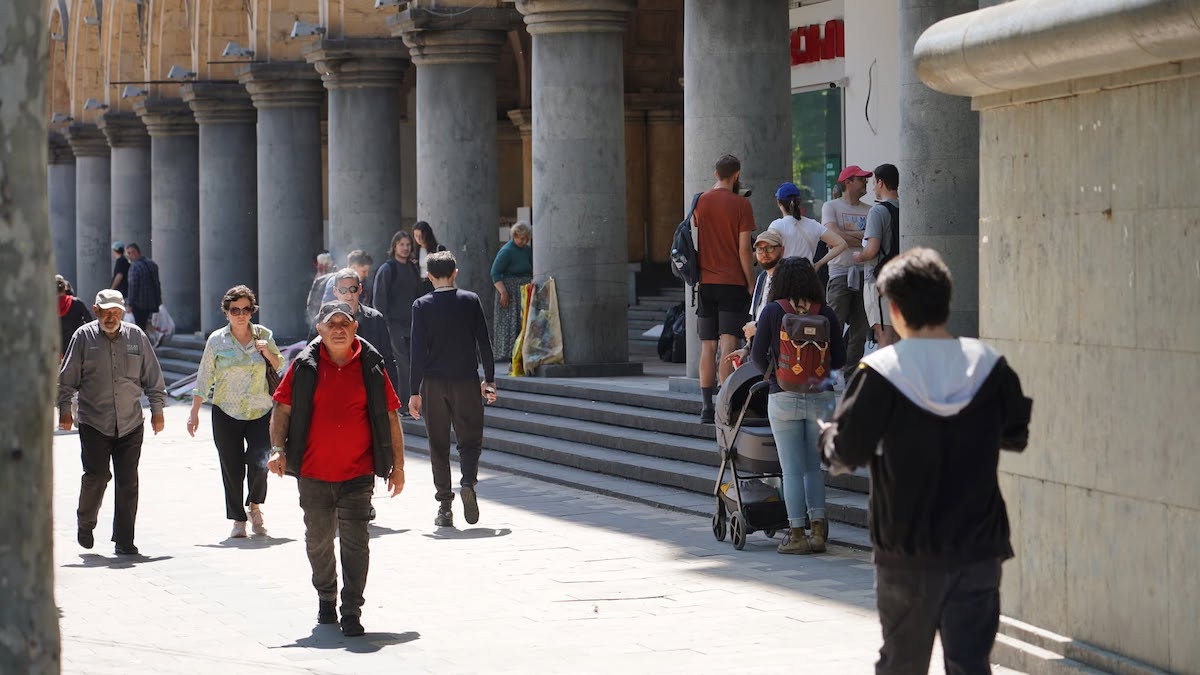
- Should state have right to ban political parties? Tbilisi street poll – Video
Judge Gotsiridze: “Seeking to ban five parties at once is unprecedented”
Judge Eva Gotsiridze questioned the plaintiffs about the criteria for banning political parties.
She noted that seeking to ban five parties at once was truly unprecedented.
Gotsiridze also pointed out that the lawsuit describes several other parties as “anti-constitutional”, yet the plaintiffs are not seeking to ban them.
In her view, the term “anti-constitutional” was being applied to political parties too loosely. Following this logic, she said, more than 10 parties in Georgia – effectively a majority – could be classified as anti-constitutional.
The judge questioned whether the criteria proposed by the plaintiffs were sufficiently clear, suggesting they might be too vague, and asked how such an approach could be reconciled with democratic principles.
What happens next
The hearing will resume on 12 November at 12:00, with the question-and-answer stage continuing. This time, judges will question representatives of the opposition parties.
The presiding judge said the questioning is expected to continue until next Tuesday.
Hearings in the case have been held at the Constitutional Court in Batumi since 21 October. Since then, the defendants have filed around 14 motions, of which only one has been granted, and that only in part.
- Georgia without an opposition? How ruling party moved to ban its opponents through constitutional lawsuit
- Podcast: Protests in Georgia – videos and photos
News in Georgia