Ukraine unbowed: Georgian journalist's view of wartime Kyiv






Interview with a Ukrainian political analyst
Kyiv is beautiful, vibrant and still resisting the war. What can Ukrainians set against Russia’s invasion, with its medieval goals of territorial conquest and the destruction of identity? Modern technology, social cohesion and a belief in justice, says young Ukrainian political analyst Oleh Saakyan. This interview was recorded in Kyiv during a wave of devastating bombardments that followed the May ceasefire. It seeks to answer a key question: what is the secret behind Ukrainians’ resilience?
The author of the article is Georgian journalist Ia Barateli, who visited Ukraine in late May as part of a press tour. The piece was prepared specially for JAMnews.
____________________________________
I walk along the cobblestones of Andriivskyi Descent in the light of a May sunset, looking at buildings that seem painted in watercolours against a grey, rain-washed sky. Rising above the historic streets of Andriivska Hill is the 300-year-old church designed by Rastrelli, striking even without illumination.
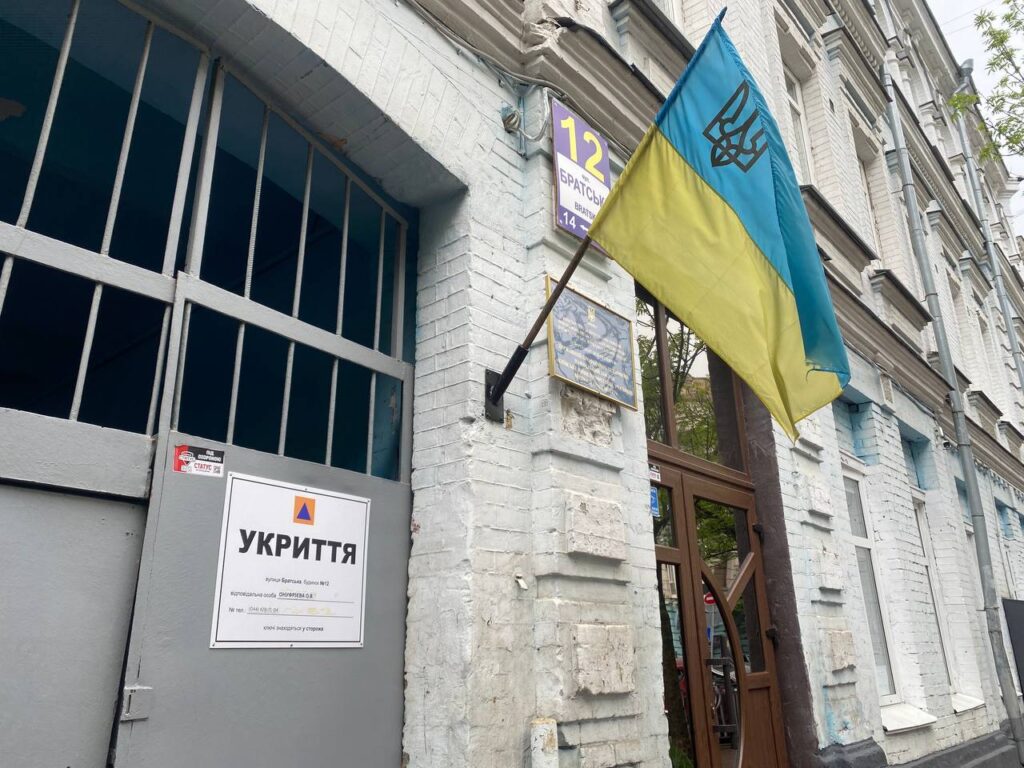
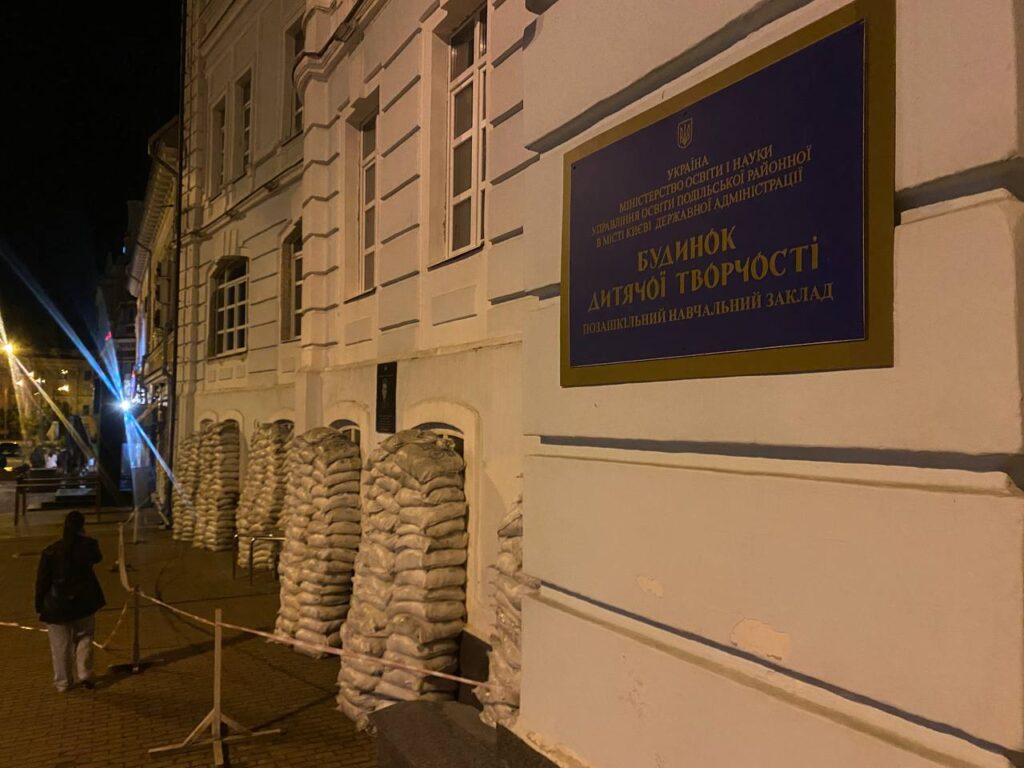
Nearby, theatres and exhibitions remain open. Women in elegant dresses and high heels step into cafés. Yet the streets are not particularly crowded, and reminders that this is still a city at war are impossible to miss: sandbags stacked outside buildings and signs marked “Shelter” in almost every public space.
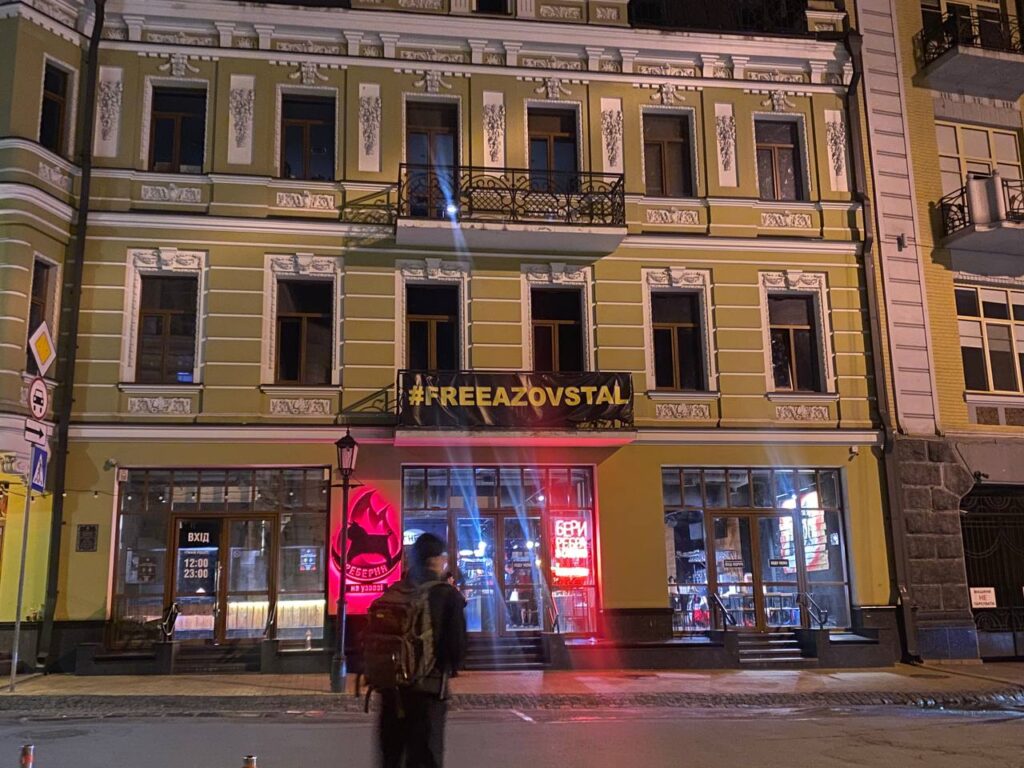
“Thank you for visiting, ma’am. We look forward to seeing you again after victory,” a restaurant manager tells me, politely hinting that I have spent rather too long photographing the restaurant’s signature Kyiv cake in the display window. Evening is the time when everyone in Kyiv hurries home. Curfew begins at midnight, and neither the blooming chestnut trees nor the beauty of a May sunset changes that. But going home offers no guarantee of a peaceful night. Everything depends on Russian attacks.
Everyone carries air raid alerts in their mobile phone. A nationwide app provides warnings for every region and city. Ukrainians also rely heavily on dedicated Telegram channels. As a result, dinner conversations often begin not with the menu but with intelligence updates:
“Just got word that aircraft have taken off from the Far East. That means we still have five or six hours. Enough time to get some sleep.”
“Tonight it won’t just be Shaheds. There will be ballistic missiles too.”
And there is always a separate explanation for those experiencing wartime Kyiv for the first time:
“Never ignore an air raid alert. Make sure you go down to the parking garage — it’s a reliable shelter and the exit won’t be blocked by debris. Don’t stay in the lobby. If a missile lands nearby, the blast will shatter all the glass.”
This turns out to be useful advice, because the air raid alerts in my hotel are delivered by a pleasant female voice. That is not nearly enough to wake me up. A few hours later, with the bombardment already under way, my colleagues had to call my room three times with a stern warning:
“Whatever you do, don’t take the lift. Use the stairs and get downstairs immediately.”
One thing I have learned is that wartime fashion appears to have staying power. A trench coat really does go with everything. You can throw it on over your pyjamas and still look respectable enough to doze off in a bomb shelter.
At dawn, another notification finally appears on the app: “Air raid alert over.” Kyiv residents insist that when that message comes through, it really does mean the danger has passed and life can return to normal.
That is exactly what people across Ukraine do. Once the alert is lifted, they get ready for work, take their children to school and kindergarten, and head to the shops. Daily life resumes almost immediately.
Last winter was difficult. Power cuts were frequent, creating major challenges for people living in high-rise apartment blocks. Yet most Ukrainians adapted. Even during blackouts, lifts in many buildings continued operating thanks to backup generators. Residents are now installing not only generators but also solar panels. As a result, even during critical periods, buildings can keep lifts running and provide hot water.
When I checked out of my hotel, the receptionist asked what sounded like a routine question: “Як вам сподобалося перебування в нашому готелі?” (“How was your stay at our hotel?”)
I answered quite seriously: “The syrnyky were excellent, but I can’t say I enjoyed the bombing.”
The exchange was so absurd that we both burst out laughing.
Five years into its fight against Russia’s invasion, Ukraine has become a remarkable case study — politically, socially and psychologically. To understand where that resilience comes from, I spoke with Oleh Saakyan, a political analyst from the Donetsk region and one of the most prominent voices of his generation in Ukraine.
“You were saying over dinner that relations between Ukraine and Russia have been damaged for the foreseeable future — perhaps forever. Is that how most Ukrainians see it?”
“Many Ukrainians believe the consequences will be felt for generations. We are already paying a heavy price for forgetting the lessons of our own history and for losing sight of what it means to live next to Russia.
“We are paying for our complacency, even though earlier generations warned us repeatedly — in the 18th, 19th and 20th centuries.
“So yes, Ukrainians are likely to view Russia with caution for a very long time. Not necessarily with hostility, but certainly with caution.
“There is no hatred of Russians as people. Large numbers of Russian citizens live comfortably in Kyiv and speak Russian openly.”
Ukrainians have a question they often ask: “Whose is Crimea?” They may ask it not only of Russians, but also of Germans or other foreigners. If someone answers that Crimea is Russian, that tells you a great deal about how they see the world. So this is not really a question of ethnicity.
“The sense of caution associated with Russian speakers — or, more accurately, with what many Ukrainians see as the mindset shaped by modern Russia — is likely to remain for at least a generation. Millions of Ukrainian children have been born and raised without ever knowing peacetime. Think of all those born in 2011, 2012 or 2014. Together, they would make up the population of a small European country. Many of them have no idea what life without war looks like.
“Children who were three or four when the full-scale invasion began are already at school. They have no memory of life without curfews or air raid sirens. They grow up knowing that their parents could be killed at any moment. Many have become so accustomed to death around them that they no longer react to it the way children normally would. Ukrainians are unlikely to forgive Russia for that any time soon.”
Do Ukrainians believe the end of the war is near, or do they expect it to continue for years?
“I think most Ukrainians feel the war has passed its midpoint and entered a new phase. The turning point came in 2025. Russia reached the height of its military power in 2024. By 2025, that peak had passed, and the Russian war machine entered a period of stagnation during the second half of the year. My view is that by 2028, it will no longer be Putin sending New Year greetings to Russians.”
Is there really a Ukrainian meme about Mala Tokmachka, the village the Russian army has failed to capture for four years?
“That only became a meme in recent months, largely thanks to Russian television. Before that, most Ukrainians had never heard of Tokmachka. Fewer than a hundred people live there.
“Now, however, Mala Tokmachka is likely to earn a place in history as a settlement that remained under siege for more than 1,500 days. Even Carthage held out for only around 700. As far as I know, no settlement anywhere in the world has endured a siege for that long since the Punic Wars.”
Do Ukrainians compare their wartime experience with Israel’s?
“At first they did, but I have not heard those comparisons for at least two years. Ukraine has developed its own experience, one that stands on its own and differs significantly from Israel’s. Israel is not facing the same kind of sustained attacks with long-range precision weapons.
“Ukraine is fighting a country far larger than itself, one that deploys advanced military technology. However crude some of that equipment may appear at times, it still reaches its targets and causes destruction.
“There is now a widespread feeling that the conditions Ukraine faces are harsher than those experienced by Israel. At the same time, Ukrainians know they can endure them. Suffering is not something that can be measured or ranked, but Ukraine’s experience has become so distinct that comparisons no longer seem particularly useful.”
Russian attacks have become part of everyday life in Ukraine. What is their broader purpose?
“Of course, one aim is to destroy infrastructure and strike specific targets. But civilian neighbourhoods and cultural sites are also targeted repeatedly. For example, Russian forces deliberately burned down the last surviving wooden palace-museum in the Kharkiv region, a building that had stood for centuries and threatened no one.
“They are deliberately destroying museums and cultural heritage sites. The purpose of this campaign is terror — to frighten people and break their spirit. But they have chosen the wrong country for that.”
How is it that Ukrainians have complied with the curfew for years?
“Not everyone does, but well over 90% of people do. Ukrainians are not naturally known for strict obedience to rules. What matters to us is not legality but legitimacy. We follow rules when we believe they are justified.
“The curfew is widely seen as a necessary wartime measure, which is why violations are relatively rare. People complied even when it began at 10pm.
“What surprises many foreigners is that there is no specific punishment for breaking curfew. If the police stop someone, they check their documents. If everything is in order, they will usually issue a warning and send the person home. At most, they might take them to a police station and keep them there until five in the morning.”
As he speaks, a patrol car pulls over a driver who has made an illegal turn on a nearly empty street. The officer begins writing out a fine. Saakyan points towards the scene.
“There are hardly any soldiers in central Kyiv. Ukrainian civic culture is built around self-organisation. Crime levels in Kyiv today are comparable to those in most European cities, and in some respects even lower.
“At the height of wartime solidarity in 2023 and 2024, people joked that you could leave your apartment door unlocked. There was a powerful sense that everyone was in the same boat. It was difficult to imagine a burglary or a car theft because society had become unusually cohesive.”
He points to another example.
“When the government tried to bring the anti-corruption agency under its control and the so-called cardboard protests broke out, only the dialogue police were deployed. Officers carried no weapons and no batons. Their job was to help journalists move around, maintain public order and make sure ambulances could get through.
“There were no riot police units. The police actually helped reporters cover the demonstrations. At most, there were thirty officers in the entire square.
“And this was happening directly outside the presidential office, which is protected by little more than a metal fence and a handful of guards. The authorities are effectively signalling that they are not afraid of society, and society responds in kind by acting responsibly during wartime.
“It is not really about respect for the law. It is about respect for order and fairness.”
I tell him that what strikes me most is the absence of fear.
Ukrainians are angry. They are frustrated. They reject Russia’s actions. But I have not encountered fear — not at any level. And whenever a foreigner describes President Zelensky as a particularly courageous leader, many Ukrainians rush to offer a correction: it is not that the president is exceptionally bold, they say, but that the public is, and the country’s leaders have little choice but to keep up.
“When the war began, I said that Putin had every opportunity to invade Ukraine, but no opportunity to emerge victorious from it.
“Ukrainians possess several qualities that Russia has never encountered in previous wars. First, we simply do not fear Russians. There is no personal fear of them.
“Second, we have strategic depth. A tank can travel 180 or 200 kilometres before it needs fuel. You can cross the entire Baltic region, reach the sea and drive back on a single tank. Ukraine is different.
“When the Persian king Darius campaigned here in Scythian times, ancient accounts complained that it was impossible to wage war against these barbarians. They would burn the land behind them, leaving no fodder for horses, and attack in small mobile groups.
“Ukraine applied a similar logic. It allowed Russian forces to push deeper into the country, stretching their supply lines and running them short of fuel. Then it began targeting logistics. Once supply chains break down, you do not need sophisticated weapons to cause serious damage.”
He pauses before adding:
“That is a luxury neither Georgia, nor Armenia, nor the Baltic states possess. Ukraine does.
“Our entire history has prepared us for this moment. We understand that our generation has been given an opportunity many before us never had — the chance to defeat Russia once and for all.”
Interview with a Ukrainian political analyst