New details emerge in killing of Chechen woman in Yerevan






Details of Aishat Baymuradova’s killing in Yerevan
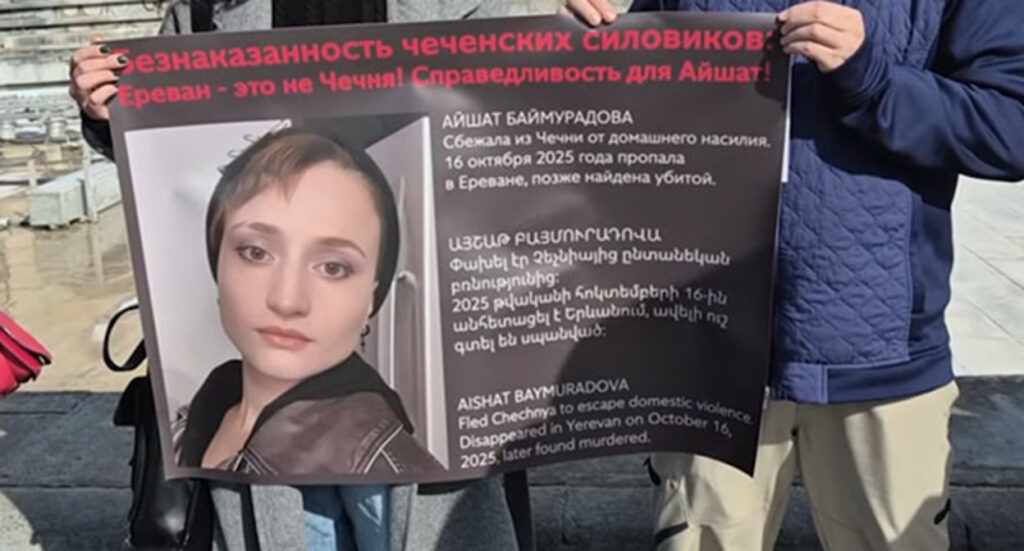
New information has emerged about the death of Aishat Baymuradova, a young woman from Chechnya who was found dead in Yerevan. David Isteev, head of the crisis group SK SOS*, citing a source close to the investigation, said:
“She was found inside the apartment near the front door. Because her T-shirt had been pulled up, investigators believe she may have tried to escape. According to the initial assessment, she suffered for a long time before she died. The scene indicated that those responsible stayed in the apartment until her death.”
Aishat Baymuradova, 23, had fled domestic violence in Chechnya with the help of human rights defenders and had been living in Yerevan since January. On 15 October, she failed to return home after meeting a friend. Police declared her missing on 17 October, and on 19 October she was found dead in a rented apartment in the Armenian capital.
Armenia’s Investigative Committee has opened a criminal case into the alleged premeditated murder of Aishat Baymuradova. Two people are considered suspects, though Armenian law enforcement has not disclosed their names. Investigators have questioned witnesses and carried out a range of forensic procedures, including a medical examination and a genetic analysis of fingerprints found at the scene. The committee said both suspects have been placed in pre-trial detention and are currently being sought by police.
According to SK SOS, police earlier identified two individuals seen leaving Baymuradova’s Yerevan apartment on the day of her death, using footage from surveillance cameras: Karina Iminova, an acquaintance of Baymuradova from Instagram, and Said-Khamzat Baysarov, a man originally from Chechnya.
Further details about the October killing have been reported by the Caucasian Knot, along with an analysis by Alexander Praht published by the Armenian outlet CivilNet.
- 10 deaths in 4 months: rights activists alarmed by prison conditions in Armenia
- ‘Gyumri — foothold of counterrevolution’: opposition candidate elected mayor of Armenia’s second-largest city
- ‘Mr Pashinyan, please confirm that I did not cooperate with Armenian intelligence’ – letter from Azerbaijani activist
New details emerge about the killing of Aishat Baymuradova
The Caucasian Knot cites David Isteev, head of the Crisis Group at SK SOS, who said that Aishat Baymuradova suffered for a long time before she died and that the perpetrators waited for her to succumb. The outlet continues:
“One Russian media outlet operating abroad published a report on Aishat Baymuradova today. It claims that Karina Iminova, who summoned Aishat to a meeting on 15 October, had arrived in Yerevan only a day earlier, on 14 October. On 16 October, Iminova and Said-Khamzat Baysarov reportedly left the apartment where Baymuradova was dying and flew to Moscow. The Caucasian Knot can provide the source of this information on request.
According to human-rights activists, including the founder of the Marem group Svetlana Anokhina, Iminova gained Aishat’s trust by saying she could help her move from Armenia to Europe. Baymuradova had recently tried to obtain a humanitarian visa to Germany but was denied.
Baymuradova’s body remains in the morgue, and Armenia’s Investigative Committee has not released official findings on the cause of death. The report says the forensic examination could take up to a year. A source close to the investigation claims that someone may have poisoned Baymuradova, although earlier reports speculated that she died from suffocation. David Isteev warned that Armenian authorities might “downplay the case and hand it over to Russia.”
Anokhina also confirmed that Baymuradova was related to the head of Chechnya, and that several of her close relatives served in the security forces. One of her friends said that she “loved her homeland deeply, called herself a proud Chechen and wanted Chechnya to be free from Kadyrov”.”

‘Baymuradova’s killing viewed as a threat to Armenia’s national security‘
CivilNet published an analysis by Alexander Praht, who links Chechen leader Ramzan Kadyrov to the killing of Aishat Baymuradova in Yerevan. He writes:
“According to preliminary information, she became the victim of a so-called ‘honour killing’ – a brutal practice still found in some Muslim communities of the North Caucasus, where relatives kill women for actions that, according to patriarchal traditions, allegedly ‘dishonour the family’.
Abductions and ‘honour killings’ outside the North Caucasus are impossible without the protection and connections of families linked to influential figures in Ramzan Kadyrov’s inner circle.
Perpetrators can organise such crimes through these channels, or by directly pressuring or threatening law enforcement in other regions.
The systemic problem of recent years is not some generalised ‘barbarism of the North Caucasus’, but the fact that ‘honour killings’ carried out beyond the region, or even within Russia, now occur almost exclusively within the network of influence created by Kadyrov’s system.
Kadyrov’s network also played a role in the killing of Chechen national Aishat Baymuradova in Yerevan.
According to human rights defenders who asked to remain anonymous, the young woman fled Chechnya last year, leaving behind her husband and child. She endured systematic abuse – first from her father, then from her husband, who forced her into marriage at a very young age.
After escaping, she did not go into hiding: she maintained active social-media accounts, openly argued with Kadyrov loyalists and encouraged other women to speak publicly about domestic abuse.
‘She did not follow safety precautions, she stayed in contact with our other clients and urged them to speak out against the authorities and tell their stories. We repeatedly warned her not to do this,’ a human rights advocate told Novaya Gazeta Europe.
On 15 October, Aishat went to meet a new acquaintance from Instagram – a woman named Karina, who introduced herself as being from Dagestan. It later emerged that Karina was not from the North Caucasus at all. But she had travelled to Chechnya several times and had followers linked to Kadyrov’s entourage, including Rubati Mitsaevа.
Mitsaevа once supported Ichkeria, lived in Europe and criticised Kadyrov. But in 2021 she posted a video asking for forgiveness and permission to return home. Kadyrov allowed her to return, and Chechen authorities welcomed her as someone who had ‘repented. Today, Mitsaevа actively speaks about the “corruption” of pro-Ichkerian activists in Europe and supports the official line of Grozny.
On 17 October, Yerevan activist Daniil Chebykin reported that Baymuradova had not been in contact for three days. Two days later, authorities found her body in a rented flat on Demirchyan Street – the place she had presumably gone for that meeting.
Although Chechen groups have attempted to kidnap women abroad before – including in Germany and Georgia – such an event is unprecedented for Armenia. And in this case it resulted not in an attempted abduction, but in a killing.
This marks a new and troubling stage. Individuals directly or indirectly linked to Kadyrov can now travel to Armenia. They can commit a murder and leave the country without hindrance.
Human rights defender Artur Sakunts told CivilNet it is unlikely Armenian law-enforcement bodies can be blamed: the suspects almost certainly fled to Russia immediately, while Baymuradova’s body was only discovered four days later.
People in Armenia should not dismiss this incident as “internal Chechen matters that have nothing to do with us”.
Kadyrov and his allies have ruled Chechnya for nearly two decades. They have turned it into one of the most lawless places in the world. Killings, torture and abductions occur there systematically. It has long been clear that this violence extends far beyond the republic. Kadyrov’s associates act with impunity in other parts of Russia.
Now it appears that individuals linked to his circle can kill with impunity even in Yerevan.
Aishat Baymuradova did not apply for asylum in Armenia. She did not report any threats. She also did not formally seek protection. Authorities in Armenia now face the challenge of preventing similar incidents. They must consider what measures could stop such crimes from happening again.
Formally, the country had no obligations toward her – for objective reasons. But Armenia now has to address the consequences of perpetrators committing a crime on its territory.
The answer is obvious, though many may find it uncomfortable. Armenian authorities may need to strengthen border controls. They could develop guidelines that require more detailed questioning of travellers. They could also increase screening for people coming from higher-risk regions.
This must not, of course, restrict access to asylum for those who need it. It is also important to remember that women in the North Caucasus often do not have international passports. This lack of rights makes Armenia one of the few places they can reach for protection.
Is ethnic profiling at the border a discriminatory practice? Without a doubt — and that is its weakness. The problem is that even minimal discrimination can become another weight on the scales labelled “authoritarianism”. Almost every restrictive measure can be justified on national-security grounds.
Kadyrov-linked criminal groups must not operate freely in a democratic, majority-Christian country. Levels of violent crime there are extremely low. This makes it a serious national security issue.It is a matter of the highest order.
In Georgia, border officials regularly deny entry to people from the North Caucasus. They also refuse entry to other groups, including programmers, Russian democratic activists, and Iranian and Indian nationals.nners. Such practices always carry the risk of arbitrary restrictions, which eventually begin to affect a wider range of people.
But when the alternative involves real human lives, authorities and society must treat the issue with the seriousness it deserves.
After all, Armenia must claim the right to set its own rules for foreign nationals. Without this, it cannot fully manage border procedures. Why, then, did it remove Russian border guards from Zvartnots Airport in the first place?
Details of Aishat Baymuradova’s killing in Yerevan