What Pashinyan and Putin agreed in Bishkek amid peak tensions in relations






Pashinyan-Putin meeting in Bishkek
Armenian Prime Minister Nikol Pashinyan and Russian President Vladimir Putin met in Bishkek, where an SCO+ meeting was held as part of the Shanghai Cooperation Organisation summit. Their talks took place late in the evening.
There was no shortage of issues to discuss as bilateral relations have recently become increasingly strained. The previous meeting between Pashinyan and Putin took place on 1 April. Since then, Armenia held parliamentary elections in June, in which Pashinyan’s party won a majority and formed a government. However, the Russian president has yet to congratulate Pashinyan on his victory.
Judging by statements from Moscow, the main issue concerning the Russian authorities is Armenia’s ambition to join the European Union.
In the opening minutes of the Bishkek meeting, Putin said Armenia’s aspiration to join the EU was the country’s legitimate right. However, he said this “creates difficulties” for Armenia’s membership of the Russian-led Eurasian Economic Union (EAEU).
“The sooner Armenia decides on the issue of joining the EU, the better. Moscow needs to understand how to develop relations further. The adoption of a law launching the process of Armenia joining another organisation amounts to a declaration of withdrawal from ours,” Putin said.
Pashinyan responded by reiterating that Armenia had no intention of leaving the EAEU.
The Armenian prime minister also recalled that, under the EAEU’s charter, there was no procedure for expelling a member state unless the country itself decided to leave.
“We greatly value our relations with the Russian Federation. We hope these relations are important to Russia as well. I think that Armenia and Russia, and we personally, should treat these relations with great care. I want to confirm that I personally and our government treat them with great care. I am sure that you also treat these relations with great care, and I want to thank you for that,” Pashinyan said.
He stressed that the issue of EU membership had not yet reached the stage at which a referendum could be held. He explained that Armenia did not currently have the alternative of actual EU membership to put before the public. In other words, the issue would be decided once the Armenian authorities had a concrete alternative to offer voters.
Putin, however, stood his ground: “The people should indeed always have a choice. So give them one, and we will close the matter. That’s all. The simplest thing is to ask people: what do you want — this or that?”
After the meeting, the Armenian prime minister posted a video on social media summarising the outcome of the talks.
Pashinyan described the meeting as “very good” and said he and Putin had agreed to continue their “sincere and constructive dialogue” during his visit to Moscow, which is apparently expected to take place in the near future.
“It should be noted that bilateral relations between Armenia and Russia are extremely important for both countries. […]However, it should also be noted that, in the new environment and under the new circumstances, there is a need to rethink these relations. I am convinced that, as a result of this reassessment, relations will become better, more constructive, more mutually beneficial and warmer,” he said.
Context: other issues on agenda
In Armenia, the meeting had been expected to involve difficult discussions on several critical issues. Armenian analysts had also warned that the meeting was unlikely to produce any positive developments on any of them.
In Armenia, there were expectations that the two leaders would discuss holding a referendum on whether the country should remain in the EAEU or pursue EU membership.
Russia and other EAEU member states have recently been pressing for such a referendum. The Armenian authorities have responded that there is little point in holding one at this stage, as the country has not yet formally applied for EU membership.
The EAEU comprises Russia, Belarus, Armenia, Kazakhstan and Kyrgyzstan.
Meanwhile, there has already been talk within the EAEU of discussing Armenia’s status in the bloc. However, under the union’s charter, only Armenia itself can decide to withdraw. As Pashinyan has repeatedly pointed out, there is no other procedure for ending its membership.
At the same time, on 24 August, the Armenian prime minister raised the possibility of submitting a formal application for EU membership. This prompted a fresh wave of criticism and an even sharper reaction in Russia. Commentators there said that “EU membership is a marathon lasting decades”, while Yerevan would feel “the costs of breaking with Russia and the EAEU here and now”.
Russian experts even predicted a “fatal outcome” for Armenia. According to them, the country faces a choice between “Turkification” and a “Ukrainian scenario”.
The two leaders had also been expected to discuss Russian restrictions on imports of Armenian food and other goods, which were introduced in May and remain in place.
Russia has traditionally been a key export market for Armenia. However, since the restrictions were introduced — which Russia has attributed to concerns over product quality — Armenian goods have increasingly been exported to EU countries, where higher standards apply.
Armenian analysts had also expected the two leaders to discuss Armenia’s membership of the Russian-led CSTO military alliance.
The Collective Security Treaty Organisation comprises Russia, Belarus, Kazakhstan, Kyrgyzstan, Tajikistan and Armenia.
Armenia has effectively frozen its participation in the organisation for the past two years in response to what Yerevan sees as inaction by its allies.
When Azerbaijani forces entered Armenia’s sovereign territory in 2021-22, its CSTO allies neither intervened nor condemned Baku’s actions. They argued that the Armenian-Azerbaijani border had not been delimited. Pashinyan responded:
“To say that there is no border between Armenia and Azerbaijan is to say that the CSTO has no defined area of responsibility. And if there is no area of responsibility, then there is no organisation.”
While Pashinyan had previously said he was not concerned about the possibility of Armenia being expelled from the military bloc, just a week before his meeting with Putin he went further, saying he would welcome such a move:
“At least it would relieve us of the dilemma of whether or not to leave [the CSTO].”
In addition, ahead of the leaders’ meeting, Russian presidential aide Yuri Ushakov said the talks would take place at a time “when opposition leaders are being arrested en masse in Armenia”.
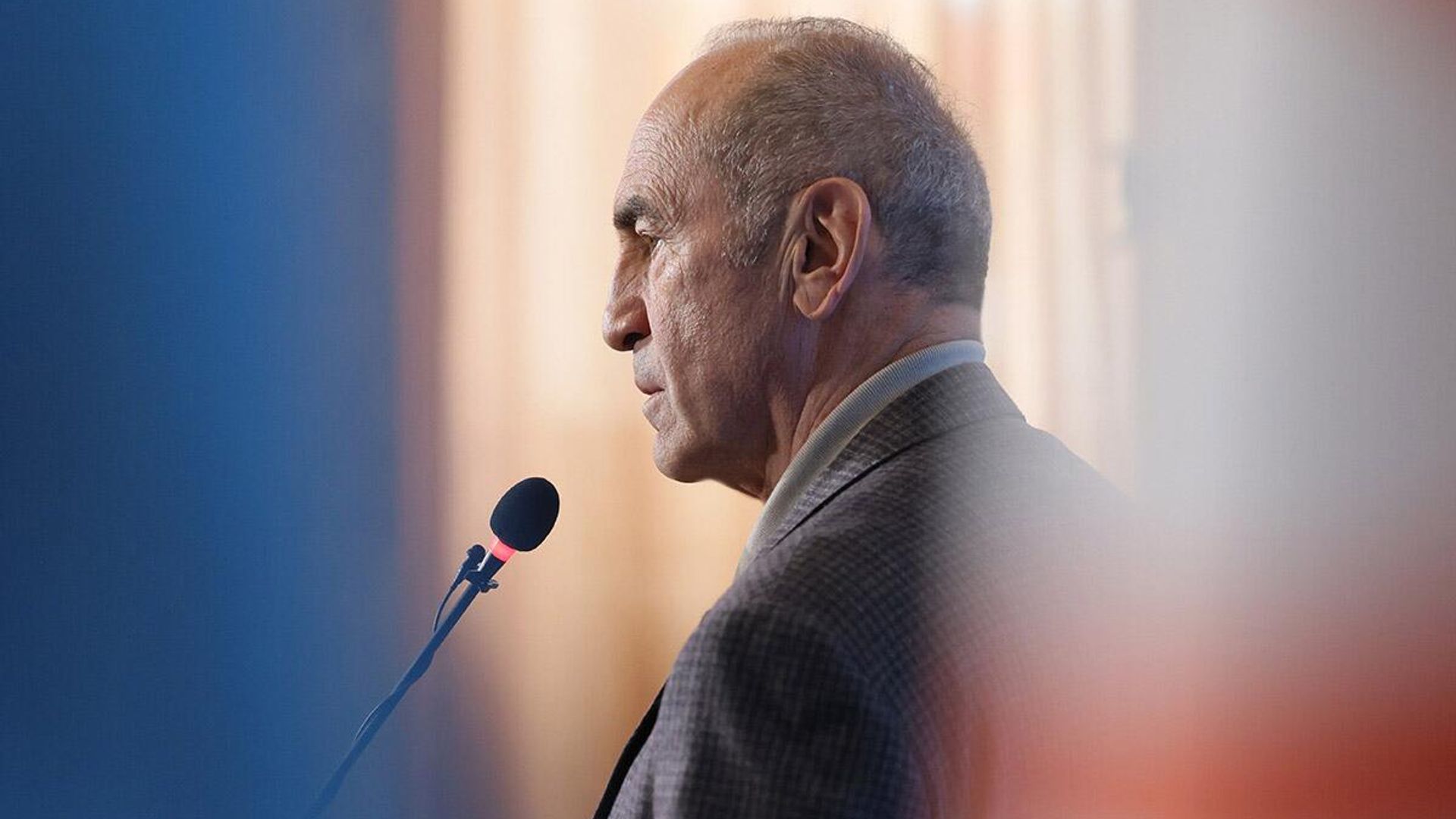
He was referring, among others, to the arrest of former Armenian President Robert Kocharyan. Kocharyan is accused of abuse of office, accepting a particularly large bribe and money laundering. A court ordered him to be held for two months. It is the former president’s fourth arrest.
In Armenia, there was speculation that Putin, who has close ties with Kocharyan, might once again ask for his release.
During his previous meeting with Pashinyan in April, Putin expressed hope that Russia’s “friends” and pro-Russian political forces would be able to take part in Armenia’s elections.
He was believed to have been referring to the party of Russian businessman Samvel Karapetyan, who is currently under house arrest on charges of making calls to seize power, as well as a bloc led by former President Robert Kocharyan. Both contested the elections but failed to secure a parliamentary majority.
Representatives of Armenia’s ruling party believe that these pro-Russian forces are encouraging the Russian authorities to take steps that could fuel public discontent. Pashinyan’s team believes the opposition hopes to use such discontent as a means of coming to power.