Laura Thornton on Georgian Dream: 'Why should US leaders meet those who insult our ambassadors?'






Laura Thornton on Georgian Dream
The absence of Georgia from the itinerary of the US vice-president’s visits to the South Caucasus is not merely a diplomatic detail, but a signal that the Georgian Dream government is viewed in Washington as an isolated and politically insignificant partner. That is according to Laura Thornton, director of global democracy programmes at the McCain Institute, in an interview with InterpressNews.
Laura Thornton said there was no reason for US leaders to meet a government that has insulted Western diplomats, accused them of seeking to open a “second front”, and supports forces chanting “Death to America”.
Thornton argues that the international isolation of Georgia’s government is a logical consequence of the policies pursued by Georgian Dream over many years. She says the ruling party should not be surprised, as it has done little beyond discrediting the United States and its traditional allies while moving closer to the West’s main adversaries.
At the same time, Laura Thornton stressed that this isolation does not extend to the Georgian people. She said many in the West continue to advocate for support for Georgian democracy, even though the current government is no longer seen as a partner.
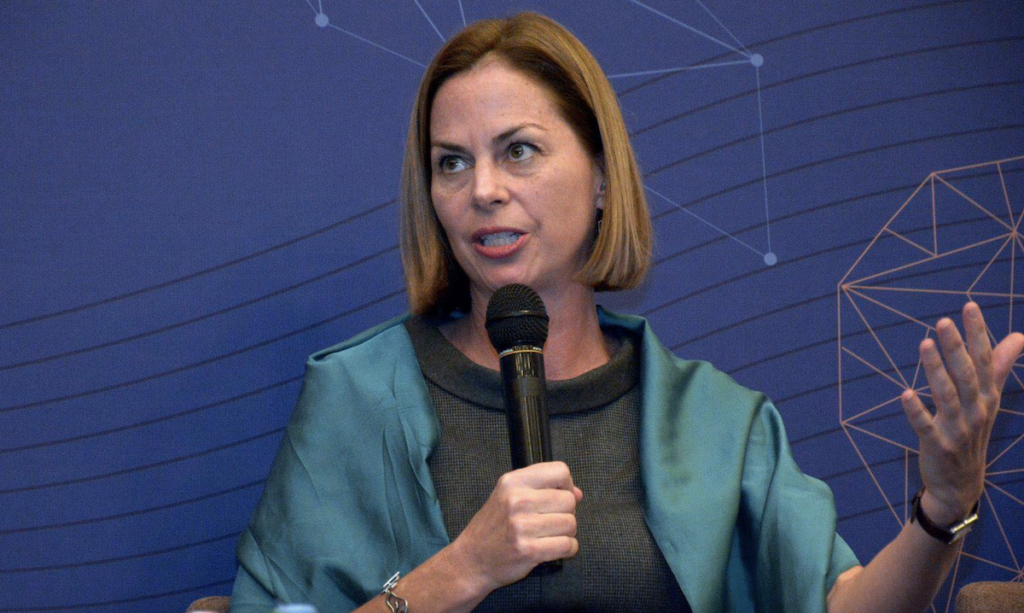
Thornton says a “reset” in relations between Tbilisi and Washington is virtually impossible under the current government. In her view, it would only become feasible following radical reforms, including new parliamentary elections with a reconstituted election commission, the release of political prisoners, legal accountability for those responsible for undermining democracy, and the repeal of anti-democratic laws.
At the same time, Thornton noted that Georgia is neither a key trading partner nor a source of vital resources for the United States. While Washington does engage with authoritarian regimes for strategic or security reasons, she said she sees no comparable motivation in Georgia’s case.
Speaking about the MEGOBARI Act currently under discussion in the US Congress, Thornton said that lobbying against it is largely driven by financial interests. She added that the bipartisan consensus — that Georgia is no longer a democratic and reliable ally — remains unchanged, but that in some cases just a handful of members of United States Congress can be enough to block a bill.
The MEGOBARI Act is a bill introduced in the US House of Representatives in May 2024 by Republican congressman Joe Wilson. The legislation would require the US president to impose sanctions on members of the Georgian Dream government and other individuals deemed to pose a threat to stability, security and democracy in Georgia. It mandates sanctions against members of the ruling regime, their supporters and their family members, including visa restrictions and asset freezes. The bill also calls for a comprehensive review of US–Georgia relations, including all assistance programmes. In May 2025, the US House of Representatives approved the MEGOBARI Act. It now requires approval by the US Senate. The final step would be the signature of US President Donald Trump.
Thornton said that even opponents of the MEGOBARI Act do not view Georgian Dream as a model of democracy or respect for human rights. She believes that, alongside the ongoing renewal of the US Congress, there remains a strong likelihood of increased pressure on the Georgian authorities through sanctions mechanisms, as the majority supports Georgian democracy rather than the current government.
In her planned testimony before the Helsinki Commission, Thornton intends to outline how Georgian Dream’s democratic project was fundamentally flawed from the outset. She argues that the party’s leader and main financier, Bidzina Ivanishvili, is a Russian oligarch who is not committed to liberal democracy or Western values.
Thornton explained that the essence of liberal democracy lies in a government’s willingness to lose elections — something she says is unacceptable to Bidzina Ivanishvili and his political circle. This, she argues, is where a systemic reaction begins: illiberal policies, a lack of transparency, the growing influence of security services, the failure of judicial reform, and attacks on civil society.
According to Thornton, these trends were reflected in events such as the so-called “Gavrilov Night”, the adoption of the “foreign agents” law, disinformation campaigns, intimidation, unfair elections, the suspension of EU integration, and a policy of appeasement towards Moscow following Russia’s full-scale invasion of Ukraine — including facilitating sanctions evasion.
She also pointed to government attempts to ban opposition parties, a growing number of political prisoners, and violence against protesters. Thornton noted that Georgian Dream’s closest partners today are Russia, Iran and China, adding that photographs of Georgian officials with Hamas have further widened Georgia’s geopolitical distance from the West.
Turning to legislative changes, Thornton said that efforts to suppress independent media and civil society often mark the final phase in the establishment of an authoritarian regime. In her assessment, the government itself recognises that independent media and the civic sector are the last bastions of democracy — and therefore seeks to eliminate them.
“Attacking these last bastions and removing space for dissent is often the final nail in the coffin of democracy,” Thornton said, adding that the new laws are aimed at restricting freedoms of expression and assembly that Georgian society has fought to secure over the years.
Thornton says her position is far from unique. She places herself among a group of experts who believe that Georgia is moving towards authoritarianism while pursuing a pro-Russian course.
According to Thornton, when a government is unable to justify its policies with facts and logic, it turns on its critics and seeks to discredit them — whether they are the European Union, the OSCE, US diplomats or European parliamentarians. Insults, she argues, cannot change reality or conceal the processes now unfolding in Georgia.
Laura Thornton on Georgian Dream