What Azerbaijan’s plan to place internal troops under presidential control could mean






Powers of Azerbaijan’s internal troops
The Milli Majlis has passed a new law placing Azerbaijan’s internal troops under the president’s direct control. Previously, the force reported to the interior ministry.
The authorities present the move as a necessary step to strengthen security. Critics, however, say it is aimed at further consolidating presidential power and could be used to suppress protests by force.
Opposition figures argue that direct presidential control over the internal troops leads to excessive centralisation of power and a dangerous expansion of the president’s authority.
Observers say the decision appears to be a form of advance preparation for possible social and economic unrest. Some point in particular to the risk of a crisis in 2026.
Observers say the move appears to be advance preparation for possible social and economic discontent, including the risk of a crisis in 2026.
- Interrogations in Azerbaijan: experts warn of government plan to crash opposition
- HRW: ‘Azerbaijan steps up campaign targeting critics abroad’
- In shadow of the Gaza war: peak in Azerbaijan–Israel relations
New law and the amendments introduced
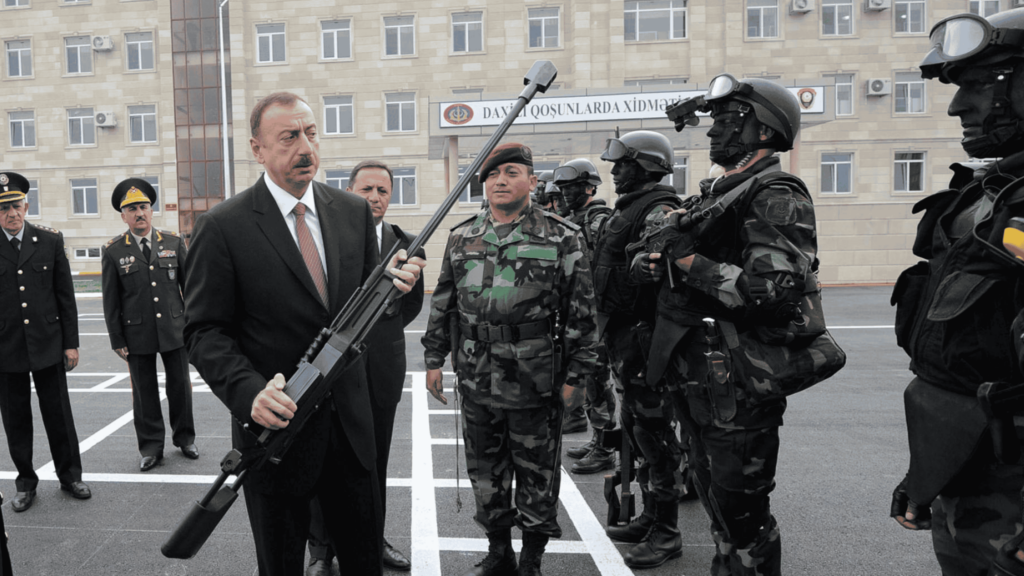
Azerbaijan’s internal troops are military formations responsible for maintaining public order. The newly adopted law introduces a number of significant changes to their status and powers. The key changes include the following:
Direct subordination to the president. The commander of the internal troops will no longer report to the interior ministry but directly to the president of Azerbaijan. The authorities justify this by citing the constitution, which defines the president as the supreme commander-in-chief of the armed forces.
Powers of detention and arrest. The new law grants the internal troops policing powers, including the right to detain and arrest suspects. Previously, they did not have such authority.
Prevention of unrest and unauthorised protests. The internal troops will now be able to take part in suppressing mass unrest and group violations of public order. Notably, the 1994 law explicitly prohibited their involvement in dispersing unauthorised demonstrations.
Use of force and weapons. The law expands the internal troops’ authority to use force. Their arsenal now includes tasers, rubber bullets, special equipment and other non-lethal means. The use of firearms is also permitted in extreme situations, such as terrorist attacks, hostage-taking, armed assaults and attempted mutinies.
Compared with previous regulations, these changes give the internal troops significantly broader freedom of action.
Officials frame the reforms as necessary to strengthen the country’s defence capacity and internal security. Arzu Naghiyev, chair of the relevant parliamentary committee, said the 1994 law had become outdated after the second Karabakh war in 2020.
“Adopting a new law is necessary to strengthen the country’s defence capability and ensure internal stability,” Mr Naghiyev said.
His remarks reflect the authorities’ broader narrative, which presents the changes as part of a modernisation of the security sector.
Official line: security and unified command
Officials and pro-government figures present the subordination of Azerbaijan’s internal troops to the president as a positive and necessary step. Their arguments focus on several key points.
- Alignment with the supreme commander principle
Elman Mamedov, a member of the parliamentary defence and security committee, noted that the president also serves as the supreme commander of the armed forces, which includes the internal troops. According to him, command should be unified, and there is nothing unusual in this change. Officially, it is described as eliminating a previously parallel chain of command and concentrating all security forces under a single centre.
- Updating the law to meet current needs
Authorities argue that the previous law on the status of the internal troops, adopted around 30 years ago, no longer reflected modern realities. Experiences from the second Karabakh war and the use of internal troops to maintain public order during the pandemic exposed gaps in their powers. The new law is intended to fill these gaps and improve the internal troops’ effectiveness both in wartime and during emergencies.
- Benefits of unified command
Official explanations point to the early 1990s, when different armed formations reported to separate centres of power, leading to chaos. Mamedov recalls that at the time, internal troops answered to one command, while Ministry of Defence forces answered to another:
“As a result, coordination was lacking, and the enemy [referring to Armenia] exploited this to seize our territories. Direct subordination of all security forces to the president now creates a unified command and prevents such disorder.”
From this perspective, authorities emphasise that the changes strengthen national defence through centralised management.
- Handling of protests
Mamedov dismissed opposition criticism as unfounded. He described claims that the change is linked to preparation for a looming crisis as “completely groundless.” Officials maintain that the amendments are purely legal and technical, with no political motive, noting that internal troops were already effectively under the president’s oversight and the new law merely formalises this arrangement.
Overall, the official narrative stresses security, stability, and unified command. The move is framed positively as a measure enabling more flexible and effective management of the country’s security forces.
At the same time, public and political implications, and potential risks to democratic values, remain a central point of discussion, prompting a range of critical assessments and hypotheses.й.
Criticism and concerns
Independent political analysts, human rights activists and opposition figures view the direct subordination of Azerbaijan’s internal troops to the president as a negative signal for democracy and civil society.
They argue that the move is driven not only by technical or legal considerations but also by the authorities’ desire to consolidate their own power. The main criticisms focus on several areas:
- Concentration of power and authoritarianism
Critics note that the changes further expand President Aliyev’s powers, effectively placing a personal armed force under his direct control. Some observers see this as establishing complete dominance of the head of state over other branches of the executive.
“Ilham Aliyev, fearing the loss of power in the event of a possible coup and trusting no one, is concentrating security forces in his own hands,” critics say. According to this view, the president is seeking to safeguard his authority by directly controlling all security agencies.
- Weakening of democratic oversight
Previously, internal troops were subject to oversight mechanisms within the interior ministry. Direct presidential control may reduce their accountability to parliament and society. Critics highlight the “risk of security forces operating outside civilian control.” Without effective parliamentary and judicial supervision, there is a greater likelihood that armed formations could be deployed within the country at the president’s personal discretion.
- Risk of forceful suppression of protests
A major concern is that the changes make it easier to disperse public protests under the guise of maintaining order. The law now allows internal troops to take part in breaking up unauthorised demonstrations, increasing the risk that peaceful actions could be treated as breaches of public order and met with force. Critics point to mass cases of police and military violence in Belarus in 2020 and Russia in 2019 involving the National Guard as cautionary examples. They fear that internal troops in Azerbaijan could now be mobilised in a similar way.
- Concerns about a potential 2026 crisis
Some analysts link the decision to the prospect of an economic downturn. Economists predict that Azerbaijan could face worsening macroeconomic conditions in 2026, with rising inflation and unemployment.
Natig Jafarli, chair of the Republican Alternative Party and an economist, said: “2026 is likely to mark the beginning of a crisis,” citing slowing economic growth, rising prices, and declining real incomes. Critics argue that the president is preparing in advance for potential public discontent.
In the event of a sharp economic decline, protests could become likely, and direct control over the internal troops would strengthen the state’s capacity to suppress them using military and police forces.
- The security versus freedom dilemma
The decision has reignited debate over the trade-off between civil liberties and security. Supporters argue that in the face of threats such as coups, terrorism or mass unrest, the state needs strong tools to respond.
Critics counter that giving the internal troops the legal authority to intervene in any protest risks further human rights violations. Ultimately, the critical perspective holds that placing the internal troops under the president undermines democratic governance. One person—the president—gains direct and unchecked control over the army, police, and internal troops, eroding the separation of powers and upsetting the balance between state institutions.
Powers of Azerbaijan’s internal troops