New interpretation of Georgia’s relations with Russia? How history is presented in new school textbooks






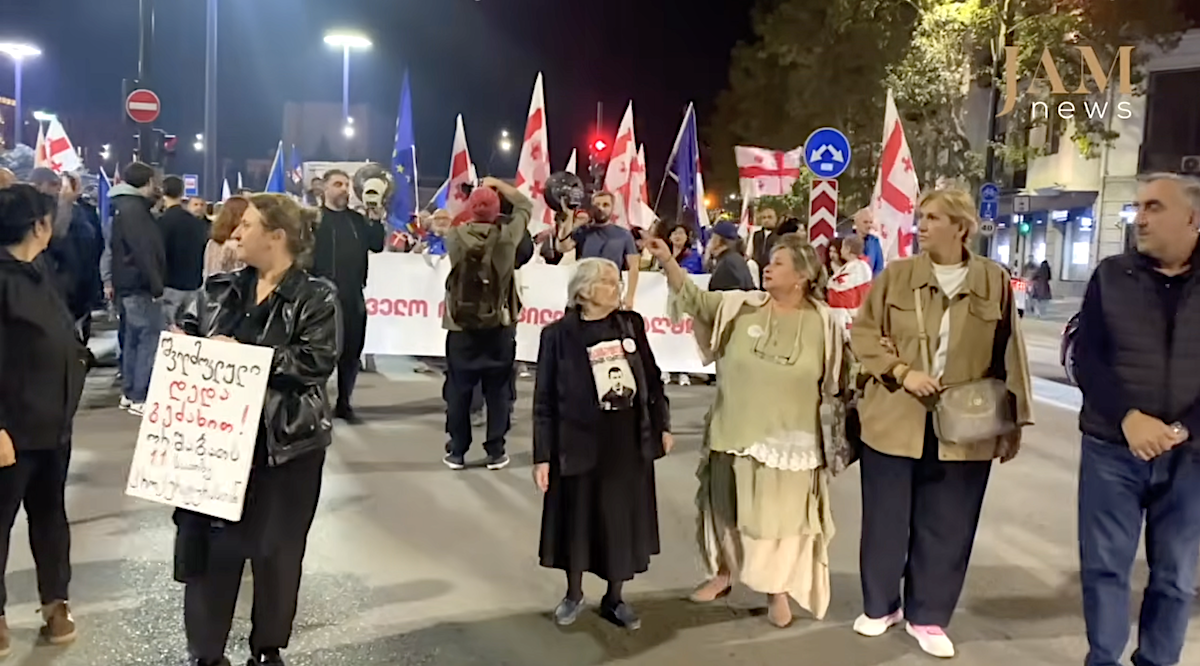
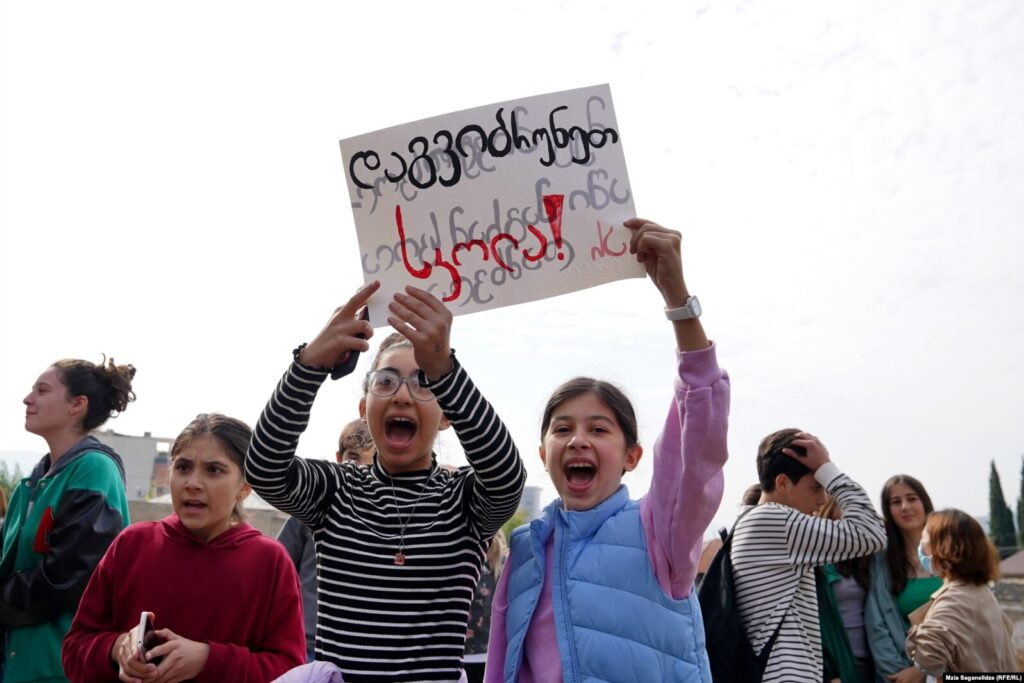
Protest against new Georgian history textbooks
From September 2026, state and private schools in Georgia have been teaching the country’s history using new textbooks. They immediately sparked widespread criticism.
Many teachers are angry that they had no opportunity to review the new Georgian history textbook for the 10th grade in advance. This is the penultimate grade in state schools.
The Education Ministry published the first part of the new textbook on 11 September — just four days before the school year began.
The textbook immediately became the subject of widespread criticism. Historians say it contains factual errors, inaccuracies, questionable wording and, in their view, distorted interpretations.
One of the main areas of criticism concerns the interpretation of historical events. This is particularly evident in the sections covering Georgia’s relations with Russia.
- ‘Occupation is off’: Russian state media RIA Novosti on Georgian PM Kobakhidze’s remarks
- Russian MoFA: Russia, Georgia ‘allies’ in defending ‘traditional values’ against West
- Is Georgia expecting a new wave of migrants from Russia?
Key new elements in the Georgian history textbook
So far, only the first part of the new textbook has been published. It contains 185 pages. Its cover features King David the Builder and Queen Tamar, monarchs associated with the “golden age” of Georgian history.
The textbook follows the “individual in history” approach.
This means that historical processes are presented through specific historical figures rather than in chronological order.
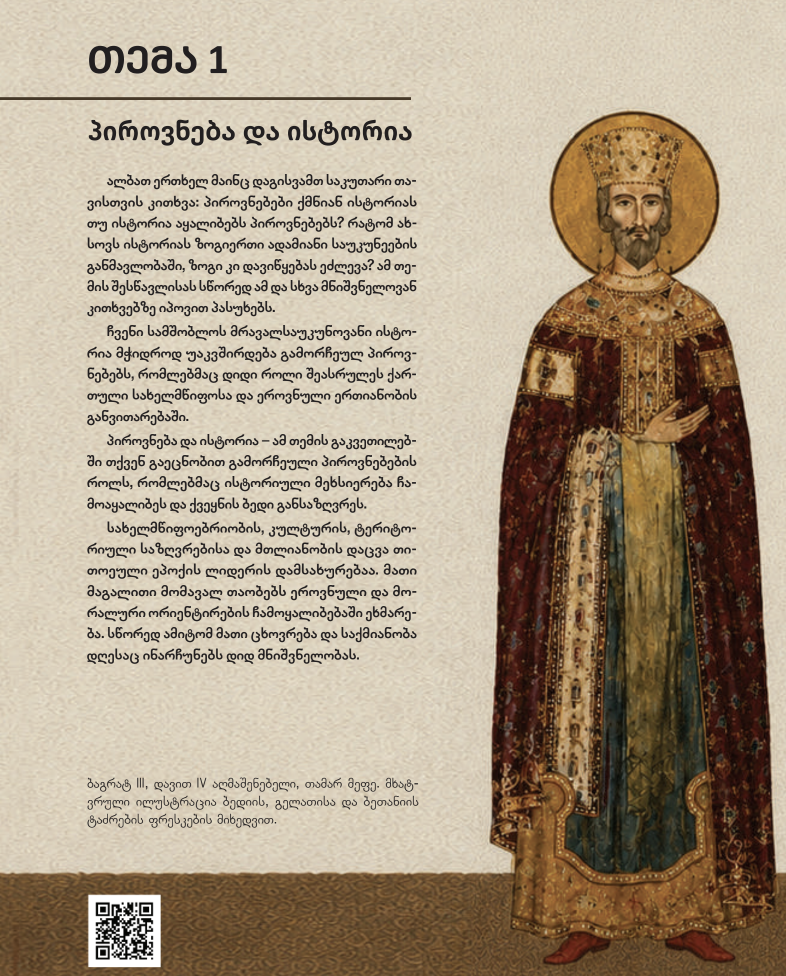
The authors explain their approach in the very first chapter:
“Perhaps everyone has asked themselves this question: do individuals make history, or does history shape individuals? Why does history remember some people for centuries while others fall into oblivion?
The centuries-old history of our homeland is closely linked to outstanding individuals who played a major role in the development of the Georgian state and national unity.”
The textbook begins with King Pharnavaz, who lived at the turn of the fourth and third centuries BC, and ends with the national liberation movement of the 20th century in the 1980s and 1990s.
Each lesson ends with sources, questions and exercises. Some sections also contain an “Expert opinion” box, which provides an assessment of a particular historical event.
The first page features a QR code. Scanning it with a mobile phone plays the Georgian national anthem.
Historians’ assessments: “Errors, outdated sources, no room for analytical thinking”
After finally getting an opportunity to examine the new textbook, many Georgian historians published sharply critical comments and reviews.
Scholars say the textbook contains factual errors and inaccuracies, while some of the historical sources it cites also raise questions.
“The authors make insufficient use of the latest research and new sources and often rely on historiographical views that took shape decades ago,” historian Shota Matitashvili writes in a detailed and highly critical review.
Historian and researcher of contemporary history Giorgi Arkania says the new textbook resembles a set of lecture notes, with no logical links between individual lessons.
According to him, the exercises in the book do not aim to develop students’ analytical thinking, encourage discussion or help them form alternative views.
Arkania also notes that the book’s content does not match its stated principle of studying history through individuals. The biographies are presented schematically and do not give students enough material for analysis.
Shota Matitashvili also notes that despite the “individual in history” approach, the textbook omits some important historical figures. In his view, these chronological gaps make it harder to understand the historical process.
“Students learn a lot about whom they should consider the makers of Georgian history. They learn much less about why history developed the way it did. And they learn even less about how we know, analyse and debate what this history means,” Professor Oliver Reisner wrote in his brief review.
According to him, teaching history with the aim of developing a democratic understanding of citizenship should not be limited to learning authoritative interpretations of the national past.
Students need to learn how historical knowledge is constructed, how to compare conflicting sources and interpretations, and how to develop their own evidence-based views of history, Reisner argues.

Giorgi Saakadze — unequivocal hero or controversial figure?
Giorgi Arkania pointed out numerous problematic passages in the textbook. One concerns Giorgi Saakadze, one of the most prominent figures of the early 17th century.
According to Arkania, the textbook presents Saakadze unequivocally as a positive hero, much as Soviet-era textbooks did.
The historian says, however, that Saakadze was a highly controversial figure. For example, during the devastation of Kakheti and the forced relocation of Georgians from the region, he served as one of Shah Abbas’s advisers and planned military operations for him.
“The section on Giorgi Saakadze should have presented both sides, allowing students to consider for themselves what role he should play in the history of the modern state,” the historian says.
Because of such details, some historians compare parts of the textbook to a toast — a story celebrating a legendary historical figure.
“The textbook fails to teach students the fundamental principle of history as a science — a critical approach to sources,” Shota Matitashvili writes.
He also criticises the authors for failing to use the latest research and new sources, and for often relying on historiographical views that took shape decades ago.
For example, one of the sources about King Vakhtang Gorgasali says:
“At the time, Vakhtang was 22 years old. And he was the greatest of all kings. He had a handsome appearance and great strength, so that he could hold up a building and a heavy iron hammer, lift a Georgian horse onto his shoulders and climb from Mtskheta to the fortress of Armazi.”
“A table toast” — this is how historian Giorgi Astamadze described the passage.
Many other excerpts from the book also reminded him of toasts.
A new, more positive interpretation of Georgia’s relations with Russia
Giorgi Arkania examined in detail one of the lessons — “Leaders of the national liberation movement” [of the late 20th century]. The lesson covers seven pages. The historian says he found at least ten errors in those seven pages alone.
In his assessment, the book misrepresents the main content of a proclamation issued by the Gorgasliani organisation.
Gorgasliani was an illegal underground anti-Soviet youth organisation. Among its members were Zviad Gamsakhurdia and Merab Kostava [well-known leaders of the national liberation movement — JAMnews], as well as other young people. They founded the organisation while they were still school students.
The textbook says that members of the organisation put up proclamations on the streets of Tbilisi condemning Soviet violence in Hungary.
However, the main purpose of the proclamations was not Hungary, but to call on people to fight for Georgia’s independence and freedom. They referred to the 9 March tragedy (1956) in Tbilisi and the events of 1924 and 1937, and called for resistance to Moscow’s rule. The proclamations described the Soviet regime as an occupier.
Context. According to various estimates, between 100 and several hundred people were killed in Tbilisi on 9 March 1956, when Soviet forces violently dispersed mass demonstrations. Security forces also opened machine-gun fire from the windows of the Ministry of Communications building at tens of thousands of people gathered on Rustaveli Avenue. The protests were sparked by Soviet leader Nikita Khrushchev’s speech denouncing Stalin’s cult of personality, in which he emphasised Stalin’s Georgian origins.
In August–September 1924, a large-scale armed uprising against Soviet rule, established in Georgia in 1921, swept across the country.
1937 — the peak of Stalinist repression and the beginning of the mass Great Terror.
“That was the main message of the proclamation. At the same time, its authors addressed the Hungarian people, who were gradually breaking free from Soviet control. This served as an example for Georgians: just as the Hungarians had raised their voices, the people of Georgia had to raise their voices against Soviet rule,” Arkania says.
From the text of the proclamation: “Georgians! Have you forgotten the bloody night of 9 March? Have you forgotten the bloody years of 1924 and 1937, the years of the expulsion and extermination of the Georgian people? How much longer must we bow our heads beneath the swords of the Communists? … Today, when all conscious humanity is outraged by Moscow’s terrible atrocities, when the very existence of our nation is at stake, the time has come to unite under a common flag and fight against the occupiers of our homeland … Down with the occupiers and their military hordes, whose hands are stained with the blood of our people!”
Historian Giorgi Arkania points to other factually inaccurate interpretations in the textbook.
“For example, the seventh paragraph of the lesson mentions only the arrest of Merab Kostava: ‘Merab Kostava was first arrested in 1956 … and for the second time in 1977.’ This gives students the impression that the Soviet regime did not persecute Zviad Gamsakhurdia,” the historian says.
He also disagrees with the textbook’s description of the events in Tbilisi from 22 December 1991 to 6 January 1992 as the “Tbilisi War”.
“In other words, a direct armed coup, the overthrow of Georgia’s constitutional order and the ousting of its democratically elected president are described as the ‘Tbilisi War’. The word ‘coup’ is not mentioned at all. Yet the state classified the event as a coup as early as the 2000s.
This was not simply the ousting of Zviad Gamsakhurdia. It was the overthrow of Georgian statehood. Ignoring this enormous crime and presenting it to schoolchildren in a distorted way is tantamount to a crime,” Arkania says.
Interestingly, the textbook Contemporary History of Georgia, published in 2008, assesses the events of 1991–1992 as follows: “In December 1991–January 1992, the legitimate government in Tbilisi was overthrown by military force. The military coup led to civil unrest in the country.”
A 2012 history textbook for 12th-graders published by Diogene begins its account with the escalation of the confrontation between the government and the opposition, while the relevant section is devoted entirely to the topic “The coup in Georgia (1991–92)”.
A new interpretation of the Treaty of Georgievsk, which brought Georgia into the Russian Empire
Historian Giorgi Astamadze took a particularly close look at the sections covering the later period of Georgian history and the country’s relations with Russia, especially the reign of King Erekle II and the Treaty of Georgievsk.
The Treaty of Georgievsk was signed on 24 July (4 August New Style) 1783 between the Kingdom of Kartli-Kakheti and the Russian Empire. King Erekle II renounced an independent foreign policy and accepted the protection of the Russian emperor. In return, Russia pledged to defend Kartli-Kakheti’s territorial integrity, preserve the rule of the Bagrationi dynasty and provide military assistance.
However, Russia did not fully honour its commitments. In 1795, when Agha Mohammad Khan invaded Kartli-Kakheti and devastated Tbilisi, Russian military assistance did not arrive in time. A few years later, Russia itself violated the treaty’s principles. In 1801, it abolished the Kingdom of Kartli-Kakheti and incorporated it into the Russian Empire.
The new textbook devotes a rather dry, informational section to the Treaty of Georgievsk.
The authors write that Erekle II unsuccessfully sought help from European monarchs. The Caucasus was a distant region for them. Therefore, the textbook says, Erekle II had to seek an alliance with the Russian Empire.
“On 24 July 1783, the Treaty of Georgievsk was signed. Under the treaty, Kartli-Kakheti accepted Russian protection while retaining internal independence and the autocephaly of its church. Under the agreement, Russian troops were also supposed to be stationed in Georgia to defend the country.” The lesson ends its discussion of the treaty there.
The textbook also includes a separate “Scholar’s opinion” box featuring the views of literary scholar Geronti Kikodze.
“In the quotation, Geronti Kikodze says that Erekle II had good judgement. He is referring to the treaty with Russia, which Erekle II himself was actually very dissatisfied with during his lifetime. It is interesting to ask who Geronti Kikodze was and why his opinion on this issue should appear in a school history textbook. Geronti Kikodze was not a historian at all. He was a literary scholar and therefore could not claim professional expertise in history,” Giorgi Astamadze says.
The historian recalled Kikodze’s ties to the Bolshevik authorities and the senior positions he held in the Soviet occupation administration. Giorgi Astamadze argues that “the openly collaborationist views of such a person on the national question have no basis, either in terms of his competence or from a moral standpoint.”
“The current Georgian regime’s publicly stated position that ties with Russia supposedly saved us has now been officially incorporated into a school textbook. And they have done so through the words of the writer Geronti Kikodze, presenting his opinion as a scholar’s view,” the historian says.
Interestingly, the previous Georgian history textbook included an assessment of the Treaty of Georgievsk by Ivane Javakhishvili, a classic of Georgian historical scholarship. He sharply criticised the treaty.
“The 1783 treaty brought nothing to Georgia. But the harm was enormous. Instead of improving Georgia’s political position, it made it dramatically worse. Much has been said about this treaty and the protection offered by the Russian state. In reality, however, the assistance Russia provided to Georgia was very limited,” Ivane Javakhishvili wrote.
Are the years 1918–1921 — the period when Georgia gained independence — missing from the textbook?
After the first part of the textbook was published, social media users actively discussed the absence of events from 1918–1921 — Georgia’s declaration of independence, the establishment of the First Democratic Republic, its political leaders and the subsequent Soviet occupation of Georgia in 1921.
Previous history textbooks treated this period as a separate and important topic.
Does this mean that 1918–1921 has been removed from the curriculum?
“It is not known yet. Historians consider this unlikely. Most likely, this material will appear in the next parts of the textbook. The introduction to the first part says that the textbook will consist of four parts.
In principle, the other parts should cover the First Republic, the Soviet occupation, the Soviet totalitarian system, the Russian-Georgian wars, including the August 2008 war. We are waiting. I hope the authors will write these sections in a way that dispels doubts and preserves the textbook’s factual character,” Giorgi Arkania says.
Does the textbook create the impression of a party narrative?
The authors of the new textbook are Jaba Samushia, Giorgi Kalandia and Aleksandre Boshishvili. Samushia also serves as a reviewer.
Jaba Samushia and Aleksandre Boshishvili are affiliated with the academic community of Tbilisi State University. Samushia has served as the university’s rector since 2022.
Giorgi Kalandia heads a state cultural institution. Since 2019, he has served as general director of the Art Palace of Georgia.
Because of these connections, some historians consider the authors affiliated with the ruling Georgian Dream party.
Additional questions concern the selection process: the state chose the authors, but it is unclear exactly how it did so.
“I hope that political considerations did not lead to certain issues being deliberately left unaddressed. However, after reading the textbook, one definitely gets the impression that some issues have been overlooked. For example, the coup I mentioned earlier.
The word ‘coup’ still creates a certain degree of political discomfort, and perhaps that is why the textbook does not give this period enough attention. The same applies to the proclamation.
Perhaps the authors considered it inconvenient to emphasise the word ‘occupation’ and remind students about the repressions,” historian Giorgi Arkania says.
Historian Giorgi Astamadze puts it more directly. He says the interpretations do not surprise him because historians close to Georgian Dream wrote the textbook. “I was completely certain that this was how it would turn out,” he says.
“We cannot allow new generations to remain unaware of what Russia has done to Georgia for more than two centuries: occupation, deception, humiliation, the abolition of the monarchy and the Church’s autocephaly, and the constant struggle against the Georgian Orthodox Church. These are facts that every young person in the country should know,” politician Pikria Chikhradze says.
On 14 September, she held a special briefing dedicated to the history textbooks. She said directly that “the authors linked to Georgian Dream used the opportunity to bring party narratives into school textbooks”.
Can schools refuse to use the new textbook?
For around two decades, Georgia had an entire textbook evaluation system. Different groups of authors and publishers produced textbooks, which the ministry then evaluated. Schools could have several approved textbooks for the same subject and grade and choose between them.
In 2026, the government began gradually replacing this system with a single state textbook model. Under the new system, the Education Ministry takes responsibility for producing textbooks.
Education Minister Givi Mikanadze said that the main principle would now be: “one grade — one subject — one standard textbook”.
Once the reform is complete, this principle should apply to both state and private schools. The ministry plans to complete the process by 2028.
But schools have no choice when it comes to the Georgian history textbook for the 10th grade discussed in this article. They must teach from this new book.
The replacement of school textbooks is part of a large-scale reform announced by the education minister. He spoke about the reform as early as October 2025.
The minister said the changes were necessary to ensure that school textbooks focused on “national values” and aimed to “raise citizens with a state-oriented mindset and national values”.
He also warned that the design of textbook covers would change, with “patriotic themes” appearing on them.
Protest against new Georgian history textbooks