Azerbaijan’s former powerbroker sentenced to 14 years, suspended, for treason


Mehdiyev, former powerbroker, sentenced in Azerbaijan
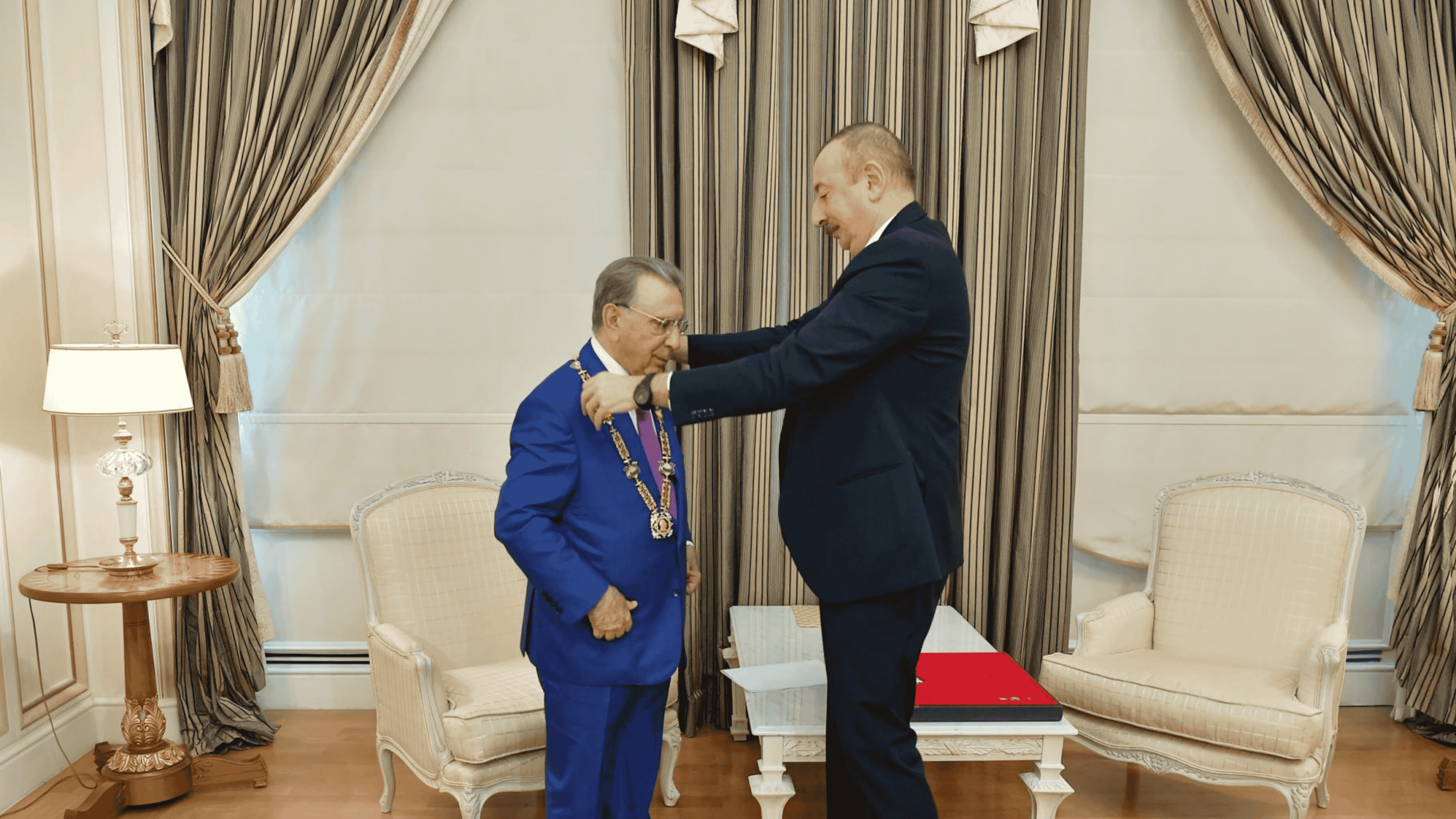
Ramiz Mehdiyev was a man who could influence who became a member of Azerbaijan’s parliament, which newspaper was shut down and who received a pardon. He headed the presidential administration for 24 years, first under Heydar Aliyev and then under Ilham Aliyev, chaired the pardons commission and was widely regarded as the country’s unofficial second-in-command.
He has now been found guilty of treason.
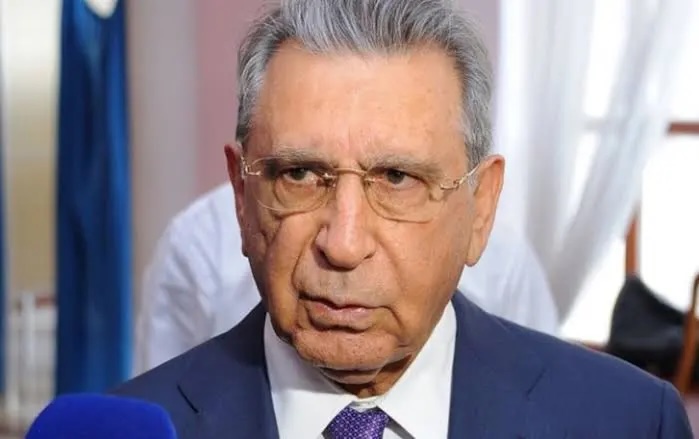
A Baku court sentenced Mehdiyev, 88, to 14 years in prison.
However, the sentence was suspended due to his age and health.
Despite being found guilty of attempting a coup, Mehdiyev will not go to prison.
Mehdiyev was convicted on four charges:
- Actions aimed at the violent seizure of power;
- Treason;
- Money laundering;
- Accepting a bribe on an especially large scale.
The court also ordered his property confiscated by the state and recommended that he be stripped of his state awards.
The verdict was delivered on 22 October, but became public only five days later, on 27 October. The trial was held behind closed doors, and the verdict has not been published. The list of confiscated assets and their value have also not been officially disclosed.
The verdict brings the criminal case to a close, but leaves unanswered the main question that has fuelled debate for the past year: why did Mehdiyev come under scrutiny, and why now?
In recent months, government officials, pro-government media, independent commentators and the opposition have offered different, sometimes contradictory, explanations.
Official version shifts from hints of Kremlin involvement to accusations against opposition
In the early days of the investigation, pro-government news agency APA presented its own account of events.
According to the agency, in early 2025, amid rising tensions between Baku and Moscow, Mehdiyev proposed a plan to Russia to overthrow Azerbaijan’s government and establish an interim State Council, which he intended to lead.
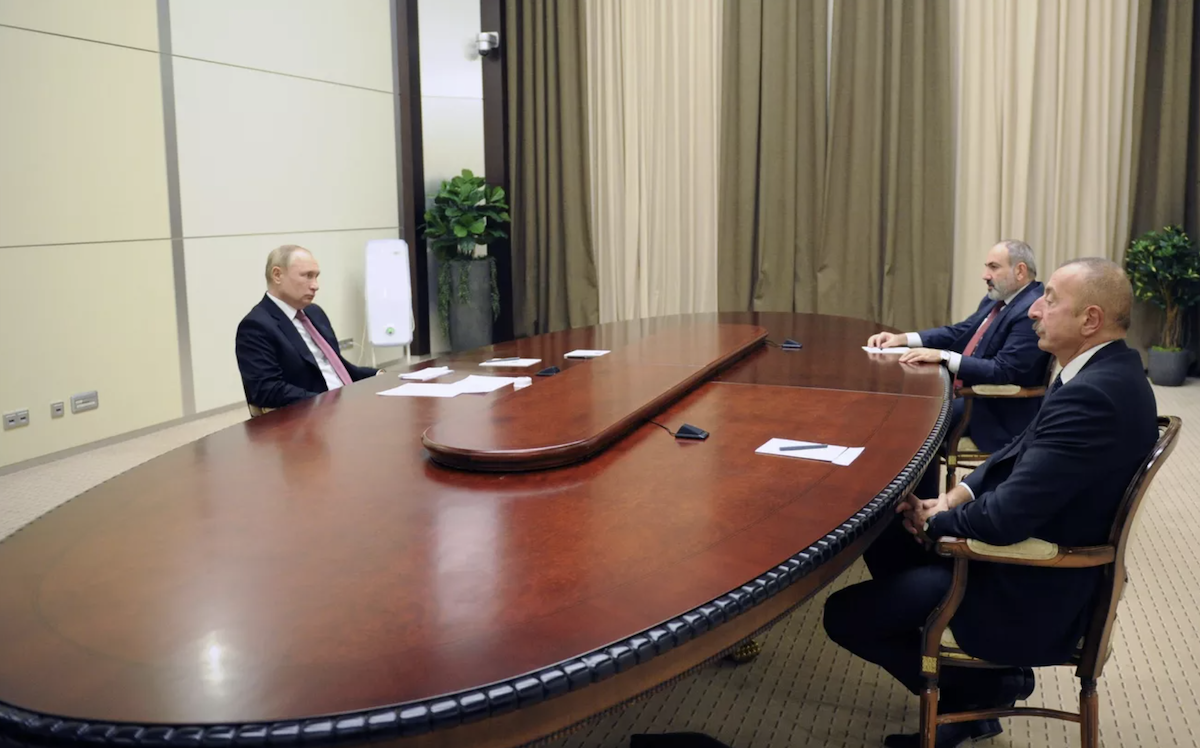
The agency claimed that Russian President Vladimir Putin informed Azerbaijani President Ilham Aliyev of the plan during a meeting in Dushanbe on 9 October.
However, a detailed statement issued by Azerbaijan’s State Security Service on 12 February 2026, followed by the indictment, presented a different timeline.
According to investigators, in August and September 2025, Mehdiyev drafted a document in a foreign language entitled “Proposals for Reorganising the System of Public Administration” and passed it through his aide, Eldar Amirov, to Ali Karimli, chairman of the opposition Azerbaijan Popular Front Party (APFP).
The final version of the document was sent on 3 October.
The indictment also refers to the Union of Russian Azerbaijani Organisations, a group registered abroad and known as the “Union of Billionaires”.
The State Security Service claims the organisation was established by foreign intelligence services and was led by Abbas Abbasov, a former first deputy prime minister, and screenwriter Rustam Ibragimbekov.
According to the investigators’ account, Mehdiyev, Abbasov and the APFP leadership were part of a group that conspired to seize power by force.
The focus of the case has therefore shifted significantly over the past year.
While the Kremlin was initially portrayed as the main player behind the alleged plot, the opposition took centre stage by the time the investigation concluded.
In February, the State Security Service released an audio recording in which Mehdiyev can be heard speaking in Russian with a woman believed to be a foreign intelligence officer. He tells her that he has proposals for reorganising the system of public administration.
The woman replies: “That is your own business.”
Judging by the published excerpt, the woman believed to be an intelligence officer appears to distance herself from Mehdiyev’s proposals rather than show interest in them.
In September, a bribery charge was added to the case. However, authorities did not disclose who allegedly paid Mehdiyev, what the payment was for or how much money was involved.
The official statement on the verdict also refers to a “foreign state” but does not identify the country.

Official rhetoric casts Mehdiyev as traitor, oligarch and schemer
The day after the verdict was announced, the presidium of Azerbaijan’s National Academy of Sciences decided to expel Mehdiyev from its membership. The decision must now be approved by the academy’s general assembly.
Academy president Isa Habibbayli described Mehdiyev’s actions as “a betrayal unworthy of a scholar”.
The central message at the meeting was that betrayal was unforgivable from someone who had enjoyed every privilege the state could offer for many years.
Meanwhile, pro-government websites focused on Mehdiyev’s assets.
They published lists of villas, plots of land, stakes in shopping centres and bank shares allegedly belonging to him, as well as information about the Sharq-Gharb publishing house.
Lawyer Chingiz Ganizade told Modern.az that once the verdict comes into force, the confiscated property could be sold at auction, rented out or partly transferred to war veterans and families of fallen servicemen.
He noted, however, that the verdict had not yet taken legal effect and that there was a 20-day period for appealing it.
Another aspect of the case involves personal grievances.
After the verdict, television presenter Khoshgadam Hidayatgizi published a lengthy post on social media. She alleged that Mehdiyev had pressured the authorities to close her newspaper in 1999–2000 and blocked her candidacy in the 2005 elections.
She also said she had learned of an alleged plot to kill her by staging a car accident.
These claims could not be independently verified. Hidayatgizi also highlighted what she described as a striking change in attitudes towards Mehdiyev: people who once called him “father” and “aksakal” – a respected elder – were now among his fiercest critics.
Eldar Namazov, a political analyst and former head of the presidential administration’s secretariat, testified as a witness in the case. He recalled warning in 2020 that the network Mehdiyev had built posed a threat to the state.
Namazov told Oxu.az that Mehdiyev attended all court hearings remotely, was fully conscious and did not object to Namazov’s testimony.
A common thread running through this rhetoric is the attempt to portray Mehdiyev as an outsider to the political system.
Yet official discourse has largely avoided a central question: why was a man who shaped personnel policy, the ideological course of the country and the system of media control for 25 years allowed to remain untouchable throughout that period?
Critics question verdict delivered behind closed doors
Independent sources have focused less on the substance of the charges against Mehdiyev than on the lack of transparency surrounding the trial.
The Turan news agency says the closed-door proceedings make it impossible to independently assess the prosecution’s evidence or the defence’s arguments. It is also unclear why the verdict was announced only five days after it was delivered, or whether Mehdiyev intends to appeal.
According to the agency, political interpretations of the case in the context of Azerbaijan’s relations with Russia also remain speculation rather than established fact.
Turan columnist Tapdig Farhadoglu highlights another contradiction:
The first official document to reveal the income and assets of a man who headed the presidential administration for 24 years was not a declaration of assets, but a criminal verdict.
Even the information released about the verdict does not disclose the scale of the asset confiscations.
Lawyer Akram Hasanov offered a brief and pointed reaction on social media: “If Mehdiyev had died a few years earlier, he would have been buried in the First Alley of Honour.”
For the opposition, the most sensitive aspect of the case concerns Ali Karimli.
Karimli, chairman of the opposition Azerbaijan Popular Front Party (APFP), and Mammad Ibrahim, a member of the party’s leadership, are being held in connection with the same criminal case, although the charges against them are being handled in separate proceedings.
Both are accused of attempting to seize power by force. The relevant article of the Criminal Code carries a sentence of 12 to 20 years in prison or life imprisonment. A preliminary court hearing is scheduled for 3 November.
The APFP rejects the charges as politically motivated. In a statement issued in September, the party said Karimli had refused to testify from the outset of the investigation and denied claims that he had co-operated with Mehdiyev.
Against this backdrop, it is significant that Mehdiyev was convicted before proceedings against Karimli had begun.
Legally, the conviction of one defendant does not predetermine the outcome of proceedings against others in the case.
Politically, however, the situation looks different: the alleged central figure in the plot has already been found guilty, casting a shadow over the forthcoming trial of Karimli.
Why was the sentence suspended?
The court cited Article 70 of Azerbaijan’s Criminal Code, which allows a suspended sentence if the court concludes that the convicted person can be rehabilitated without serving time in prison.
Lawyer Ramil Suleymanov explained that a suspended sentence is not the same as house arrest. If the convicted person breaches the conditions imposed by the court, the suspended sentence can be revoked and the person sent to prison to serve the term.
The Turan news agency notes that the probation period under the law ranges from six months to five years. The length of the period imposed on Mehdiyev has not been disclosed.
The political significance of the verdict, however, appears to be independent of the form of punishment. Mehdiyev has been officially found guilty of treason, his assets are to be confiscated, and he could lose his state awards and membership of the National Academy of Sciences.
The authorities have secured this outcome without exposing the 88-year-old to the risk of dying in prison.
A suspended sentence also leaves open the possibility of tougher punishment in future. Any breach of the court-imposed conditions during the probation period could lead to the suspension being revoked and Mehdiyev being sent to prison.
This means the sentence could still be enforced through actual imprisonment at a later date.
At the same time, the verdict presents an obvious contradiction.
The state portrays Mehdiyev as a man who attempted to overthrow the constitutional order by force, yet considers it acceptable to leave him at liberty.
This leaves two possible explanations: either the threat was not as serious as the charges suggest, or the main purpose of the verdict was not so much to neutralise a threat as to send a political message.
News in Azerbaijan