How Shevchenko became a symbol of Ukraine’s resistance: A report from Kaniv


Taras Shevchenko museum
A report by Novaya Gazeta Europe. By Olga Musafirova
Russia’s full-scale war in Ukraine has finally dismantled the Soviet myth of Taras Shevchenko as a rural poet of sorrow and lament. His poetic prophecies are taking on an almost mystical resonance on billboards as Ukrainian forces liberate occupied territories in the east, while the Russian army shoots at his statues as if he were a living person.
Olga Musafirova traveled to Kaniv, to the hill overlooking the Dnipro River where, as Shevchenko wished, his remains lie buried, and visited the Taras Shevchenko Museum. Its most valuable exhibits have been hidden away to protect them from Russian bombing. She explores how different political regimes tried to tame Shevchenko – and how he became a symbol of Ukrainian resistance.
Who was Taras Shevchenko?
Taras Hryhorovych Shevchenko (born March 9, 1814; died March 10, 1861) was a Ukrainian poet, prose writer, artist and thinker. His work laid the foundations of modern Ukrainian literature and language. Born into a family of serfs, he was orphaned at an early age. His owner, Pavel Engelhardt, took the talented young artist to St. Petersburg to serve as a personal attendant, known as a “kazachok.”
Seven years later, in 1838, the painter Karl Bryullov, the poet Vasily Zhukovsky and the Ukrainian artist and educator Ivan Soshenko bought Shevchenko’s freedom for 2,500 rubles. He became a student at the St. Petersburg Academy of Arts. His 1840 collection, Kobzar, established his reputation as a poet of the Ukrainian people.
In 1847, Shevchenko joined the secret Cyril and Methodius Brotherhood, which advocated the abolition of serfdom, the overthrow of autocracy and a confederation of free Slavic republics. He was arrested and exiled for 10 years to the Orenburg region and the Kazakh steppes, under strict orders not to write or draw.
Released in 1857, he died in St. Petersburg. Two months later, his remains were transferred to Ukraine and buried on Chernecha Hill near Kaniv.
Among Shevchenko’s best-known works are Zapovit (Testament), The Dnipro Roars and Groans, The Dream, Haidamaky, Kateryna and the poem The Caucasus. In the latter, Shevchenko condemns the Russian Empire’s war of conquest in the Caucasus and celebrates the struggle of peoples for freedom.
A line from the poem, “Fight on – and you will prevail. God is with you,” has become an enduring rallying cry for Ukraine’s revolutions. Shevchenko wrote prose, including the novellas The Artist and The Musician, in Russian while in exile. As an artist, he produced more than 1,000 works.
Icons of the revolution
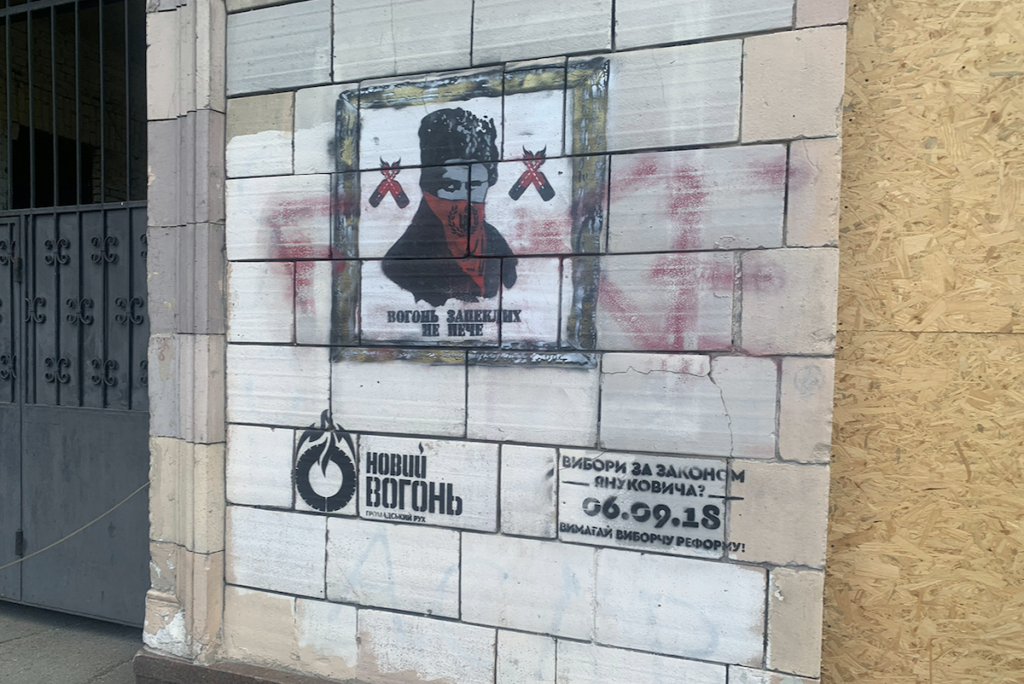
In mid-February 2014, Kyiv’s Maidan protests entered a phase defined by the choice between “freedom or death.” Around that time, graffiti appeared on the facade of the Institute of Linguistics in central Kyiv, on Hrushevsky Street, to the right of the main barricade. The images were styled as portraits set inside frames.
They seemed to have emerged overnight through the soot left by the protest bonfires. They were immediately dubbed the icons of the revolution. Their creator, an artist known by the pseudonym “Sociopath,” was in no hurry to reveal his identity.
The first image showed Taras Shevchenko wearing a bandana that covered the lower half of his face. Many Maidan protesters dressed that way to avoid being identified. The police had lists and photographs of activists; they were being hunted down, abducted and killed. Beneath the portrait was a line from Shevchenko: “The fire cannot burn the resolute.”
- Georgia joins joint statement in support of Ukraine at UN
- “Four members of my family are fighting: my mother, two brothers and me” – story of Ukrainian Olha Bihari, known by call sign “Witch”
- Georgian ‘delegation’ delivers gifts to Russian unit fighting against Ukraine
- “Saturday march” in Tbilisi: “Abkhazia is Georgia” and solidarity with Ukraine. Video podcast “Protests in Georgia”
Lesya Ukrainka was depicted wearing a respirator as protesters were being doused with tear gas. Her words read: “Those who liberate themselves will be free.”
Ivan Franko appeared in an orange hard hat bearing the slogans “I am an extremist” and “Down with the gang!” Construction helmets and bicycle helmets offered some protection from the batons wielded by the Berkut riot police.
But they could not protect protesters from bullets when Yanukovych’s regime, following Putin’s advice, began drowning the protests in blood, seeking to crush them as a dangerous example for others to follow. The Ukrainians did not scatter.
Several years later, the icons of the revolution were targeted for destruction by businesspeople renting space in a neighboring boutique. Vandals smeared paint over the images and scrawled “Fake!” across them. The murals were designated a local historical monument, and their restoration was undertaken by the same artist, “Sociopath,” with support from the Ukrainian Institute of National Memory and the Maidan Museum.
Today, the graffiti still gaze out from the institute’s wall onto Hrushevsky Street. But the ground-floor windows have been boarded up with particleboard panels since a Russian strike hit the building.
The poetic prophecy inscribed beneath Franko’s portrait could hardly be more fitting: “Our whole life is a war.”
Shevchenko in street art
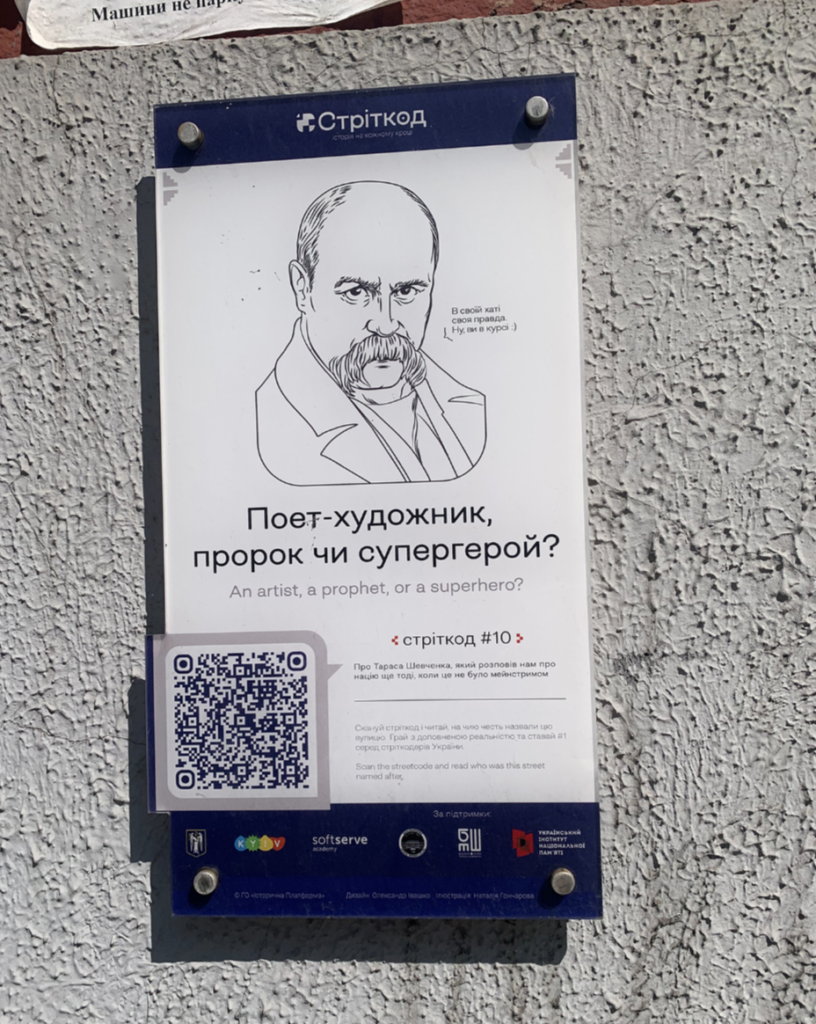
Since then, Shevchenko has become the most sought-after figure in street art. On Kyiv’s Shevchenko Boulevard alone, I counted three murals bearing the inscription: “Poet, artist, prophet or superhero?” A QR code offered a crash course on the man who “told us about our nation back when it wasn’t mainstream,” along with a gallery of contemporary interpretations.
Traditional Ukrainian literature teachers would have fainted at the sight. In place of the stern genius of humble origins stands “Sheva”: a tattooed rocker in red trousers holding a bandura, a reconnaissance soldier in winter camouflage with bunny ears, a serviceman with a “Demining” patch on his tactical vest, and a young man who looks as if he has stepped out of a Renoir painting.
Taras really did wear many masks: young gentleman, intellectual, traveler, fixture of St. Petersburg’s bohemian circles. He was no canonical old man in a sheepskin coat, but a fiercely defiant lover of freedom. By today’s standards, is 47 really that old?
The niche media outlet Osvitoria (“education” in Ukrainian) pointed out that no government has ever accepted the poet without editing out parts it found inconvenient. The Soviet secret services were particularly thorough. Some archival materials on the life and work of the Kobzar, as Shevchenko is affectionately known, are still being declassified today.
▇ No government has ever accepted the poet without editing out parts it found inconvenient.
Shevchenko as a target of the Russian army
Russia’s invasion of Ukraine has made Taras Shevchenko, however strange it may sound, the Russian army’s foremost mystical enemy as well. Destroying his images has become a matter of principle.
In April 2022, I visited Borodianka, in the Kyiv region, shortly after it was liberated. Near the blackened shells of apartment blocks and piles of concrete on Tsentralna Street, survivors were waiting. Rescuers were pulling bodies and body parts from the rubble, which had become mass graves. The remains had lain there for a month: the occupying forces had prevented the debris from being cleared while the dead were still inside.
The Russians had also shot up a bust of Shevchenko in the main square. Three times: once in the forehead, once in the temple, and then a finishing shot to the back of the head with a larger-caliber weapon. The day after the town’s liberation, someone brought Taras the first tulips, wrapped in cellophane – yellow, greenhouse-grown flowers. Where they managed to find them remains a mystery.
The border village of Hlyboke, in the Kharkiv region, was cleared of Russian forces in September 2022. Russian soldiers had turned the Ukrainian language and literature classroom at the local school into a shooting range. The portrait of Shevchenko above the blackboard served as the target.
With one hand, they shot at his head; with the other, they tried to draw Ukrainians into the “Russian world.” There is a term for this phenomenon: appropriation – the act of claiming elements of another culture as one’s own. In October 2022, the Kharkiv Regional Prosecutor’s Office released physical evidence showing how the occupying forces had set about imposing a Russian-style education system.
At a secondary school in the village of Hlushkivka, in the Kupiansk district, investigators found not only Russian textbooks and tricolor flags but also posters featuring Russian literary figures. Among them were Gogol and Shevchenko. The caption beneath Shevchenko read: “Poet, prose writer, artist. Bought out of serfdom by Russians. Kept his diary in Russian.”
Shevchenko’s monuments in Melitopol and Balakliia
In January 2023, Russian occupying forces removed a monument to Taras Shevchenko from the center of occupied Melitopol, in the Zaporizhzhia region. The dismantling took place late in the evening. The city’s mayor, Ivan Fedorov, reported the removal, adding: “They probably took him to the basement. That’s the only way they know how to deal with those they don’t like.”
He knew about basements from personal experience. In March 2022, he was abducted from his office, a bag was pulled over his head, and a week later he was exchanged for nine very young Russian conscripts captured by Ukrainian forces. By May 9, 2025, a bust of Stalin had been installed on the pedestal in Melitopol where Shevchenko’s monument had stood.
Shevchenko has repeatedly reappeared in Ukrainian territories soon after Russian forces were driven out. A short video, filmed by Ukrainian Air Force assault troops in the liberated city of Balakliia, in the Kharkiv region, during the autumn 2023 counteroffensive, was shown on what seemed like every television channel in the country.
In the footage, soldiers tear down a Russian tricolor banner from a roadside billboard. It bears the words “We are one people with Russia.” Beneath it, a portrait of the Kobzar is revealed, along with a famous stanza from his poem The Caucasus. The banner had been put up in the last year before the invasion that could still be described as relatively peaceful, to mark another anniversary of Ukraine’s independence.
One soldier reacts in disbelief: “Holy f—!” Another orders him: “Read it!” And he reads the stanza aloud:
“Fight on – and you will prevail! God is with you! For you are truth, for you are glory, and holy freedom!”
Serhiy Nihoyan, a student who became one of the first people killed during the Maidan protests, had recited the same passage aloud against a backdrop of barricades.
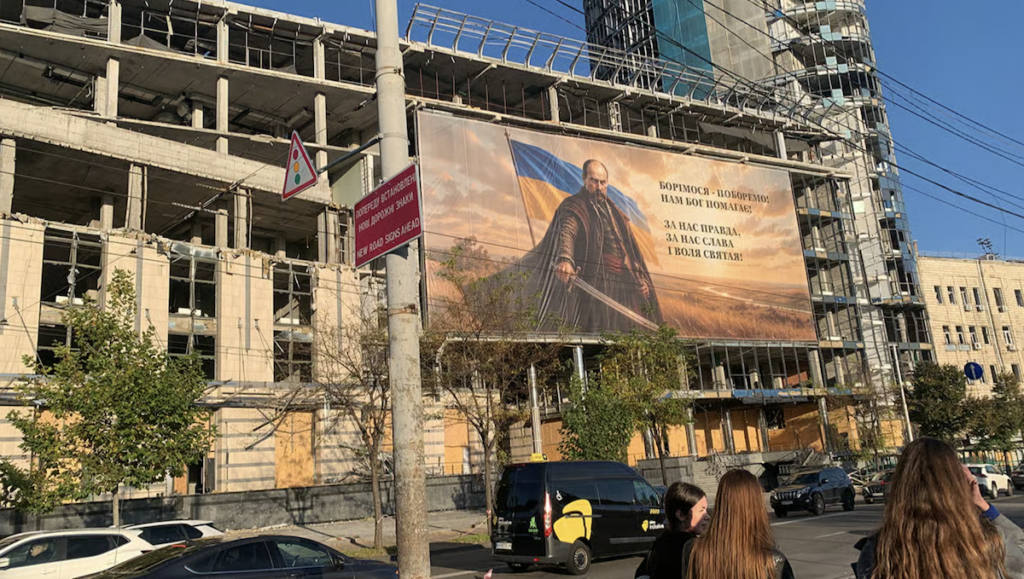
Today, in Kyiv’s Lukianivka district, where little remains untouched, a banner bearing Shevchenko’s portrait and the words “We are fighting. We will prevail” covers the facade of a damaged building. Ukrainians immediately recognize the reference: the call to “Fight on – and you will prevail!” is etched into their collective memory.
Shevchenko’s lines are continually adapted to the moment. At Barbara, a coffee shop near the author’s home, one version reads: “Get out of our home. We are free forever. There will be no Muscovy here. Glory to Ukraine!”
Chernecha hill under the tsars
The hill near Kaniv, overlooking the Dnipro River and its green slopes, became a place of pilgrimage almost immediately after Shevchenko’s remains were transferred there from St. Petersburg in May 1861, in accordance with his Testament.
In 1884, local residents raised funds to erect a cast-iron cross. Nearby, at the edge of the woods, they built a simple hut.
One half became an improvised folk museum called Tarasova Svitlytsia (“Taras’s Chamber”); the other served as the home of a caretaker. The exhibits included a copy of Kobzar, an oil portrait of the poet with a halo above his head, brushes belonging to an unknown artist, a kobza, a traditional Ukrainian stringed instrument, and an old visitors’ book lying on a table.
Embroidered Ukrainian towels, known as rushnyky, hung on the walls, including some bearing Shevchenko’s image. Many of those who brought them could neither read nor write, yet knew his poems by heart.
Secret reports from the Kaniv gendarmerie on visitors to the site have survived in the State Archives of the Kyiv Region. People came to Chernecha Hill not only from neighboring villages but from far away. Surveillance intensified ahead of major anniversaries.
The authorities refused to permit either accommodation for pilgrims or the establishment of an association to maintain and protect the grave. A document dated April 8, 1910, from the Kyiv provincial authority responsible for public associations explained why. Such an association, it warned, “would provide a convenient means of bringing together activists and adherents of the Ukrainophile party, allowing them to gather in an isolated place, difficult for the administration to observe and monitor.”
The association’s activities, officials cautioned, “would be directed toward strengthening propaganda for the cultural and political autonomy of Little Russia.” They even found evidence of suspicious intentions in the application’s failure to specify the language to be used for official business. The implication was clear: the language in question might not be Russian.
The Moscow art theatre at Shevchenko’s grave
The warnings from the gendarmerie and the authorities’ fears of “advocates of autonomy” did not deter prominent figures in Russia’s artistic and intellectual circles.
Zinaida Tarakhan-Bereza, the oldest living staff member of the Shevchenko National Reserve, cites historical accounts in her scholarly chronicle The Shrine (Kyiv, 1998). In May 1912, a steamer decorated with Shevchenko’s portrait, embroidered towels and flowers arrived at the Kaniv landing.
“No speeches, politically charged songs or other demonstrative performances!” the “tourists” were reminded once again as they came ashore.
Only two wreaths were permitted at the poet’s grave.
One came from the Ukrainian Club, a national and cultural association headed by the composer Mykola Lysenko. The other was an elaborate wrought-metal wreath decorated with oak leaves, symbolizing eternity, a laurel branch and a bronze plaque bearing the inscription: “A bow to the ground before the genius Shevchenko from the Moscow Art Theatre.”
The Moscow Art Theatre was touring Kyiv at the time. From then on, its actors spent every summer living communally at a nearby hamlet beside Taras Hill, drawing inspiration from the place. Among them were Ivan Moskvin, Yevgeny Vakhtangov and Mikhail Chekhov.
The Ukrainian Club was shut down in 1912.
I examined the leaves from the theatre’s wreath in a museum display case. They have survived two world wars and are now enduring Russia’s invasion.
The Museum in a bomb shelter
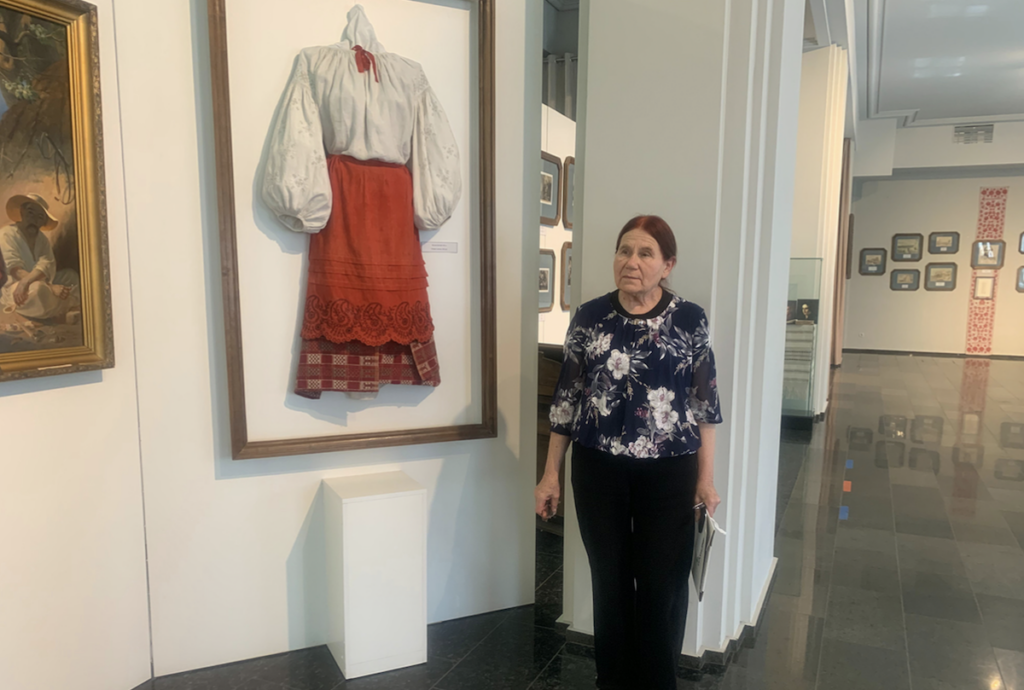
Few original exhibits remain on display at the museum. The most valuable surviving objects have been moved to a secure location to protect them from bombing.
“Kaniv, and particularly the Kaniv Hydroelectric Power Plant, has come under fire more than once. But our academic council collectively decided not to evacuate anything outside the country,” says Hanna Manzhara, the museum’s senior collections curator.
She is 80 and cannot imagine her life apart from the museum.
“We resumed work in July 2022 because the number of visitors kept growing. That was such an incentive! We moved the exhibition to the basement, which had been converted into a bomb shelter. At the beginning of this year, we returned to the surface, to the galleries.”
Unlike monuments in Kyiv, Shevchenko’s memorial in Kaniv has not been covered with sandbags. It is not simply a sculpture but a burial mound with a crypt inside, a place where people come to pay their respects.
Yet Russian forces have also struck cemeteries: in Cherkasy in July 2025, in Odesa in October 2024 and in Kramatorsk in April 2023.
Ukrainian Culture Days in Moscow
The conversation naturally turns to Russia. The Moscow and St. Petersburg periods of Shevchenko’s life and work cannot simply be erased from his story.
Hanna Manzhara recalls taking part in Ukrainian Culture Days in Moscow in 2003, together with Vita Dzyma, a senior researcher.
“The Ukrainian Center on Arbat Street asked us to take part.
“We brought an exhibition featuring lifetime editions of individual poems, as well as publications from 1911 and 1914, marking the 50th anniversaries of his birth and death. We added woven Ukrainian folk towels made by Marуsia Vasylashchuk, a traditional craftswoman. The response was fantastic! Teachers from Moscow came, along with members of the Ukrainian diaspora. Our fellow museum professionals were particularly remarkable in the attention they gave us.”
“And, of course, there were collectors,” Dzyma continues. “I won’t name them; we lost contact a long time ago. But copies of Moscow newspapers reporting on Taras Shevchenko’s funeral found their way to Kaniv through antique shops on Arbat Street.
“The museum was preparing for reconstruction, and we were trying to build up our collection.”
Manzhara adds: “You see, the life and work of the Kobzar are far broader than anything we ourselves could convey to an audience.”
Dzyma has a similar story. In the family of the St. Petersburg literary scholar Ieremiya Aizenshtok, a self-portrait of 16-year-old Taras was discovered, dating from the time he served as Engelhardt’s personal attendant, or kazachok. Research and evidence suggested it was the earliest portrait of the Kobzar.
“But Aizenshtok’s relatives asked for a very high price. The Kaniv museum simply couldn’t afford it. What happened to the portrait, and who owns it now, is unknown.”
At that moment, the author’s phone begins to vibrate: an air-raid alert has been issued in Kyiv.
On social media, Russian military personnel who have spent nearly five years launching missiles, including at Ukrainian museums, are sarcastically dubbed “Pushkinists.” Among the institutions hit have been the Hryhorii Skovoroda Museum in Skovorodynivka, the Kupiansk Museum of Local History and the Odesa Fine Arts Museum.
A Shrine to an Icon: The Museum Under Soviet Rule
“Now the working people of Ukraine and the Soviet Union will be able to become more familiar with the great legacy of the poet-revolutionary, a fighter against the social and national oppression that weighed so heavily on the peoples of the former tsarist Russia,” the republican newspaper Kommunist wrote in 1936.
The newspaper recalled that in 1923, a temporary monument had been erected over Shevchenko’s grave “in place of the cross so hated by the poet and all working people,” and that a temporary exhibition had been set up nearby in 1934. At the same time, construction of a museum was underway on Taras Hill.
Visitors often ask why the Soviet authorities invested so heavily in the project during the Holodomor, the famine that devastated Ukraine. It was the first building in Ukraine designed specifically to house a museum. Until then, museums had generally occupied historic aristocratic or manor houses.
Vita Dzyma offers an explanation:
“Look around: every home had a portrait of Shevchenko – embroidered, painted, burned into wood or assembled from straw. Kobzar lay beside the Bible, or took its place when the campaign against religion began.
“The villages at the foot of Taras Hill were being starved to death. People hired themselves out to work on the construction site for a piece of bread. They carried stones by hand, as in ancient Egypt. Yet they were proud of their work. The Shevchenko Museum was no less than a temple.
“Arguing with Ukrainians about this is a losing battle. Taras is both a father and a prophet!”
A sculptural composition of Lenin and Stalin was installed in the entrance hall, while Shevchenko’s bust was moved to the second floor so that it would not compete with them. According to Dzyma, whose account is supported by research, Soviet propagandists in the 1930s seriously pursued the idea of finding a physical resemblance between Lenin and Shevchenko.
The burial mound was given an upgrade, too. Behind a granite balustrade at the base of the monument, a platform was built resembling the speaker’s tribune at Lenin’s Mausoleum, intended for members of the Ukrainian Communist Party’s Politburo.
In 1939, marking the 125th anniversary of the Kobzar’s birth, Nikita Khrushchev, the first secretary of the Communist Party of Ukraine, spoke at the opening of the museum and the unveiling of the new monument.
“The tradition of placing microphones beside Shevchenko and addressing the community as if speaking on his behalf, from his elevated position, has survived to this day,” Hanna Manzhara explains.
The museum under nazi occupation: Director Dmytro Lebedko
In mid-August 1941, the last train carrying mobilized troops left Kaniv across the bridge over the Dnipro. The bridge was bombed, and its ruins can still be seen from Taras Hill.
There was no time to evacuate the museum before the Nazi occupation. Its staff scattered. The women I spoke to avoid going into detail about what happened next. “It would be disrespectful to the local residents,” they say.
Dmytro Lebedko, a former librarian at the reserve who had been mobilized into the Red Army and survived the bombing of his train, found himself in two roles at once: collaborator, having agreed to work with the occupying forces, and preserver of the museum’s collection.
The Nazis did not close the museum. Instead, they ordered it to be put in order and kept open. Visitors, mostly German soldiers, were brought through in formation. For the first time, not a single entry appeared in the visitors’ book.
The local population was afraid to visit Taras Hill, even though in the nearby district center of Horodyshche, the Nazis had toppled a statue of Karl Marx and replaced it with one of Shevchenko.
Archival documents preserve Lebedko’s testimony: “In 1941, I managed to recover from the village of Pekari 15 chairs, about 2,000 books, two carpets embroidered with portraits of Shevchenko, six silk curtains and a number of other valuables.”
After becoming director, he carried out a full inventory of the museum’s collection, cataloguing 4,000 items. He was not afraid to compile a list of paintings and drawings that the local Nazi district commissioner had supposedly taken for “temporary use.” He also recorded every vase and carpet appropriated by yet another official with an interest in “Slavic exoticism.” Then he took a risk that could have cost him his life: he moved the most valuable objects into a hiding place, sealed it behind a wall and went into hiding himself.
After Soviet troops arrived, Lebedko still managed to help restore the museum, which the Nazis had ransacked shortly before retreating. He voluntarily admitted in court to having been involved in a “Ukrainian nationalist Bandera organization.”
The authorities demanded that he strengthen his self-incriminating statement. “I thought Soviet rule would no longer exist in Ukraine and that Ukraine would become independent. I now understand the serious political error in my views,” he was made to say.
He was convicted of treason and sentenced to the maximum term. Three years later, he died in the Norilsk labor camps from a perforated stomach ulcer.
Dmytro Lebedko was 47, the same age as Taras Shevchenko. His name was erased from the history of the reserve for decades. Museum staff emphasize that only 10 exhibits from the prewar collection have survived to this day.
Yanukovych’s makeover
Toward the end of Leonid Kuchma’s presidency, plans emerged for a major restoration project in Kaniv. A nationwide fund was established specifically to restore historical and architectural heritage sites, and UkrNDIproektrestavratsiya, a Ukrainian research and design institute specializing in restoration, was selected to develop the project. Its specialists proposed returning the building to its original appearance, based on the drawings of architect Vasyl Krychevsky.
In the 1930s, Krychevsky had been unable to realize his full vision. His design was deemed “too Ukrainian,” and both he and his closest student, Petro Kostyrko, were removed from the project. The construction was completed by more compliant hands. As a result, museum staff, whose building had received no major restoration since World War II, were afraid even to express their hopes aloud.
The project stalled, then resumed under President Viktor Yanukovych. According to those involved, the massive, even pompous building made a strong impression on him. If the museum was to host the annual Shevchenko National Prize ceremony, Ukraine’s highest state award for achievements in culture and the arts, it had to meet the president’s aesthetic standards.
Few understood Yanukovych’s tastes better than Hanna Herman, one of his closest allies, a member of parliament from the Party of Regions and head of its humanitarian policy team, and her protégé, architect Larysa Skoryk.
“History repeated itself,” Vita Dzyma says. “At the final stage, UkrNDIproektrestavratsiya was removed from the project, and the national character of the design was discarded. ‘No painted decoration on the exterior – this isn’t some village hut!’ they said. But the preparatory work for the majolica facade had already been completed. The same was true of the alfresco work – the decorative painting in relief.
“The Ministry of Culture’s scientific and methodological council convened and decided: whitewash it!”
Hanna Manzhara adds: “Even the surviving fragments of Krychevsky’s original work, which had miraculously survived the previous war and were rediscovered during the restoration, were covered up again.”
Skoryk developed a stripped-down design concept. The polychrome landscape inspired by the poem Haidamaky was replaced with a monochrome version.
The original coffered ceiling was concealed behind a stretch ceiling. Red lines of Shevchenko’s poetry ran across the gray fabric like information scrolling through a subway station. Glass replaced the wooden mosaic partitions in the entrance hall, while granite slabs took the place of parquet flooring.
“We wanted at least to restore the unique botanical and floral patterns on the columns.
“Both museum staff and Krychevsky’s relatives wrote to Yanukovych. It made no difference. What we got was a gray-and-white renovation,” Dzyma concludes.
She asks whether the author noticed the granite boulder at the entrance, in the center of the lobby. The author is puzzled. Surely this is not a geological museum.
▇ “Shevchenko is the cornerstone of the national idea. It’s a metaphor!”
Photographs From 1944 and a Forced-Labor Camp in the Museum
The author’s attention was drawn to two framed photographs on the wall, dated the last day of January 1944. Yakov Davidzon, a frontline correspondent, arrived at Taras Hill immediately after Kaniv was liberated. He found the museum surrounded by barbed wire, with burned books, torn paintings and shattered sculptures. Sixteen shrapnel wounds had been counted on the pedestal of Shevchenko’s monument.
“We learned only in 1981 that a forced-labor camp had operated inside the museum during the final months of the occupation,” says Valentyna Avramenko, head of the Tarasova Svitlytsia section.
She recalls a visitor from Moscow who wandered through the galleries as if he knew every corner of the building. It turned out that he was a native of the area who, as a teenager, had been caught in a roundup.
Young people were deported to the Reich for forced labor, while children as young as 13 or 14 were made to dig trenches and build fortifications. Several hundred schoolchildren were held inside the building, half-starved, sleeping on damp, rotting straw alongside horses. A toilet had been hacked directly into the parquet floor. Armed guards marched the children to the banks of the Dnipro with shovels and forced them to work under gunpoint. If one escaped, the others were beaten almost to death.
Staff at the reserve began tracking down the former child prisoners and recording their testimonies. Those who had survived long enough were later helped to submit applications for compensation from Germany. Why had no one spoken about the camp sooner?
The author found the answer herself in an archival leaflet issued by the Taras Shevchenko partisan unit, which operated in the forests of the Cherkasy region:
“We will find and kill everyone who helps the Germans build defensive lines along the Dnipro!”
Makohon’s bust: From Kaniv to Volodarka
In Davidzon’s second photograph, Shevchenko’s bust has a bullet hole in its forehead. The resemblance to the monument in Borodianka, shot up by Russian forces in 2022, is chilling.
The author was told that Ivan Makohon, a prominent Soviet Ukrainian sculptor, had created the plaster bust in 1937 specifically for the opening of the museum in Kaniv. But the work’s fate after World War II remains unknown. It is held neither in the museum’s exhibition nor in the collection of Ukraine’s National Art Museum.
The sculptor’s son, Ihor Makohon, himself a painter, sculptor and graphic artist, is now 90 and lives in Italy. He was surprised to hear the story of the wounded, missing Kobzar.
“There must be some misunderstanding! I visited Kaniv in the mid-1950s and took photographs. The bust was on the second-floor balcony, completely undamaged.
“In 1961, my father decided to modify the composition slightly, adding shoulders. The new version was more monumental. Two plaster casts were made in the workshop at the Kyiv Art Institute, where Professor Makohon taught, and the mold was preserved.”
More than 60 years passed. In 2024, Ihor Makohon received a request from Volodarka, a district center in the Kyiv region. Local residents wanted to install a “historic” Shevchenko monument by Makohon and asked for his permission.
Ihor Ivanovych not only found the original mold but also arranged for the bust to be produced.
“We cast the bust in concrete with the lads and took it to Volodarka. There was enormous interest, and a lot of people gathered,” he recalls.
The unveiling took place on the Feast of the Intercession of the Holy Mother of God, which Ukraine also celebrates as the Day of Defenders and Defendresses. The project fulfilled an idea conceived by Oleksandr Ushynskyi, a local resident, environmentalist, researcher of the Holodomor, Maidan protester and war veteran.
In 2014, Ushynskyi volunteered for the front, defended Donetsk airport and later established a community museum dedicated to the Russian-Ukrainian war in his hometown. The monument in Volodarka became the 1,385th monument to Shevchenko in Ukraine and around the world.
The nazis, the communists and Russian propaganda
“Both the Nazis during World War II and the Soviets used Shevchenko to manipulate Ukrainians’ minds for propaganda purposes,” says Ihor Solovey, head of the Center for Strategic Communications and Information Security under Ukraine’s Ministry of Culture.
“The Nazis tried to exploit our national sentiments under the guise of ‘friendship.’
“They took passages from Kobzar and amplified them to turn people against Soviet rule. The message was supposedly about resistance to Russian oppression, mixed with all sorts of vile nonsense about ‘Jewish Bolshevism.’ They even put Taras’s words on posters – the familiar line: ‘Muscovites are strangers; they bring you harm.’
“To present themselves as benefactors, the Nazis deliberately published his poetry and prose during the occupation and ran articles about Shevchenko that served their purposes. They wanted people to believe that Ukrainian culture was free and flourishing under the Reich.”
“The Communists did exactly the same thing. They just dressed it up differently to persuade Ukrainians to fight the Germans. Think of the famous rallying cry: ‘Drench freedom in the enemy’s blood!’” Solovey continues.
Eighty years have passed. In June 2026, Ukraine’s Security Service announced that a 57-year-old woman from Kaniv had been formally notified of suspicion over the dissemination of “materials justifying and denying the Russian Federation’s armed aggression against Ukraine.”
The woman reportedly referred to the invasion as a “special military operation,” urged support for the Russian army and openly promoted pro-Kremlin narratives among acquaintances and colleagues. According to investigators, she was one of the deputy heads of the Shevchenko National Reserve.
Modern Russian propaganda reproduces methods first used under the Russian Empire and later adopted by the Soviet Union. One is to present Shevchenko primarily as part of Russian culture, pointing to the fact that he wrote his diaries and prose in Russian.
Another is to portray him as a “pan-Russian poet,” downplaying the importance of his work in shaping Ukrainian national identity.
But those carrying out Russia’s full-scale war on Ukrainian soil increasingly see Shevchenko, his monuments and his museums not as shared cultural heritage, but as an adversary and a source of resistance.
exchange