Giorgi Davitadze case: how it drew attention to what is happening in Georgia's prisons






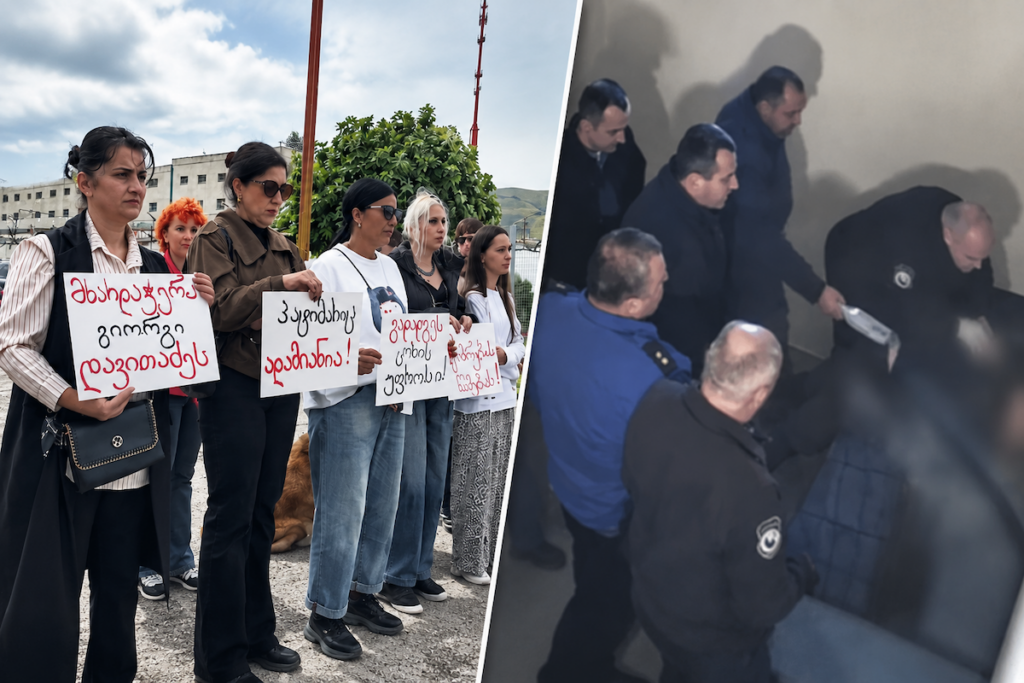
36-year-old prisoner Giorgi Davitadze says that about 10 prison staff at Prison No. 6 in Rustavi, Georgia, sexually assaulted him.
Authorities have not yet investigated Davitadze’s case. The Penitentiary Service, however, calls his allegations “a complete lie” and has released silent video footage as evidence. Davitadze’s family says the footage is incomplete and that authorities have not released the actual footage showing the alleged abuse.
Georgia’s Public Defender says the video provided to the office does not show the abuse Davitadze described.
Davitadze’s case has unfolded in a particularly sensitive context for Georgia. The allegations concern sexual abuse inside the very system that Georgian Dream made one of the main targets of its promised reforms when it came to power.
What Giorgi Davitadze says
The public learned about the alleged sexual abuse of Giorgi Davitadze on 2 October, during a hearing at the Court of Appeals.
Davitadze told the court that on 21 December 2025, about 10 prison staff sexually assaulted him and subjected him to degrading treatment in a de-escalation room, a special facility for temporarily isolating prisoners experiencing severe emotional or psychological distress.
“They took me down to the de-escalation room and raped me — with a finger, with a hand. […] Ten people, the guards, raped me. You can see everything on the camera,” Davitadze told the court.
He said he later attempted suicide.
Davitadze demanded that the authorities punish the prison staff he named, threatening to go on hunger strike if they failed to do so.
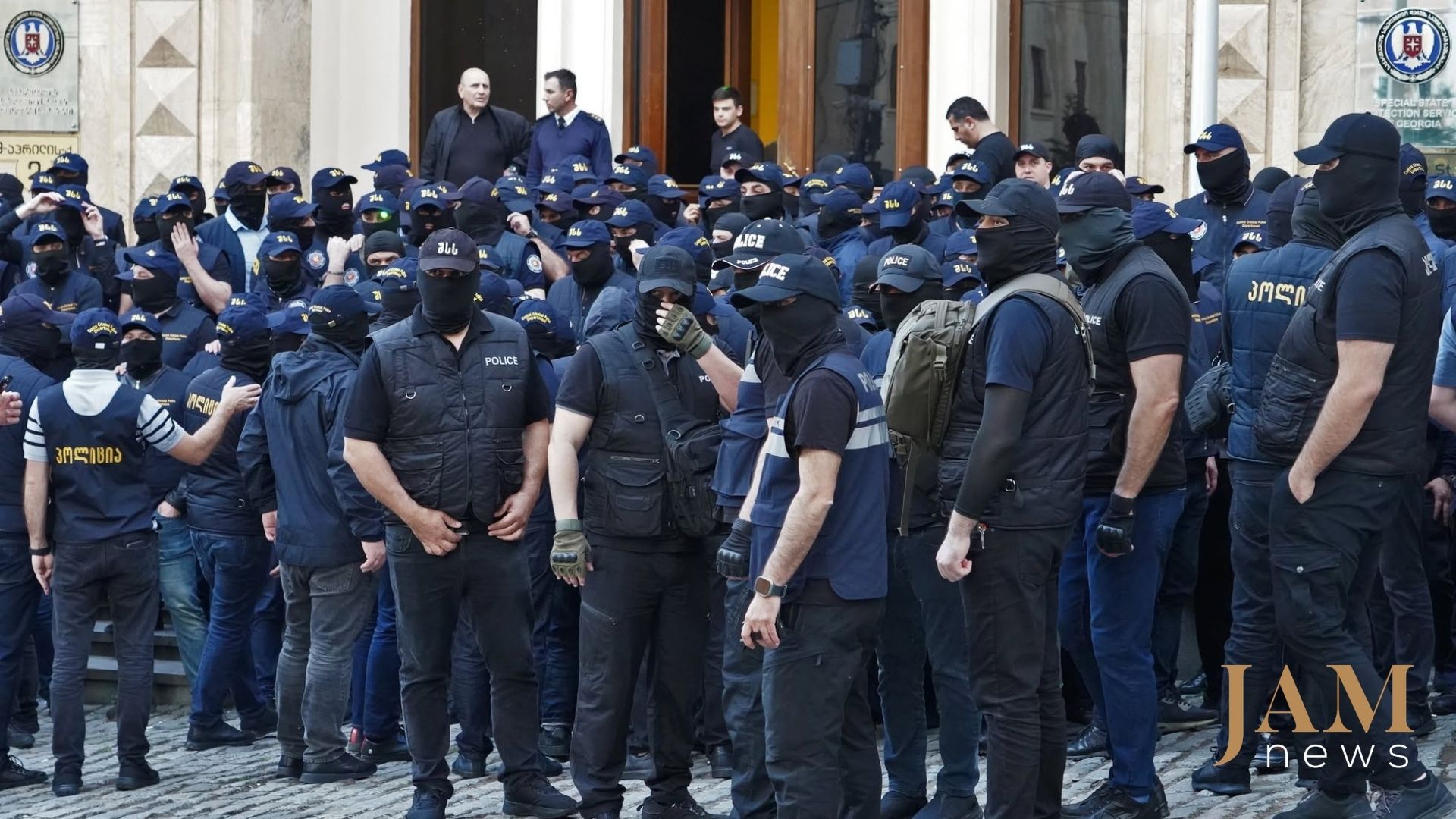
Davitadze’s allegations sparked widespread attention in the media and society.
The severity of the allegations drew particular attention, as did Davitadze’s claim that surveillance cameras should have captured the incident he described.
Davitadze’s family demanded the full release of the footage, while civil society organisations said the prisoner’s allegations required an effective and comprehensive investigation. The Penitentiary Service, in turn, categorically denied the allegations of sexual abuse.
It later emerged that government agencies had known about the alleged abuse since December 2025.
The Public Defender’s Office was also aware of the case. On 26 December, Davitadze’s lawyer told the office that his client had suffered ill-treatment.
That same day, a representative of the Public Defender’s Office went to the Rustavi prison and spoke with Davitadze. He repeated his account, saying prison staff had subjected him to abuse, including sexual abuse.
The Public Defender’s Office passed the information to the Prosecutor General’s Office, which opened an investigation. The office also demanded that video footage from the period identified by Davitadze be preserved in the archive.
More than nine months have passed since then. The investigation remains incomplete, and Davitadze is still being held in the same prison whose staff he accuses of abuse.
What the video released by the Penitentiary Service shows
On 2 October, the Penitentiary Service released footage that, according to the agency, shows Davitadze being taken to the de-escalation room on 21 December 2025 and the events that followed.
The video has no sound.
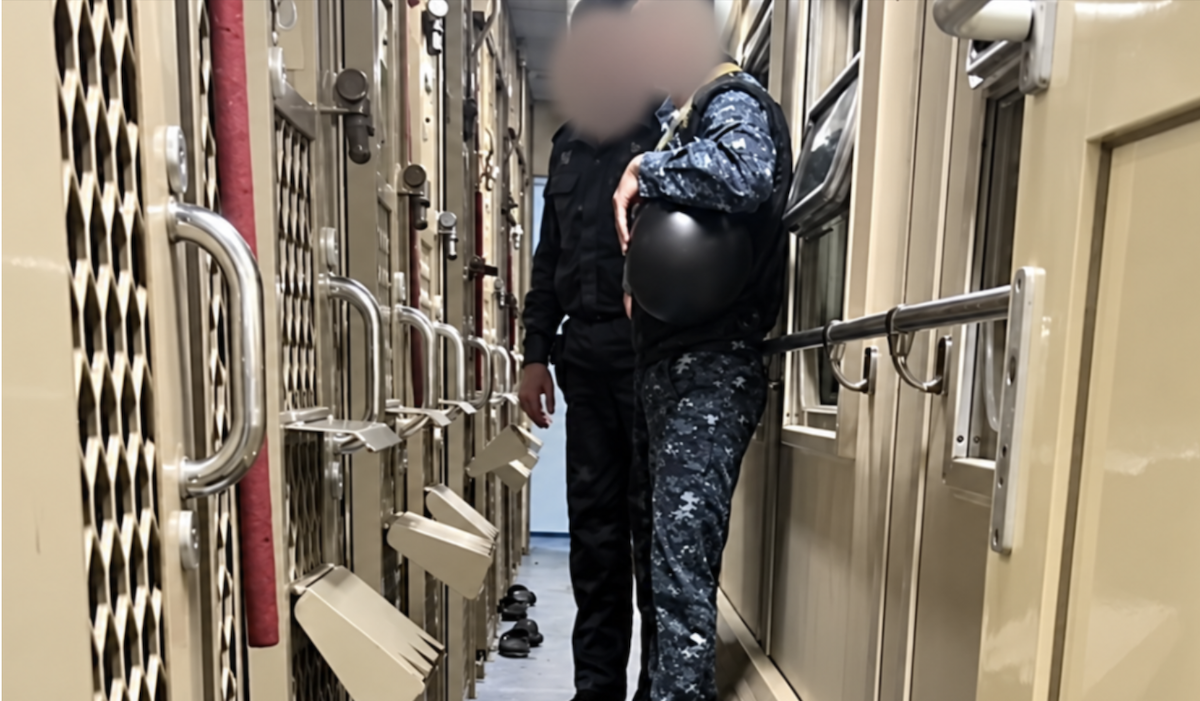
The footage shows Davitadze and about 10 prison staff members. One of them wears disposable medical gloves.
The staff search Davitadze, including with a metal detector. Several people hold the prisoner’s arms behind his back. The staff then forcibly search Davitadze after pinning him down on a bed.
The Penitentiary Service says prison staff must search prisoners when moving them to a de-escalation room. According to its account, Davitadze refused to undergo the search and insulted the staff, so they carried out the search by force.
The service calls the allegations of sexual abuse “a complete lie” and says “there was not only no sexual violence against Davitadze, there was no violence of any kind.”
The Penitentiary Service says it had not previously released the footage because the case remains under investigation. The agency also says it has continuously archived video footage related to Davitadze since 3 March 2026.
Family says the released video is incomplete
Davitadze’s family says the video released by the Penitentiary Service is incomplete.
His mother, Irma Davitadze, says she saw five video files covering about 20 minutes in total and believes the footage had been edited.
On 3 October, family members and Davitadze’s supporters held a protest outside the prison. They demanded the release of the full footage, an impartial investigation and the resignation of prison director Shota Trapaidze.

Another demand from the family is to transfer Davitadze to another prison, away from the staff members he accuses of abuse.
The prisoner’s father, Avtandil Davitadze, says:
“[These staff members] come to his cell, shout something, say something that insults his dignity, provoke him, and then what should never happen begins.”
However, Justice Minister Paata Salia says transferring a prisoner to another facility requires the authorities to follow certain procedures and meet specific conditions. The minister says officials are considering the request and will transfer Davitadze if he meets those conditions.
What the ombudsman says
The Public Defender’s position has become one of the most contentious aspects of the case.
According to an official statement from the Public Defender’s Office, its representatives requested and reviewed the relevant video footage but found no details showing the severe abuse Davitadze described.
However, the office stresses that authorities must investigate the allegations regardless and verify the prisoner’s complaint by collecting and comparing all available evidence.
The Public Defender also calls on the Prosecutor’s Office to make the findings of the investigation public as soon as possible.
On 5 October, Public Defender Levan Ioseliani repeated on TV Pirveli that the footage released so far does not show sexual abuse itself. When asked whether inserting a finger into a prisoner’s body could form part of a search procedure, Ioseliani initially said he needed to check the relevant regulation:
Journalist: [Davitadze says] he felt a finger penetrate his body. Is that part of the search procedure?
Public Defender: We need to see what the regulation says — whether it allows such a thorough search. However, the regulation does require searches, including with a detector and scanner.
When the presenter asked whether he therefore ruled out the possibility of something that does not appear in the footage, Ioseliani replied: “The Prosecutor’s Office must investigate what we cannot see.”
Questions that remain unanswered
Public organisations say the footage and explanations released by the Penitentiary Service cannot provide an adequate response to such a serious allegation. More than ten organisations have called for an effective and comprehensive investigation. They include the Georgian Young Lawyers’ Association (GYLA), the Social Justice Center, Transparency International — Georgia, the International Society for Fair Elections and Democracy (ISFED), the Institute for Development of Freedom of Information (IDFI), the Civil Society Foundation, Safari and others.
In their statement, they raise eight main questions:
- Why did authorities need to move Davitadze to the de-escalation room?
- What exactly did he do before the authorities took this step?
- Was the measure necessary and proportionate?
- Why were about ten staff members in the room?
- Who were they and what did each of them do?
- Does the published video show the full sequence of events without interruption?
- Does the original video still exist, and can an independent expert examine it?
- Do recordings from other cameras exist?
“The video released by the Penitentiary Service cannot replace an independent and effective investigation,” the organisations say.
Why the video has no sound
Another question concerns the fact that the released footage has no sound.
On 5 October, journalists asked Justice Minister Paata Salia whether the original recording had sound. The minister did not answer. When they asked whether cameras installed in de-escalation rooms can record sound at all, Salia said he could not comment. Later, speaking on Imedi TV, the minister said Georgian law does not provide for audio recording.
Salia also could not explain why authorities moved Davitadze to the de-escalation room on 21 December 2025 and referred journalists to the Penitentiary Service for an answer.
The minister says authorities are investigating Giorgi Davitadze’s original allegation and that they need to complete the investigation before giving a final answer.
“If anyone attempts to destabilise or disrupt the operation of penitentiary institutions, whether from inside or outside, the authorities will respond strictly, as provided by law,” Salia said.
He also mentioned that some public statements may contain signs of a criminal offence, but he did not name any specific individuals or give examples.
Prisons — one of the most painful issues in modern Georgia
The issue of violence in Georgian prisons goes beyond human rights.
It holds a special place in the country’s recent political history. In 2012, conditions in the penitentiary system became one of the key factors behind the change of government.
On 18 September 2012, less than two weeks before the parliamentary elections, Georgian television channels broadcast footage recorded at Prison No. 8 in Tbilisi.
The footage showed guards beating, humiliating and sexually abusing prisoners. The broadcasts triggered mass protests in Tbilisi and other cities.
The footage exposed a problem that human rights groups had already raised. A 2013 Human Rights Watch report said the images highlighted a longstanding problem of torture and ill-treatment of prisoners.
The government at the time acknowledged the systemic nature of violence in prisons. The ministers responsible for prisons and internal affairs resigned, and authorities arrested several penitentiary staff members. Within days, the prison system became one of the central issues of the election campaign.
In the parliamentary elections on 1 October 2012, Mikheil Saakashvili’s United National Movement lost power, and Bidzina Ivanishvili’s Georgian Dream coalition took control of the government.
One of the new government’s main political promises was to reform the penitentiary system that had developed under the previous government and protect prisoners’ rights.
But data from recent years and reports by human rights organisations show that violence and ill-treatment by security, law enforcement and penitentiary authorities remain serious concerns. The problem extends beyond prisons to police stations, the detention process and protests.
In June 2026, Georgian human rights organisations said in a joint statement that, in their assessment, torture and ill-treatment in Georgia had become a “systemic and widespread practice”. Amnesty International describes a similar situation.
At the same time, the penitentiary system continues to grow in scale. According to official statistics, Georgia’s penitentiary system received a total of 22,767 convicted people in 2025 — 25.5% more than the previous year. This marks the highest figure since the authorities began keeping the relevant statistics.
In 2024, Georgia ranked second among 46 Council of Europe countries in terms of the number of prisoners per 100,000 people.
What is happening in Georgia’s prisons
After the allegations by Giorgi Davitadze became public, several incidents occurred at Rustavi Prison No. 6. According to the Public Defender, its representatives met three prisoners on 3 and 4 October who had protested against the treatment of Davitadze. They told the representatives why they were protesting and described their conditions in prison.
The Penitentiary Service denies that the authorities moved these prisoners to de-escalation rooms because they had expressed solidarity with Davitadze. According to the agency, the authorities moved them to protect the safety of the prisoners and prison staff.
For example, the service says that on 2 October one prisoner kicked the prison’s deputy director in the stomach. On 4 October, two other prisoners allegedly “physically insulted” staff members — that is, attacked them — while returning from a walk. The agency also released video footage showing these incidents.
Later that same evening, on 4 October, an incident also involved Davitadze himself. According to the Penitentiary Service, he called over a prison employee and, in front of him, swallowed “several small objects of unknown origin”. Staff offered to transfer Davitadze to Vivamedi Clinic, but he refused.
The following day, the Public Defender’s Office said its representative had met with Davitadze. According to the prisoner, he felt well and had refused the transfer to the clinic as part of his protest. Davitadze said he would not go to the clinic until the authorities returned the three prisoners who had protested in his support from the de-escalation rooms to their cells.
Amid these events, reports also emerged of possible violence against another prisoner. According to lawyer Anna Akopova, her client Lasha Chachanidze suffered a beating at the same Prison No. 6 after he shouted from his cell to express solidarity with Davitadze. The lawyer says authorities transferred Chachanidze and two other prisoners to Prison No. 3 in Batumi.
Akopova says the prisoner has multiple injuries on different parts of his body. According to her, about ten people took part in the alleged assault. The lawyer is demanding a medical examination and the preservation of the relevant video footage, which could establish Chachanidze’s condition when staff took him out of his cell and when they returned him.
The Penitentiary Service categorically denies the allegation and says nothing of the sort happened. The Public Defender’s Office said it had received information about the case and would visit the prisoner.
Saba Skhvitaridze, who authorities detained during pro-European protests, also wrote about the tense situation at Prison No. 6. According to a statement published on his Facebook page, authorities transferred some prisoners to other facilities, placed others in de-escalation rooms and several prisoners went on hunger strike. Skhvitaridze also reported that authorities beat a prisoner and that some prisoners injured themselves.
Giorgi Davitadze remains in the same prison, whose staff he accuses of sexual abuse.
The Prosecutor’s Office investigation, which it launched in December 2025 after the Public Defender’s Office filed a complaint, remains incomplete. The Public Defender’s Office says it continues to monitor the investigation and calls on the Prosecutor’s Office to make its findings public as soon as possible.
The Penitentiary Service denies all the allegations, including reports of a hunger strike among prisoners, and insists that “complete calm” prevails at Rustavi Prison No. 6.
The Giorgi Davitadze case