Georgian judge challenges in Constitutional Court law criminalising insults against public officials






Georgia: judge challenges officials’ insult law
A judge at Kutaisi City Court in Georgia, Tsitsino Kikvadze, has asked the Constitutional Court to review the constitutionality of Article 173¹⁶ of the Administrative Offences Code.
Kikvadze says the provision, which establishes special administrative liability for insulting state and political officials and public servants, may violate freedom of expression.
The judge notes that such conduct is already covered by Article 166 of the Administrative Offences Code. But Article 173¹⁶ ties liability to a person’s official status and therefore provides for harsher penalties.
Under the contested provision, verbal insults, swearing, offensive remarks or other insulting acts directed at a state or political official, public or civil servant while they are performing their duties or in connection with their work are subject to administrative liability.
Since June, Georgia’s Interior Ministry has had a new department tasked with combating hate speech, including monitoring what people write and say in public places. Lawyers criticised the initiative at the time as an attempt to legalise censorship. On social media, the department was dubbed the “scrolling agency”.
Since then, dozens of people have been fined. Also, TV host Vakho Sanaia was sentenced to 14 days of administrative detention and activist Giorgi Akhobadze to one month, both over Facebook posts.

What arguments did the judge make in her constitutional petition?
The constitutional petition stems from a specific administrative case.
On June 23, 2026, a unit of the Interior Ministry’s Human Rights Protection Department filed an administrative offence complaint with Kutaisi City Court against citizen Irakli Kezevadze.
According to the complaint, Kezevadze verbally insulted Tbilisi Mayor Kakha Kaladze in a Facebook post on June 3. At the court hearing, he confirmed this and said he had been drunk.
Kezevadze also described his difficult social and family circumstances. He said his wife had died three years ago, he had no children, was unemployed and was caring for his sick mother.
Asked whether he continued to make similar comments on social media, he said he no longer did so and was “not engaged in such activities at all”.
Duplication
Judge Kikvadze argues that such conduct is already covered by Article 166 of the Administrative Offences Code. The purpose of that provision is to protect public order and the peace of all citizens. Article 173¹⁶, by contrast, provides special protection to a particular category of people — public officials — and makes liability dependent on their official status.
The two articles provide for different penalties
- Article 166 provides for a fine of 500 to 3,000 lari (about $190-$1,100) or up to 20 days of administrative detention.
- Article 173¹⁶ provides for a fine of 1,500 to 4,000 lari (about $600-$1,500), while administrative detention can last up to 45 days.
Harsher penalties for insulting public officials than private citizens
The judge also considers it problematic that Article 173¹⁶ does not allow for exemption from liability.
Under Article 166, however, the court has the option to exempt a person from liability.
According to Kikvadze, this means that for essentially similar conduct, the court’s options differ solely because of the victim’s official status and the context of their work.
Politicians should tolerate more criticism than private citizens
Kikvadze’s petition places particular emphasis on freedom of expression.
She notes that Article 17 of Georgia’s Constitution protects freedom of expression and that restrictions are permitted only in cases established by the Constitution.
In this context, Kikvadze cites the case law of Georgia’s Constitutional Court and the European Court of Human Rights, which holds that public officials, and particularly political officials, are expected to tolerate a greater degree of criticism than private individuals.
Her submission cites European Court of Human Rights cases including Lingens v. Austria and Handyside v. the United Kingdom.
Judge warns law could deter citizens from criticising authorities
One of the judge’s main concerns is the possible “chilling effect” of the provision.
The risk of a substantial fine or administrative detention for expressing an opinion in harsh or insulting terms about a state or political official could deter citizens not only from prohibited conduct, but also from criticism that is lawful.
Kikvadze points to a statement by Kezevadze that he no longer makes such comments and “doesn’t engage in such activities anymore”.
These words alone do not prove that the provision has a chilling effect on everyone, but they illustrate how sanctions can lead to self-censorship.
The judge’s petition also cites a 2021 ruling by the European Court of Human Rights in Vedat Şorli v. Turkey. The case concerned the use of a special criminal provision in Turkey for insulting the president.
The European Court found a violation of Article 10 of the European Convention on Human Rights. It held that imposing a special and more severe liability regime when the president is involved raises concerns regarding freedom of expression.
According to Kikvadze, the case does not directly concern the Georgian provision being challenged, but provides an important reference point when assessing whether public figures should receive greater legal protection and face different sanctions based on their status.
- Opinion: ‘The calculation is that people will resort to self-censorship’
- Georgian Dream effectively dismantles political freedoms – Social Justice Center
- Georgian blogger says Interior Ministry wants to punish him for insulting Russian propagandists
The state can protect officials — but is a stricter regime necessary?
The judge says the state has the right to protect public officials and political figures from unlawful interference while they are carrying out their duties.
But she stresses that the issue is not whether such protection is a legitimate aim, but whether the special and more severe regime under Article 173¹⁶ is necessary to achieve it.
The Constitutional Court should consider three questions when assessing the contested provision:
- To what extent is a special, harsher penalty necessary to protect public officials;
- Whether less restrictive means could achieve the same aim, including Article 166 of the Administrative Offences Code or civil-law remedies;
- Whether the protection of public interests achieved through the stricter Article 173¹⁶ is proportionate to the harm that the restriction on freedom of expression may cause, including its potential “chilling effect”.
Kutaisi City Court is also asking the Constitutional Court to assess whether it is constitutional for Article 173¹⁶ to impose special administrative liability for verbal insults specifically against state and political officials, public and civil servants, while excluding the possibility of exempting the accused from liability.
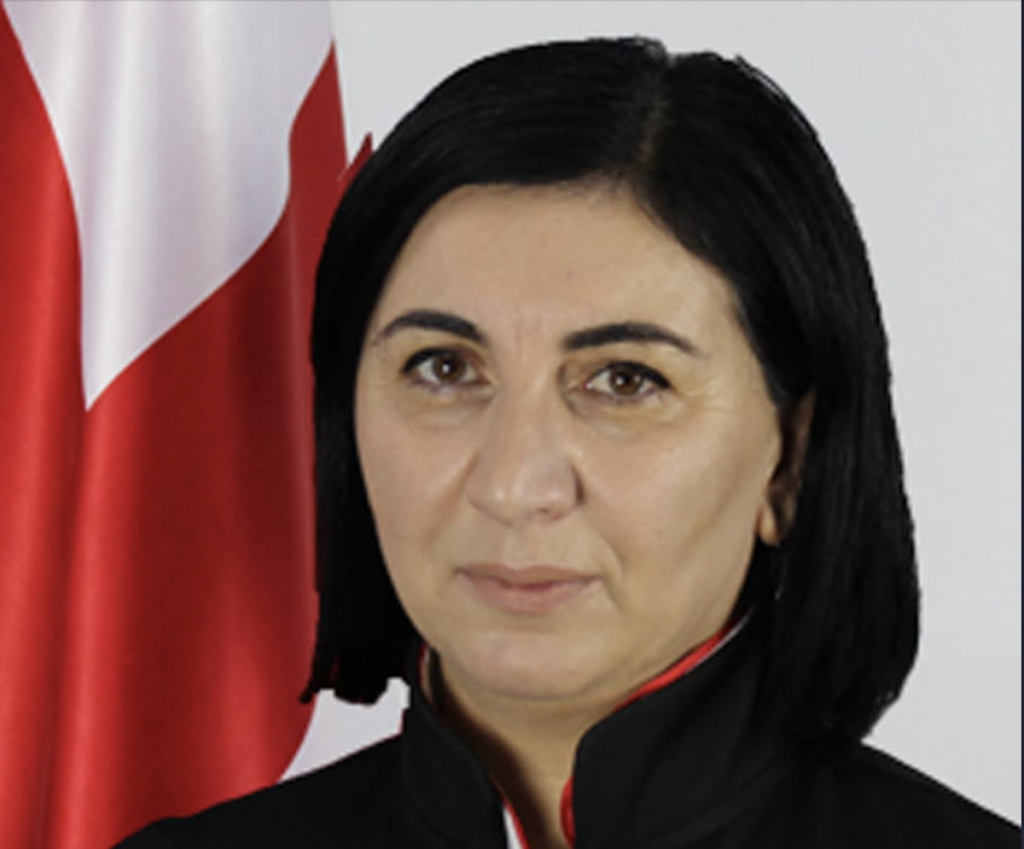
Tsitsino Kikvadze has been a judge in Georgia’s common courts system since 2005. She has worked at Kutaisi City Court since 2013 and was appointed as a judge for life in 2016.
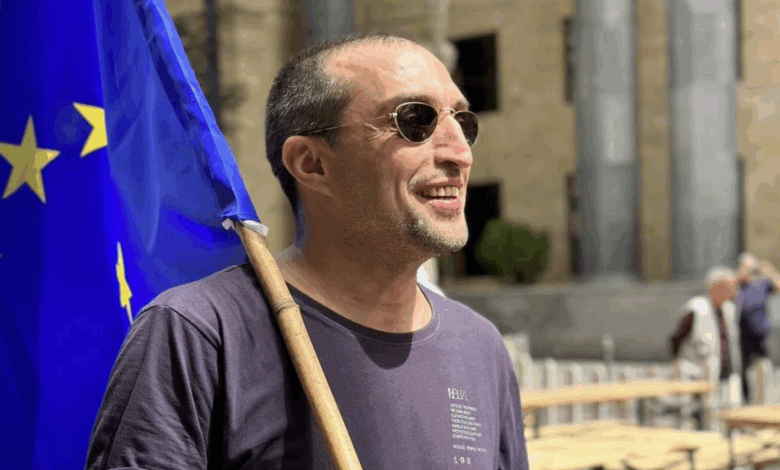
In 2024, she was among the judges who signed a public statement protesting the government’s decision to suspend Georgia’s EU accession process.
News in Georgia