Debates in Georgia mulled: should the opposition negotiate with the government?






Debates in Georgia
In Georgia, where political polarisation is reaching a peak, contact between the government and the opposition — broken for years — is suddenly being restored in the form of debates.
The ruling Georgian Dream party, which for years boycotted media outlets critical of the authorities and avoided direct confrontation with its opponents, is now itself initiating public discussions.
The process is particularly notable against the backdrop of a deep legitimacy crisis for Georgian Dream, both domestically — amid protests over alleged election fraud — and internationally. A striking example was US Vice-President JD Vance’s recent visit to the South Caucasus, which did not include a stop in Georgia.
The question of debates has sparked intense discussion both in society and political circles. Opinions are divided over whether the opposition should take part in debates initiated by the government. Both supporters and opponents of the idea have put forward their arguments.
Return to debates
On 22 January 2026, Prime Minister Irakli Kobakhidze publicly declared his readiness to debate his opponents and launched an initiative to revive “public discussion”.
Before this initiative, dialogue between the government and the opposition in Georgia had effectively been suspended for years. During Georgian Dream’s first term in power, ministers and MPs regularly appeared on opposition television channels. But this practice ended completely several years ago, as the government moved to boycott critical media. The situation changed, particularly after the authorities took control of Rustavi 2, the most popular opposition channel.
In response to Irakli Kobakhidze’s initiative, opposition television channels offered the government airtime on their own platforms. However, the ruling party chose pro-government channels Rustavi 2 and Imedi as venues for the debates — both of which the opposition and some civil society groups consider to be propaganda outlets.
Rustavi 2 even set up a special debate studio, with a large red table at the centre.
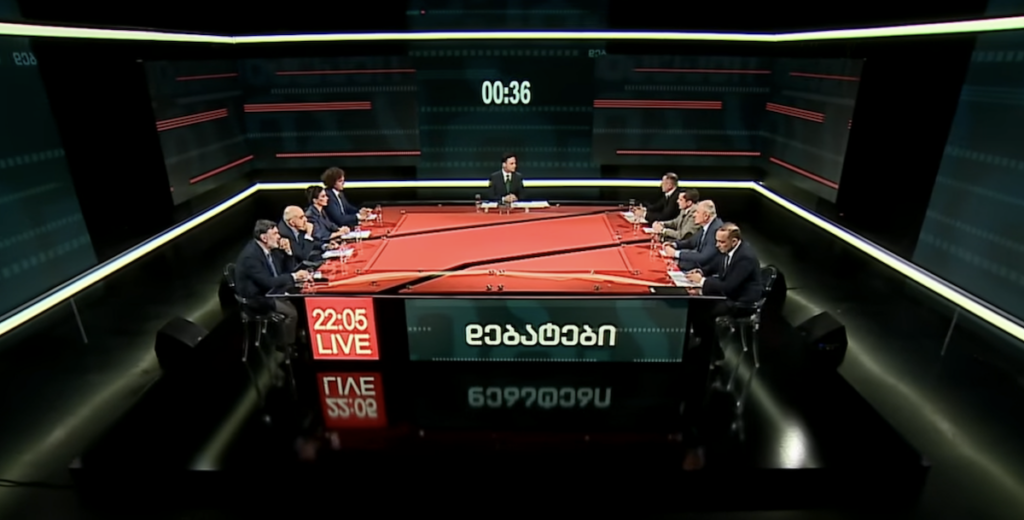
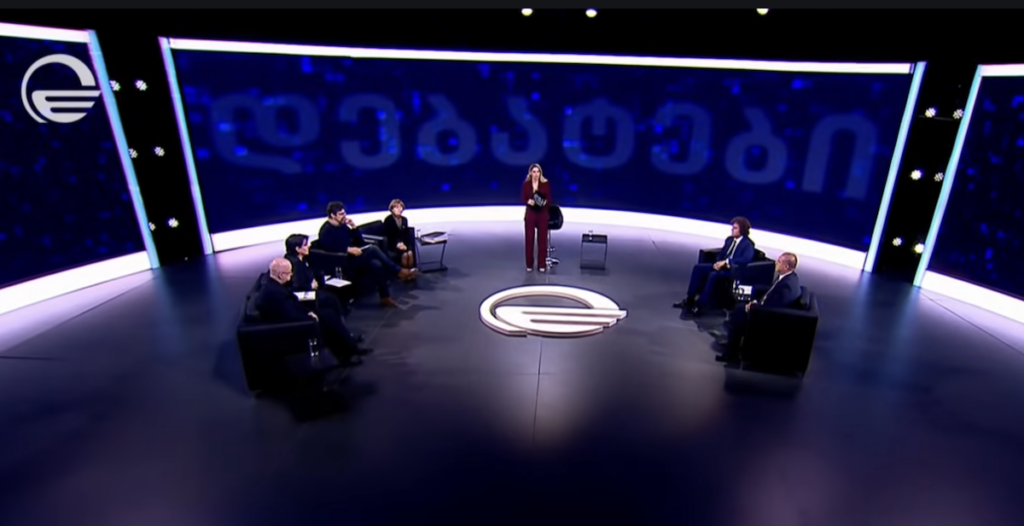
The “debates” are hosted by television presenter Rezi Chichinadze. The programme’s description says it is a “public dialogue” returning to the air as a necessary tool for audiences to hear different viewpoints in one space. The format is intended to “put an end to polarisation”.
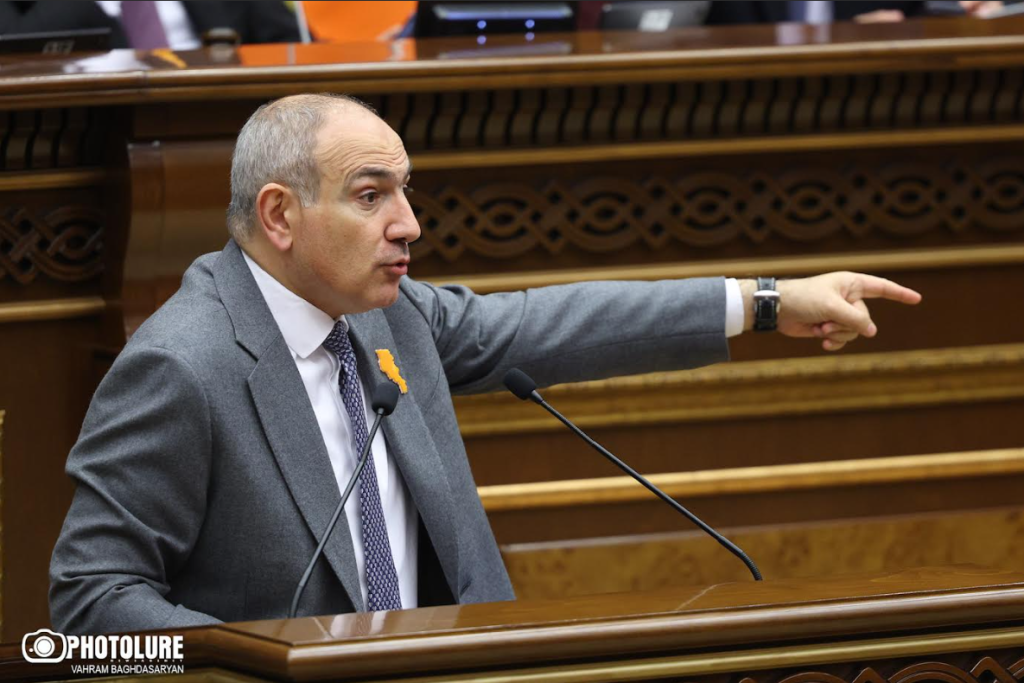
One of the first topics in the new format was rising prices in Georgia. Prime Minister Kobakhidze himself took part in the discussion.
Kobakhidze also appeared in a debate on the Imedi television channel on 14 February, посвящённых education reform.
Why now?
Analysts say the government’s initiative may be driven by several factors: a desire to strengthen domestic legitimacy, an attempt to break out of international isolation, and an effort to attract neutral voters.
This view is shared by Georgia’s fifth president, Salome Zourabichvili.
According to her, there are now virtually no “real, substantive debates” left in the one-party parliament dominated by Georgian Dream, so the format proposed by the prime minister is an attempt to “soften the image of isolation and one-party rule”.
“It is hard to say exactly what the purpose of these debates is, but it is clearly about achieving the government’s goals. You cannot achieve much in an hour-long debate with a prime minister who is not an expert in the subject under discussion.”
Simon Janashia, an education expert and one of the leaders of the political movement Freedom Square, who took part in the 14 February debate, also analysed the reasons behind the government’s shift in strategy. He said the authorities see that polarisation is no longer working.
“Recent research available to political parties shows that the number of groups with sharply opposing views is shrinking, while the number of people with relatively moderate positions — the so-called neutrals, nihilists and others — is growing.”
In his view, the government is trying to win over moderate voters. “Georgian Dream is playing the role of a constructive government and hopes that only it will be able to influence the moderate group, either because it will fail to draw the opposition into the debates or because it will artificially exclude it from them.”
What do supporters of participation in the debates say?
Opposition supporters and participants in pro-European protests have reacted to the debates in mixed ways, with heated arguments, emotional posts and sometimes mutual accusations.
Those in favour of taking part argue that any platform can be used to speak the truth, including pro-government television channels.
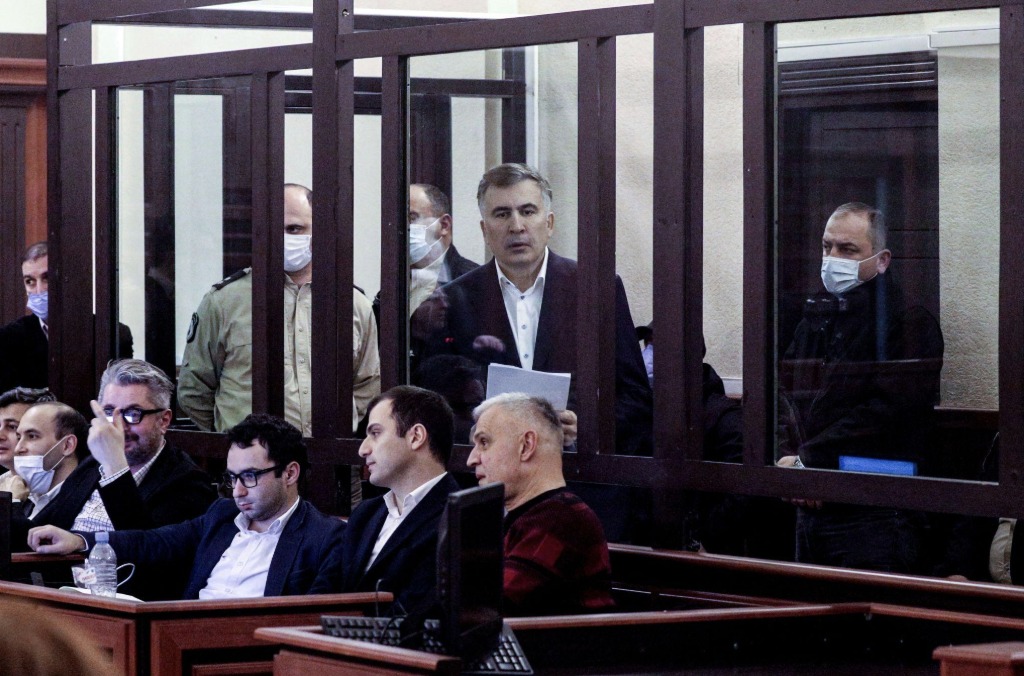
Protest march organiser Gota Chanturia said: “I want to remind everyone that one of the demands of the Public Broadcaster March was precisely to open up airtime. Yes, the main demand was to open the air ‘to the people’, but we never rejected discussions and debates.”
Tinatin Mosiashvili, a protest participant, pointed to growing media polarisation: “I support debates. Today we still live in parallel realities. One part of the population watches one set of media, another watches something else, and there is no dialogue between us.”
Simon Janashia, who took part in the debates himself, said: “My goal is not to convince Kobakhidze of anything. My goal is to break out of the narrow space where only the opposition speaks. Imedi has the highest ratings in Georgia, and that cannot be ignored.”
Janashia rejected the idea that taking part in debates amounts to recognising the authorities: “They [opponents of the debates] think it is acceptable to talk to the regime at the airport or on the street, but not in debates, because they believe that would be seen as recognising it. That is simply not the case. I saw Zviad Gamsakhurdia speaking to Russian soldiers after 9 April, but that did not mean he recognised the legitimacy of the Soviet government in Georgia.”
Writer Lasha Bugadze commented: “It is obvious that a politician must appear anywhere there is even the slightest chance to speak and influence people. If you cannot win an argument with the sociopath Ivanishvili and the extremely weak, deceitful and manipulative ‘prime minister’ on Imedi, then how do you plan to win the bigger battle? You have to win.”
Supporters’ arguments largely come down to the following:
Писатель Лаша Бугадзе прокомментировал: «Очевидно, политик должен появляться везде, где есть хоть малейший шанс высказаться и повлиять на народ. Если вы не можете выиграть спор с социопатом Иванишвили и крайне слабым, лживым и обманчивым “премьер-министром” на “Имеди”, то как вы планируете выиграть в большой схватке? Вы должны победить!».
Аргументы сторонников в основном сводятся к следующему:
▇ Main arguments of supporters
- Years without debates have not produced results, so a different tactic might work.
- The opposition should speak everywhere to spread the truth, including on pro-government television;
- The opposition needs to reach government supporters and undecided voters. It cannot do that without appearing on pro-government TV, since many in that audience watch Imedi and Rustavi 2;
- Taking part in debates does not mean recognising the authorities. On the contrary, it allows participants to explain live to pro-government viewers why the Georgian Dream government is illegitimate;
- It offers a chance to ask the government important questions directly;
- Debates could help reduce polarisation;
What do opponents of taking part in the debates say?
Critics of participation are categorical in their stance. Their main argument is that if the debates are initiated and organised by Georgian Dream, taking part amounts to recognising the government’s legitimacy.
Radio Free Europe/Radio Liberty interviewed several participants in a rally on Tbilisi’s central Rustaveli Avenue. One protester, Tamuna Giorgadze, said: “When people are arrested for protesting on the pavements, and a little girl is threatened with two years in prison for tearing up newspapers, it is completely inappropriate to take part in debates organised by the government and thus give it even a small measure of legitimacy.”
Another demonstrator, Tea Paichadze, said: “I do not support it for a simple reason: if it benefits them, it should not benefit us. It will create the illusion of democracy in a country where it does not exist. What is there to discuss with someone who has been beating protesters for more than 400 days?”
Former president Salome Zourabichvili has also spoken out against participation. In her view, one of the aims of allowing the opposition into the debates is to divide it.
“They do not know how to govern the country, but they do know how to ‘divide and rule’. It is an old technique that every regime uses at some point,” Zourabichvili said.
▇ Main arguments of opponents
- Pro-government television channels are not a suitable platform for genuine public discussion.
- The debates are organised by the government itself, so taking part gives it legitimacy. There is a risk the authorities will use them to create an image of “normalisation” for both domestic and international audiences;
- Appearing in debates on pro-government television would create the illusion of a normal democratic process, which could be seen as hypocritical while the government restricts independent media and spaces for public discussion;
- Playing on the “opponent’s territory” would put the opposition at a disadvantage from the outset;
- Government supporters who have avoided critical information for years are unlikely to change their views after a debate;
- Taking part in government-organised debates amid repression, arrests and fines is morally unacceptable;
- One of the aims of reviving debates may be to deepen divisions within the opposition;
Debates on European integration
The Rustavi 2 television channel has begun promoting debates on the topic “Does Georgia need European integration?”. The subject has drawn particular criticism.
The party For Georgia, led by former prime minister Giorgi Gakharia, which had previously taken part in debates, refused to participate this time. “European integration is the historical and constitutional choice of our country, unequivocally supported by the people of Georgia. Accordingly, there is nothing to discuss,” the party said.
Sociologist and supporter of the pro-European protests Iago Kachkachishvili wrote on Facebook that he had also been invited to take part in a debate on European integration on Rustavi 2, but declined. “Debates on this topic are harmful in themselves, not to mention that they are unconstitutional.” In his view, scepticism towards European integration had been artificially created by the government.
Constitutional lawyer Vakhtang Khmaladze said the aim of such debates was clear. “When 80 or 90 percent of participants in a debate speak against European integration, and the debate is organised that way, it becomes obvious they are trying to create the impression that the overwhelming majority opposes it, while only marginal groups support it.”
According to some experts, one of the goals of these debates is precisely to turn the European course, guaranteed by the constitution, into a subject of criticism.
What to expect from the debates?
The discussion about debates reflects a broader dilemma: how the opposition and civil society should confront a government with vast resources — through public dialogue or a strategy of boycott.
Simon Janashia acknowledges the risks of participation, including the possibility that the government will use the process to improve its image. But he adds: “The stage has already been set, and now our task is to be kind, brave and competent… We have to overcome our sense of helplessness.”
Ultimately, most agree that debates in Georgia are less about genuine discussion and more about a struggle over the political agenda.
There is little doubt that it will become increasingly difficult for the opposition to engage in dialogue while the government controls much of the media, adopts what critics call anti-democratic and unconstitutional laws, and continues to suppress protests and opposition forces. At the same time, refusing to take part in debates means giving up contact with a wider audience.
Debates in Georgia