Anti-Annexation Platform: Minsk meeting between Georgian and Russian officials threatens to undermine Geneva talks


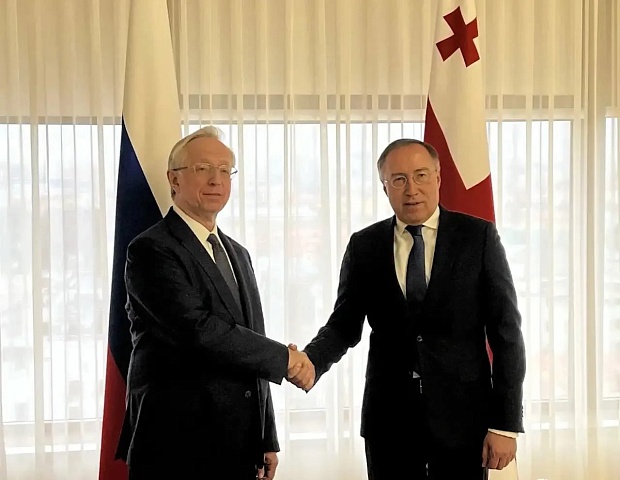
The Anti-Annexation Platform has called on the Georgian authorities to explain a meeting in Minsk between Giorgi Zurabashvili, the prime minister’s special representative for relations with Russia, and Mikhail Galuzin, Russia’s deputy foreign minister.
The platform says the meeting, which took place on 19 November, does not continue the informal dialogue with Russia that existed previously. Instead, it creates a new, direct high-level political channel that could undermine the Geneva International Discussions.
What does the platform’s statement say?
The platform points out that the meeting took place in an official setting, with the two countries’ national flags on display.
It says the Russian side presented the meeting as an official contact between the foreign ministries of the two countries, and the Georgian side did not object.
“This raises the question: are the authorities laying the groundwork for normalising Russian-Georgian relations in a way that no longer makes de-occupation a precondition?” the statement says.
The Anti-Annexation Platform is a non-partisan civic association founded in Georgia on 27 August 2026. It aims to oppose Russia’s occupation and annexation policies and defend Georgia’s territorial integrity and sovereignty.
Its founders include politicians, former military personnel, diplomats, security experts and journalists.
The Anti-Annexation Platform also focuses on the location of the meeting and the issues discussed.
It says Minsk was not chosen by chance: Russia openly stated in 2024 that it wanted to move the Geneva International Discussions to Minsk.
The platform therefore warns of a risk that Minsk could become the centre of a political channel running parallel to the Geneva format.
The statement stresses that the Geneva International Discussions remain the only active international negotiating format involving the European Union, the United Nations and the OSCE. The talks address the situation in the occupied territories, Russia’s responsibility, security and humanitarian issues.
The platform believes that moving these issues into a bilateral format with Russia would weaken international involvement and Georgia’s negotiating position.
19 ноября в вечернем эфире проправительственного грузинского телеканала «Имеди» министр On 19 November, Georgian Foreign Minister Maka Bochorishvili said on the evening news programme of the pro-government Imedi TV channel that “there is nothing wrong with dialogue with Russia”.
“In recent years, whenever it comes to our relations with Russia or our attitude towards it, there have been attempts to instil fear of dialogue and talks, and to reject them outright. This is the country with which we have the most problems, and they are the biggest ones. We cannot resolve any problems without talks and dialogue if our goal is to find solutions or settle disputes,” the minister said.
The Anti-Annexation Platform says Bochorishvili’s remarks the previous day about fear of talking to Russia miss the point:
“Georgian society is not afraid of dialogue. The key question is on what terms this dialogue takes place, what agenda it follows and whose interests it serves.”
The Anti-Annexation Platform has called on the authorities to answer the following questions:
- Why did the Georgian side agree to hold the meeting in Minsk?
- Why did it not explore the possibility of holding a meeting under the new format in Geneva rather than Minsk?
- What do the “practical arrangements” mentioned by Russia involve?
- How will the authorities distinguish this new format from the Geneva International Discussions?
- What guarantees are there that this process will not undermine the Geneva format and lead to the normalisation of diplomatic relations without de-occupation?
The meeting and its political context
According to statements by the Georgian government and the Russian Foreign Ministry, the two sides discussed trade and economic cooperation, cultural and humanitarian ties, regional security and the importance of the Geneva International Discussions.
Both sides said they had reached certain practical arrangements and agreed to maintain contact. However, they did not disclose the details of these arrangements.
This was the first meeting of its kind since Zurabashvili became the prime minister’s special representative. His mandate covers not only trade, economic and humanitarian issues but also the peaceful settlement of the conflict with Russia.
Since 2012, direct dialogue with Russia had taken place under the so-called Karasin-Abashidze format. The meetings were held mainly in Prague and focused on trade, transport and humanitarian issues.
The new format, the choice of Minsk as the venue and Zurabashvili’s broader mandate have prompted criticism in Tbilisi.
Former diplomats and experts have expressed concern that the meeting could mark a step towards direct political dialogue with Russia and the restoration of diplomatic relations.