Theologian jailed for 30 days as Azerbaijan hijab-in-schools row reignites






Azerbaijan schools hijab row
Theologian Abgul Suleymanov was detained for 30 days. His family links his detention to social media posts in which he spoke out against new school uniform requirements concerning the wearing of the hijab.
It has not been reported under which article of the Code of Administrative Offences the court sentenced him. It is therefore not yet possible to establish how Suleymanov’s posts were used to justify the decision to detain him.
Suleymanov’s wife, Zahra Suleymanova, told Meydan TV that the theologian was taken away from outside his home on the evening of 22 September. The following day, his family was unable to establish where he was being held.
According to Suleymanova, her husband has severe diabetes and needs to take medication. His relatives said on 24 September that, following the court hearing, he was taken to a temporary detention facility in Baku’s Binagadi district.
Hijab post and previous arrest
Following the Cabinet of Ministers’ decision, Suleymanov spoke out against restrictions on schoolgirls wearing the hijab. He wrote that if such a ban were introduced, he would rather go to prison. His family links his detention to this stance. Neither the police nor the court have publicly disclosed the reasons for his arrest.
The hijab issue is not new for the theologian. He is known for taking part in protests against restrictions on religious head coverings in schools, and his supporters refer to him as a “hijab prisoner”.
Suleymanov was detained in 2011 and sentenced to 11 years in prison on charges including organising unrest, attempting to disrupt public security and inciting disobedience. Official reports also alleged that drugs had been found in his possession. Suleymanov denied the charges. He was released in September 2022 after serving his sentence.
Following his release, Suleymanov said his religious beliefs had not changed and that he would defend his rights again if he faced obstacles to practising his religion. Documents relating to the current administrative case have not yet been made public.
Does new decision outlaw hijab?
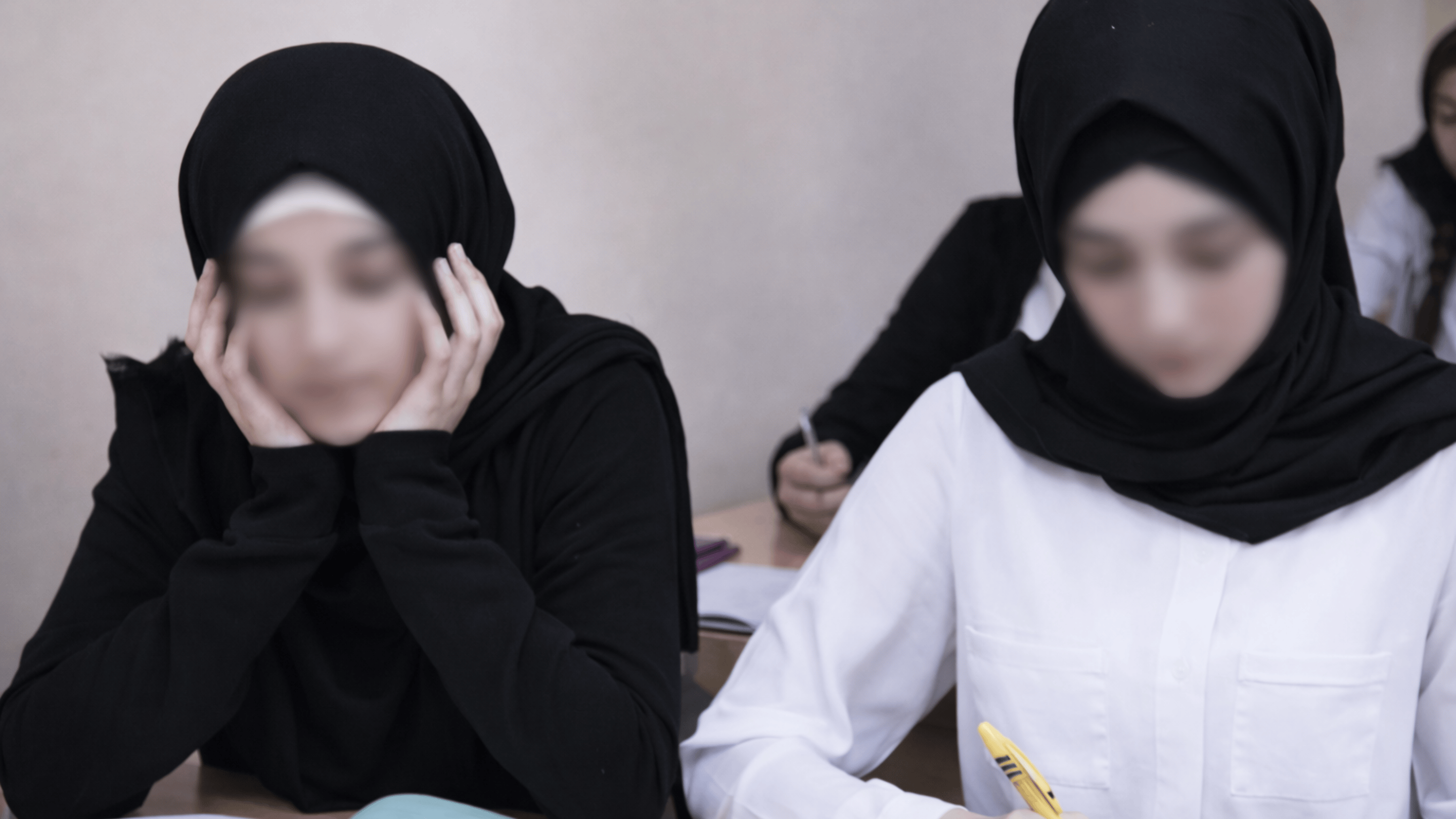
A Cabinet of Ministers decision dated 21 September amended dress requirements for pupils at state schools. Under the new rules, pupils are prohibited from wearing additional items of clothing that disrupt the uniformity of the prescribed school uniform or are inconsistent with the principle of secularism in general education.
The word “hijab” is not mentioned in the decision. However, because religious head coverings are not part of the school uniform, the changes have been interpreted as a ban on wearing the hijab. The document does not specify which items of clothing are considered inconsistent with the principle of secularism, raising questions about how the new rule will be applied in schools.
Under the decision, parents or legal guardians must ensure that their children comply with the dress requirements. Issues relating to compliance are to be decided by each school’s pedagogical council. Elements of national dress may be worn only at certain events with the council’s approval. The document does not specifically provide for girls wearing the hijab to be excluded from classes.
Before the decision was adopted, the principle of “national values and secularism” was added to the Law on General Education in July, while the requirement for pupils and teachers to comply with dress rules was enshrined in law.
Previous complaints and unanswered questions
There have been previous complaints about girls wearing hijabs being denied access to schools. In an article we published in April, we reported on a parent’s complaint about School No. 15 in Sumgayit. He said his daughter had been prevented from attending classes because of her head covering. The school uniform requirements in force at the time did not specifically mention the hijab.
At the heart of the dispute are, on the one hand, requirements for a standard school uniform and the principle that children should not be forced to wear religious clothing and, on the other, pupils’ rights to freedom of religion and education. The issue of wearing the hijab in schools also came to prominence in 2012 following a protest outside the Education Ministry and subsequent arrests.
It remains unclear how schools will apply the new rules to pupils who wear the hijab. A key question also remains unanswered in Suleymanov’s case: what specific action did the court consider grounds for sentencing him to 30 days of administrative detention?