Meydan TV case in Azerbaijan: journalists barred from presenting motions at court






The Meydan TV trial
On February 6, the Baku Court for Serious Crimes held the fourth hearing in the Meydan TV case. The proceedings, presided over by Judge Ayten Aliyeva, began with the state prosecutor continuing to read out the operative part of the indictment.
The hearing, originally scheduled for last week, was postponed because Meydan TV staff member and editor-in-chief of Arqument.az, Shamshad Agha, was granted a three-day leave to attend mourning events following his mother’s death. During this time, Shamshad Agha was under supervision in the village of Shivli in the Lerik district, where the funeral took place.
At the hearing, state prosecutor Ergin Gafarov continued presenting the indictment. Defense lawyers and the defendants said they had important motions to submit and voiced objections.
In response to an objection by lawyer Zibeyda Sadigova, the judge stated that only urgent motions would be allowed. Despite the lawyer informing the court that she had a motion to change the preventive measure, the judge did not allow her to present it.
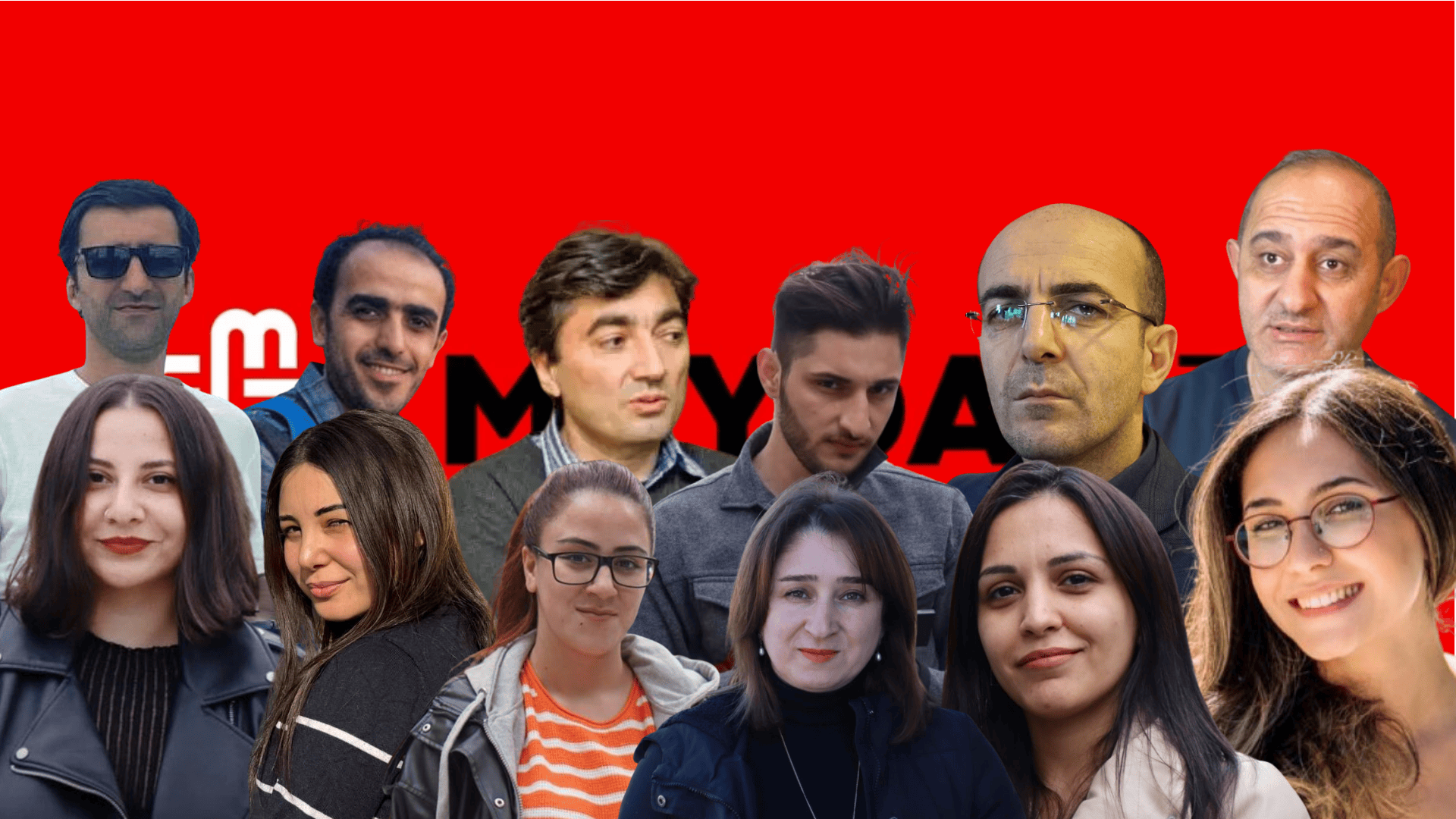
On December 6, 2024, Meydan TV staff members Ramin Deko (Jabrailzade), Aynur Ganbarova (Elgünesh), Aysel Umudova, Aytaj Ahmedova (Tapdig), Khayala Aghayeva, and Natig Javadli were detained.
They were charged under Article 206.3.2 of the Criminal Code (smuggling committed by a group of persons by prior conspiracy), and the criminal case brought against them became known as the “Meydan TV case.”
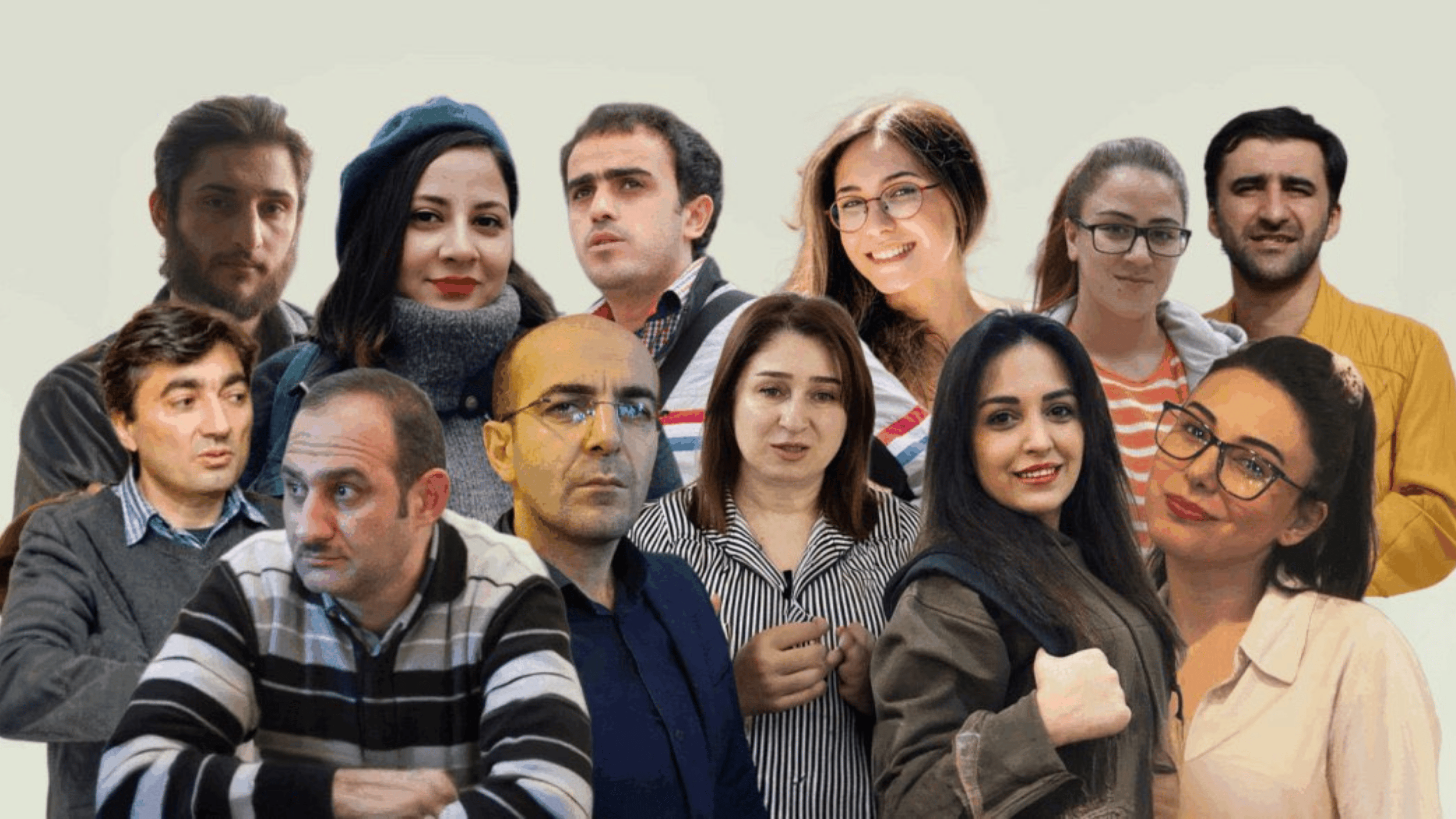
Later, journalists Shamshad Agha, Nurlan Libre, Fatima Movlamli, Ulviya Ali, and Ahmed Mukhtar were also arrested in connection with the case.
In August 2025, the charges against the journalists were tightened, and additional articles were added to the case.
Meydan TV says the arrests are linked to its critical reporting.
“I will not end my hunger strike until my last colleague is freed”
The court hearing began without the participation of Nurlan Libre, who has been on a hunger strike for 21 days. His lawyer, Javad Javadov, said that Nurlan Libre was in the courthouse but was waiting downstairs due to dizziness.
After some time, Nurlan Libre was brought into the courtroom.
He protested being seated separately from the other defendants, in a different part of the hall.
“My friends are here. These are people who came to my wedding and to funerals, who stood by me, and now I need their moral support. That’s why I want to sit next to the other defendants, inside the glass cage.”
The judge initially objected, but after persistent demands from Nurlan Libre and the other defendants, he was allowed to move into the glass cage. However, his handcuffs were not removed, and a convoy officer stood inside the glass enclosure next to him. The judge explained this by citing the fact that he had previously harmed himself in court and the need to prevent similar incidents.
In response, Nurlan Libre stated that he had harmed himself during a December hearing, but had not done so during the January proceedings and had not disrupted the hearing.
Once placed in the glass cage, it was clear that Libre was barely able to stand, suffering from dizziness and severe weakness. He told those present that blood tests had been taken on the 8th and 20th days of his hunger strike, but the results had not been shared with him. He also said that he had been forcibly taken out of his cell without his consent and brought to the court hearing.
“I am being treated very badly. On the way here, my notes are taken away from me. Even my journalistic texts, which were not intended for presentation in court, are confiscated. I am being kept in complete isolation, my phone calls are restricted, and I cannot pass a letter to my lawyer.
When they brought me here, I was treated so roughly that I was shaking from tension. After arriving at the courthouse, a doctor examined me and gave me medication, which made me feel a little better. Since the moment I was taken out of my cell, I have been in these handcuffs. They were not removed on the way here or now.
Taking advantage of the fact that I am weakened after 21 days of hunger strike, they treat me even more harshly, trying to break me. I will not end my hunger strike until my last colleague is freed.”
Some time later, the journalist’s handcuffs were removed, but a convoy officer remained inside the glass cage, standing over him.
Libre also noted that he is being held in a two-person cell in the detention center and has no complaints about the conditions of detention. He said he is continuing the hunger strike not for himself, but for the release of his colleagues.
Some journalists voiced their protest
As the reading of the indictment dragged on, the defendant journalists periodically took the floor.
One of them, Natig Javadli, said he had not been allowed to attend the court hearing wearing a suit. He noted that no law in Azerbaijan prohibits a defendant from appearing in court in a suit. In response, Judge Ayten Aliyeva said the issue would be addressed later. The journalist also urged the state prosecutor to finish reading the indictment.
“If you don’t respect us, at least respect yourselves,” Javadli said.
Shamshad Agha also spoke during the reading of the indictment. He said he had remarks regarding the document and did not intend to wait until it was fully read out to express his views on the charges it contained. When the judge objected, the journalist responded:
“There is no rule stating that a defendant may express their position on the wording of the indictment only after it has been fully read.”
He demanded that media access and filming be allowed at the hearings, since the proceedings are open.
“Moreover, there is a Supreme Court ruling stating that those attending court hearings have the right to enter the courtroom with mobile phones. However, everyone coming to the hearing has their phones confiscated at the entrance. This is completely illegal.”
He again emphasized that he insists on being able to respond immediately to the wording of the indictment as it is being read.
“For example, the phrase ‘Meydan TV, which has not undergone state registration’ is repeatedly used. Meydan TV is registered in Berlin, Germany. It is not required to undergo state registration in Azerbaijan.”
Shamshad Agha’s remarks were met with applause in the courtroom. The judge, however, stated that his motions were left without consideration.
In the end, Judge Ayten Aliyeva announced that out of 12 defendants, the charges had been read out for five, and that the reading of the operative part of the indictment would be fully completed at the next hearing.
The next court hearing is scheduled for February 13 at 2:30 p.m.
News in Azerbaijan