Russia’s state Duma passes law targeting citizens abroad, restricting property rights and passport renewals






Russia Passes Law Targeting Citizens Who Left the Country
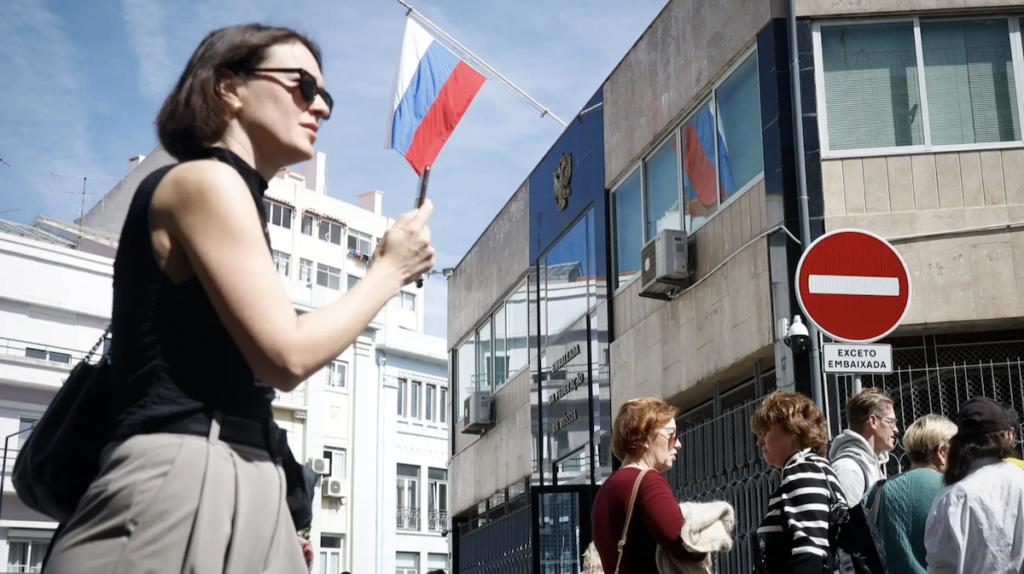
On July 22, Russia’s State Duma approved, in its second and third readings, a bill introducing what it calls “temporary restrictive measures.” The legislation targets people living outside Russia who are deemed to be evading criminal or administrative penalties.
The restrictions will apply to anyone convicted under any article of Russia’s Criminal Code. They will also affect people facing a range of administrative charges — many of them based on provisions that Russian authorities have increasingly used to prosecute political opponents and dissenters.
The law will take effect once it is officially published.
This article is based on reporting by Novaya Gazeta Europe.
What restrictions would the law introduce?
Authorities would be able to impose the following measures on people entered into the special registry:
- freeze bank accounts and other assets;
- block access to banking apps and online accounts;
- redirect a person’s income into a special ruble-denominated account;
- prohibit the sale of real estate and vehicles;
- block the registration of property and automobiles;
- suspend licenses, permits and accreditations;
- bar individuals from registering as sole proprietors or self-employed workers;
- restrict driving privileges;
- deny access to government and consular services;
- prohibit notarial services and transactions carried out through a power of attorney.
Before the vote, State Duma Speaker Vyacheslav Volodin said that Russians living abroad should be thinking about how to appear before a court.
“We are talking about people who are harming our country — extremists, traitors to our homeland. People who have spent years trying to do everything possible to destroy our state,” Volodin said.
How the registry will work
The government will create a state registry of people who are outside Russia and deemed to be evading criminal or administrative penalties. The registry will be maintained by the Justice Ministry, which already administers the country’s lists of “foreign agents” and “extremists.”

Information will be supplied to the Justice Ministry by the Interior Ministry, the Federal Security Service (FSB), the Prosecutor General’s Office, the Federal Bailiff Service and other government agencies.
To be entered into the registry, a person must meet three criteria:
- have a criminal conviction or administrative penalty that has entered into legal force;
- be officially deemed to be “evading” enforcement of that sentence or penalty;
- be outside Russia.
The law, however, does not specify how authorities will determine whether someone is “evading” enforcement.
An interagency commission will be established to coordinate information sharing between the Justice Ministry and law enforcement bodies. It will also decide whether to impose the restrictions.
Lawyer Yevgeny Smirnov said he expects the registry to expand regularly, much like Russia’s list of “foreign agents.”
“I believe the mechanism will closely resemble the weekly expansion of the ‘foreign agents’ register. It will become a show of intimidation through the constant addition of new names,” he told Novaya Gazeta Europe.
Who could be affected?
Formally, the law applies to anyone outside Russia who has been convicted of a crime or an administrative offense and is deemed to be evading enforcement of the resulting sentence or penalty. The specific article under which a person was convicted does not matter.
In practice, however, those most at risk are people prosecuted for political reasons. According to lawyer Yevgeny Smirnov, this primarily includes journalists, politicians, human rights defenders and civic activists.
The law also applies to people facing administrative charges under six specific provisions:
- failure to comply with Russia’s “foreign agents” law;
- violations of regulations governing the activities of a “foreign agent”;
- calls to violate Russia’s territorial integrity;
- “discrediting” the Russian Armed Forces;
- calls for sanctions against Russia;
- participation in the activities of an “undesirable organization.”
Lawyer Anastasia Burakova said the legislation is primarily intended to intimidate Russians living abroad. Since the state cannot physically detain them, she argued, it is instead restricting their civil and property rights.
In her view, the authorities also aim to silence opponents of the war and spread fear among Russians who have left the country.
What happens to a person’s money and property?
The law allows authorities to freeze a person’s funds and other assets. Formally, this does not amount to confiscation, since ownership does not transfer to the state. In practice, however, it would make it much more difficult for people to manage or dispose of their property.
All payments, including pensions, would be redirected to a special ruble-denominated account. The rules governing access to and use of those funds will be determined later by the Central Bank of Russia. Court costs and other financial penalties could also be deducted directly from the same account.

People included in the registry would be barred from selling real estate or vehicles. They would also be unable to register ownership of newly acquired property or register a vehicle.
In addition, banks would block their access to mobile banking apps and online accounts, making routine bank transfers impossible. Banks would also be allowed to deny them loans and other forms of credit.
Lawyer Valeria Vetoshkina described the measures as a tool of financial pressure.
“It creates a paradoxical situation. A person is deprived of access to the very financial tools needed to fulfill the obligations that led to their inclusion in the registry,” she said.
Restrictions on business and employment
People included in the registry would be barred from registering as sole proprietors or self-employed workers.
If their profession requires a license, authorities would refuse to issue a new one. Existing licenses could also be suspended until the individual is removed from the registry.
The government would also be able to suspend permits and accreditations that have already been granted.
Driver’s licenses would not be revoked outright. However, the right to drive would be suspended until the person is removed from the registry.
Ban on powers of attorney and access to government services
People included in the registry would no longer be able to use an enhanced qualified electronic signature. Existing certificates could be revoked, and new ones would not be issued.
They would also lose access to Russia’s Gosuslugi online government services portal, making it impossible to submit applications, process official documents, or access federal and regional public services online.
Before carrying out any notarial act, Russian notaries would be required to check the registry. If a person’s name appears on the list, the notary would be obligated to refuse service.
The law would also prohibit anyone from carrying out transactions on behalf of a listed individual under a power of attorney. In practice, this would deprive Russians living abroad of one of the main ways to manage their property and handle legal matters in Russia remotely.
Which consular services would be denied?
One of the law’s most significant restrictions concerns Russian consulates abroad. People included in the registry would lose access to nearly all consular services.
They would no longer be able to:
- obtain a new international passport;
- notarize a power of attorney;
- certify copies of documents or authenticate signatures;
- obtain notarized consent required for legal transactions;
- register a marriage or a legal name change through a consulate;
- receive consular assistance if detained abroad;
- rely on Russia for emergency consular assistance while overseas.
Lawyer Valeria Vetoshkina said the most consequential provisions are the ban on representation through a power of attorney and the restrictions on consular services. Those are the mechanisms that allow Russians living abroad to handle most legal matters remotely.
At present, even people held administratively liable can still obtain a new international passport through a Russian consulate. Those charged with or convicted of criminal offenses also retain access to some consular services.
Once the law takes effect, however, obtaining official documents without returning to Russia will become significantly more difficult.
Lawyer Yevgeny Smirnov described the initiative as a form of de facto deprivation of citizenship.
“Citizenship technically remains, but a person is no longer able to exercise the rights that come with being a citizen,” he said.
Lawyer Anastasia Burakova agreed with that assessment. In her view, the law would leave affected individuals in a situation approaching statelessness, as the Russian state would effectively cease providing them with documentation and legal assistance.
What is the “humanitarian allowance”?
The law provides for what it calls a humanitarian allowance. The payment may be granted if a person included in the registry has close relatives who are financially dependent on them.
Eligible relatives include parents, a spouse, or children who have no independent source of income. The allowance would be paid monthly using the person’s own frozen funds.
The decision to grant the payment would be made by the interagency commission, while the amount would be set by the Russian government in coordination with the Central Bank.
When would the restrictions take effect?
The restrictions would come into force the day after a person’s name is added to the registry.
In theory, a person could be removed from the registry in several circumstances:
- if a court overturns or revises the underlying decision;
- if the person begins serving their sentence or complies with the penalty;
- if the person returns to Russia;
- if the person dies.
If the Justice Ministry fails to remove someone from the registry without justification, that person may file a request for review. The ministry must issue a decision within 20 working days, and its refusal can be challenged in court.
In practice, however, not all penalties can be served remotely. For example, a prison sentence cannot be served from abroad. As a result, anyone convicted and sentenced to imprisonment would have no realistic way to be removed from the registry without returning to Russia.
Administrative penalties present a different paradox. A person on the registry would face restrictions on banking services while also being barred from appointing a representative under a power of attorney. It therefore remains unclear how they would be able to pay an administrative fine and secure their removal from the registry.
What do lawyers recommend for those at risk?
The law will take effect once it is officially published. Lawyers advise people who could potentially be affected to resolve key property and documentation issues before it comes into force.
In particular, they recommend:
- settling matters related to real estate and vehicles in Russia in advance;
- obtaining notarized copies of Russian documents;
- securing apostilles for school certificates, university diplomas, and civil status documents;
- renewing international passports while they can still obtain long-validity documents;
- withdrawing funds from Russian bank accounts and deposits;
- obtaining apostilled certificates confirming the absence of a criminal record and their driving history.
Once a person is added to the registry, many of these steps would no longer be possible.
exchange