Chechnya’s recruitment machine: How Kadyrov sustains his forces by enlisting civilians






Kadyrov’s Forces in Ukraine
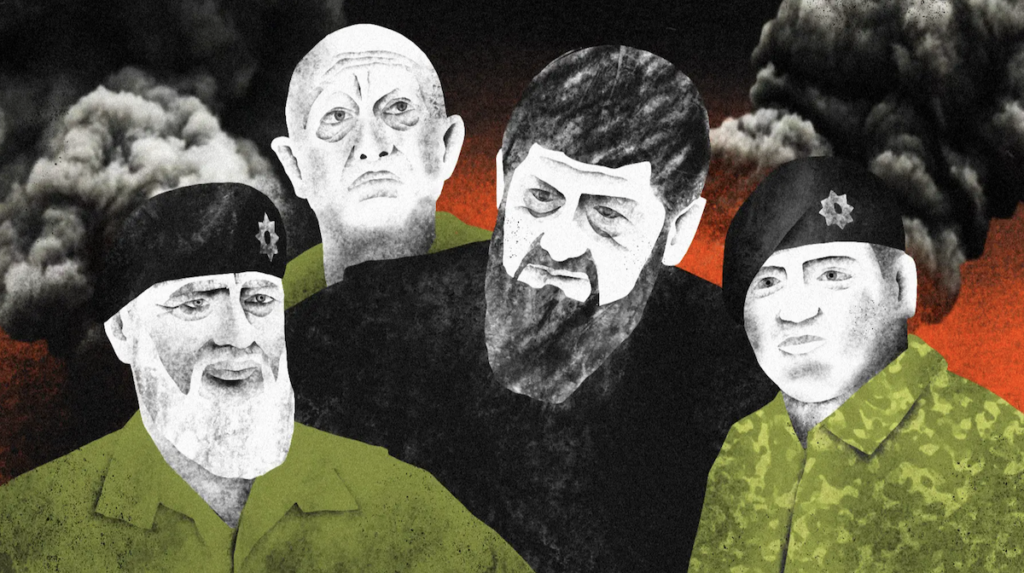
An investigation by Novaya Gazeta Europe shows how the war has reshaped the system of power in Chechnya.
Ramzan Kadyrov has significantly expanded the number of armed units under his control. But his most loyal formations are largely kept away from the front lines.
Instead, combat losses are replenished with ordinary residents of the republic, who are often pressured into signing military contracts.
For the investigation, journalists interviewed 178 Chechen families who lost relatives in the war, as well as current and former servicemen. Their reporting examines how Chechnya’s recruitment system operates and reveals the true scale of its wartime losses.
Kadyrov’s forces
Over the course of the war, five new regiments and five battalions have been established in Chechnya. Formally, they are part of Russia’s Defense Ministry and the National Guard. In practice, however, Kadyrov determines key personnel appointments, where the units are deployed and how extensively they are involved in combat.
According to figures provided by Kadyrov, the number of security personnel in Chechnya has grown from 4,800 in 2003 to 36,243 today. At the start of 2022, before Russia’s full-scale invasion of Ukraine, those forces numbered roughly 16,000 to 18,000. That means Chechnya’s security apparatus has approximately doubled in size over the course of the three-year war.
The human rights group Memorial argues that the expansion amounts to the strengthening of Kadyrov’s personal army. But a source in Chechnya’s regional office of the Federal Security Service offered a different explanation. According to the source, Kadyrov became trapped by the image of being “Putin’s chief foot soldier.” While he continued to create new units, he also sought to shield his most loyal security personnel from frontline combat.
At first, the authorities attracted recruits with high salaries. They then began actively recruiting people from other parts of Russia. Later, military service was opened to unemployed residents of Chechnya. As the flow of volunteers dwindled, the authorities increasingly turned to coercion.
The safe rear ended in the Kursk region
In 2023, Kadyrov secured the deployment of several Chechen units to the Russian border regions of Bryansk, Kursk and Belgorod. At the time, these areas were considered relatively safe rear positions, allowing Kadyrov’s forces to be pulled back from the most intense sections of the front.
That changed on Aug. 6, 2024, when Ukrainian troops crossed into the Kursk region. The Akhmat-Chechnya Regiment, which had been guarding the border, offered little visible resistance. Its personnel abandoned their positions, and some were surrounded and taken prisoner.
The border regions subsequently became the scene of heavy fighting involving the Akhmat special forces, the West Akhmat Battalion and the Akhmat-Chechnya Regiment. One Akhmat commander claimed that Apti Alaudinov’s unit alone suffered more than 1,500 killed and wounded.
Security forces are shielded, civilians sent to the front
After the fighting in the Kursk region, Kadyrov moved to reduce the involvement of key National Guard units in the war. Much of the burden was shifted instead to formations under Russia’s Defense Ministry.
Sources interviewed by the publication say the decision was driven by the need to preserve the foundations of Kadyrov’s rule. His grip on power depends on the loyalty of the republic’s security forces. A prolonged war depletes that resource faster than the Chechen leadership can replace it.
A telling example is the National Guard’s Baysangur Benoevsky Battalion. It is overseen by Adam Kadyrov, the 18-year-old son and presumed heir of the Chechen leader. The battalion has been equipped with modern weapons, its own training ground and a well-funded infrastructure. Its personnel signed contracts that предусматривают service in the war. Yet the unit has remained almost entirely in Chechnya, where it focuses on training.
Another National Guard unit, the Sheikh Mansur Battalion, was deployed to the front in December 2023 and has been engaged in combat ever since.
According to the investigation, the Baysangur Battalion is effectively financed with federal funds allocated for the war while serving as the Kadyrov family’s personal security reserve.
Coerced recruitment
Since the autumn of 2024, the Chechen authorities have carried out a large-scale campaign of forced recruitment. Kadyrov publicly proposed sending what he called “troubled youth” to the front. District police departments were then assigned monthly recruitment quotas of between 25 and 50 people.
Those detained are taken to collection centers in Sernovodsk and at the Khankala military base. According to testimonies from recruits and their relatives, they are held under guard, given inadequate food and receive little to no military training. Some are sent without proper uniforms or equipment, receiving weapons only after they reach the front.
People can be sent to the front for reasons as minor as a street fight, a traffic violation, driving without insurance, tinted car windows or unpaid utility bills. Others are detained for subscribing to opposition channels or for political posts found on their phones. In some cases, relatives are offered the chance to pay for a detainee’s release or to find other “volunteers” to take their place.
According to the journalists’ estimates, 67 such raids were carried out across Chechnya between October 2024 and May 2025.
Hidden casualties
The Chechen authorities prohibit the publication of information about those killed in the war. Families are often instructed to bury relatives at night and to forgo the traditional multi-day mourning rituals. As a result, publicly available casualty lists capture only a fraction of the true death toll.
Officially, around 500 residents of Chechnya have been confirmed killed. But a source in the republic’s government told the investigators that more than 2,300 deaths have been verified internally. Another roughly 1,000 people are listed as missing in action.
Of the 183 fatalities documented by the journalists, 113 were sent to the war after October 2024. Of those, 97 had signed military contracts under coercion. The average time between deployment and death was about two months. Only 84 of the 178 families interviewed were able to recover and bury the bodies of their relatives.
The investigation identifies a fundamental shift in Kadyrov’s approach. At the start of the war, he deployed members of the security forces while portraying those forcibly recruited as volunteers. Now, his most loyal units are kept inside Chechnya, while civilians are openly treated as expendable manpower.
The authors argue that this marks a troubling precedent. Repressive practices first tested in Chechnya have often, over time, spread to the rest of Russia.
exchange