School reconstruction in Georgia: how well-intentioned reform paved road to chaos for children and parents






School reconstruction in Georgia
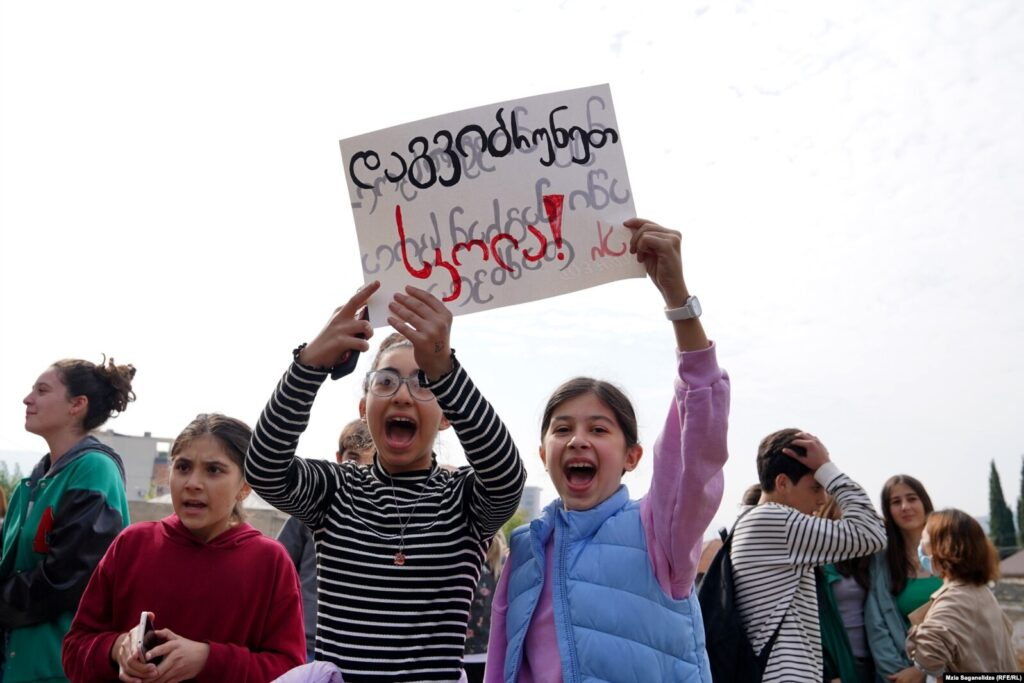
23 October 2023. Students of Tbilisi Public School No. 11 demand the timely completion of reconstruction works on their school building, which has been closed since 2020. Around 1,000 pupils were relocated to two other schools. Construction of the new building has still not been completed. Photo: Radio Free Europe/Radio Liberty.
Thousands of children in Georgia have been unable to return to their schools for years. As older buildings undergo reconstruction, pupils have been reassigned to other schools, but planned construction and renovation deadlines have been missed in almost every case. The result has been overcrowded classrooms, multi-shift learning schedules and disrupted daily routines. Why are school reconstruction projects in Georgia not being completed on time, and who is responsible for the prolonged delays?
Dozens of schools across Georgia today resemble abandoned construction sites. A programme intended to make the educational environment safer and more comfortable has, in practice, forced thousands of pupils and teachers out of their own buildings. What was meant to be a temporary solution has turned into years of uncertainty.
- School uniforms, phone ban, standardised textbooks: what Georgia’s education reform includes
- Opinion: When education becomes a party project in Georgia
In this article, we examine the conditions in which schoolchildren are studying, the choices facing children and parents, why the reconstruction process has dragged on for years and, more broadly, how the state views children and their interests.
Across the city: Nini and Gigi’s story
“We’re late, the bus will leave without us!” Mari rushes to pull jackets onto six-year-old Gigi and nine-year-old Nini (all names have been changed) so they can make it to their school buses.
They drive to the stop by car. Although Nini and Gigi attend the same school, they travel on different transport. First, Mari drops off second-grader Gigi at a minibus stop on one street. She then runs to a parallel street, where the bus for fourth-grader Nini stops.
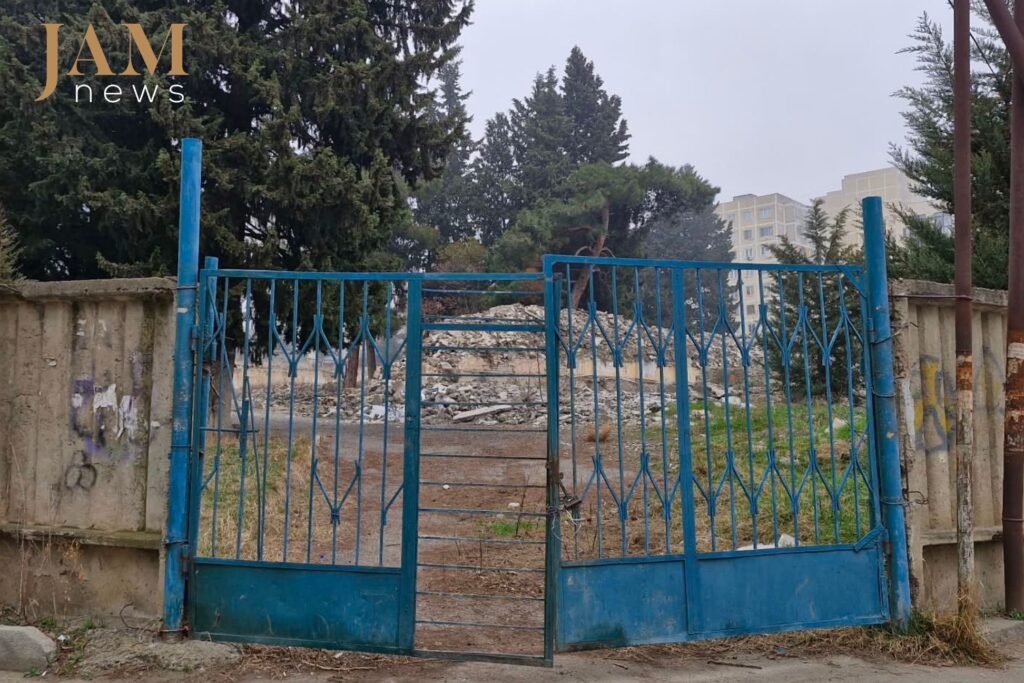
Mari has been living at this frantic pace since last year, when the school her children attended was placed on the reconstruction list. Soon afterwards, the building was vacated and fenced off.
Mari lives with her husband and two children in the Isani district of Tbilisi. When choosing a school, she wanted one close to home. They opted for Public School No. 99, where Nini studied for three years and one term, and Gigi completed only the first term of his first year. In March 2025, the school was vacated and its pupils transferred to Public School No. 182 in the Varketili district — practically on the other side of the city.
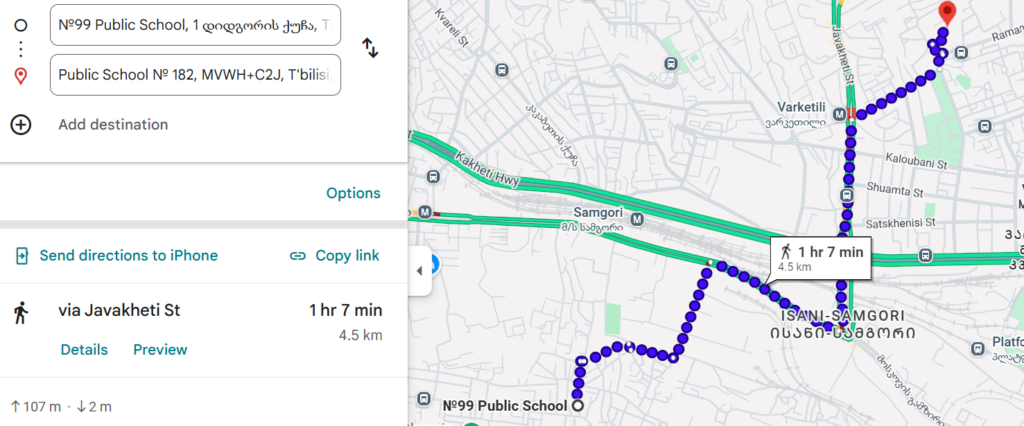
As the new school is located far away, special transport was provided for pupils from School No. 99. Classes now begin at 13:15, during the afternoon shift. School transport departs at 12:45.
For Mari, the logistics are extremely inconvenient. First- and second-grade pupils travel in minibuses together with their class teachers, while older children use larger buses. School No. 99 had a large student body, and transporting everyone now requires so many vehicles that they cannot fit on a single street and instead stop on two parallel ones.
“Many parents, including me, have to make sure they get their children to both streets during the day, and in the evening we have to wait for them in both places as well. You end up running back and forth between the two stops, trying to guess which bus will arrive first,” Mari says.
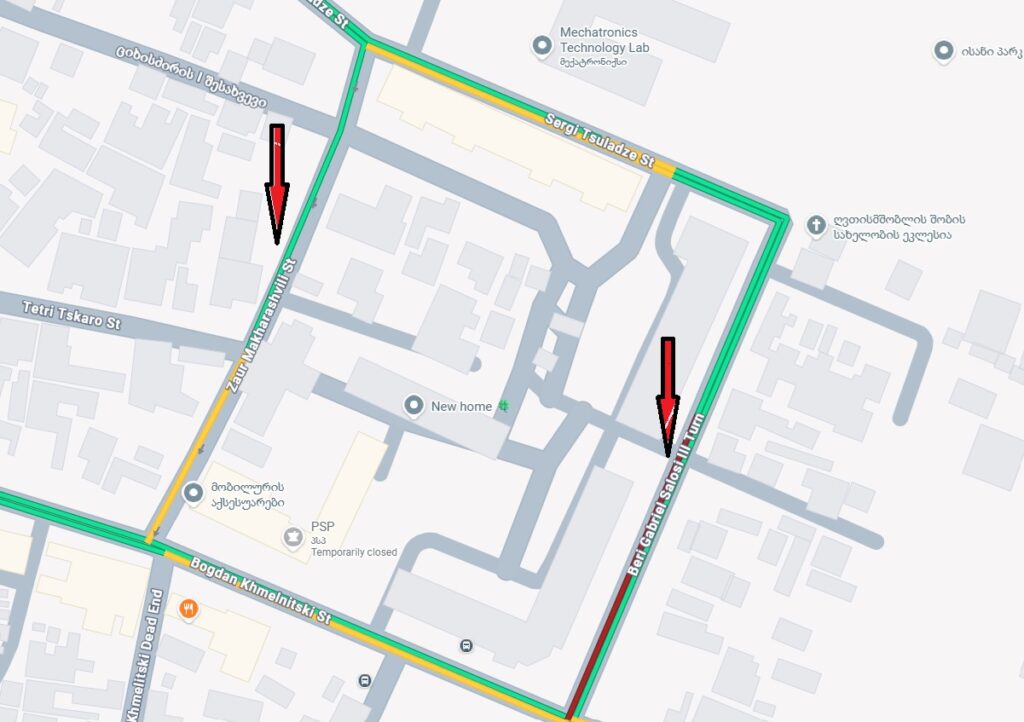
At midday, when the roads are less busy, the journey to School No. 182 takes about 15 minutes. Minibuses stop close to the school, while larger buses park much farther away.
“From the stop, the children walk to the school for about ten minutes under a teacher’s supervision. They walk along the roadside in all weather, whether snow or heat. The pavement is narrow and dug up, and when it rains it turns into terrible mud,” Mari says.
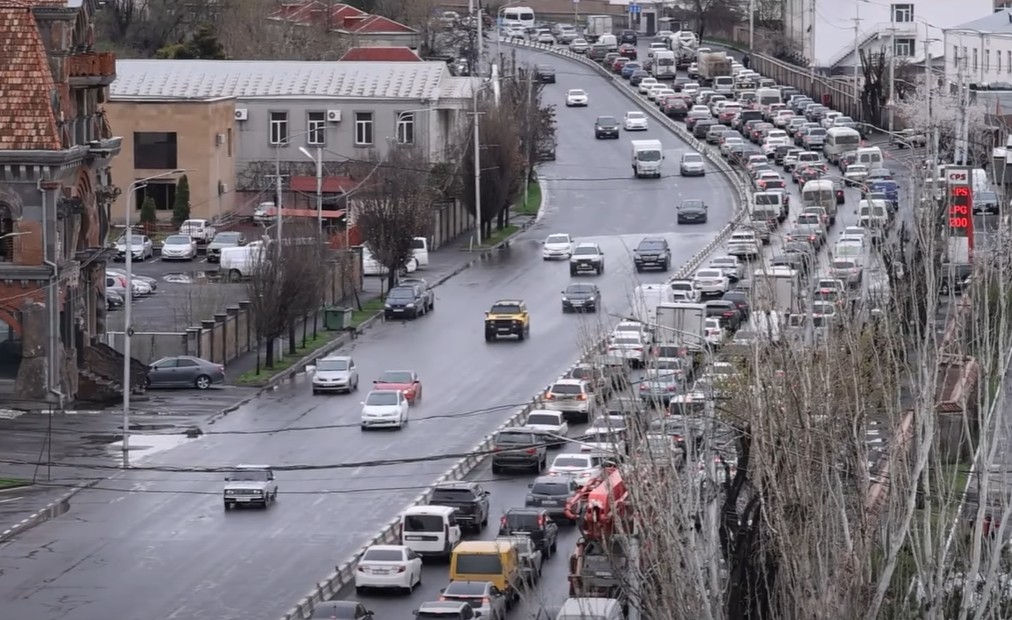
Lessons finish at the height of rush hour, when traffic congestion is at its worst. As a result, parents never know exactly what time the school buses leaving Varketili will arrive in Isani.
“There’s no way to calculate the exact time your child will be brought back,” Mari says.
That means parents cannot plan anything else for their children — no after-school clubs, which are usually held in the evenings, nor any other activities. Mari says the journey exhausts Nini and Gigi so much that they have no energy left for anything else. At first, the children even enjoyed travelling to school by bus, she says, but they soon grew tired. Now they often complain that there is not enough air on board and that they feel sick.
“Once, when the minibus braked sharply, my son, who was sitting at the edge, fell and was thrown towards the door, almost tumbling over.”
Mari does not work, which allows her — just about — to keep running between the bus stops. Sometimes her husband steps in. Parents whose children study in different shifts spend virtually the entire day travelling back and forth between school and home. Thousands of families across Georgia are living like this.
Why did the reconstruction begin, and how many schools are affected?
Public School No. 99 in Tbilisi — where renovation has, notably, not even begun — is one of dozens of schools across the country included in a nationwide reconstruction programme. According to the Ministry of Education, the aim is to fully modernise school infrastructure.
The programme began in 2022 at the initiative of former Prime Minister Irakli Garibashvili. It envisaged the renovation of 800 schools in total: 80 to be rebuilt from scratch and 720 to be refurbished. The project budget stands at one billion lari (about $374m).
The Ministry of Education says the programme will benefit more than 230,000 pupils.
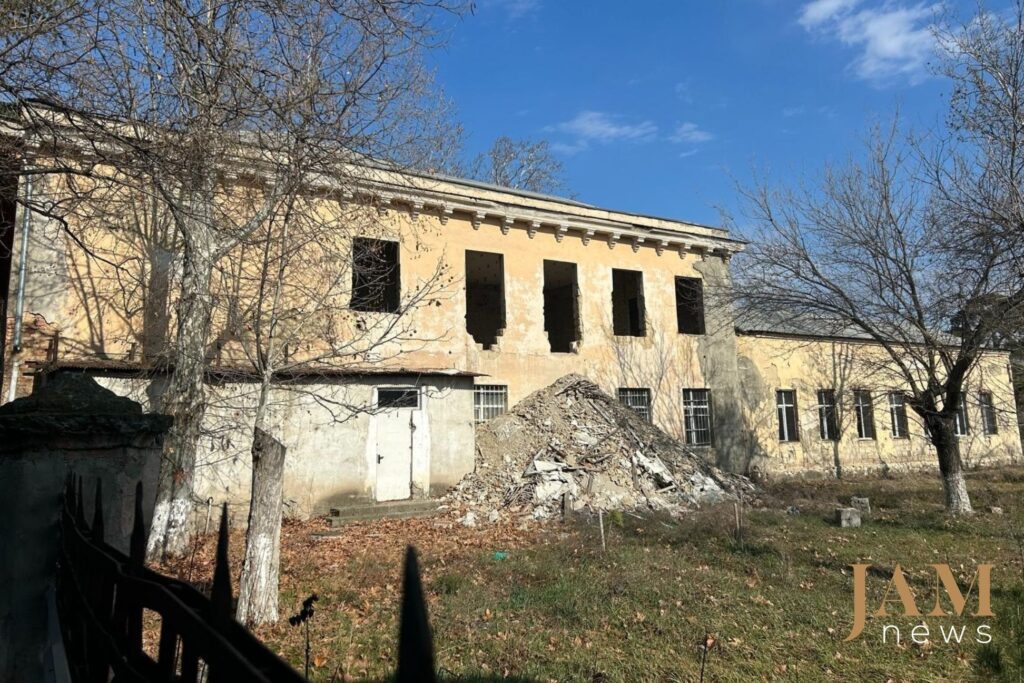
It is not known how many schools have been vacated in total or how many pupils have been relocated to so-called “temporary learning sites”. No consolidated information is available on the Ministry of Education’s website or in its reports. Moreover, the ministry told us that such data does not exist in aggregated form and would need to be processed, meaning an official request must be submitted to obtain it.
Georgia’s National Statistics Office says there are 2,086 public (state) schools in the country, with more than 570,000 pupils enrolled in the 2025–26 academic year.
According to the platform Factcheck.ge, as early as 2024 a total of 21,203 pupils had already been reassigned to other schools because of reconstruction works.
Since 2009, school reconstruction had been the responsibility of a Legal Entity of Public Law (LEPL) under the Ministry of Education — the Educational and Scientific Infrastructure Development Agency. The agency was abolished on 1 September 2025, after which its responsibilities were transferred to the Ministry of Infrastructure.
In October 2025, Infrastructure Minister Revaz Sokhadze told parliament that the ministry had taken over 77 school projects from the agency. Of these, 53 schools were being rebuilt from scratch, 14 were undergoing renovation and 10 were at the design stage. He also said that 135 schools had been identified as priorities at the current stage. According to his forecast, construction of 32 schools and renovation works at nine others were expected to be completed by the end of 2026.
The overcrowding problem: Tatiya and Dachi’s story
Large schools in Georgia were already operating in two shifts. After taking in relocated pupils, some introduced a third shift. Schools that previously had no afternoon classes were forced to reorganise their own timetables. In most cases, the same principle applied: older pupils study in the morning shift, while younger children attend classes in the afternoon.
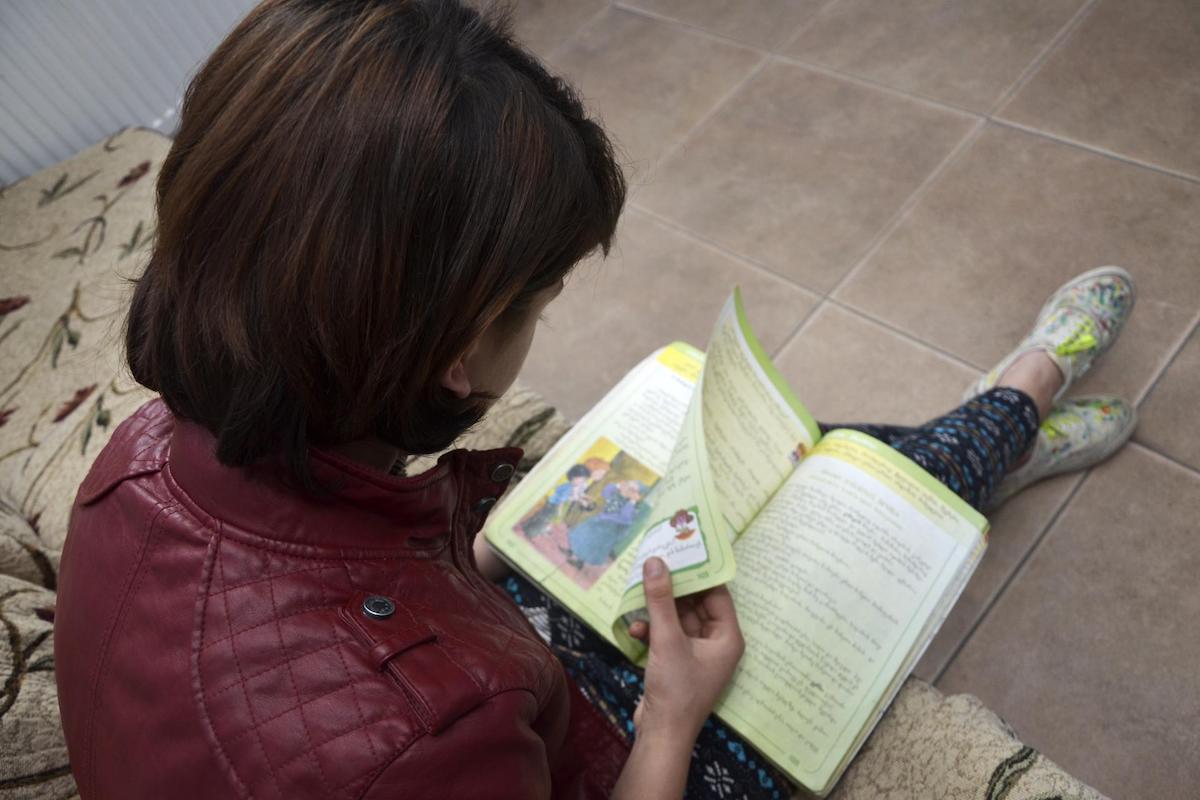
Dachi and Tatiya study at Public School No. 146 on the outskirts of Tbilisi. Tatiya is in the third grade and Dachi in the fifth. When Dachi first started school, pupils from Public School No. 152 had already been relocated to their building, and classes have since been held in three shifts.
“It’s hell,” says Megi Tsiklauri, the mother of Dachi and Tatiya, summing up in two words what it is like for her children to study in different shifts. According to her, their daily routine has been completely disrupted.
“I wake my younger daughter, Tatiya, at 11:00 because she got home late the night before and went to bed late. She has breakfast and we rush to school. She stays there until five o’clock — which means she misses lunch and eats sandwiches at school that I pack for her. When she gets home, between five and eight she has to manage dinner, rest and homework (and she eats very slowly). At eight o’clock we run back to school for her dance class and stay there until ten in the evening. She comes home exhausted, drained and hungry, and still needs to bathe. She might have a snack at 10 or 11pm and then she has to go to bed. If she hasn’t finished her homework by then, she simply has no strength left.”
In such overcrowded schools, even basic cleaning becomes a problem.
“One class leaves, another comes in. The cleaner doesn’t have time, so class teachers quickly sweep the classrooms themselves. The rooms are not properly ventilated. And the school was far from ideal to begin with. Opposite Tatiya’s classroom is the boys’ toilet, and the smell carries into the class. I once mentioned it to the teacher, but she said there was no smell. Perhaps they’ve become so used to it that they don’t notice anymore.”
Because of the large number of pupils, toilet paper often runs out in the bathrooms, Megi says, so she gives her children wet and dry tissues to take with them. She adds that they try to use the toilets as rarely as possible.
The children’s schedule has also completely disrupted Megi’s own routine. She can only sit down to work after seeing her younger child off to school, and as a result she finishes late. Her husband also works, so the family has had to rely on a nanny.
Traces of corruption
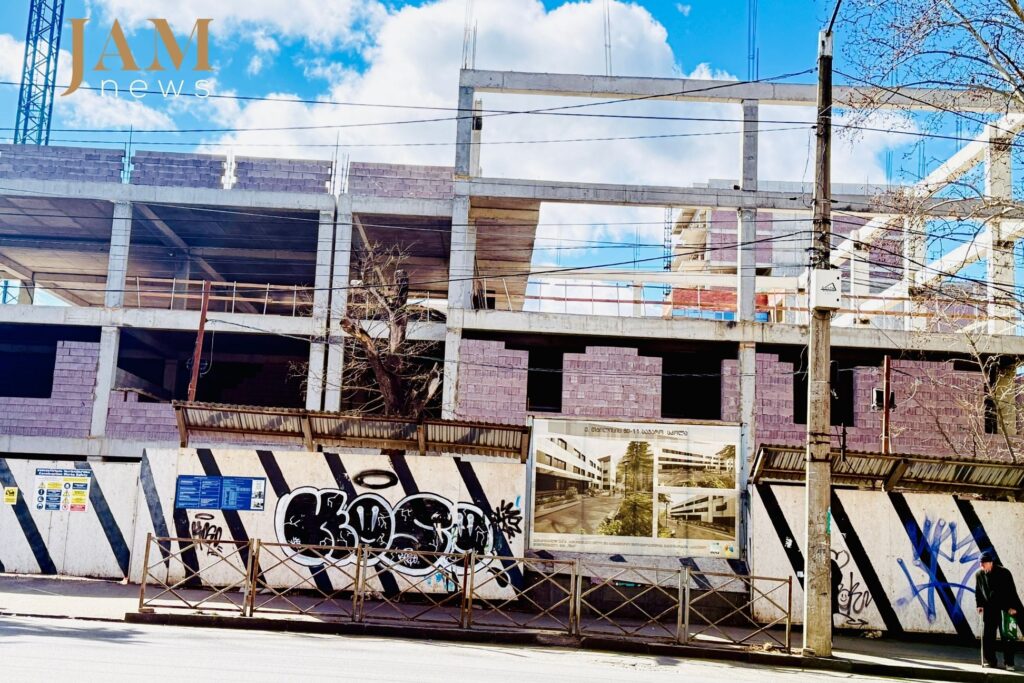
In fact, school reconstruction in Georgia did not begin in 2022. A State Audit Office report published in May 2025, covering the period from 2019 to 2022, shows that numerous violations occurred during the construction and renovation of schools.
Among them were repeated cases of cost overruns caused by inadequate project planning. No proper inventory was kept of reusable materials during school demolitions, creating risks that these materials could be misused. In some cases, project documentation did not reflect actual needs, leading to repeated amendments to contracts and further delays in completing the works.
At several schools, the same work was carried out multiple times, wasting hundreds of thousands of lari. The audit report states, for example:
“At Public Schools No. 25 and No. 26 in Rustavi, as well as in the villages of Norio and Gamarjveba, 89 types of work were repeated, resulting in nearly one million lari (about $373,000) being spent unnecessarily.”
Several corruption scandals also became public. A number of senior officials linked to the reconstruction of schools and kindergartens were arrested. Among them were former Deputy Infrastructure Minister Kakha Gabunia, former executive director of the Municipal Development Fund David Tabidze and several other employees of the agency. The fund operates under the Ministry of Infrastructure and is responsible for announcing tenders related to schools and kindergartens.
In one of the cases, investigators examined the family of the sister of ruling party Georgian Dream MP Irakli Zarkua, which owned the company Lagi Capital. The firm won tenders to design and build schools and kindergartens in several municipalities across Georgia. Company employees are now also under arrest on suspicion of illegally misappropriating nine million lari (about $3.36m) allocated for the construction of 30 kindergartens and four schools.
MP Zarkua has said that his sister’s family later sold the company. This is indeed the case. However, when Lagi Capital began winning state tenders, it was still owned by them.
For example, under a tender announced in January 2023, Lagi Capital was awarded 20m lari (about $7.46m) to build schools in the Shida Kartli region. The contract was signed in April 2023. At that time, the company was still owned by Aleksandre Amisulashvili, the husband of the MP’s sister. In September of the same year, Amisulashvili sold his stake in the company.
What else is slowing the process down?
Research published in 2024 by the Centre for Civil Integration and Inter-Ethnic Relations (CCIIR) confirmed that many schools across Georgia genuinely require reconstruction.
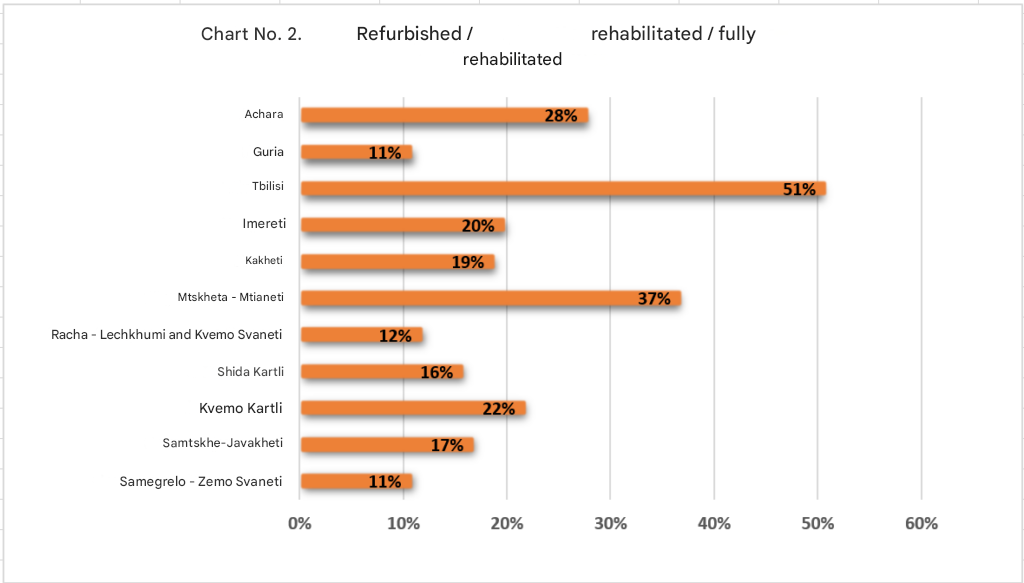
The organisation collected data on 1,561 schools out of the country’s 2,086 public schools — more than 75% of the total — and found that 59% either need to be rebuilt from scratch or require full or partial renovation.
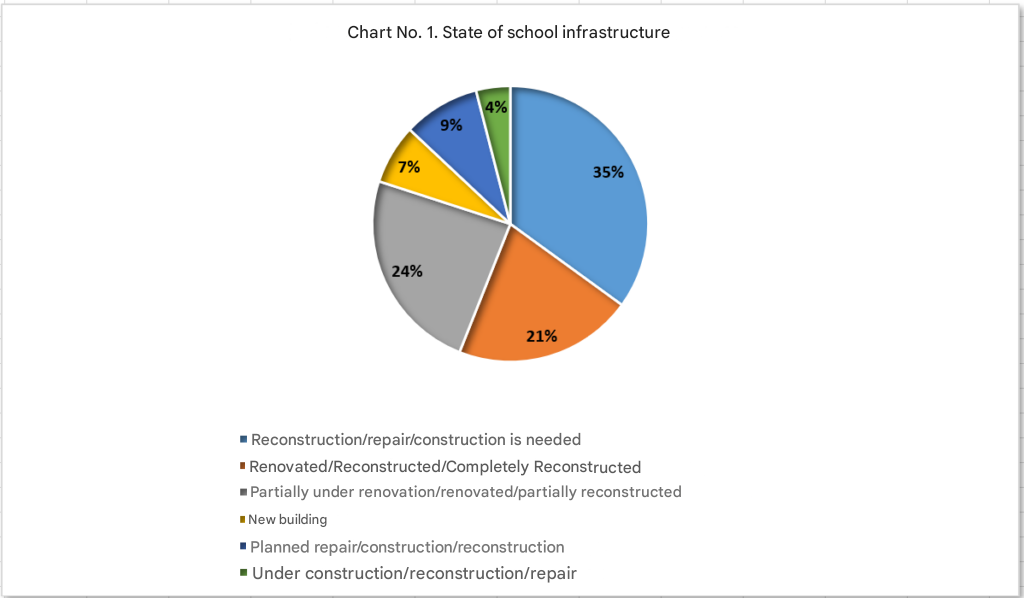
According to the same study, the highest share of renovated schools is in Tbilisi, at 51%. The lowest shares are in the regions of Samegrelo–Zemo Svaneti, Guria, and Racha-Lechkhumi and Kvemo Svaneti, where only 11–12% of schools have been renovated.
The large number of schools involved is not the only reason reconstruction and renovation projects have been delayed.
“There are many problems,” says education expert Simon Janashia, who points not only to corruption but also to poor planning, a weak understanding of the process and other systemic shortcomings.
Proper planning, he says, should be not only efficient but also democratic. “In our case, that simply does not exist. Schools are not asked whether they will be able to organise the learning process properly after their buildings are demolished. Parents and local residents are not consulted either — demolition and construction begin without warning.”
As a result, parents cannot plan their children’s education. The expert mentions cases in which families struggled to enrol a child in a school, only to discover later that the building was about to be demolished.
Janashia also says that the way the process is managed has become a separate problem. After the abolition of the Educational and Scientific Infrastructure Development Agency — which had accumulated relevant expertise and institutional knowledge — “no one knows where that knowledge has gone”.
According to Factcheck.ge, six schools in one district were demolished simultaneously in 2024, while renovation work was already under way at two others at the same time.
“Perhaps this is also happening because the children of senior officials mostly do not study in public schools,” the expert suggests.
A way out — transferring to a private school?
Noa studies in the afternoon shift in the third grade at Public School No. 108 in Tbilisi, which has been sharing its building with another school for almost seven years.
In spring and winter, the start and end times of Noa’s lessons differ. During winter, classes begin earlier so that pupils can finish before dark rather than return home in complete darkness. The school building itself was not adapted for afternoon learning in winter conditions. In particular, there is no proper lighting on the staircases, and after lessons children sometimes had to make their way down almost by touch, says Noa’s mother, Kristina Pardjiani.
“For us, it means that if you create a certain daily routine for your child during the warmer months, in winter you have to rewrite it completely. Right now, for example, Noa has basketball and chess training in the mornings four days a week. From 1 March, when the school switches to its ‘summer schedule’, I will have to reorganise everything again to fit the new timetable.”
Noa requires the support of a teaching assistant at school, which is why his parents chose a state school offering inclusive education services. The school is also close to their home, allowing his grandparents or a nanny to collect him when his parents are busy. Kristina works and cannot take Noa to school during the day.
“After his activities, Noa goes straight to school. He eats in the car. He is already tired. In the first grade it was especially difficult for him to start lessons at midday, sit through them and stay focused.”
Kristina says she is very grateful to the school principal, who, in her words, does everything possible to reduce the children’s discomfort. But neither she nor Noa can continue reshaping their daily routine every time the timetable changes. She does not rule out transferring him to a private school from the fifth grade.
What about twins? Tekla and Sandro’s story
Education expert Simon Janashia says another major problem is that reconstruction planning often ignores demographic realities.
“In some villages where the number of children is falling, enormous schools are being built, while in cities some high-demand schools are not built at all. Or a municipality sells land and then it suddenly turns out there is no longer enough infrastructure for children.”
One example is Didi Digomi, one of the fastest-growing districts in Tbilisi. Local resident Tamta Janadze says there are only three public schools in the entire area.
Tamta has three children. Her eldest daughter, Ana, is in the fourth grade. Her younger children — twins Tekla and Sandro — will turn six in the summer and are due to start school in September.
“Of course, we planned to enrol them in the same school as their older sister — Public School No. 221 in Didi Digomi. But it turned out that first-graders will study in the afternoon shift. That means I would have to spend the entire day travelling between home and school: first take the eldest, then rush home, take the younger ones, pick the eldest up again, and so on.”
Tamta says she has almost no time left for herself or personal development. She might accept that if she were certain her children would receive a good education — but even that, she says, is not guaranteed.
“We already know the school cannot provide the level of education it should, and when classrooms are this overcrowded, it becomes even harder for teachers to give each child proper attention.”
The family has discussed every possible option — even selling their flat and moving to another district with more schools. But that would mean additional expenses and complications. Private education is simply unaffordable: even the most budget private school for three children would cost 25,000–30,000 lari a year (about $9,000–11,000).
“The system is forcing me into an extremely difficult choice. In such a huge district there are only three schools. We barely managed to get a proper asphalt road built to the school Ana attends so children would not have to walk through mud. We have also long asked the city hall to add a public transport stop near the school, but so far without success,” Tamta says.
What worries her most, however, is the possibility that her eldest daughter’s school could also be closed. Several months ago, a windowpane fell out of one of its windows. Fortunately, no one was hurt, but parents were alarmed and are now demanding an expert inspection of the building.
School reconstruction in Georgia