What possible EU sanctions on Georgia’s Kulevi port could mean






Kulevi port may face EU sanctions
The European Union is considering including Georgia’s Black Sea port of Kulevi in its 20th package of sanctions against Russia. The proposal, prepared by the European Commission, would restrict operations at four specific terminals, including Kulevi.
The news was first reported by Radio Free Europe/Radio Liberty, which obtained a draft of the Commission’s working document. According to the text, the Georgian port has been used for the maritime transport of crude oil and petroleum products produced in Russia, or carried by Russian tankers using “irregular and high-risk schemes”.
The Georgian government has rejected the allegations and says it is ready to provide Brussels with detailed explanations.
What does the new sanctions package include?
The EU’s proposed 20th sanctions package, which has not yet been adopted, contains several key measures:
- Sanctions would be imposed on a further 43 vessels from Russia’s “shadow fleet”;
- A ban on technical services for tankers carrying Russian liquefied gas;
- Restrictions on operations with four specific port terminals in third countries. These include the port of Kulevi, described in the document as infrastructure used to transport Russian crude oil or petroleum products through high-risk schemes. According to the proposal, this threatens the effectiveness of anti-Russian sanctions and could be used to circumvent them.
Tbilisi’s reaction
According to Georgian Prime Minister Irakli Kobakhidze, the government does not believe any activity at the port of Kulevi violates international sanctions.
“We do not think anything is happening there that contradicts sanctions policy. We are ready to provide the European Commission with detailed information and discuss the issue,” he said in response to a question from Radio Free Europe/Radio Liberty.
Georgia’s Maritime Transport Agency also rejected claims about Russian tankers, saying inspections had found no violations of sanctions.
Previous scandals and concerns
Because of its alleged links to Russia, the port of Kulevi has drawn international attention several times in recent months.
In October 2025, Reuters reported that the Russian oil company Russneft had delivered the first shipment of crude to a newly built refinery in Kulevi. UK authorities later imposed sanctions on Russneft.
The Russian investigative outlet Proekt also reported on possible links between the family that owns the Kulevi refinery and representatives of Russia’s military intelligence agency, the GRU.
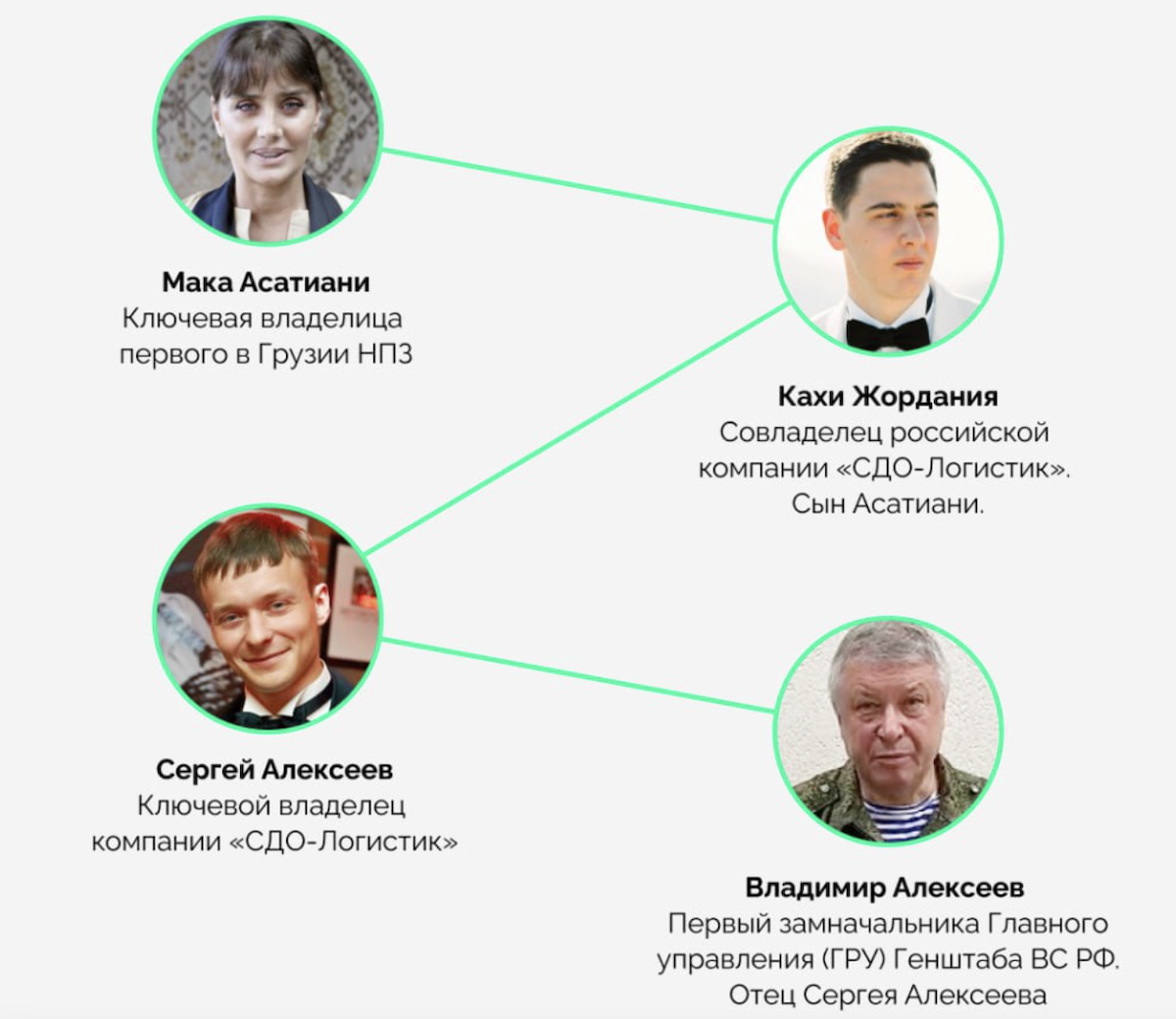

Construction of the oil refinery in the Kulevi Free Industrial Zone began in late 2024. The plant is currently expected to process 1.2 million tonnes of crude oil per year, with plans to expand capacity to four million tonnes. The project belongs to Black Sea Petroleum, a company registered in October 2022. Businesswoman Maka Asatiani owns 70% of the shares.
Prime Minister Irakli Kobakhidze attended the plant’s opening.
Construction of the refinery was also financed by the state investment Development Fund of Georgia, with sponsorship from Cartu Bank—owned by Bidzina Ivanishvili, the founder of the ruling Georgian Dream party—and two other banks.
The “shadow fleet” issue
A new scandal erupted around Kulevi several days ago over the tanker Silvari, which Ukraine says is part of Russia’s “shadow fleet” — a network of vessels Moscow uses to circumvent sanctions.
According to the Georgian outlet iFact, the tanker unloaded about 32,000 tonnes of crude oil and petroleum products at the port of Kulevi.
The vessel was later transferred to an Indian company.
Georgia’s Maritime Agency dismissed the claims as “disinformation,” saying neither the ship nor its cargo fell under international sanctions.
An iFact investigation also found that between 2024 and 2026, 19 vessels matching the characteristics of Russia’s “shadow fleet” called at Georgian ports, including Kulevi.
What the port of Kulevi is and why it matters
The Kulevi oil terminal is located on the Black Sea coast and belongs to Azerbaijan’s state oil company SOCAR.
The terminal has been operating for about two decades, but an oil refinery was also launched there in 2025, increasing its regional importance. According to SOCAR, 2.2 million tonnes of oil and petroleum products were handled at the terminal in 2025 alone.
Possible EU sanctions would not directly block port operations, but could significantly complicate financial transactions and cooperation with European companies.
The broader context
As Western sanctions against Russia tighten, Moscow has been actively seeking to diversify its energy exports and use alternative logistics routes.
The expansion of the “shadow fleet” has raised international concern not only because it undermines sanctions, but also due to environmental and maritime safety risks.
If the EU does include the port of Kulevi in its 20th sanctions package, it would mark the first time a Georgian infrastructure facility has been placed on an EU sanctions list — a step that could significantly increase political and economic pressure on Tbilisi.
Kulevi port may face EU sanctions