

Top stories in Azerbaijan, Armenia, and Georgia from 22-26 December, 2025
 Live
Live




-
Friday, December 26, Azerbaijan. Interim report on last year’s plane crash: no explosion on board, external impact confirmed
-
Friday, December 26, Armenia. Armenia proposes opening the land border with Azerbaijan
-
Thursday, December 25, Armenia. The government proposes revoking the church’s ownership rights to land plots
-
Thursday, December 25, Azerbaijan. It has been exactly one year since Russian air defenses shot down an Azerbaijani passenger plane
-
Thursday, December 25, Georgia. Kobakhidze intends to resolve the problem of rising prices by involving law enforcement agencies
-
Wednesday, December 24, Azerbaijan. In absentia sentences have been handed down to bloggers, and charges have been brought against journalists in the “Meydan TV case"
-
Wednesday, December 24, Georgia. In Tbilisi, the former head of the State Security Service has been arrested; in Tskhinvali, activist Tamar Mearakishvili has been detained
-
Wednesday, December 24, Armenia. The Ayakve movement is calling for a boycott of Azerbaijani gasoline
-
Tuesday, December 23, Armenia. Putin: “There is an opportunity to create new routes that would open Armenia’s borders”
-
Tuesday, December 23, Azerbaijan. Ilham Aliyev did not take part in the informal CIS summit in Moscow for the second year in a row
-
Tuesday, December 23, Georgia. The arrested activists refuse to submit a petition for pardon and demand a fair trial
-
Monday, December 22, Azerbaijan. Amnesty for more than 20,000 people comes Into effect
-
Monday, December 22, Armenia. Nikol Pashinyan: “Armenia is ready for mutually beneficial cooperation within the EAEU" (under Russia’s leadership)
-
Monday, December 22, Georgia. Andro Chichinadze refuses a pardon and calls for a fair trial
-
Top stories in Azerbaijan, Armenia, and Georgia from 15-19 December, 2025

-
Friday, December 26, Azerbaijan. Interim report on last year’s plane crash: no explosion on board, external impact confirmed
● Kazakhstan’s Ministry of Transport has published an interim report on the investigation into the causes of the crash of an Azerbaijani passenger aircraft that occurred on its territory on December 25 last year. The plane was hit by Russian air defense systems while approaching Grozny (Chechnya) and was redirected to Aktau. The crash occurred three kilometers from the airport, killing 38 people.
The report states, in particular:
- No traces of explosive substances were found on board the aircraft following expert examinations.
- No signs of an explosion were detected on the three oxygen cylinders submitted for analysis.
- The aircraft damage was presumably caused by external striking elements, but their origin could not be identified.
- Penetrating damage may have been caused by external objects made of iron-based metal alloys (steel).
- Data could not be retrieved from the Central Maintenance Computer cassette due to thermal damage. It was recommended to contact the manufacturer of the memory card, the U.S. company Delkin Devices Inc.; relevant negotiations are currently underway.
- The examination of GPS1 and GPS2 cassettes has been completed, and analysis is ongoing.
“The final timeline for completing the investigation depends on the completion of all assigned examinations and work. Conclusions and flight safety recommendations will be presented in the final report,” the statement said.
● The British Embassy in Baku expressed condolences on the anniversary of the crash of the AZAL passenger aircraft operating flight J2-8243 on the Baku–Grozny route.
● Armenia has proposed to Azerbaijan launching overland cargo transportation by opening the border between the two countries, Armenian Economy Minister Gevorg Papoyan said. The border has remained completely closed since the early 1990s, following the first Karabakh war. Recently launched rail shipments of goods to Armenia from other countries via Azerbaijan inevitably pass through Georgian territory. This happens for two reasons: the closed Armenia–Azerbaijan border and the destroyed railway between the two countries.
Papoyan proposed the following scheme: cargo would travel through Azerbaijan by rail to the Armenian border, then be transferred via a multimodal system onto trucks and delivered through the Armenia–Azerbaijan land border. “I think there are no circumstances in either Armenia or Azerbaijan that would prevent this. I have the impression that businesses are also ready for it,” Papoyan said. According to him, the preliminary cost of cargo transit from Azerbaijan to Armenia via Georgian railways appears relatively high and uncompetitive.
A few days ago, Armenian Prime Minister Nikol Pashinyan commented on reports that Georgia had set an unreasonably high tariff for the transit of these goods. Pashinyan said that if the issue is not resolved, alternative ways of ensuring import and export flows would have to be sought. Read more here
● The National NGO Forum of Azerbaijan sent an open letter to U.S. President Donald Trump in response to a recent appeal by the American Lemkin Institute, which called for pressure on Azerbaijan to release ethnic Armenians detained in Baku, including Russian dollar billionaire and former state minister of the former unrecognized “Nagorno-Karabakh Republic,” Ruben Vardanyan. The Azerbaijani NGO Forum also sent an open letter to the Lemkin Institute itself, accusing it of attempts to undermine the peace agenda between Azerbaijan and Armenia and calling on its leadership to “apologize to Azerbaijani society for provocative appeals.” The letter to the U.S. president is titled “Defending Law, Stability, and the Vision of the Trump Corridor in the Name of International Peace and Prosperity.” It states, among other things:
“About one-fifth of Azerbaijan’s internationally recognized territories were under Armenian occupation for more than 30 years; nearly one million Azerbaijanis were subjected to ethnic cleansing, and hundreds of civilian settlements were destroyed. Disinformation campaigns seek to portray as ‘hostages’ individuals accused of financing terrorism, waging aggressive war, and committing crimes against humanity during the occupation. Azerbaijan is conducting judicial proceedings, including the case of Ruben Vardanyan, transparently and in strict compliance with its international obligations.
[…] Thanks to your peacemaking leadership, the South Caucasus region is experiencing its most stable and peaceful period in the past 35 years. This historic achievement was directly ensured by you and enshrined in the Washington Joint Statement of August 8, 2025, which became a key milestone toward lasting peace in the region.
[…] We are confident that such subversive structures as the Lemkin Institute will fail to mislead the American public and distort the true picture of ongoing processes.”
● A decree has entered into force under which the commander of the internal troops and officers in positions requiring the highest military ranks will be appointed and dismissed personally by the president. The head of state will also confer the highest military ranks on internal troops personnel and approve regulations governing the military council.
● Ethiopia is interested in increasing imports of petroleum products, agricultural technologies, and industrial machinery from Azerbaijan. In return, it offers coffee, dairy products, sesame, and spices. This was stated by Ethiopia’s ambassador to Azerbaijan, based in Ankara, Adem Mohammed Mahmoud, in an interview with the pro-government outlet Report.
● A Karabakh resident, ethnic Armenian Karen Avanesyan, has been sentenced to 16 years in prison on terrorism charges. According to investigators, Avanesyan went to a forest near a city, retrieved an AK-47 rifle hidden there earlier, along with four boxes of ammunition and five grenades. He was detained while attempting to approach an event in Khankendi, where President Ilham Aliyev was allegedly present. Avanesyan resisted police with armed force, throwing three hand grenades and opening fire. He was wounded during his arrest. Human rights defenders in Armenia claim that Avanesyan suffers from a psychiatric disorder.
● The criminal trial of former leaders of the former unrecognized “Nagorno-Karabakh Republic (NKR)” is nearing completion. They are accused of war crimes, terrorism, attempted overthrow of the government, and other offenses. During recent hearings, the defendants delivered their final statements. According to the state agency AZERTAG, Levon Mnatsakanyan (former “defense minister of the NKR”) concluded his statement first. He said he does not consider himself guilty of any of the charges, withdrew testimony given during the preliminary investigation, and asked the court to base its decision solely on his statements made in court. He submitted the full text of his speeches—51 pages in total over three days—for inclusion in the court record.
Next, defendant Arkady Ghukasyan (former “speaker of the NKR parliament”) stated that he also does not plead guilty to any of the charges. The prosecution presented his work at the newspaper Soviet Karabakh as a crime; Ghukasyan explained that he was involved in translating materials into Russian and does not consider the newspaper’s activity criminal. He said he completely left politics in 2007.
Finally, defendant Bako Sahakyan (former “president of the NKR”) delivered his final statement, rejecting the prosecution’s claim that they constituted a criminal organization. “There was no criminal organization, and there could not have been one,” Sahakyan said.
The trial continues today, December 26.
● Azerbaijan’s cyber police have shut down a cryptocurrency fraud scheme totaling more than 1 million manats (approximately $590,000). Two Azerbaijani citizens were detained; both had previously been convicted of similar crimes in Turkey and Russia.

-
Friday, December 26, Armenia. Armenia proposes opening the land border with Azerbaijan
● “Now is a very good time to open the land border between Armenia and Azerbaijan,” said Economy Minister Gevorg Papoyan. The border has remained completely closed since the early 1990s, following the first Karabakh war. Recently launched rail shipments of goods to Armenia from other countries via Azerbaijan pass through Georgia. This is due to two factors: the closed Armenia–Azerbaijan border and the destroyed railway between the two countries. Papoyan proposed a new scheme: “Cargo arriving by rail through Azerbaijan to the Armenian border could then be transferred multimodally onto trucks and delivered via the Armenia–Azerbaijan land border. I believe there are no circumstances in either Armenia or Azerbaijan that would prevent this. I have the impression that businesses are also ready for it,” the minister said.
● Representatives of the International Committee of the Red Cross (ICRC) visited all Armenian detainees held in Azerbaijani prisons. Zara Amatuni, head of ICRC communications programs in Armenia, noted that the delegation also included a doctor. Families did not hand over any parcels, and the visit was limited to private meetings.
● At a government meeting, a draft law amending the Law on Audiovisual Media was approved. The law will ban the dissemination of content that undermines the constitutional order, promotes war, violence, or cruelty, or pursues similar objectives. The amendments also introduce a provision prohibiting the distribution, via foreign audiovisual programs, of content that interferes in Armenia’s internal political life.
● “We are observing active efforts by Armenian authorities to search for agents of alleged Russian influence among any opposition-minded politicians and public figures,” Russian Foreign Ministry spokesperson Maria Zakharova said at a briefing.
“By what criteria do Armenia’s competent authorities identify these agents of Russian influence? Are they those who advocate developing relations between the two countries? For example, Prime Minister Pashinyan constantly says that relations with Russia should be developed and speaks of a friendly attitude toward our country,” she said.● Azerbaijani authorities have sentenced Karen Avanesyan, a Karabakh resident and ethnic Armenian, to 16 years in prison. He was convicted of terrorism, including the attempted murder of two police officers. Human rights defenders in Armenia claim that Avanesyan suffers from a psychiatric disorder.
● The prime minister and deputy prime ministers will undergo integrity checks. The government approved draft laws amending the Law on Public Service and the Law on the Corruption Prevention Commission. The measures are said to promote transparency, increase trust in the state system, and reduce corruption risks.
● “Azerbaijani gasoline is sold cheaply in Armenia because it is imported cheaply—this is the logic of competition,” said Gegham Gevorkyan, chairman of the Competition Protection Commission.
“If the price turns out to be unjustifiably low, we will of course take preventive measures. As for the overall market impact, I think the volume of Azerbaijani gasoline on the market will be small,” he added.● Prime Minister Nikol Pashinyan: “Visible works under the TRIPP transit project (the route from Azerbaijan to its autonomous region of Nakhchivan via Armenian territory) will begin in the second half of 2026.”
● Nikol Pashinyan positively assessed the dynamics of relations with Tehran and said Armenia would like to sign a strategic partnership document with Iran.
● The Shoghakat TV channel, which broadcasts religious programming, will cease operations on January 1. The government decided to dissolve and liquidate the closed joint-stock company “Spiritual and Cultural Public Television Company.” The opposition links the decision to what it calls Pashinyan’s “anti-church campaign.” The prime minister has long called for the resignation of the Catholicos, accusing him of violating celibacy rules. Several clergymen have been arrested, mostly on charges of calling for the overthrow of the government.
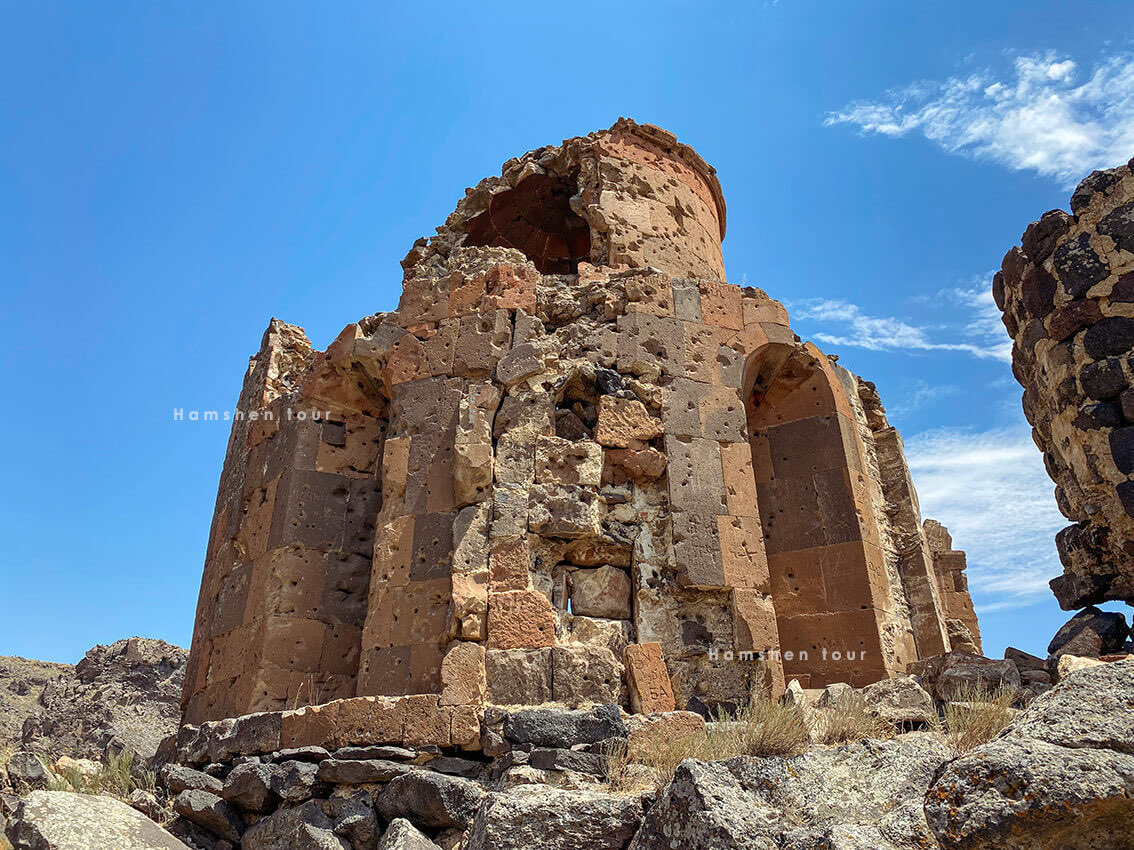
● $471 million has been allocated for the restoration of the 7th-century Shushanavank Church in the village of Bagaran, Armavir Province (pictured).
-
Thursday, December 25, Armenia. The government proposes revoking the church’s ownership rights to land plots
● The government is proposing to revoke the Armenian Apostolic Church’s ownership rights to land plots and retain only the right to free use of the land. Draft amendments to the Land Code have been included on the agenda of today’s National Assembly session.
● Diana Gasparyan, former head of Echmiadzin, the seat of the Armenian Apostolic Church, has been charged with the illegal alienation of land plots. The Anti-Corruption Committee says that Gasparyan, who served as head of the Vagharshapat community since October 2018, carried out these transactions with the assistance of associates, abusing her official authority. The case includes the alienation of a 0.9-hectare plot belonging to the community. She is also accused of laundering particularly large sums of money with the prior agreement of the aforementioned individuals.
● Premium-grade Azerbaijani gasoline will be sold at 430 drams (about $1.10), compared with the usual price of 500–520 drams. “This means it will be sold at a lower price, which is good,” Economy Minister Gevorg Papoyan said on social media.
● Former Yerevan mayor Hayk Marutyan said he will take part in the 2026 parliamentary elections. Last year, he founded the New Force party. “Our party follows a social-democratic platform, and we will focus on social issues,” Marutyan said. Much of Armenia’s opposition is seen as pro-Russian.
● Former opposition MP Ruben Hakobyan, who was arrested on charges of “calling for the seizure of power,” has been found guilty and fined. His son said the verdict will be appealed.
● Former deputy head of the State Revenue Committee Vakhtang Mirumyan has been detained at the request of the Anti-Corruption Committee. No further details have been released.
● Donald Trump reportedly presented a gift with a personal inscription to Armenian Prime Minister Nikol Pashinyan “as a sign of high appreciation.” The gift was delivered during Trump’s meeting with Armenia’s ambassador to the United States, Narek Mkrtchyan. The ambassador thanked the U.S. president for his consistent efforts to promote peace between Armenia and Azerbaijan, as well as for the historic agreement and documents signed at the White House on August 8.
-
Thursday, December 25, Azerbaijan. It has been exactly one year since Russian air defenses shot down an Azerbaijani passenger plane
● Today marks one year since the tragedy in which an Azerbaijani passenger jet was shot down by Russian air defenses while approaching Grozny (Chechnya). The aircraft was later redirected by air traffic controllers to Kazakhstan, where it crashed three kilometers from the city of Aktau. The Embraer 190 operated by AZAL on flight J2-8243 was carrying 67 people – 62 passengers and 5 crew members. 38 people were killed, and 29 were injured. Russian sources claim this occurred during attempts to repel Ukrainian drone attacks.
The crew members who died were Captain Igor Kshnyakin, First Officer Alexander Kalyaninov, and flight attendant Hokuma Aliyeva. Two other flight attendants — Zulfugar Asadov and Aydan Rahimli — survived. After learning of the crash, President Ilham Aliyev cut short his visit to Russia and returned to Baku. The fallen crew members were posthumously awarded the title National Hero of Azerbaijan, while the surviving crew received the Rashadat Order, First Class.
The tragedy led to a sharp deterioration in Azerbaijani-Russian relations. A partial easing of tensions occurred only in October 2025, when Aliyev and Vladimir Putin met one-on-one in Dushanbe. Putin said the investigation was nearing completion and promised compensation and legal assessments of officials’ actions. Read more here
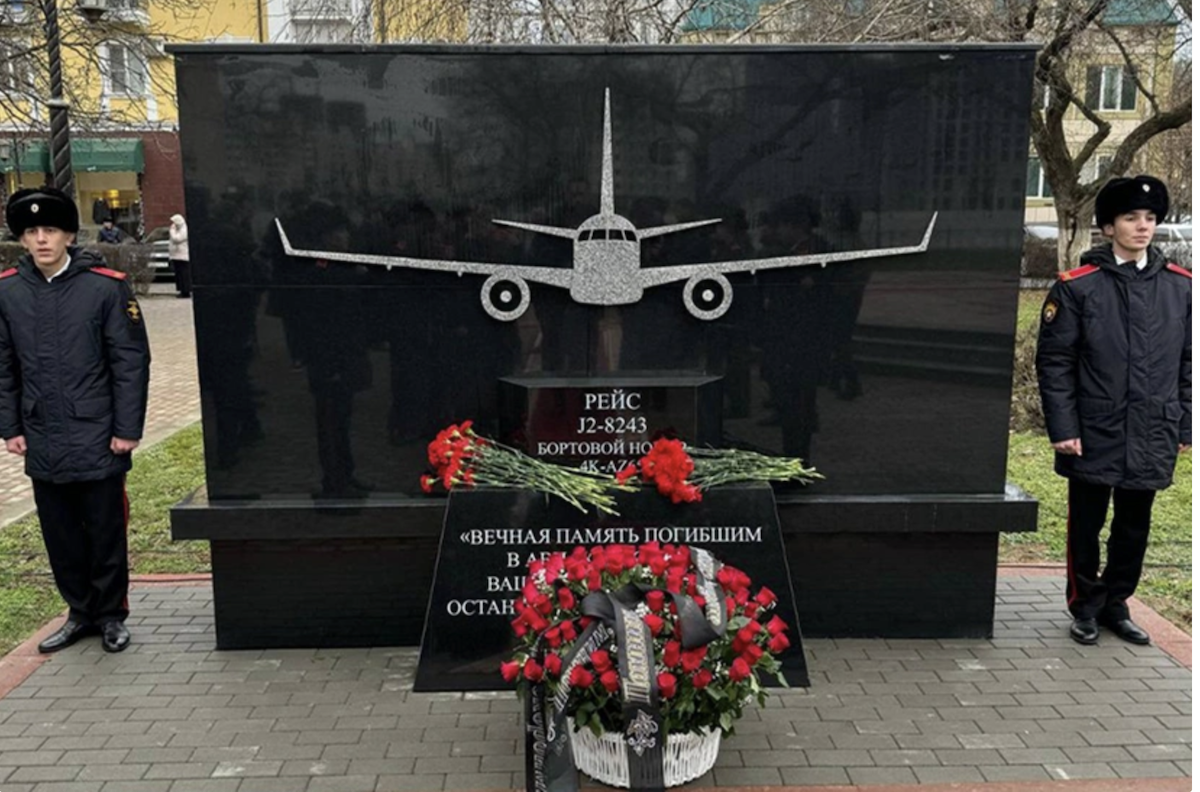
● A memorial plaque honoring the victims of the AZAL crash was unveiled in Grozny (pictured).
● President Ilham Aliyev expressed outrage over what he described as years of Western support for separatists in Karabakh, speaking at a meeting with former internally displaced persons who have returned to their homes in the Aghdam district after its liberation from Armenian control following the Second Karabakh War of 2020. “Every year, marathons were held in the United States and France in support of Armenian separatists. Their leaders – who are now standing trial in Baku – were granted visas to travel there. How was this possible? How could separatists visit the countries that co-chaired the Minsk Group?” Aliyev asked. “Separatist strongholds exist in Ukraine, Moldova, and Georgia. Can the United States, France, or European countries issue visas to their leaders? No. So why were visas issued to Armenian separatists? They were also funded through covert channels so they could keep these lands under occupation indefinitely and carry out violence against the Azerbaijani people. We have no right to forget this,” he said.
● Ilham Aliyev: “Azerbaijan has faced the greatest injustice of recent history. Our lands were occupied. In such cases, international organizations and major powers usually apply pressure on the occupier, including sanctions. Had sanctions been imposed on Armenia, it would have ended the occupation of Azerbaijani territories. Instead, not only were no sanctions imposed, but some countries supplied Armenia with weapons worth billions of dollars – free of charge.”
● Ilham Aliyev: “The total value of weapons we captured from Armenia during the Second Karabakh War and subsequent anti-terror operations – and later destroyed – amounts to around $5–6 billion. This includes the Russian-made Iskander-M ballistic missile, which Armenia should not have possessed at all, as its export is prohibited. How was an Iskander-M missile used to strike Shusha? That is a very serious question.”
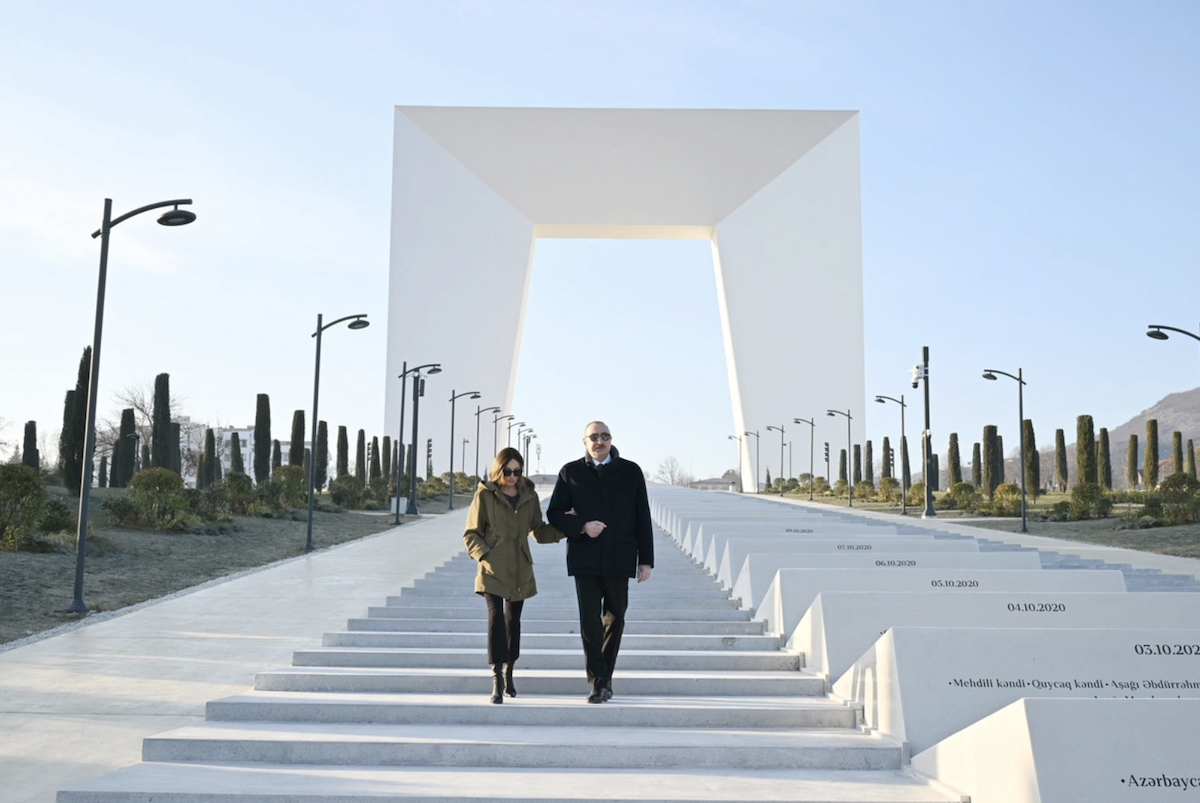
● President Ilham Aliyev and the First Lady attended the opening of Victory Park in the city of Khankendi in Karabakh (pictured). From the park’s entrance, 44 steps lead to the Triumphal Arch, symbolizing the 44 days of the Second Karabakh War in the autumn of 2020. Inscriptions along the way describe the course of the war, including the names of settlements and the dates of their liberation from Armenian control. The park also highlights the results of the anti-terror operation carried out in 2023. The Triumphal Arch is also 44 meters high and consists of ten floors and a terrace. On the terrace, a structure in the shape of the number eight has been erected as a symbol of Victory Day. An exhibition space called the Victory Gallery is located on the ninth floor. The park features fountains and newly planted greenery, including more than 500 trees and over 11,000 shrubs and flowers.
● “At this stage, it is too early to speak about Azerbaijan’s participation in an international stabilization mission in the Gaza Strip. The United States has proposed that Azerbaijan join the mission, but no final decision has been made,” presidential aide Hikmet Hajiyev told Nikkei. He noted that the UN Security Council resolution does not clearly define the mandate or rules of operation for a mission in Gaza.
● The European Court of Human Rights has requested information from the Azerbaijani government regarding a complaint filed by Ali Kerimli, the detained chairman of the Azerbaijan Popular Front Party. However, the request concerns not his current arrest, but a previous incident in June 2019. Kerimli says he arrived at the headquarters of the Musavat party to take part in a charity marathon when police entered the building, detained him without explanation, and took him to a police station. He was released after a two-hour discussion with a prosecutor and senior police officials. Kerimli previously appealed to domestic courts, but his claim was rejected. Authorities told him he had not been arrested or detained and that he was merely given a “preventive talk” over illegal parking.
At present, the chairman of the Popular Front Party and his deputy, Mammad Ibrahim, are charged with attempting to seize power by force. Both deny the accusations. Around 20 members of the Popular Front Party are currently imprisoned.
● Russia plans to begin supplying grain and fertilizers to Armenia via the territory of Azerbaijan and Georgia in the near future, Russian Deputy Prime Minister Alexey Overchuk said. He described the new route as “an important development.” The first shipment of Russian grain – 1,000 tons – was sent along this route in early November.
According to official data, Armenia imports around 450,000 to 500,000 tons of grain annually, almost all of it from Russia. Previously, deliveries were carried out mainly by road and partly by sea through Georgian ports. Analysts say the new railway route will significantly reduce transportation costs and improve the reliability of supplies.
● More than 15 civil society representatives have criticized the new amnesty law, calling it “manipulative,” according to the Azerbaijani service of Radio Free Europe/Radio Liberty. The statement says that while the scope of those eligible for amnesty is broad in terms of including vulnerable social groups, the law does not address the problem of prison overcrowding and makes no meaningful contribution to the release of political prisoners. Official reports say that around 20 people from lists of political prisoners have already been released, most of them religious activists detained on drug possession charges.
The large-scale amnesty was initiated by the president and is expected to affect more than 20,000 people in total. Reports say the list will primarily include those who took part in combat operations to defend the country’s territorial integrity, close relatives of those killed or missing during those operations, and people who “suffered as a result of Armenia’s military provocations against the civilian population.”
● Three Saudi nationals were sentenced to two years in prison for filming and posting offensive videos at the Alley of Martyrs in Baku. They will be deported after serving their sentences.
● The Second Forum of Religious Figures of Azerbaijan was held in Baku.
-
Thursday, December 25, Georgia. Kobakhidze intends to resolve the problem of rising prices by involving law enforcement agencies
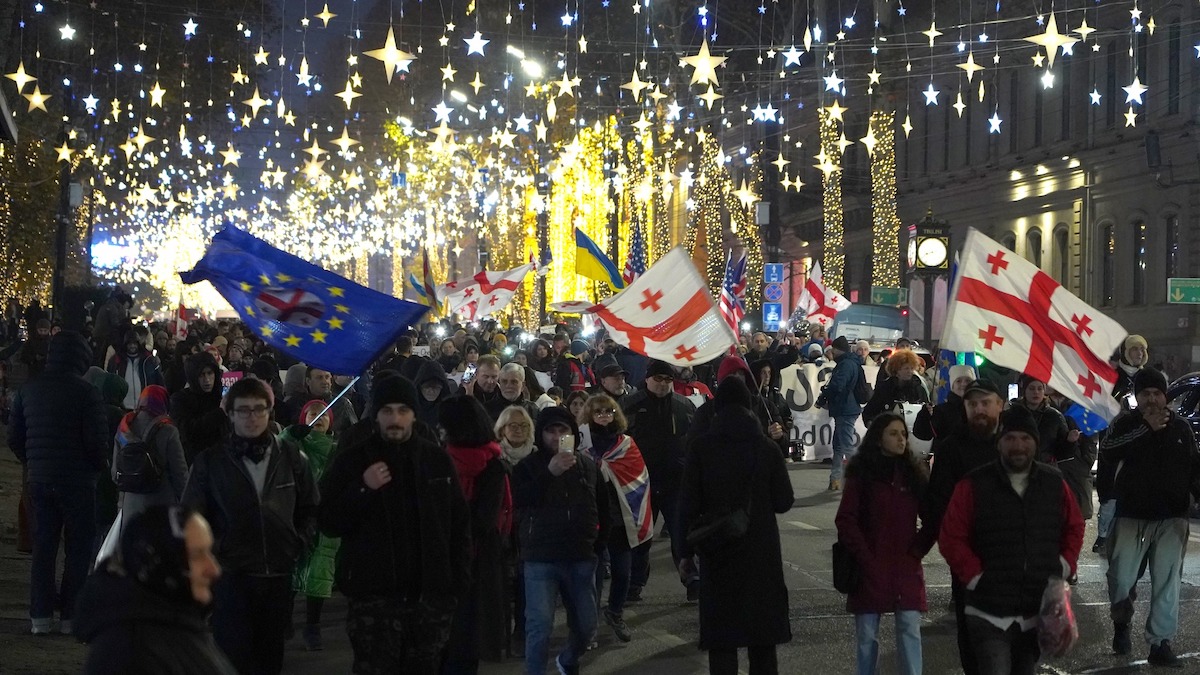
● Ombudsman Levan Ioseliani said he will challenge in the Constitutional Court the repressive legislative amendments adopted by the Georgian Dream party in 2025. The human rights defender said the decisions violate human rights and do not meet international standards of proportionality.
● Prime Minister Irakli Kobakhidze of Georgian Dream said law enforcement agencies should be involved in addressing food price hikes, which he said in some cases significantly exceed prices in European countries. He cited possible violations of antitrust (competition) law as one of the potential reasons for the disparity. Read more here
● Parliamentary Speaker Shalva Papuashvili of Georgian Dream continued the discussion, saying that immediately after the opening of the spring parliamentary session a special investigative commission will be set up to examine how product prices are formed.
● Georgia’s State Security Service responded to these statements by announcing the launch of an investigation.
● The president of the Distributors Association, Lasha Rijamadze, criticized this one-sided interpretation of the reasons behind rising food prices, saying there are many factors negatively affecting the situation. Some experts point to “potential collusion between cartels and the ruling party” as a cause. Read more here
● Former head of the State Security Service Grigol Liluashvili will remain in custody during the pretrial investigation. The next court hearing is scheduled for February 16.
● His lawyer, Rostom Grigalashvili, said his client’s testimony will be made public, as the former senior official “has nothing to hide.” The lawyer also said he is filing an appeal against the preventive measure imposed on Liluashvili.
● The U.S. government will allocate a grant of more than $10.4 million to Georgia’s Ministry of Defense, the government said. The funds will be used to strengthen Georgia’s defense capabilities and improve the technical equipment of the Georgian army.
● Economy Minister Mariam Kvrivishvili of Georgian Dream said the government will invest an additional 7 billion lari (about $2.6 billion) in strategically important infrastructure projects through 2032. Of this amount, 1 billion lari (about $400 million) will be mobilized for further development of the railway sector, including upgrading the locomotive fleet and expanding rolling stock, starting as early as next year.
● Prime Minister Irakli Kobakhidze also spoke about the upcoming modernization of railway infrastructure. “Our future lies in an intermodal transit function that will bring all modes of transport together into a single ecosystem. In this context, the digitalization of logistics processes, which is now actively underway, is also important,” Kobakhidze said.
● Former boxer Giorgi Kandelaki has been released on bail. He is accused of selling large quantities of counterfeit alcoholic beverages and cigarettes without excise tax stamps. Interpressnews, citing his lawyer, reported that bail was set at 200,000 lari (about $70,000).

-
Wednesday, December 24, Azerbaijan. In absentia sentences have been handed down to bloggers, and charges have been brought against journalists in the “Meydan TV case"
● At the latest court hearing in the “Meydan TV case,” the prosecutor announced the indictment against 12 journalists who are currently under arrest in the case. It was also announced that the tax service has filed a civil lawsuit against them for 79,589 manats (about $47,000). The journalists categorically deny the charges and say they are being persecuted for their professional work and criticism of the authorities. The journalists, in turn, submitted a series of motions on various issues. Most were denied, but several were accepted for consideration. The court rejected defense lawyer Zibeyda Sadigova’s request to allow independent audio and video recording of the trial. At the end of the hearing, the journalists protested by singing together a song with the lyrics:
Oh, what a wonderful country,
Everything is concentrated in a few hands,
Prisons, prisons, prisons everywhere.
If only I could tear away even a little freedom,
I would dance until I dropped.“They don’t let us write, so we sing,” said detained journalist Aynur Elgunesh. Read more here
● On the same day, in absentia verdicts were handed down against two outspoken critics of the Azerbaijani authorities living in exile abroad. Ganimmat Zahid, editor-in-chief of the Azadliq newspaper, was sentenced to seven years in prison on charges of “repeated public calls to overthrow the government.” Elshad Abdullayev, former rector of the now-defunct Azerbaijan International University, was sentenced to 15 years in prison on charges including human organ trafficking, large-scale tax evasion, and bribery. Neither has commented on the verdicts so far. Ganimmat Zahid has repeatedly said he does not consider himself guilty and links the charges to his journalistic work. “The court is the most powerless institution in this process,” Zahid said earlier.
Over the course of this year, similar in absentia sentences have been handed down to many bloggers and public figures who have emigrated from the country. Human Rights Watch has previously said that the authorities “abuse the justice system to silence critics.” According to the organization, since November 2023 dozens of journalists, human rights defenders, and academics have been arrested on false financial and other criminal charges. In March this year, criminal cases were opened against several bloggers living in exile. According to HRW and other international human rights organizations, persecution of Azerbaijanis living abroad has intensified significantly overall.
● Today is President Ilham Aliyev’s birthday; he turns 64. Officials at all levels are congratulating him on social media, and media outlets and websites of various institutions and organizations are publishing congratulatory messages listing his achievements in various posts and since October 2003, when Ilham Aliyev became Azerbaijan’s president. His wife, Vice President Mehriban Aliyeva, wrote on Instagram: “Dignity, purity of intentions, and a kind heart are a prayer without words that the Almighty hears. May the Great Allah protect you and our people!”
● One of Turkey’s main goals is the full liberalization of trade relations with Azerbaijan based on a Free Trade Agreement. This was stated by Turkish Trade Minister Ömer Bolat in comments to the pro-government outlet Report. According to him, trade turnover between Azerbaijan and Turkey reached a record level of about $8 billion in 2024. He also described the development of joint brands and their export to third countries as an important task.
● The criminal trial of former leaders of the former unrecognized “Nagorno-Karabakh Republic (NKR)” is nearing completion. They are accused of war crimes, terrorism, attempts to overthrow state power, and other serious crimes. According to the state news agency AZERTAC, at the hearing with closing statements, defendant Levon Mnatsakanyan (former “defense minister of the NKR”) stated:
- The NKR Defense Army received weapons from the Armenian armed forces.
- Civilian objects, monuments, and forests were not deliberately shelled during the fighting in April 2016; the targets were military facilities.
- He did not participate in attacks on the Azerbaijani civilian population in Tunnel and Bashlybel and was undergoing medical treatment at that time.
The next court hearing is scheduled for December 25.
● In Aghdam (Karabakh), the Hilton Garden Inn Agdam hotel was opened, with the ribbon cut by President Ilham Aliyev. The hotel has 127 rooms of various categories, a restaurant, conference halls, a banquet hall, an indoor swimming pool, and a gym. A total of 120 people are employed there on a permanent basis.

-
Wednesday, December 24, Georgia. In Tbilisi, the former head of the State Security Service has been arrested; in Tskhinvali, activist Tamar Mearakishvili has been detained
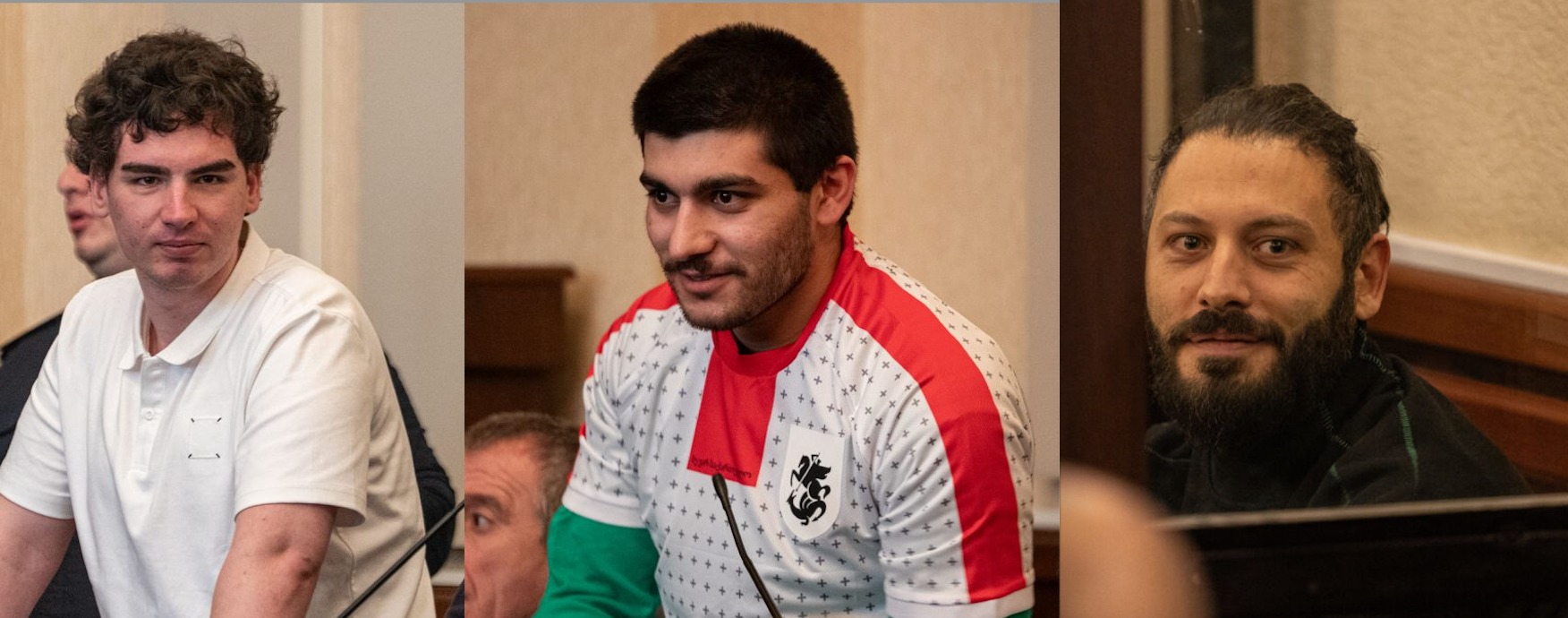
● Statements continue from activists arrested during the mass pro-European protests that have been ongoing in Tbilisi for more than a year. They are refusing the initiative proposed by the president from Georgian Dream for them to submit petitions for pardon.
Saba Skhvitaridze: “I am not going to confess to something I did not do. I am not going to ask forgiveness from an illegitimate president. The truth is on my side, and I will never renounce my truth. You will not wash away your filth at our expense. You scoundrels will have to carry this burden for the rest of your lives.”
Nikoloz Javakhishvili: “A few months ago, when I was sent to court, I was threatened with up to six years in prison. Prison will not break us. Prison will pass, the wound will heal, the pain will fade, and love for our homeland will never disappear from us. And they will never be forgiven.”
Rezo Kiknadze: “I will honestly serve the years of imprisonment unjustly imposed on me and leave this place with my head held high, completely clean, unlike those who put me here. I will accept this sentence with honor for the fight to save the future of my homeland. Let them ask me to pardon them. We will go to the end!”
● Former head of Georgia’s State Security Service Grigol Liluashvili has been arrested. He has been charged with accepting particularly large bribes. According to the Georgian Prosecutor General’s Office, Liluashvili is accused of four episodes involving corruption schemes carried out by a group of individuals acting in prior conspiracy, with total amounts reaching millions of lari and dollars. If convicted, he faces 11 to 15 years in prison. Read more here
● Political analyst Gia Khukhashvili voiced a controversial version of Grigol Liluashvili’s arrest on Pirveli TV. He suggested that the decision is a form of blackmail against Georgia’s perceived shadow ruler, oligarch Bidzina Ivanishvili, by Prime Minister Irakli Kobakhidze, who himself was appointed by Ivanishvili. Khukhashvili said the threat is that Ivanishvili’s son, Bera, could be the next to be arrested. He also did not rule out the possibility that the blackmail could be coming from the Kremlin.
● In Tskhinvali, Georgian citizen and activist Tamar Mearakishvili has been arrested. Local self-proclaimed authorities have charged her with espionage. It has been announced that the investigation is being conducted under the Russian Criminal Code, and she faces a possible prison sentence of 10 to 20 years. Georgian journalist Goga Aptsiuri reported that, according to his information, Mearakishvili has begun a hunger strike. Read more here
● The Tbilisi City Court has upheld the in absentia detention of opposition figure Giorgi Gakharia as a preventive measure. Gakharia has been abroad for several months. He is accused in connection with a 2019 episode, when he served as interior minister. According to the prosecution, he unilaterally decided to build an additional police checkpoint near the village of Chorchana in the Georgian–Ossetian conflict zone. As stated in the indictment, this decision was used by the occupying regime to seize additional territories.
● Harvard University professor and professor of history at Ilia State University, Stephen Jones, sharply criticizes the education reform initiated by Georgian Dream, stating that the government’s real goal is to tighten control over universities and suppress political opposition. “Higher education is one of the most dangerous spaces for authoritarian regimes, because universities become centers of critical thinking and protest.” According to him, this is precisely why Georgian Dream is trying to control the university space and isolate politically active students and academic circles. Read more here
● January 5–6, 2026, have been declared public holidays in Georgia.
📸 Pictured: prisoners of conscience Nikoloz Javakhishvili, Rezo Kiknadze, and Saba Skhvitaridze
-
Wednesday, December 24, Armenia. The Ayakve movement is calling for a boycott of Azerbaijani gasoline
● Grain was shipped from Russia’s Volgograd region to Armenia by rail for the first time, transiting through Azerbaijan. The outlet Volzhsky.ru reports that railcars loaded with wheat departed from the Gmelinskaya station in the Volgograd region. The first shipment consisted of eight grain railcars. By the end of 2025, more than 2,000 tons of wheat—30 railcars in total—are planned to be sent to Armenia.
● A group of local residents has launched a boycott of RAN OIL gas stations, which have begun selling Azerbaijani gasoline. The fuel was purchased by Mega Trade, a company owned by the family of ruling-party MP Khachatur Sukiasyan. “The regime presents the delivery of about 600 tons of gasoline from hostile Azerbaijan to Armenia as a historic achievement of a stillborn ‘peace agenda.’ We call on all drivers to show civic responsibility and not refuel at RAN OIL gas stations. Here, the Baku dictator Aliyev is selling us Azerbaijani gasoline, trying to create the illusion that he wants peace,” the opposition movement Ayakve said in a statement. Much of Armenia’s opposition is known for its pro-Russian stance.
● After three years in office, U.S. Ambassador Kristina Kvien will conclude her mission in Armenia in mid-January, according to a statement from the embassy. “The United States remains committed to its partnership with Armenia and looks forward to further developing the strategic partnership, as well as implementing the bilateral agreements signed by President Trump and Prime Minister Pashinyan at the historic peace summit held on August 8 in Washington,” the statement said.
● Vagif Khachatryan, a Karabakh Armenian imprisoned in Azerbaijan, has been hospitalized. Reports say he is in critical condition with heart problems. He was arrested in July 2023 while traveling from Karabakh to Yerevan for surgery in an ICRC vehicle accompanied by his daughter.
Khachatryan was accused of participating in the mass killings of the Azerbaijani population in the Karabakh village of Meshali in December 1991, during the First Karabakh War. He himself and Armenian human rights defenders continue to deny his guilt.
● “The government of Armenia has fulfilled its most important obligation to the people—opening an era of peaceful development for Armenia and the region,” Prime Minister Nikol Pashinyan said at a meeting with members of the Armenian community in St. Petersburg, Russia.
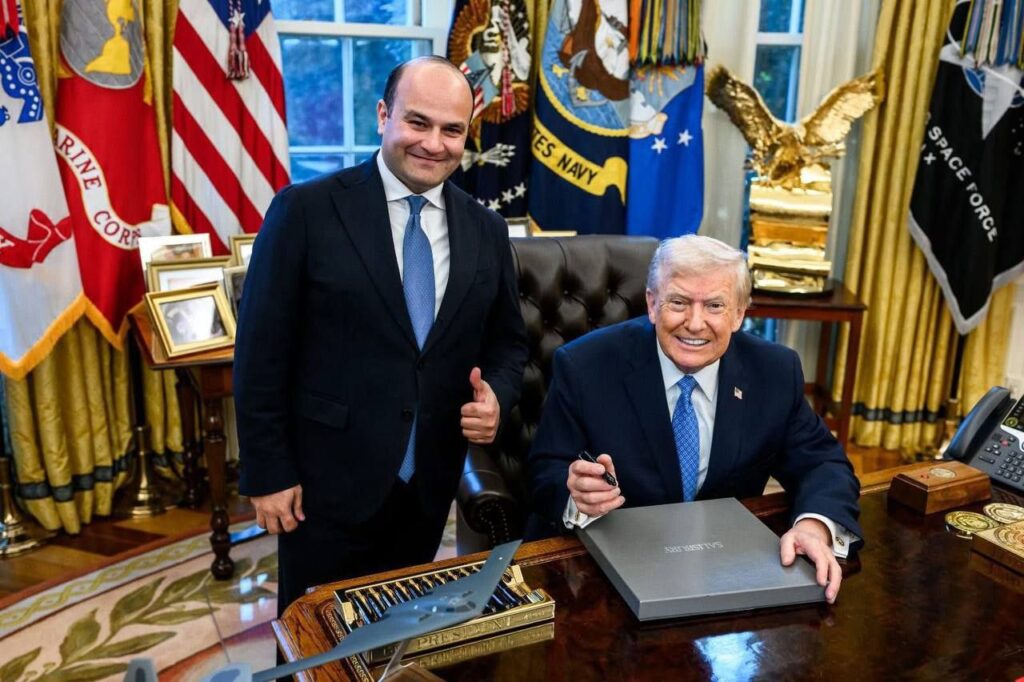
● Armenia’s Ambassador to the United States, Narek Mkrtchyan, met with President Donald Trump at the White House and thanked him for his consistent efforts to establish peace between Armenia and Azerbaijan, as well as for the historic agreement and documents signed at the White House on August 8.
In turn, Donald Trump congratulated the Armenian people, stressing that they deserve a lasting and sustainable peace, and reaffirmed his unconditional support for peace efforts. The Armenian Embassy reported that President Trump “particularly noted the leadership of Prime Minister Nikol Pashinyan and his significant role in the peace process.”
● Yerevan’s Council of Elders has approved the city’s 2026 budget. The priorities include sustainable territorial development of the capital, continuous maintenance of a well-developed urban environment, and modernization of city infrastructure.
● The mayor of Yerevan acknowledged difficulties with the construction of the Achapnyak metro station. According to him, work has not yet begun because “this is one of the most complex projects, classified as a fifth-level risk.” “These processes take time. Where did the allocated funds go? A significant portion was spent on purchasing 45 trolleybuses,” the mayor explained.
● Wizz Air will launch direct Yerevan–London flights starting June 12.
● An event titled “Promoting Governance and Oversight in the Field of Security in Armenia” was held in Geneva, organized by the Geneva Centre for Security Sector Governance.
-
Tuesday, December 23, Armenia. Putin: “There is an opportunity to create new routes that would open Armenia’s borders”
● NATO Deputy Secretary General Radmila Shekerinska said: “I highly appreciate Armenia’s contribution to the NATO mission in Kosovo. We are ready to support reforms and hope to agree on a new framework document for our partnership next year.”
● Armenian Prime Minister Nikol Pashinyan met with Russian President Vladimir Putin on the sidelines of the informal CIS summit in St. Petersburg. Pashinyan spoke about talks with the United States on launching the implementation of the TRIPP transit project (from Azerbaijan to its autonomous region of Nakhchivan via Armenian territory). “These are truly very large and substantive changes in our region, and there are many nuances concerning our bilateral relations with Russia,” Pashinyan said.
● Nikol Pashinyan also told Putin that the agenda for restoring several sections of the railway connecting Armenia with Azerbaijan and Turkey is now ripe. He mentioned the Ijevan, Yeraskh, and Akhuryk segments.
● Yerevan and Moscow discussed nuclear energy issues, the Russian president said after his meeting with Nikol Pashinyan. He also noted that there is “an opportunity to create new routes that would open Armenia’s borders.”
● Armenia’s Ambassador to the United States, Narek Mkrtchyan, took part in a roundtable of ambassadors from the South Caucasus and Central Asia in Washington focused on the TRIPP route. Mkrtchyan said the project has become a key element of the regional strategy and подчеркнул the decisive role of U.S. President Trump in this process.
● Babken Tunyan, Deputy Chair of the Standing Committee on Economic Affairs of the National Assembly, said: “Only $1.5 million worth of gasoline has been imported from Azerbaijan to Armenia, yet some people are raising an outcry, saying: you are filling the budget of an enemy country and strengthening its army. I wonder whether these people came down from the Moon and don’t know that for nearly 30 years we have been importing goods from what they consider no less an enemy country—Turkey—in volumes hundreds of times greater. Over the past 20 years, Armenia has imported more than $4.3 billion worth of Turkish-made goods: clothing, equipment, construction materials. They say they will not buy Azerbaijani gasoline. That is your right—what to buy and what not to buy. But before making emotional speeches, it would be a good idea to check your own clothes and those of your relatives. What if they are Turkish or made from Turkish fabric, so that your arguments don’t short-circuit. Armenia will continue the process of normalizing relations with neighboring countries, including through the development of economic ties.”
Read more here on the supply of Azerbaijani petroleum products to Armenia
● In Azerbaijan, another case has been opened against a Karabakh Armenian. Prosecutors have requested an 18-year prison sentence for Karen Avanesyan, who, according to the charges, attempted to carry out a terrorist attack in Karabakh.
● The mayor of Yerevan said: “With the help of artificial intelligence, we are obtaining data on potholes on the city’s roads.”
● An office of the French Development Agency has opened in Yerevan.
● Turkish Airlines will begin operating Istanbul–Yerevan–Istanbul flights in March 2026. This was announced on social media by Turkey’s special representative for normalization with Armenia, Serdar Kılıç.
-
Tuesday, December 23, Azerbaijan. Ilham Aliyev did not take part in the informal CIS summit in Moscow for the second year in a row
● President Ilham Aliyev did not take part in the informal CIS summit held yesterday, December 22, in St. Petersburg, Russia. The official press release cited “a busy work schedule” as the reason. “Moscow understands the reason for President Ilham Aliyev’s absence. All heads of state have very busy schedules, especially in December, ahead of the New Year,” Russian presidential spokesperson Dmitry Peskov said. He emphasized that Azerbaijan continues to participate in all CIS formats, and that Russia is “developing partnership relations and constructive cooperation with Azerbaijan.”
President Aliyev also did not attend the summit last year. At the time, his absence was explained by a deterioration in relations with Russia after Russian air defense forces shot down an Azerbaijani passenger aircraft while it was approaching Grozny, killing more than 30 people.
● Azerbaijan and Turkey have approved a 110-point plan for economic cooperation following the latest meeting of the intergovernmental commission in Baku, co-chaired by Prime Minister Ali Asadov and Turkish Vice President Cevdet Yılmaz. Special emphasis was placed on energy initiatives, including expanding the Southern Gas Corridor, supplying Azerbaijani gas to Europe and the Middle East, and the Iğdır–Nakhchivan gas pipeline project. The strategic importance of the Baku–Tbilisi–Kars railway was also highlighted, along with the prospects of the TRIPP transit route (from Azerbaijan to its autonomous region of Nakhchivan via Armenian territory).
● Cevdet Yılmaz: “The main objective of Turkey and Azerbaijan is to develop joint production, expand mutual investments, and implement projects in third countries.”
● Azerbaijan’s state oil company SOCAR is acquiring the Gama Enerji İç Anadolu power plant (870 MW) in Turkey for $225 million, Prime Minister Ali Asadov announced.
● Ali Asadov: “Azerbaijan and Turkey are each other’s largest investors. Azerbaijan has invested more than $20 billion in the Turkish economy, while Turkey has invested over $18 billion in Azerbaijan. Around 3,000 Azerbaijani companies operate actively in Turkey, while more than 4,600 enterprises with Turkish capital function in Azerbaijan. Approximately 20 Turkish companies are implementing nearly 50 projects worth about $5 billion in territories liberated from Armenian occupation. These projects include road and railway construction, energy, agriculture, irrigation, and other sectors.”
● Armenian Prime Minister Nikol Pashinyan stated that “the situation has reached a point where preparatory work must be carried out for the possible restoration of railways connecting Armenia with Azerbaijan and Turkey.” He specifically mentioned the Ijevan, Yeraskh, and Akhurik sections. Russian media report that Pashinyan made this statement during a bilateral meeting with President Vladimir Putin in St. Petersburg. “Peace between Yerevan and Baku opens new opportunities for the development of Armenian-Russian relations,” Pashinyan said.
● Former Greek finance minister and economist Yanis Varoufakis has called on President Ilham Aliyev to release imprisoned Radio Free Europe/Radio Liberty journalist Farid Mehralizade. Varoufakis noted that Mehralizade translated his recently published book Economic Conversations with My Daughter. “He is not alone. Another 24–25 journalists are currently in prison in Azerbaijan. International human rights organizations say they were arrested for criticizing the Azerbaijani government. The Azerbaijani authorities claim that Farid and the other journalists were detained for various crimes. We know that every authoritarian regime says this when it imprisons journalists. Our duty is to call for their release,” Varoufakis said in a video message published on X.
● Low-income families will receive a one-time financial assistance payment of 200 manats (approximately $120) by December 30. This assistance has been provided annually since 2006. The number of recipients has decreased compared to last year: 75,312 families will receive the payment this year, down from 78,892 families last year.
● The criminal trial of former leaders of the former unrecognized ‘Nagorno-Karabakh Republic (NKR)’ is nearing completion. They are charged with war crimes, terrorism, attempts to overthrow state authority, and other serious offenses. According to the state agency AZERTAC, the defendants delivered their final statements at a hearing on December 11. David Manukyan (former “deputy commander of the NKR army”) stated that he does not consider himself guilty on any of the charges. Levon Mnatsakanyan (former “NKR defense minister”) presented the following arguments in his defense: “All operations along the line of contact between the ‘NKR’ and Azerbaijan were conducted according to plans developed by Armenia’s General Staff.”
• Mnatsakanyan rejected the testimony of victim Ilham Mammadov, who accused him personally of participating in beatings and torture. “Mammadov was not tortured,” Mnatsakanyan claimed.
• He also denied the prosecution’s claim that he took part in planning a military attack in Shushakend during the 2020 Second Karabakh War: “I did not participate in any military operations in 2020 or 2023 at all. […] The person responsible within the armed forces for preparing the attack on Shusha was Samvel Babayan,” Mnatsakanyan said.
• Referring to the April 2016 clashes, he stated that at the time he was the “commander of the NKR army.” He denied the prosecution’s arguments and the testimonies of victims, asserting that Armenian forces did not attack Azerbaijani military positions.
The court proceedings will continue today, December 23.
● In Khankendi, Karabakh, criminal proceedings are ongoing in the case of local resident Karen Avanesyan, who was arrested on charges of terrorism and other serious crimes. He was detained in September, and the Ministry of Internal Affairs released the following details. According to the МВД, Avanesyan went to a forest near the city, where he had previously hidden a Kalashnikov assault rifle, four boxes of ammunition, and five grenades. He was detained while attempting to approach an event taking place in Khankendi, where President Ilham Aliyev was reportedly expected to attend. Avanesyan reportedly offered armed resistance to police, throwing three hand grenades and opening fire with the assault rifle. He was wounded during his arrest. According to local media, prosecutors are seeking a sentence of up to 18 years in prison. However, court reports so far have not indicated the defendant’s position regarding the charges brought against him. The trial is scheduled to continue on December 25.

-
Tuesday, December 23, Georgia. The arrested activists refuse to submit a petition for pardon and demand a fair trial
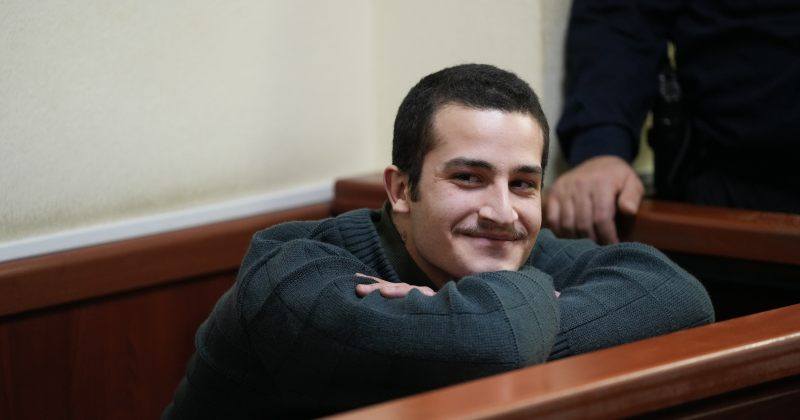
● Pro-European protest activist Mate Devidze (pictured), who was arrested during the demonstrations: “I’ve heard rumors that I could write a pardon request and be released from prison. Sorry, but that’s nonsense. First I was accused of using violence, then repeatedly labeled a traitor, and now they suddenly want to show mercy? Any proposed concession will be rejected. My struggle will go on until the end – until my last breath, and even after.”
● Pro-European protest activist Zviad Tsetskhladze, also arrested during the demonstrations: “I am not a misguided person. I take full responsibility for every action I have taken. My actions never contradicted the Constitution of Georgia. I protested in accordance with my conscience, in defense of Article 3, Paragraph 3 of the Constitution (no one has the right to usurp power). My actions fully comply with the right recognized in the Preamble of the Universal Declaration of Human Rights, according to which a citizen living under a dictatorship has the right and the duty to rebel. Accordingly, I have no need to apologize or ask for forgiveness (especially from Kavelashvili). I am fighting today on the same principles, I will fight tomorrow, and I will always fight.”
● Prime Minister Irakli Kobakhidze of Georgian Dream: “Some people have developed a sense of impunity. They took to the streets again, committed crimes, and ultimately ended up behind bars for specific offenses. For this to have a preventive effect—so that no one is tempted to commit similar crimes in the future—it is important that punishment is properly served. We are not happy that anyone is in prison; anyone in prison, regardless of the crime or its nature, is a tragedy. But we must focus on prevention, and the best way to prevent this is to properly punish those responsible.”
● Irakli Kobakhidze: “Georgia’s policy toward Russia is absolutely clear. As long as 20 percent of the country’s territory is under occupation, a significant change in the status quo, including the restoration of diplomatic relations, is impossible. Although Georgia maintains trade and economic ties with Russia, this interaction is based on pragmatism.”
● Irakli Kobakhidze: “This year was interesting, including from the perspective of foreign policy. We faced serious challenges and serious difficulties; however, in 2025 we were able to adequately overcome all major challenges. Of course, challenges remain, but I would say that 2025 was successful from the standpoint of foreign policy.”
● Zurab Japaridze, leader of the opposition party Girchi–More Freedom, was released from detention on bail of 30,000 lari (about $11,000) as a preventive measure. He had spent eight months in custody on charges of refusing to cooperate with a parliamentary commission created by Georgian Dream to investigate the activities of the previous government (during Mikheil Saakashvili’s presidency), as well as certain politicians up to the present day. Japaridze must pay the bail within 30 days. The measure is linked to new charges against him—sabotage and assisting hostile activities in the interests of a foreign state. These articles of the Criminal Code предусматривают imprisonment for 7 to 15 years. Japaridze is banned from leaving the country without permission from the prosecutor’s office; his passport and ID have been confiscated.
● Zurab Japaridze said he has not yet decided whether he will pay the bail. “This is not just my personal story—my actions may determine what other politicians will have to do next, so I have a lot to think about,” he said.
● Fifth President Salome Zurabishvili held a briefing on the possible suspension of EU visa liberalization. She stressed that “it is extremely important that any restrictions apply only to Georgian Dream officials, not to citizens.”
● Tamar Oniani has been elected chair of the Georgian Young Lawyers’ Association (GYLA).
● President Mikheil Kavelashvili of Georgian Dream, speaking at a conference of Georgian ambassadors abroad: “My visits to Azerbaijan, Armenia, Turkey, and then to the UN and Serbia made it even clearer that our foreign policy vector has no alternative. Our starting point remains strengthening regional and global peace and open dialogue based on equality, mutual respect, and consideration of national interests.”
-
Monday, December 22, Azerbaijan. Amnesty for more than 20,000 people comes Into effect
● “The conflict between Azerbaijan and Armenia is behind us, and instability is giving way to cooperation and development. We believe the countries will soon sign a peace agreement. The region is turning into a new geopolitical hub focused on cooperation,” Turkish Vice President Cevdet Yılmaz told the pro-government outlet Report. He described as a crucial milestone the joint declaration signed by the leaders of the two countries on August 8 in Washington with U.S. participation, which includes the opening of regional transport routes. “The launch of negotiations on the TRIPP transit project, which is to be implemented within the sovereignty and jurisdiction of the countries of the region, is extremely important for economic integration in the South Caucasus,” Yılmaz said.
● Armenian Prime Minister Nikol Pashinyan thanked Azerbaijan for its decision to unblock cargo transit and stressed the “importance of further constructive changes between Armenia and Azerbaijan that will ensure the development of trade, improvement of logistics processes, and strengthening of regional economic resilience.” He made these remarks while speaking at a meeting of the Eurasian Economic Council in St. Petersburg, Russia. Armenia is a member of the EAEU (an economic union led by Russia), while Azerbaijan is not.
● Major opportunities for cooperation in the energy sector were discussed at a joint press conference in Baku by the foreign ministers of Montenegro and Azerbaijan, Ervin Ibrahimović and Jeyhun Bayramov. “Azerbaijan aims to become a leader in the transportation of energy resources, while Montenegro seeks to serve as an energy hub between the Balkans and Europe. Montenegro has significant potential in renewable energy: the country enjoys more than 200 sunny days a year and has substantial hydropower resources. We will find opportunities for cooperation within the framework of the Ionian–Adriatic Pipeline, which will be of strategic importance from Azerbaijan to Western Europe,” Ibrahimović said.
● A delegation led by Turkish Vice President Cevdet Yılmaz is arriving in Baku today to take part in the 12th meeting of the intergovernmental commission on economic cooperation.
● A new investigative documentary titled The Oligarch’s Design is being actively discussed in the media and on social networks. The film examines the criminal financial past of Ruben Vardanyan, the former “prime minister” of the now-defunct unrecognized “Nagorno-Karabakh Republic,” who is currently under arrest in Baku. He is accused of attempting a coup and committing war crimes, with prosecutors seeking a life sentence. The film focuses largely on the activities of the Troika Laundromat financial network, through which billions of dollars were moved via offshore structures. According to Azerbaijani media reports, one of the film’s interviewees, Juliette Garside, The Guardian’s editor for European financial affairs, questions Vardanyan’s claims that he was one of Troika’s founders but was unaware of the fraudulent schemes. “These claims seem unlikely, especially since some of his own funds passed through the same network of companies,” Garside says. Another interviewee, Jamison Firestone, the lawyer who represented the late Sergei Magnitsky, speaks in the film about a direct link between the Magnitsky investigation and the Troika Laundromat scheme. “The money Sergei uncovered was stolen from the state treasury, passed through the Troika Laundromat to leave Russia, and ultimately ended up in the pockets of some very influential Russian officials,” Firestone says.
According to local media, the film also addresses the activities of the Aurora Foundation, an international philanthropic festival held annually in Yerevan, which was founded and financed by Ruben Vardanyan. The documentary includes interviews with well-known figures from various countries who took part in the festival.
The premiere of The Oligarch’s Design took place in Baku on December 19. The film is not yet available to the general public.
● The implementation of an amnesty act begins today. It was initiated by President Ilham Aliyev and subsequently approved by the Milli Majlis. It is expected to affect more than 20,000 people in total. Reports say the list will primarily include individuals who took part in combat operations to defend the country’s territorial integrity, close relatives of those killed or missing during those operations, as well as those “who suffered as a result of Armenia’s military provocation against the civilian population.” Overall, implementation of the law will take four months, and each release will take place with the participation of officials, civil society representatives, and the media.
● An attempt to illegally smuggle a large batch of medicines – 83,000 units – from Turkey into Azerbaijan has been thwarted. The drugs were found hidden inside a shipment of sunflower oil during an X-ray inspection.

-
Monday, December 22, Armenia. Nikol Pashinyan: “Armenia is ready for mutually beneficial cooperation within the EAEU" (under Russia’s leadership)
● “Armenia is ready for mutually beneficial cooperation within the framework of the EAEU (the Eurasian Economic Union led by Russia – JAMnews),” Prime Minister Nikol Pashinyan said while speaking at a meeting of the Supreme Eurasian Economic Council in St. Petersburg, Russia.
● In the same speech, Nikol Pashinyan expressed gratitude to the president of Azerbaijan for the decision to unblock cargo transit to Armenia through Azerbaijani territory.
● The United Kingdom is working with the Armenian government to help prepare for key events to be held in Armenia next year: parliamentary elections, a meeting of the European Political Community, and COP17. This was stated by UK Ambassador Alexandra Cole in a New Year’s greeting video delivered in Armenian.
● “We are proud to remain committed to supporting peace and security in the region by conducting continuous, 24/7 monitoring of the Armenian-Azerbaijani border,” the EU civilian monitoring mission in Armenia said in a statement.
● The United States is recalling its ambassador to Armenia, along with ambassadors to 29 other countries, the Associated Press reported. A source in Donald Trump’s administration said: “All of these diplomats were appointed during Joe Biden’s presidency. But the diplomatic corps should consist of people who fully support Trump’s political priorities, known under the slogan ‘America First.’” The largest number of diplomatic changes is expected in Africa. In Europe, in addition to Armenia, ambassadors will be recalled from North Macedonia, Montenegro, and Slovakia. US Ambassador to Armenia Kristina Kvien was appointed in February 2023; prior to that, she served as Chargé d’Affaires at the US Embassy in Ukraine from 2020 to 2022.
● Nikol Pashinyan held an informal meeting with a group of representatives from the technology, scientific, and education sectors. The discussion covered a wide range of issues related to Armenia’s development, economic growth, investment opportunities, capital market progress, human resources development, and the rebranding of Armenia.
● A large quantity of weapons and drugs was found at the home and workplace of the director of the Malatia gold market. He was detained and taken to a police station on suspicion of illegal possession and use of narcotics, as well as illegal possession and carrying of weapons and ammunition.
-
Monday, December 22, Georgia. Andro Chichinadze refuses a pardon and calls for a fair trial
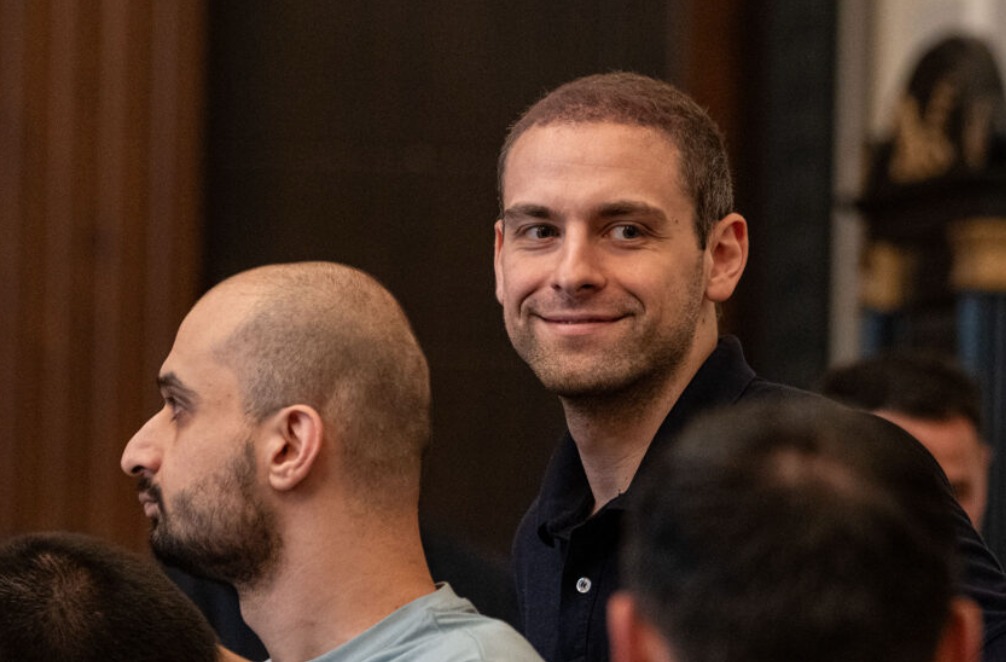
● Prominent actor Andro Chichinadze, who was arrested during pro-European protests (photo: Publica), has said he does not intend to request a pardon, responding to a corresponding offer from Georgian Dream–affiliated President Mikheil Kavelashvili. “I will not sign any documents related to this issue. A few days ago, I also refused an offer of conditional early release. The only possible solution for me is an objective and impartial decision by the Tbilisi Court of Appeals,” he said.
● The Center for Social Justice demands an immediate investigation into alleged cases of human trafficking and abuses related to surrogacy in Georgia. “Information has spread in international and local media about the so-called ‘black market’ of surrogacy in Georgia. It is apparent that this business is based on alleged practices of human trafficking and systematic violence. Georgia is one of the few countries where surrogacy is fully legal, including commercial surrogacy and surrogacy for foreigners. It is precisely this unregulated and low-cost environment that has made Georgia a kind of center for surrogacy. The overwhelming majority of couples using surrogacy services in Georgia are foreigners. Between 2019 and 2024, 4,674 children were born in Georgia through surrogacy,” writes the Center for Social Justice.
● Irakli Kandashvili has been elected chair of the Georgian Bar Association following the completion of the second round of voting. Kandashvili received 1,473 votes, while his opponent, Irakli Khomakashvili, received 1,366.
● A Georgian citizen born in 1979 has been arrested for robbing a monastery in the village of Surami. He stole money from the donation box and church items. It was later established that this was not the first time he had robbed the monastery. The Interior Ministry reported that he had previously been convicted of various serious crimes.
● Two Georgian films made it onto the list of the top films of 2025 published by the British Film Institute. Ranked 9th on the list is “Dry Leaf” directed by Alexandre Koberidze, a Georgia-Germany co-production. It tells the story of a father searching for his missing daughter, who has become fascinated with photographing football fields in rural Georgia.
At 24th place is “April” directed by Dea Kulumbegashvili, a co-production of Georgia, Italy, and France. It is the story of a gynecologist, Nina, a gynecologist, Nina, carrying out illegal abortions.
● New York City Mayor Eric Adams held an opening ceremony for a Georgian cultural space—the New York Suite at the Telegraph Hotel. The project was created by the Georgian business group Silk Road and the US-based Georgia Heritage Foundation. It is described as “a specially designed space reflecting the energy, unique dynamics, and spirit of New York.”
-
Top stories in Azerbaijan, Armenia, and Georgia from 15-19 December, 2025