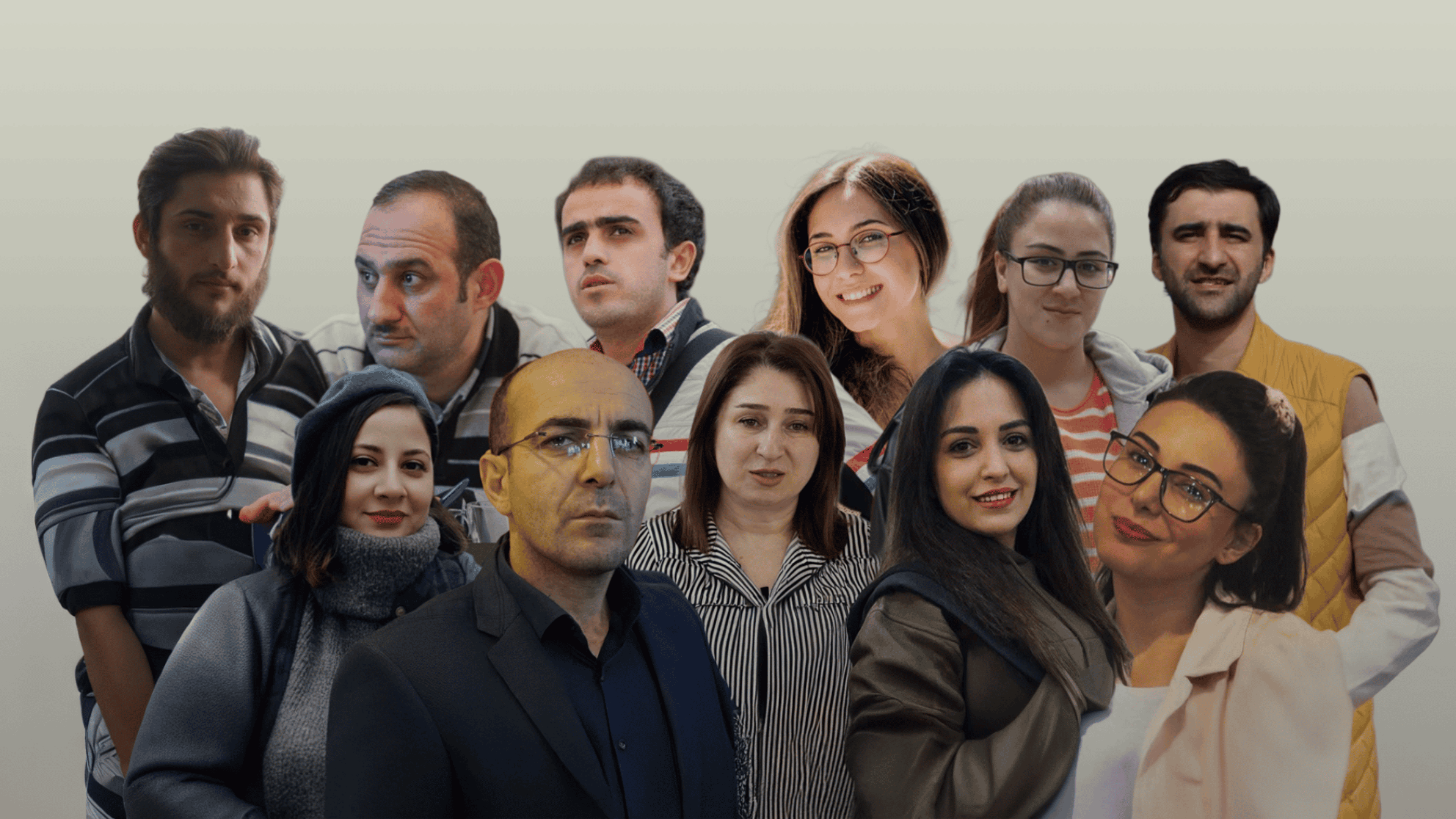
Meydan TV case in Azerbaijan: 'If I wrote paid articles, I would choose local officials, not foreigners'






Seventh court hearing in the Meydan TV case
On 13 March, another hearing in the Meydan TV case was held at the Baku Court for Grave Crimes, presided over by Judge Ayten Aliyeva.
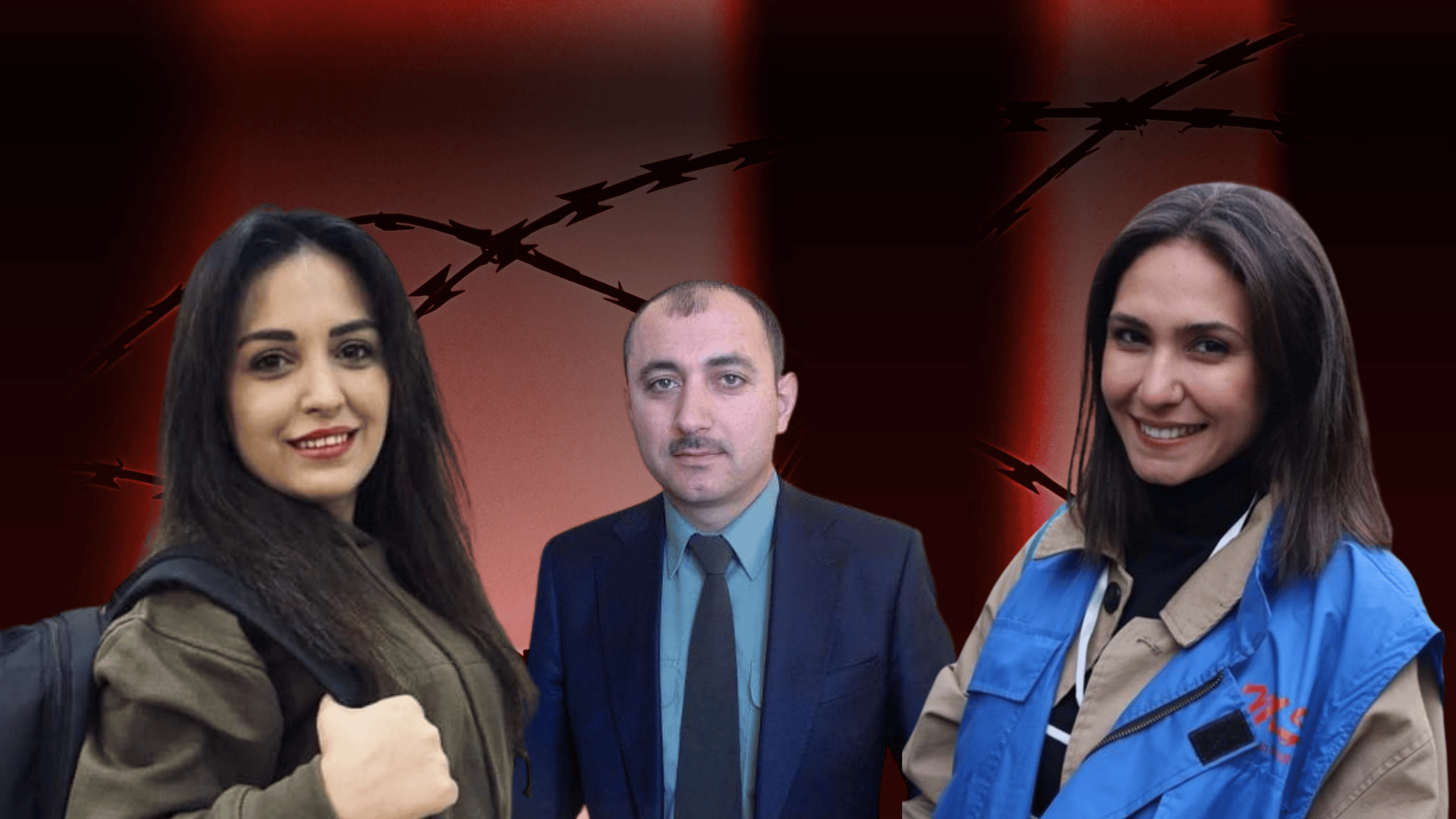
Journalists Aytaj Tapdig, Khayala Agayeva and Aysel Umudova said they had been forcibly brought to court. At the same time, they noted that they were not subjected to physical violence during the transfer.
“We simply chose not to resist. We decided to come to the court building and stay in the waiting room. But we agreed that we would enter the courtroom only if we were told that we would be taken out of the glass cage and allowed to sit next to our lawyer. We stayed in the waiting room for 30 minutes and said we would not enter the courtroom until our demand was met. In the end, we were told that this would be ensured,” the journalists said.
However, all three entered the courtroom wearing house slippers in protest. Khayala Agayeva was also dressed in pyjamas.
‘I cannot live in the house of power and criticise it‘
When the hearing began, lawyer Zibeyda Sadygova filed a motion asking that the defendants be allowed to sit next to their lawyers. The motion was granted. Judge Ayten Aliyeva then noted that, as previously agreed with the lawyers and defendants, the proceedings would continue with the defendants’ free statements and invited Aynur Elgunes, editor-in-chief of Meydan TV, to speak first. However, the defence lawyers said they had several motions to submit before the statements began.
Lawyer Nazim Musayev said the court was violating procedural rules, as the motions should be considered first. Judge Aliyeva responded sharply, telling him to “sit down”. Musayev then said he was filing a motion to recuse the panel of judges and asked for a break to submit it in writing.
“If I challenge the judge, the judge cannot continue the proceedings,” Musayev said.
However, the judge did not allow him to file the motion. The hearing then continued with the free statement of Meydan TV editor-in-chief Aynur Elgunes. Below are some excerpts from her remarks:
“We, 12 people, are accused under seven absurd articles of the Criminal Code. I have been under arrest for exactly 13 months simply because I am not a scribe for the authorities. During nearly a year of investigation they produced 30 volumes of a criminal case and a 560-page indictment. Yet there is not a single original document in this case to support what they claim.
You have nothing except witness testimony. And we know under what conditions those testimonies were given. Even if we assume that a friend of mine supported me at my request, what proof do you have that this was connected to Meydan TV? All the witnesses say they brought money in different months for some organisation, and the sums mentioned are not even considered large. You arrested 12 people in the name of Meydan TV, and exactly half of them had no professional ties with this structure. Even if you divide the money that was allegedly brought by months, it would not even be enough to wash away the dirt you have thrown at us.
How is it possible that I signed different documents and not a single letter in the signature differs? Either the signature is mine but the handwriting is not. That would mean I signed a blank form. I hope you do not think I am foolish enough to do that. And if the form was not blank, why would I sign a document about money I never received? What interest could I possibly have in that?
Another piece of ‘evidence’ cited is how our names appear in the Getcontact app. How can a programme in which anyone can save a name however they like be treated as evidence?
Let me also say a few words about the violations during my detention. After police officers broke into my home, I was searched by a male officer. A female officer arrived about an hour later. The person leading the operation kept repeating like a parrot in response to my protests: ‘We are the ones violating the law and we will decide everything ourselves.’ They searched the house but did not find my personal money. The day before I had counted it and put it in my laptop bag. They looked but did not see it. A report was already being drafted when suddenly we saw a witness bring a pouch containing the money, waving it around. Despite my repeated demands, this was not recorded in the report. Moreover, the amount did not match the sum I had counted and put in the bag. I told the investigator about this several times. The witness took a considerable part of my money. I even saw the person leading the operation shake his hand by the lift and say he would contact him. I realised he was one of their ‘regular’ witnesses. None of these complaints were included in the case.
At a time when journalists in newsrooms were hitting each other with ashtrays over apartments, I was being persuaded to accept one. Back then most of the fee for my articles went on rent. At an OSCE event on media issues, the then head of the Press Council and former MP Aflatun Amashov told me: ‘Bring the documents and we will give you a two-room apartment, move your family there. It is a state apartment, not from anyone’s personal budget. We know you live in rented housing and your family lives in a school.’ He said: ‘Everyone who publicly says the same things as you spends the night at my door waiting for an apartment.’ I replied: ‘I do not play to the public, I do not live a zigzag life. I cannot sit in the house of power and criticise it.’
I recall this now so you understand: if my values were for sale, I would have sold them then and lived in complete comfort. If I wrote commissioned texts, why would I choose foreigners whose language I do not know? I would choose our own officials, who are ready to do anything for flattering words.
Yes, I love life no less than you do. But I love my values and convictions even more. My friends and I are prisoners precisely because of those convictions.
And finally, one more thing: since childhood I have rarely fallen, and when I did, I always found something on the ground. Be sure that this time I will rise again not empty-handed.”
After Elgunes finished her statement, state prosecutor Ergin Gafarov said he wanted to ask her questions. She replied that she would not answer them. The judge nevertheless allowed the prosecutor to read out his questions. He asked about 20 in total, including: “Who created Meydan TV?”, “What are its sources of funding?”, “Did other people bring you money from abroad?”, “Did you undergo state registration and do you have a journalist’s certificate?”, “Did your phone have the encrypted messaging app Signal?”, and “In what areas did Meydan TV operate?”
“These questions make it clear that under the guise of a smuggling case they are actually talking about Meydan TV,” journalist Aytaj Tapdig said after the prosecutor finished speaking.
‘My students work in all the main pro-government media outlets‘
After that, several lawyers questioned Aynur Elgunes. Bahruz Bayramov, who represents Ulvi Tahirov, asked: “What did you do at the Baku Journalism School (BJM), and are there any of your former students who now work in state media?”
Elgunes said that she had taught there on four courses until 2014.
“Later BJM focused mainly on video journalism, so I stopped teaching there, because my field is written journalism. I was also the editor-in-chief of the media website var.az, which was created for the school’s graduates. That work ended in 2014. However, Ulvi Tahirov is my close friend, so I often visited the school.
Most of my students were studying journalism at universities. This journalism school played a flagship role. After us, ANS also created a journalism school, but it turned out to be unsuccessful. Later structures such as Report and APA also opened journalism schools. This summer I watched on television from the pre-trial detention centre an event in Shusha marking the 150th anniversary of the press. You will not find a single media organisation there that does not have one of our students.”
‘Ulvi Tahirov was arrested only because he is my friend‘
Answering Bahruz Bayramov’s question about what role Ulvi Tahirov played in the activities of Meydan TV, Elgunes said he had no role at all.
“In previous years, several of our journalists attended open trainings at the Baku Journalism School. We had no cooperation. If there had been cooperation, the head of that organisation, Zardusht Alizadeh, would be here, not Ulvi. He is here only because he is my friend.”
Aynur Elgunes said the BJM case had been merged with the Meydan TV case in order to increase the alleged smuggling amount to more than one million manats (about $590,000). Otherwise, she said, the amount would not have exceeded 173,000 manats (about $102,000). At that moment Shamsad Aga also spoke, saying that if the investigation had not merged the cases, it would not have been able to bring an “especially serious charge”.
“When the investigation was completed and I was reading the case materials, I even asked the investigator about this. He told me: ‘If you were in my place, would you divide them?’ Ulvi has never worked in journalism. Such an organised group does not exist, and he is not a member of it. Moreover, although we are close friends, our ideological views are on opposite poles. He is a convinced supporter of Aliyev, and I am a convinced opponent of Aliyev,” Elgunes added.
Lawyer Azer Rasulov, who represents Fatima Movlamli, asked whether his client had close ties with Elgunes. She replied that Movlamli had once taken part in a training where she gave a masterclass and had also called her once to ask if there was a vacancy.
“But since we had no vacancies, we could not hire her. Only after our arrest did Fatima provide informational support to Meydan TV for two months without payment. In the end she was arrested as well. While I was working, she had no connection with Meydan TV.”
Lawyer Nemat Kerimli asked whether his client, Ramin Deko, had implemented any grant projects. Elgunes said he had not received any grants and that staff members in principle did not have the authority to apply for grants.
“We are all accused of illegal entrepreneurship. But logically, all 12 people cannot be engaged in entrepreneurial activity,” she added.
The defendants then began asking questions themselves. Fatima Movlamli, taking the floor, asked ironically: “Is there a vacancy now?” Elgunes replied that there was. Shamsad Aga then asked the editor-in-chief how much she loved him.
“More than anything in the world, even more than myself,” Elgunes replied.
‘Let İctimai TV broadcast my statement live‘
Shamsad Aga then took the floor and asked the court to allocate time between the defendants’ statements to submit motions. Judge Ayten Aliyeva replied that he would be able to speak in detail when it was his turn to give a free statement.
“This is a motion that cannot be fulfilled if I submit it on the day of my statement. I demand that on the day I testify, İctimai TV come to the court and broadcast my statement live.
After my arrest, many smear campaigns were carried out against me in various media outlets. Questions that were supposedly part of the investigation’s secrecy were published in the media just four days later. We had no chance to respond to them. This is precisely what İctimai TV is meant to do. The channel was created as a joint project of Azerbaijan and the Council of Europe. It should give us the opportunity to speak to the public. Therefore, I demand that a 15–20 minute live broadcast be organised from the courtroom on the day I speak.”
The court rejected the request.
‘I have been on hunger strike for 57 days‘
Taking the floor, Nurlan Libre said he had been on hunger strike for 57 days and that his health had deteriorated sharply.
“I ask the court to send a letter to the pre-trial detention centre requesting that I be transferred either to the medical unit of the detention centre or to the Medical Facility of the Penitentiary Service. I must be held in a place that meets sanitary and hygiene standards. In addition, on 23 February I was again subjected to ill-treatment in the detention centre.”
Judge Ayten Aliyeva said the court would contact the detention centre and request a medical examination. If his health condition proved to be poor, he would be transferred to an appropriate facility. Nurlan Libre was taken out of the courtroom for a medical check. When he returned, he said his blood pressure had been measured at 110 over 70.
‘Factual data has been replaced by the investigation’s conclusions‘
Ulvi Tahirov then took the stand to give his free statement. He said he was charged under several articles as a member of an organised group, but that he did not know five of the 12 defendants at all and had first seen them only three months ago, on 12 December, at the first court hearing.
“I have never had any working relationship with the people present here. Yet I am accused of being part of the same group as them. But without meetings or coordination of any actions, this cannot be called cooperation.
Factual data has been replaced by the conclusions and assessments of the investigation. All the documents listed in the criminal case materials are presented only in electronic form. Their originals do not exist. They can be falsified in any way. The indictment does not substantiate a causal link between my actions and the damage that the state claims was caused.
I am accused of bringing money from abroad without declaring it and of deceiving the customs authorities. I did not bring any money. There is no evidence of this. The facts are not proven.
The Baku Journalism School applied eight times to the Ministry of Justice for state registration, but each time it was refused. Although our work included some commercial activity, it was not aimed at distributing profit. In other words, we are not a commercial structure.”
‘I am the deputy director. The director is Zardusht Alizada’
After Ulvi Tahirov finished his statement, state prosecutor Ergin Gafarov questioned him. The questions concerned who had founded the Baku Journalism School and when, what its sources of funding were, how the office rent had been paid and who had been recruited as staff. Tahirov replied that BJM had been established in 2005 by a group of intellectuals, including himself.
“I do not have detailed information about the sources of funding. Moreover, I am the deputy director. The director is Zardusht Alizadeh. In other words, I am not the one who makes decisions. At different times there were different organisations involved. In addition, Zeynal Mammadli is also part of the leadership.
The rent for the office was paid from personal funds, and the computers for the office were also purchased with personal funds,” Tahirov said.
‘How can an NGO register in the media registry?‘
When the state prosecutor again asked Ulvi Tahirov whether he had ties with the Association for Democracy operating in Germany and other international organisations, a remark by Shamsad Aga caused laughter in the courtroom.
“Mr Ergin, it seems that it is you who has connections with these organisations,” Shamsad Aga said.
Another question from the prosecutor to Tahirov — whether they were registered in the media registry — also drew protests. Tahirov replied that they were not a media organisation and that the prosecutor was mistaken. At that moment Shamsad Aga again intervened, asking how an NGO could register in the media registry.
“It is obvious that Ergin Gafarov is not sufficiently familiar with the case materials,” Shamsad Aga added.
Another question from the prosecutor concerned whether Ulvi Tahirov used the encrypted messaging application Signal. Tahirov replied that he did use the app.
Responding to a question from lawyer Bahruz Bayramov, Tahirov said that if he had really created an organised group, he would not want to see some of the defendants in it.
“For example, Ramin Deko is a devoted Barcelona fan. At the time when I followed football, I was a Real Madrid fan. So we could not have been in the same group.”
Answering Bayramov’s question about the search of his home, Tahirov said he had been detained at his mother-in-law’s house and was then taken with his wife to his own apartment.
“After we arrived home, the police first began inspecting the rooms. I asked them: ‘What are you looking for?’ A little embarrassed, they replied: ‘We are looking for money.’ I said: ‘All right, I will show you where the money is,’ and took them to the room. In my drawer there were £15,000, €13,000, $1,200 and some Azerbaijani manats. They asked why I had paid so little attention to Azerbaijani manats. I replied that it was the third day of mourning for my mother-in-law and the money had been spent on the mourning ceremony. I added that if they had come a little earlier, there would have been more manats here.”
‘Why did the state prosecutor refuse to see the violence used against us?‘
After the questioning of Ulvi Tahirov ended, Judge Ayten Aliyeva announced the result of one of the motions submitted at the previous hearing. She said a response had been received to the court’s request sent to the Baku pre-trial detention centre regarding statements by Aytaj Tapdig, Khayala Agayeva and Aysel Umudova that they had been subjected to physical violence. According to the reply, the court’s request had been forwarded to a higher authority — the Penitentiary Service.
At that moment Aytaj Tapdig stood up and addressed state prosecutor Ergin Gafarov.
“Violence was used against us. Why did the state prosecutor refuse to see it? Why did you not investigate what happened to us? Why did you turn a blind eye to it?”
The judge then announced that the next court hearing would take place on 3 April at 14:00.
Seventh court hearing in the Meydan TV case