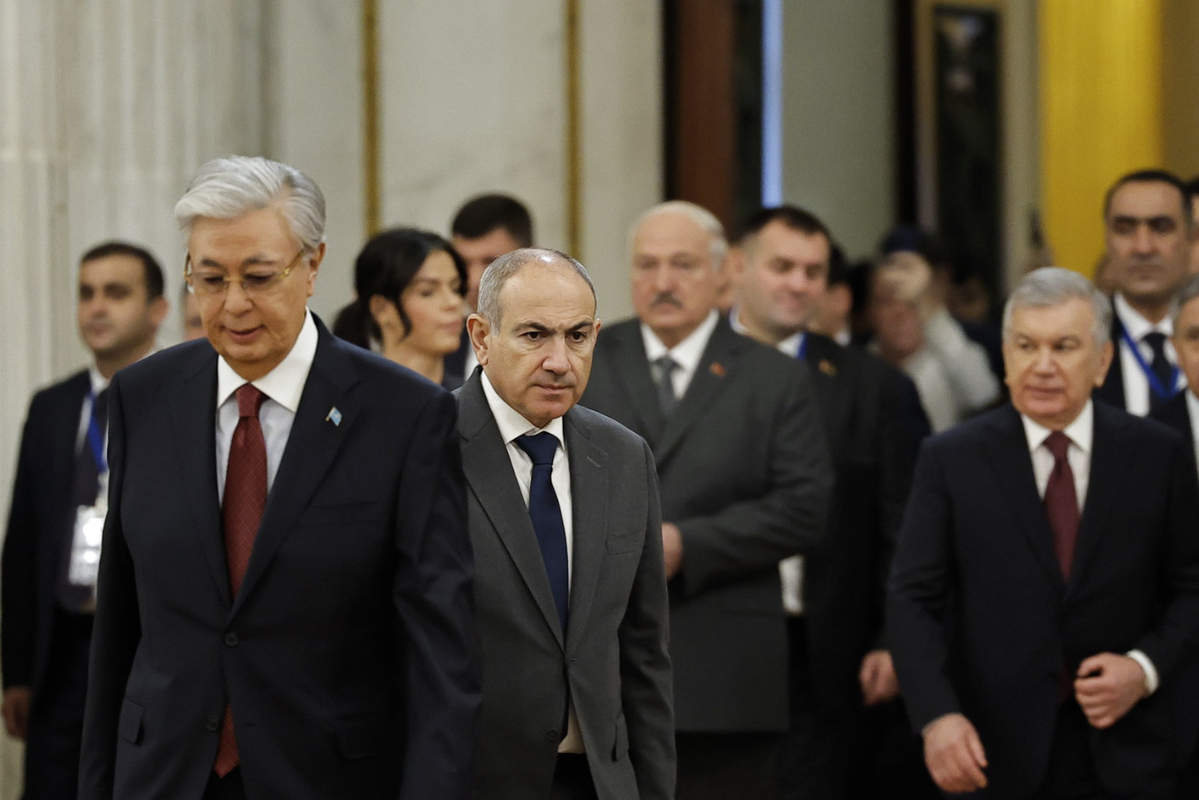
Vanity Fair: Trump son-in-law received $750m from Azerbaijani bank


Kushner’s links to Azerbaijani bank
Reports have emerged of hundreds of millions of dollars being transferred through Azerbaijan to a secret bank account that Jared Kushner, the son-in-law and former senior adviser to US President Donald Trump, allegedly had access to.
However, no evidence has been presented that the money belonged to the Azerbaijani state or that Azerbaijani authorities were involved in arranging these transactions.
The name of the Azerbaijani bank through which the transfers were allegedly made has also not been disclosed.
According to an investigation published in Vanity Fair, Dutch intelligence, while monitoring Kushner’s phone, discovered that a large sum of money had been transferred from an Azerbaijani bank to an account in the United Arab Emirates.
The claims were detailed in an article by American investigative journalist Matthew Cole, published on 22 October. The article is an excerpt from his new book, Princes and Thieves.
The investigation refers to a bank account holding approximately $750m, as well as an additional $1bn allegedly transferred to Israel through Azerbaijan. The author links these financial transactions to unofficial diplomatic negotiations involving the United States, Saudi Arabia, the UAE and Israel.

How did Dutch intelligence gain access to Kushner’s phone?
According to Matthew Cole’s investigation, the Netherlands’ Military Intelligence and Security Service (MIVD) gained access to data from Kushner’s phone in late 2017 through a hacker linked to Russian military intelligence.
Dutch intelligence officers initially discovered screenshots from Kushner’s iPhone on Russian military intelligence servers. Then, exploiting the same technical vulnerability, they were able to monitor activity on his phone screen in early 2018.
The intelligence officers’ attention was drawn to Kushner’s use of a bank account in the UAE. According to the investigation, hundreds of millions of dollars had previously been transferred to this account from an Azerbaijani bank.
Dutch intelligence initially suspected that the bank account from which the funds originated might have been linked to the Azerbaijani government. However, the article does not provide any banking documents confirming this connection.

$750m and possible intermediary role of Azerbaijani bank
The account, referred to in the investigation as Alpha, was held at First Abu Dhabi Bank, one of the UAE’s largest banks.
According to the author, the Saudi and UAE leadership transferred around $750m into the account from 2017 onwards. The funds were allegedly intended to finance unofficial foreign policy initiatives.
The account did not legally belong to Kushner. It was held by Watani Al Emarat, a charitable organisation funded by the UAE government. However, according to the investigation, Kushner had signing authority over the account, allowing him to carry out certain banking transactions.
The section of the investigation concerning Azerbaijan focuses particularly on the mechanism used to transfer the funds.
According to Cole, all the funds deposited into the account monitored by Dutch intelligence arrived in US dollars from an Azerbaijani bank.
The author claims that some Azerbaijani banks acted as intermediaries in transferring large sums of money abroad. They accepted funds in Saudi riyals and UAE dirhams before transferring the equivalent amounts overseas in US dollars, charging a commission of 6–7%.
Under the arrangement described, a client would transfer funds in local currency to an Azerbaijani bank, which would then send the equivalent amount in US dollars to a recipient abroad from a separate internal account. The author notes that such transactions could make it more difficult to trace the original source of the funds.

Additional $1bn allegedly transferred to Israel
The investigation also describes a second major financial transaction allegedly carried out through Azerbaijan.
According to the author’s sources, by spring 2018, UAE leader Mohammed bin Zayed had transferred around $1bn to Israel through Azerbaijan, allegedly intended for Kushner.
The second account, referred to by Cole as Beta, was reportedly held at the Bank of Israel.
The article claims that Israeli Prime Minister Benjamin Netanyahu was to be informed of any potential transfers from this account. According to the author, former US ambassador to Israel David Friedman acted as an intermediary between Kushner and Netanyahu.
Friedman categorically denied these allegations. Kushner’s lawyer also stated that his client was unaware of the accounts in question, had no involvement with them and had not broken any laws.
Kushner’s financial ties have previously come under scrutiny
The new allegations come amid ongoing debate in the US over Kushner’s business ties with Gulf states.
In March 2026, US Senator Ron Wyden and House Representative Robert Garcia launched an investigation into Kushner’s continued efforts to raise funds from foreign governments for his investment firm while simultaneously engaging in diplomatic activities.
The members of Congress sought to establish whether investments received by Kushner’s firm, Affinity Partners, from Middle Eastern governments could have influenced his involvement in US foreign policy.
An investigation published by The New Yorker in September reported that Saudi Arabia’s sovereign wealth fund had invested $2bn in Kushner’s firm in 2021. The UAE and Qatar also invested in Affinity Partners.
These were separate financial arrangements, not directly linked to the alleged secret banking transactions of 2017–2018 described in the Vanity Fair article.
In addition, on 1 October, CNN published an investigation into investments made by Kushner’s firm in Israeli financial group Phoenix Financial. According to CNN’s analysis, Phoenix Financial had invested in at least nine companies supplying equipment to the Israeli military.
However, CNN said it had found no evidence that Kushner’s diplomatic decisions had directly influenced these investments. Kushner’s lawyer also stated that his client had not been involved in the companies’ investment decisions.
On 8 October, Kushner published a detailed response on his website to the earlier New Yorker article, rejecting allegations that he had used his diplomatic activities for personal financial gain.
Which previous investigations have implicated Azerbaijani banks?
Azerbaijan’s role in international financial transactions has previously been the subject of journalistic investigations.
In 2017, the Organized Crime and Corruption Reporting Project (OCCRP), together with its partners, published a major investigation titled The Azerbaijani Laundromat.
The investigation documented financial transactions totalling around $2.9bn, carried out between 2012 and 2014 through various companies and bank accounts.
According to OCCRP, around $1.4bn of this amount was transferred through Baktelekom LLC, a company that held an account at the International Bank of Azerbaijan.
The investigation highlighted the role of Azerbaijan-linked financial entities in international money transfers. However, there is no confirmed link between this scheme and the recently reported accounts allegedly connected to Kushner.
Meanwhile, in January 2026, the Council of Europe’s Committee of Experts on the Evaluation of Anti-Money Laundering Measures and the Financing of Terrorism (MONEYVAL) reported progress by Azerbaijan in this area.
The committee upgraded Azerbaijan’s compliance ratings against international standards in seven areas, including money transfer controls, identification of the ultimate beneficial owners of legal entities and banking supervision.
However, the country remained subject to enhanced monitoring.