Georgia’s government called the critical OSCE Moscow Mechanism report biased






Georgian authorities on the OSCE Moscow Mechanism report
Georgia’s government criticized the report prepared under the OSCE Moscow Mechanism, saying it does not reflect the full picture of the country’s political and legal reality.
According to Georgia’s permanent representative to the OSCE, Alexander Maisuradze, the report contains factual inaccuracies, selective interpretations, and politically biased conclusions, calling its credibility into question.
On January 29, 2026, 24 OSCE member states launched a special investigation into Georgia under the so-called “Moscow Mechanism,” a tool used when there are suspicions of a serious deterioration of human rights in a country.
On March 12, following the investigation, the OSCE Office for Democratic Institutions and Human Rights (ODIHR) published a report confirming a worsening situation regarding human rights and fundamental freedoms in Georgia.
The nearly 217-page report provides detailed information covering the period from the beginning of 2024 to the present, including:
- democratic backsliding,
- worsening human rights and media conditions,
- persecution of protesters and opposition figures,
- repression of dissent,
- existence of political prisoners,
- repressive legislation, and more.
The OSCE has activated this mechanism only 16 times in its history. The three previous cases before Georgia examined the situations in Turkmenistan, Belarus, and Chechnya (Russian Federation).
Reaction from Georgia‘s authorities
According to Alexander Maisuradze, the Georgian government expresses “deep concern” over the content of the report.
He said the document does not reflect the full complexity of the country’s political and legal context, ignores important clarifications provided by state institutions, and selectively highlights certain cases presented as “politically motivated.”
He also noted that parts of the report describing legislation, electoral processes, and investigative actions related to protest rallies contain factual inaccuracies and misleading interpretations.
Cooperation with the OSCE mission’s expert
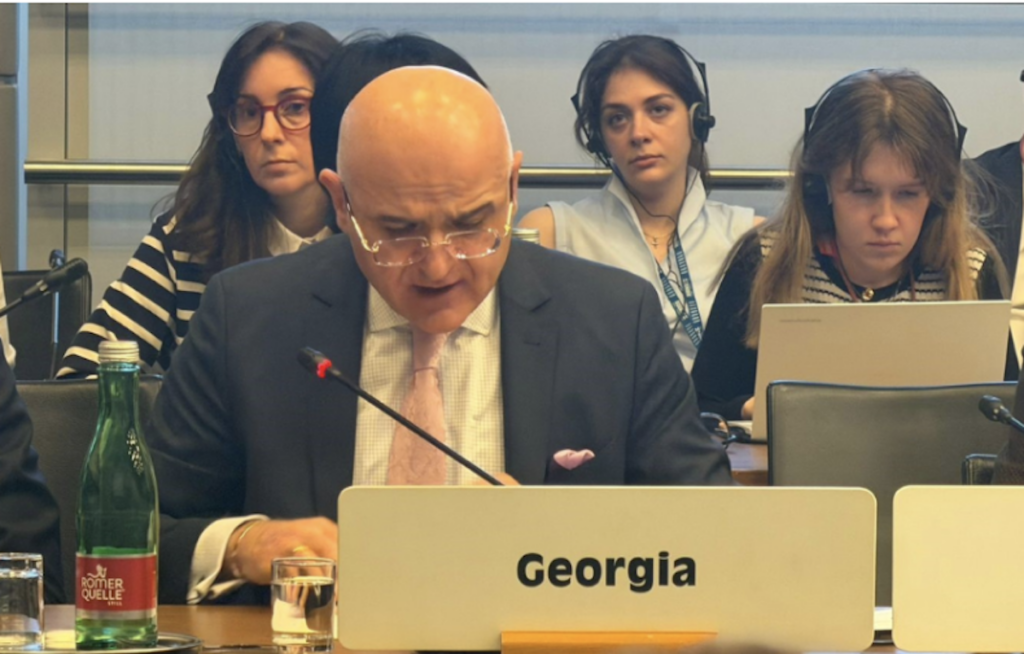
According to Alexander Maisuradze, although Georgia initially expressed doubts about the political motives behind the use of the OSCE Moscow Mechanism, Tbilisi nevertheless cooperated with the mission’s expert.
He said the OSCE expert was in Georgia on February 17–18, 2026, and the authorities organized high-level meetings for him.
These included meetings with the prime minister, the speaker of parliament, the ministers of internal affairs, justice and education, as well as the chair of the High Council of Justice, and the heads of the prosecutor’s office, the Central Election Commission, the Communications Commission, and the Public Defender.
According to Georgia’s Ministry of Foreign Affairs, the expert was provided with extensive written materials and given access to relevant documentation and institutions to enable him to prepare his assessment.
Accusations of politicization
According to Alexander Maisuradze, despite the cooperation, the final report is still based on selective information. In his view, the way the information is presented and the timing of the report’s publication point to a tendency toward politicization of its conclusions.
He said the report also ignores democratic reforms carried out by Georgia in recent years, the development of political pluralism, the strengthening of judicial independence, and progress in protecting human rights.
He also stressed that over the past decade the number of cases filed from Georgia with the European Court of Human Rights has decreased by more than 85%, which, he said, indicates the effectiveness of legal protection mechanisms within the country.
Accusations of exceeding the mission’s mandate
According to Alexander Maisuradze, some of the recommendations in the report go beyond the mandate of the OSCE Moscow Mechanism. He said the document contains calls for other international organizations and states to take action against Georgia, which exceeds the mission’s authority.
He also noted that the fact-finding mission repeatedly used the term “Republic of Georgia” in the report instead of the official name, “Georgia.”

Position of the Georgian government
The Georgian government categorically rejects the conclusions and recommendations presented in the report and calls on the OSCE and its member states to take into account the legal arguments and clarifications provided by Tbilisi.
According to Alexander Maisuradze, the response prepared by the Georgian authorities includes official positions and detailed explanations regarding the assumptions made by the mission, aiming to provide international partners with comprehensive factual information.
He also stated that the independence and impartiality of any monitoring or fact-finding mechanism are crucial for its credibility.
Maisuradze added that attempts to use international organizations as a political tool undermine their institutional neutrality and weaken trust in them.
He emphasized that Georgia remains committed to OSCE principles and its international obligations and continues to cooperate within the organization
News in Georgia