Gang wars in Georgia: 'thieves-in-law' declare vendetta against former chief prosecutor






Georgian crime bosses turn on former prosecutor
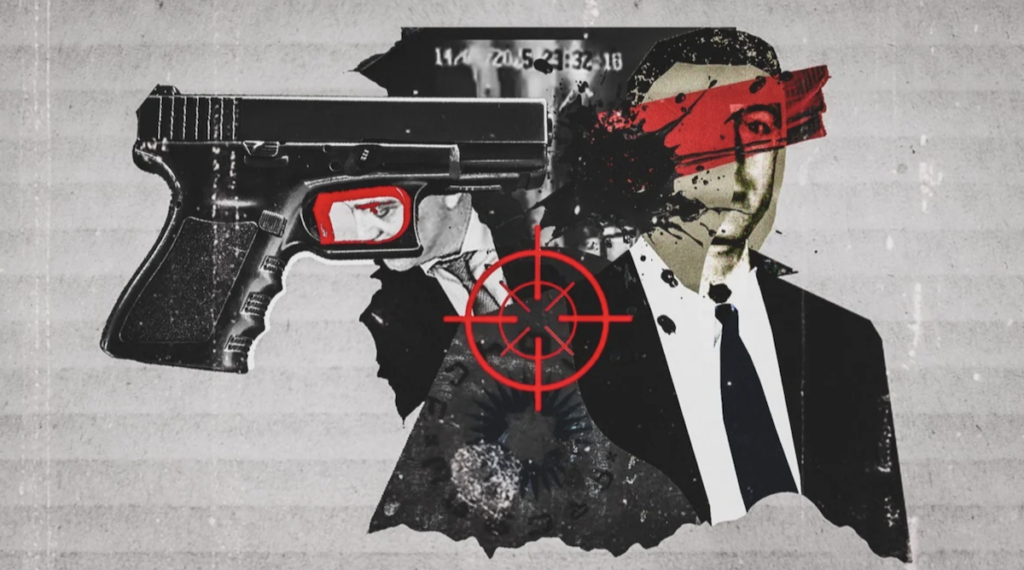
In late December, Georgia’s Interior Ministry named former chief prosecutor Otari Partskhaladze as the organiser of the high-profile killing of businessman Levan Jangveladze — the brother of one of the country’s most influential “thieves-in-law” — and said the case had been fully solved. Investigators allege that Partskhaladze, whom law enforcement describes as the “undisputed leader” of a criminal group, oversaw the planning of the attack. Jangveladze was shot dead late in the evening of 15 March 2025 on a central avenue in Tbilisi.
Following the Interior Ministry’s announcement, the authorities moved to distance themselves from a figure long seen as untouchable. Partskhaladze has been placed on an international wanted list, while the ruling Georgian Dream party publicly disassociated itself from its former law enforcement official.
How did Georgia’s authorities find themselves caught up in a war between mafia clans — and what really lies behind the killing?
A report by Novaya Gazeta Europe.
Killing after funeral
Tbilisi, the evening of 14 March. On Chavchavadze Avenue — an upscale district known for its universities and luxury storefronts — two men step out of an apartment building. One of them is 58-year-old businessman Levan Jangveladze, the brother of Merab “Sukhumski”, a prominent thief-in-law. He had flown in from Moscow for just a few hours to attend a friend’s funeral.
Jangveladze arrived late for the wake, when only family members were still present. According to investigators, he asked passers-by for directions and was pointed to the correct entrance by a man who later turned out to be the gunman, who had arrived at the building earlier that evening.
As Jangveladze left the memorial gathering and walked towards his car, where his driver and bodyguard were waiting, a nondescript man in a coat and cap was sitting nearby. He stood up, waited for pedestrians to pass, approached, and opened fire. Jangveladze collapsed on the pedestrian crossing, while the attacker fled down a nearby street after also wounding the driver. The entire attack lasted only seconds.
It was the most high-profile killing in Georgia in 2025. Security cameras captured the events in detail, yet the motives behind the murder proved far more complex. The case has drawn together Georgian and Russian criminal networks, Russia’s FSB, and the political backdrop surrounding the ruling Georgian Dream party.
Accused prosecutor
Nine months after the high-profile killing, just days before the New Year, Georgia’s Interior Ministry made a sensational announcement, accusing former chief prosecutor Otari Partskhaladze of organising the crime. He was named as the main заказчик of Levan Jangveladze’s murder and placed on an international wanted list. Partskhaladze has not been in Georgia since June 2025 and is believed to be in Russia. A Tbilisi-based lawyer representing the former prosecutor has said his client denies any wrongdoing.
The accusation came as a surprise, given that throughout the investigation Partskhaladze had never even been summoned for questioning, despite what investigators now describe as clear indications of his involvement.
Although he left the post of chief prosecutor more than a decade ago, Partskhaladze had remained a largely untouchable figure, primarily because of his close ties to Georgia’s informal ruler, billionaire Bidzina Ivanishvili.
Investigators had long ignored allegations against Otari Partskhaladze, despite claims involving large-scale embezzlement of state funds, racketeering and even the public assault of civil servants. He avoided accountability even after the US State Department imposed sanctions on him for alleged cooperation with Russia’s FSB. Then came a sudden criminal case carrying a possible sentence of 16 to 20 years in prison — effectively barring his return to Georgia.
Parliament speaker Shalva Papuashvili thanked law enforcement on behalf of the authorities for solving the high-profile case, but warned that extraditing Partskhaladze from Russia “would not be easy”.
Signs that attitudes towards Partskhaladze had shifted emerged as early as October, when a symbolic “clean-up” of the inner circle around Bidzina Ivanishvili began. The revamped leadership of the State Security Service announced — without explaining its motives — that 230 officers had been deployed simultaneously to search the homes of three former officials and “persons linked to them”: a former prime minister, a former head of the security service and a former chief prosecutor.
The results were striking: bundles of cash, gold bars and jewellery worth a total of $7.22m. In relative terms, Partskhaladze appears to have been treated most leniently. Former prime minister Irakli Garibashvili has been sentenced to five years in prison and has already begun serving his term over a case involving concealed illicit доходы, while former security chief Grigol Liluashvili is behind bars on charges of large-scale corruption.
How Partskhaladze became “Romanov”
Otari Partskhaladze’s tenure as chief prosecutor was brief, lasting just 40 days. In 2013, he became the second chief prosecutor under the Georgian Dream government. Before him, the post was held by Archil Kbilashvili, an experienced lawyer who had worked closely with Bidzina Ivanishvili during the election campaign. Kbilashvili planned to carry out a liberal reform of the prosecutor’s office but failed to secure backing from his allies and stepped down a year later.
Unlike his predecessor, Partskhaladze was not a prominent legal figure, but he did have experience in the financial police, where he began his career under the government of Mikheil Saakashvili. His appointment to such a senior post despite his low public profile was widely attributed to personal connections: his grandson was baptised by Bera Ivanishvili, the son of the Georgian Dream leader.
Partskhaladze was forced to resign after the opposition questioned the validity of his university diploma and published documents showing that in 2001 he had been convicted in Germany for shoplifting, receiving a suspended sentence in absentia. Partskhaladze acknowledged the conviction but insisted that it was not for a criminal offence, claiming instead that it stemmed from an altercation with a police officer.
Even after leaving the prosecutor’s office, Partskhaladze retained significant influence. Soon, however, his focus shifted to Russia, where he obtained citizenship in 2022.
His transformation into what was described as a “Russian oligarch of Georgian origin” became widely known in Tbilisi only in September 2023, after the US State Department published a sanctions list. Partskhaladze was sanctioned as a figure whom Russia’s Federal Security Service (FSB) had allegedly used to influence Georgian society and advance pro-Russian policies. According to the State Department, he personally benefited from his ties to the FSB. In Russia, he owned two consulting companies whose activities were said to be linked to sanctions evasion and to expanding Russia’s capacity to wage war against Ukraine.
Figures in the Georgian opposition say Partskhaladze’s main role in Russia is to carry out informal tasks on behalf of Bidzina Ivanishvili.
Having failed to establish himself politically in Georgia, Partskhaladze has instead promoted closer ties between Georgia and Russia from Moscow. In January 2023, he founded the “Russian Georgians” people’s movement. In a press release, the group claimed that Partskhaladze had personally secured the resumption of direct flights between Russia and Georgia and the lifting of visa requirements for Georgian citizens by the Kremlin.
Those claims were met with scepticism by Giorgi Kadjaya, an adviser to Georgia’s prime minister on relations with Russia. Responding to journalists’ questions, the career diplomat dismissed the statements, saying they were “just words” and that Partskhaladze had played no role in the reopening of air links.
Meanwhile, a close associate of Partskhaladze, Russian businessman of Georgian origin Mamuka Pipia, has claimed that the leader of “Russian Georgians” acts as a “guest expert” for the State Duma’s CIS committee. According to Pipia, Partskhaladze has taken part in discussions on restoring diplomatic relations between Moscow and Tbilisi, as well as reopening rail links through occupied Abkhazia — an idea Russia has been signalling to Georgia for years.
Mamuka Pipia himself recently caused a stir by calling for Georgia to sign a “new Treaty of Georgievsk” with Moscow, under which the country would recognise Russia’s protectorate. Pipia claims his organisation has collected signatures from “100,000 citizens” in support of the idea, arguing that the Georgian authorities should seriously consider restoring diplomatic relations with Russia, which were severed after the 2008 war.
Seemingly keen to underline his new status, Partskhaladze in 2024 added a Russian surname — Romanov — to his Georgian one. Asked by Georgian journalists how this came about, Pipia said, with evident reverence, that a “special commission” in Russia had been set up to study the matter and had concluded that Partskhaladze had links to Russia’s imperial family.
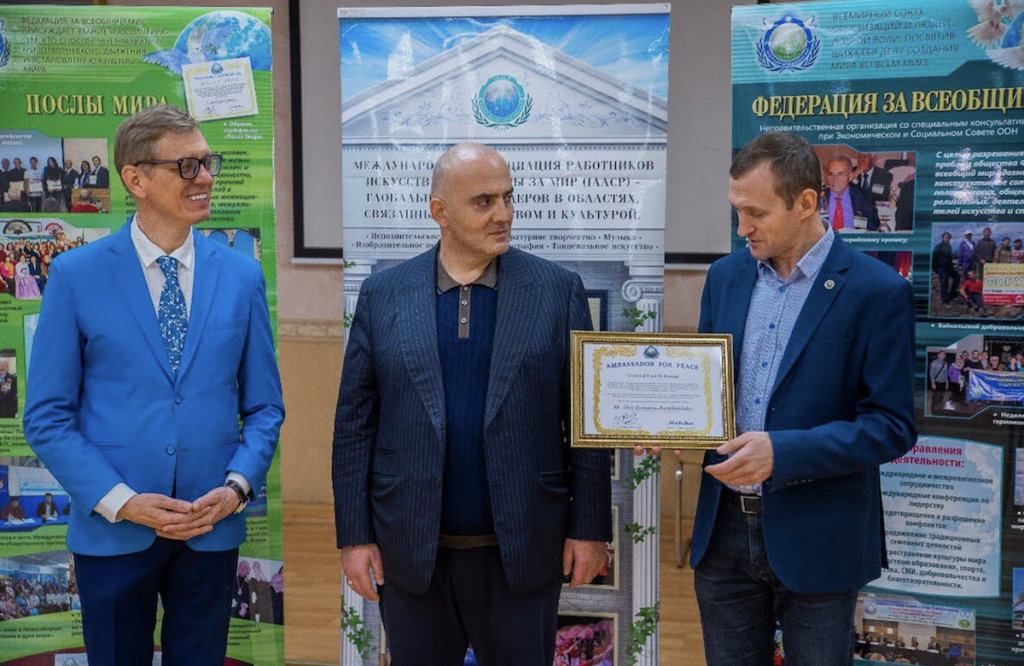
Another step in boosting his profile followed when Partskhaladze became a “peace ambassador” for a Russian organisation called the Federation for Universal Peace. Among the group’s recent activities is a campaign to collect plastic bottle caps for recycling. As for peace, that role appears to be taken on by speakers enthusiastically discussing President Vladimir Putin’s televised call-in shows and anticipating the establishment of a “Russian world” in Ukraine.
The organisation recently presented Partskhaladze with a certificate in a gilded frame bearing the inscription “Ambassador for peace”. Speaking on camera in his new role, he promised to “develop relations between Russia and Georgia”, adding that “for Georgia, Russia is like a big brother”.
The newly minted Romanov speaks Russian with a very strong accent.
Georgian vendetta from Italy
Two months after his brother’s killing, in June 2025, Merab “Sukhumski” convened a thieves-in-law gathering in Italy, where those present are said to have sentenced Otari Partskhaladze to death.
Many heavyweights of the criminal underworld attended the meeting. Joining by video link was even “Shakro Molodoy” — Zakhary Kalashov, a Tbilisi native who is widely regarded in Russia as the country’s most powerful thief-in-law. The decision was backed by almost all those present, including Shakro himself. According to a thief-in-law who spoke to Novaya Gazeta Europe and asked to be identified as Artur, this was not only because Levan was Merab “Sukhumski’s” brother — the businessman also commanded significant respect in criminal circles in his own right.
Artur said Levan was regarded within the underworld as a master of shadow deals and trading schemes that enabled not only the evasion of customs duties and excise taxes, but also the laundering of large sums of money.
He managed his brother’s finances and provided services to other crime figures, including the well-known thief-in-law “Taro” — Tariel Oniani.
“Levan started out back in Soviet times and rose very high,” Artur said. “In 1991, Jangveladze helped secure the early release of ‘Yaponchik’ — the thief-in-law Vyacheslav Ivankov. Even then, he had contacts across many different spheres. He resolved issues at the level of deputy ministers and senior officials in the interior ministry and the FSB. At the same time, he tried to keep a low profile and stay out of politics. Perhaps that is why he managed to live so long.”
It is hardly surprising that his actions interfered with many interests, depriving others of a large share of their profits. For a long time, he was protected by the authority of his brother, Merab “Sukhumski”. The situation changed when Partskhaladze appeared, believing that administrative leverage mattered more than criminal protection. The former prosecutor began encroaching on schemes where he was neither expected nor welcome, and where everything had already been divided up.
The public accusation of the former chief prosecutor in the murder of Levan Jangveladze was a real New Year’s gift for Merab. “I won’t pretend to know who and how much Merab paid within Georgia’s Interior Ministry for this accusation to materialise,” the source said.
At the same time, rumours have been circulating in criminal circles that after the announcement of the “thieves’ vendetta”, Otari Partskhaladze was placed under the protection of an FSB special unit.
Meanwhile, a criminal case has been opened in Moscow against Merab “Sukhumski” under Article 210.1 of Russia’s Criminal Code (“occupying the highest position in the criminal hierarchy”).
However, Merab “Sukhumski” was banned from entering Russia as far back as 2016, after being accused of illegally obtaining Russian citizenship — an offence punishable by eight to 15 years in prison. As a result, the new charge was widely seen in criminal circles as a reminder that Merab has not been forgotten and remains under scrutiny.
“For his part, Merab issued a ‘countermove’, announcing that whoever carries out the sentence handed down by the thieves’ gathering will be immediately ‘crowned’,” the source said. “Not everyone in our world agreed with this, but the words were spoken. And all the ‘brodyagi’ understood that even without a coronation, Merab ‘Sukhumski’s’ gratitude would be substantial.”
After Partskhaladze was charged, many in Tbilisi were quick to accuse the ruling Georgian Dream party, arguing that the case against the former prosecutor was opened only after pressure from criminal authorities. Yet the fact that Partskhaladze may be unable to return to Georgia for some time is unlikely to amount to full satisfaction: crime bosses with Georgian surnames have long since become rare visitors to the country themselves. After Georgian Dream publicly distanced itself from him, the former prosecutor appears to be left relying only on his patrons in Moscow.
Russia’s law enforcement agencies have so far declined to comment on the accusations against Partskhaladze-Romanov.
“I personally don’t really believe that the charges against Partskhaladze-Romanov were pushed through by the criminal underworld,” retired FSB colonel Vladimir V told Novaya Gazeta Europe. “Merab ‘Sukhumski’ is certainly a highly influential crime boss, but hardly to the extent that he could issue orders from abroad to Georgia’s interior minister or prosecutor general. Most likely, this is some kind of multi-step operation. Perhaps Partskhaladze stepped out of line, and someone on Lubyanka decided to ‘tighten the leash’ to bind him more securely. Otherwise, I don’t understand what our agents of influence are doing in Georgia at all. And the fact that such agents exist and function quite effectively is demonstrated by developments over the past few years.”
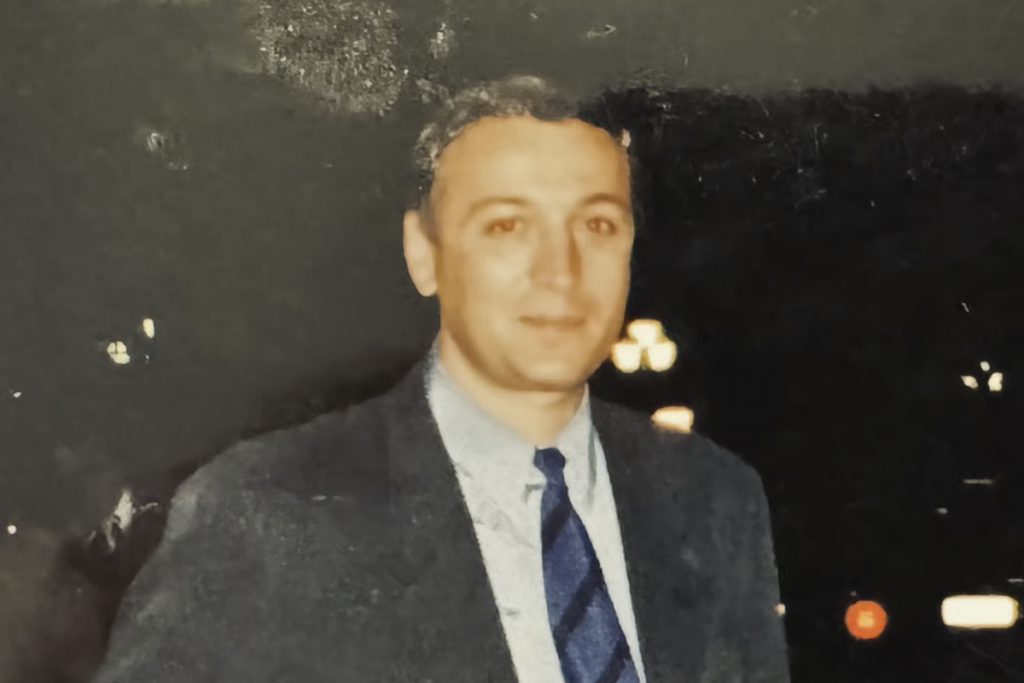
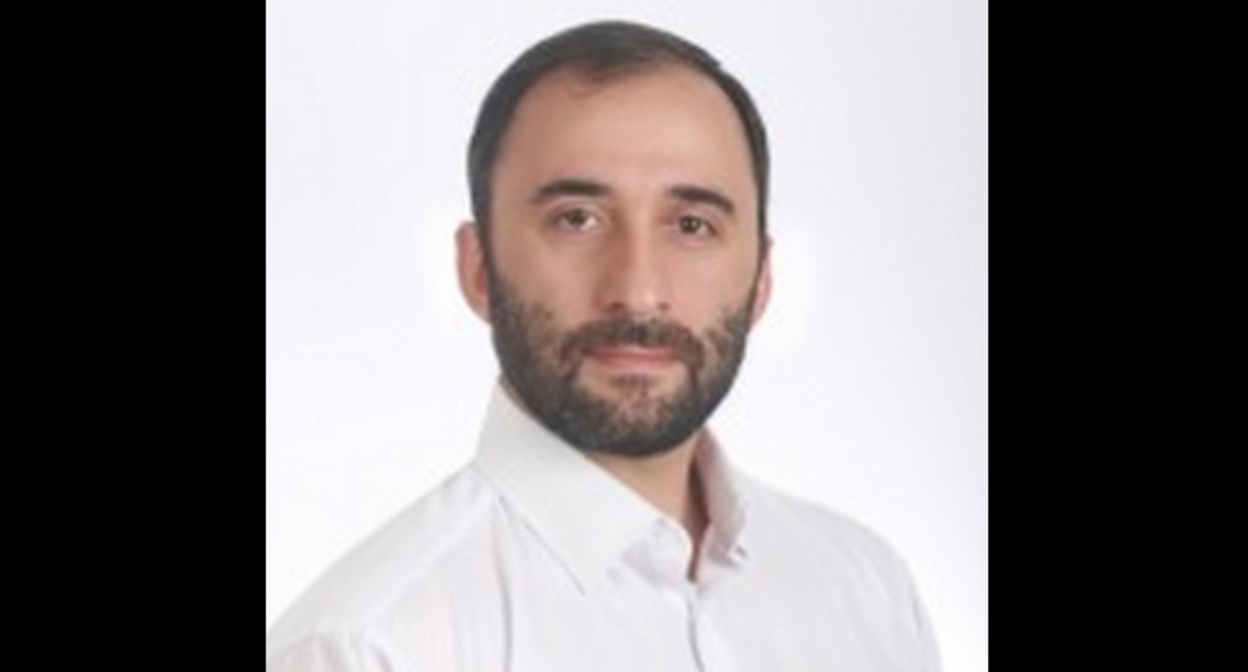
Levan Jangveladze. Photo: primecrime.ru
Grandson of Ded Hasan
Yet there is a striking coincidence. For the first few months, investigators stubbornly pursued an unconvincing version of events, according to which a gunman with a pistol in his pocket almost случайно encountered Levan Jangveladze in the Vake district and emptied a magazine at him out of personal resentment. But in August — two months after the announcement of a “thieves’ vendetta” — the case saw a breakthrough. Prosecutors finally carried out a series of high-profile arrests, and the killing was reclassified as a contract murder.
The alleged gunman, 50-year-old former special forces officer Gela Udzilauri, was detained on the third day after the killing. Immediately after the shooting in central Tbilisi, he took a taxi to a monastery, where he reportedly prayed throughout the night. The following day, he unsuccessfully attempted to cross into the Tskhinvali region, which is not controlled by the Georgian authorities. After returning to Tbilisi, Udzilauri repeatedly tried — again without success — to contact his immediate employer, businessman Giorgi Jokhadze, for whom he worked as a security guard.
According to case materials, Jokhadze promised that Udzilauri would “not stay in prison for long”. In the end, however, Jokhadze himself had to leave the country after prosecutors placed him on a wanted list.
In August, alongside Jokhadze, prosecutors charged brothers Giorgi and Davit Mikadze with organising the murder. The two are considered part of Georgia’s business elite and are said to be close to Otari Partskhaladze.
Giorgi Mikadze holds dual Georgian and Canadian citizenship. Before his arrest, he chaired the supervisory board of M|Group, a hospitality management company that owns several high-end restaurants, including Kvarelis Tba, Puris Sakhli, Monograph and Maspindzelo. Davit Mikadze owns a 45% stake in MyPhone, a VoIP services provider whose revenue in 2023 totalled 2.4 million lari (around $1m).
Giorgi Mikadze, like the other alleged organisers of the murder, faces up to 20 years in prison. He has already spent six months in Rustavi Prison No. 6, a maximum-security facility. Georgian media report that other inmates, acting on instructions from Georgian crime bosses abroad, have periodically subjected him to “noise” — a form of psychological pressure. His brother Davit Mikadze, who has been charged in absentia, fled the country and is now wanted.
Two other accomplices have also been jailed, charged with illegal possession of weapons and concealing a crime — offences carrying sentences of up to 11 years.
Alongside the charges against influential businessmen, investigators have also put forward a version of events involving another legendary crime figure — 75-year-old Aslan Usoyan, known as Ded Hasan.
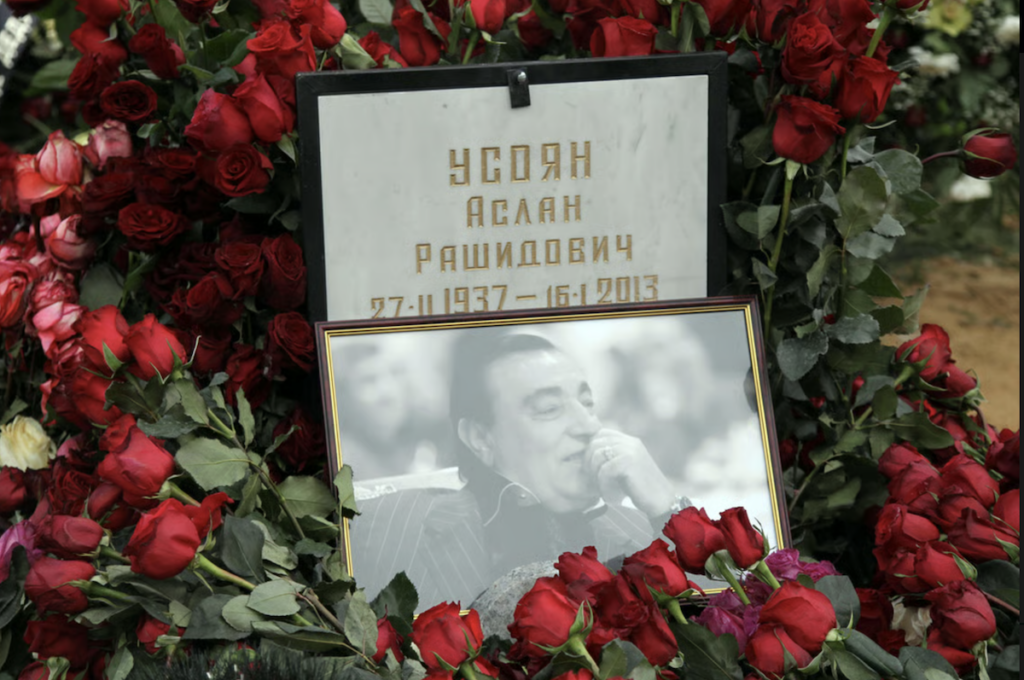
Ded Hasan was killed in Moscow in January 2013. A Kurdish Yazidi from Tbilisi, he for many years led one of the largest criminal clans operating in Russia.
A relative of Jangveladze, Mikhail Berdzenishvili, told Tbilisi City Court that the Jangveladze brothers had at one point been accused of involvement in Ded Hasan’s killing. Because the Mikadze brothers were believed to be linked to the Usoyan family “as godfathers”, Jangveladze feared a possible trap on their part.
“I only once allowed myself to ask Levan about the killing of Ded Hasan, because the Jangveladze brothers were sometimes mentioned in connection with it. But Levan told me that he had no connection whatsoever to that man or to his murder,” Berdzenishvili said in court.
He also confirmed that Levan Jangveladze’s meetings in Tbilisi with the Mikadze brothers and Otari Partskhaladze almost always ended in arguments.
A version suggesting that the заказчик of Levan Jangveladze’s murder could have been Ded Hasan’s grandson, Irakli Usoyan, was voiced in court in September by investigator Robiko Gogiashvili.
It was also during those hearings that the name of Otari Partskhaladze was mentioned for the first time. The investigator presented the information as “operational intelligence” from an unnamed informant, whose identity the court did not request. According to this version:
- Partskhaladze and the Mikadze brothers had tense relations with Jangveladze over the export of cigarettes and alcohol to Russia;
- the Mikadze brothers allegedly refrained from using force because Levan’s brother was a thief-in-law;
- Irakli Usoyan, who Russian media say is following in his grandfather’s footsteps, allegedly ordered Partskhaladze and the Mikadze brothers to kill Jangveladze for $5m.
The investigator also sought to explain why the gunman, Gela Udzilauri, had been briefly sent to Greece before the murder — “so that the investigation would link this to thieves-in-law based there”, in other words, to suggest a revenge motive.
In an attempt to refute this version, Davit Mikadze, who is currently on the run, contacted Georgian media. In an online interview, he said that “claims by some police investigator are unsubstantiated slander and lies”, adding that “under these circumstances he has no intention of returning”, though he insisted he was “not in hiding” and was ready to answer investigators’ questions.
Within criminal circles, the theory that the Jangveladze brothers were involved in Ded Hasan’s killing a decade ago was indeed discussed, but never confirmed. Although Levan Jangveladze conducted financial dealings with Tariel Oniani, who was at odds with Ded Hasan, the Jangveladze brothers also maintained good relations with Shakro Molodoy. And after Shakro took part in the gathering in Italy and backed the verdict against Partskhaladze, speaking of revenge by the Usoyan family would be incorrect, sources familiar with the situation told Novaya Gazeta Europe.
Illustration: Novaya Gazeta Europe
Witnesses from Russia
The final witnesses to testify at the trial in Tbilisi were two Russian businesspeople — a man and a woman — who flew in from Moscow to take part in the proceedings on 26 December. Both said they were part of Levan Jangveladze’s close circle and told the court about a conflict between the murdered businessman, Otari Partskhaladze and the Mikadze brothers. Their testimony suggested the dispute began around a year before the killing and centred on the import of alcohol and cigarettes. The statements were deemed sufficient to bring charges against Partskhaladze.
One of the Russian witnesses, Ilya Mikulsky, said he met Levan Jangveladze in February 2025 at a Moscow restaurant, where Jangveladze complained about hostility from Partskhaladze.
“He told me he had problems with a man who, although from Georgia, lived in Moscow, had influence there and was capable of anything. He said he feared for his life. He gave me the man’s name — Otari — and mentioned his Georgian surname, though I didn’t remember it at the time. But I did remember his Russian surname — Romanov. After Levan’s murder, I recalled his Georgian surname as well — Partskhaladze.
“He said they were in conflict over the transport of cigarettes and alcohol, as their business interests had crossed and they had gone from being good acquaintances to enemies.
“He also told me that in Georgia, Otari Romanov had trusted associates with the surname Mikadze who carried out his instructions.”
The Jangveladze family’s Georgian lawyer, Tariel Kakabadze, said he had no doubt that the organisers of the murder had “high-ranking patrons”.
As far back as late October, the lawyer had pointed to a version of events involving Partskhaladze that was not being investigated. “We will not allow those responsible in this case to go unpunished. The prosecution said it could not bring charges on the basis of just a few testimonies. But the factual circumstances of the case could have been established within days of the killing. Instead, there was a deliberate operation to confuse and conceal. For example, mobile phones were seized only three months after the murder,” he said.
Illustration: Novaya Gazeta Europe
State and mafia war
Much of Georgia’s opposition agrees that the killing in central Tbilisi may have been the result of a struggle over spheres of influence in Russia. The main concern, they say, is that the Georgian Dream authorities fail to draw a clear line between organised crime and state institutions.
Opposition politician and former Georgian Dream member Dmitry Tsikitishvili argues that “a reshuffle appears to have taken place within the Russian mafia, with Tbilisi turning into the periphery of a large criminal syndicate”.
“When the United States accused Partskhaladze of ties to the FSB, the entire state apparatus rushed to his defence. Now he is being charged over links to organised crime,” Tsikitishvili said. “It looks as though our state is acting on the instructions of criminal syndicates, while state interests are being completely ignored. Georgia has become a territory for the settling of scores within Russia’s criminal underworld.”
Tsikitishvili believes that both Jangveladze and Partskhaladze were involved in arrangements linked to illegal transit operations, and that the authorities were most likely well aware of this.
“Apparently, Partskhaladze is no longer as necessary as he once was, so he has been sacrificed,” he said. “Perhaps these operations now have other overseers, less problematic than Partskhaladze. Bidzina Ivanishvili is accustomed to easily discarding people who are no longer useful to him. This seems to be another such case — possibly done to preserve relations with the criminal world that controls this shadow business in both Georgia and Russia.”
Giorgi Shaishmelashvili
Member of the Freedom Square party
“In states with remnants of the Soviet legacy, there have been cases where prosecutors general were accused of ordering killings, but these were usually linked to political aims — for example, the murder of prominent journalists. But for a chief prosecutor to become involved in clashes between criminal syndicates and to be a party to them — it is hard to find such a precedent, either in Georgia in the 1990s or anywhere else in the post-Soviet space. It is almost impossible to imagine.
“Of course, all these arrests were ultimately allowed by Ivanishvili himself. Most likely, he is trying to rid himself of the ‘legacy’ the party has carried since 2012. In addition, because of sanctions, he is facing financial constraints and has decided to consolidate resources within his own circle — where, as he appears to have discovered, far more money was being stolen than he had previously tolerated.”
Shaishmelashvili also believes the purge of Ivanishvili’s inner circle is intended to “demonstrate positive momentum to voters — to show that the authorities have changed and that an internal reset has already taken place”.
Gia Khukhashvili
Political analyst, former adviser to Bidzina Ivanishvili
“Power and organised crime have fused, because this is how the leaders of Georgian Dream see the world — authority is built not on institutional order, but governed ‘by informal rules’. That implies close, mutually beneficial ties with criminal groups. This starts with elections, when crime bosses stand near polling stations, and extends to prisons, where ‘thieves’ rules’ are returning amid claims that jails are otherwise difficult to manage.
“Ivanishvili’s worldview was shaped in Russia, where everything is mixed together — it is hard to tell where the state ends, where organised crime begins, and where the security services fit in.
“He never studied politics and does not understand what state institutions are. When he was prime minister in 2013, a dispute arose between two business groups and they planned to meet. Ivanishvili called me and said he would take part in that discussion himself.
“What we are seeing now is a major mafia war. After the killing of Jangveladze, fingers were pointed at people close to Ivanishvili, forcing him to demonstrate that he had nothing to do with it. But his opponents read this as weakness. Their appetite has grown, and they will now methodically constrain Ivanishvili, building direct links with members of the government.
“I believe this situation will ultimately work against Ivanishvili and forms part of an operation to ‘neutralise’ him. Look at what is happening: those who were once closest to him and represented his interests are now either in prison, facing jail, or on the run. Ivanishvili has made many mistakes.
“At this point, it is less about revenge for a family member than about the redistribution of large financial flows and shadow businesses. I would not rule out further shootings in disputes of this kind — everything has entered a dangerous spiral, and neither side has a way back. What we are witnessing is a classic mafia war.”
Georgian crime bosses turn on former prosecutor