Old links on Aliyev’s X account redirected users to opposition videos: cyberattack or global vulnerability?


Interference with Ilham Aliyev’s X account
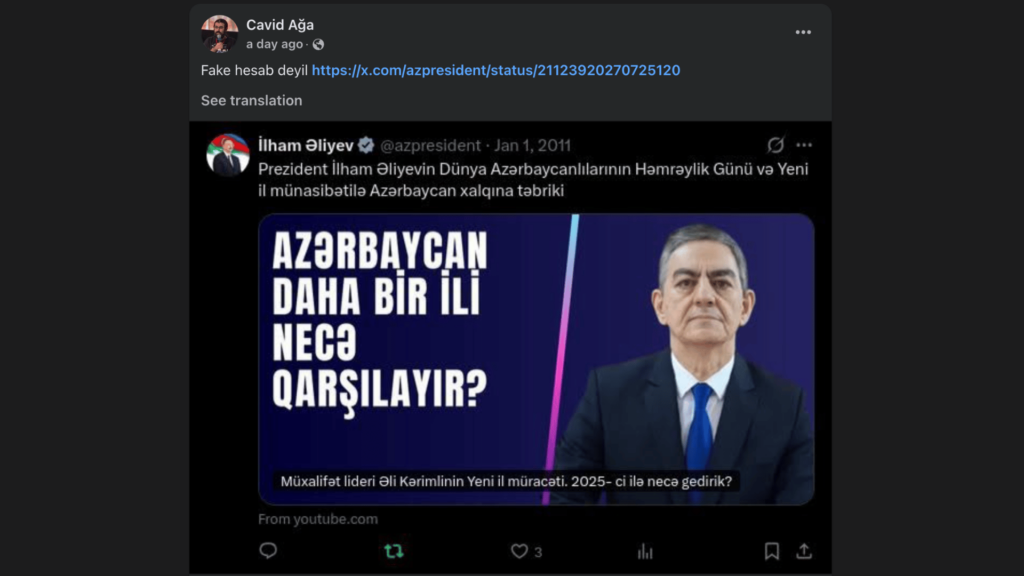
On 15 November, links in some old posts on President Ilham Aliyev’s account on X redirected users to videos featuring opposition politicians and bloggers, as well as footage of protests. Most of the posts dated from 2010–2011. The links led to videos featuring Ali Karimli, chairman of the Azerbaijan Popular Front Party, and bloggers Mehman Huseynov and Gabil Mammadov.
The posts themselves remained unchanged, but the links they contained began directing users to different pages. The altered links remained accessible for several hours, and users shared the posts across social media.
That evening, the Azerbaijani president’s press service issued a statement:
“Cyberattacks are currently targeting the social media accounts of Azerbaijani President Ilham Aliyev. Relevant agencies are taking the necessary measures to prevent these attacks and investigate the incident.”
The statement did not specify which platforms had come under attack, how the attacks were carried out or who was behind them.
Similar incidents affected the accounts of several prominent politicians, government agencies and companies around the world on the same day. This raises the question:
Were the president’s accounts actually hacked, or was the incident the result of a global vulnerability that affected numerous accounts, including those of Donald Trump and McDonald’s?
Trump, Gates and Burger King among those affected by similar incidents
According to a CNN investigation published on 15 November, links in old posts by politicians, government agencies and companies on X began redirecting users to unrelated videos, images and websites over the weekend.
The largest number of such cases involved the personal account of US President Donald Trump. Links in at least 12 of his posts began directing users to other websites. Similar changes affected posts by Bill Gates dating from 2010 and former Canadian Prime Minister Justin Trudeau from 2011.
A link in a 2011 Burger King post listing the locations of its restaurants redirected users to a page listing Nazi concentration camps. A link in one of McDonald’s posts led to a page about the 11 September attacks. Similar cases also affected posts by the FBI, the US Department of Defence and former Vice-President Mike Pence.
All the links had been shortened using Bitly, a service that turns long web addresses into shorter ones. The service was widely used on Twitter, now known as X, between 2009 and 2014. According to CNN, Bitly links do not expire, and users with paid subscriptions can change the addresses to which they redirect.
Bitly said it had identified “an issue that allowed malicious actors to reuse some old, inactive links”. The company said it had suspended the accounts used to change the links and deactivated the links themselves. However, Bitly did not say who was behind the activity.
No password required
An attack of this kind does not require access to an account password. The original post remains unchanged; only the destination address of the shortened link changes. As a result, someone clicking a link in a post published by the president 15 years ago ends up on a completely different page.
IT expert Osman Gunduz also believes that the problem stems not from hacked accounts but from a security vulnerability in Bitly’s system. He recommended that government agencies and other organisations check their old links, deactivate potentially dangerous ones and use their own domains wherever possible.
Ari Lightman, a professor of digital media at Carnegie Mellon University, told CNN that many old accounts remain inadequately monitored. He described the situation as “problematic”.
Government agencies have not yet confirmed that the incident involving the president’s account was linked to a Bitly vulnerability. The president’s press service has issued no further statements on the matter.
Who appears in the videos?
The videos feature some of the most vocal critics of the Azerbaijani authorities.
Ali Karimli, chairman of the Azerbaijan Popular Front Party, has been under arrest since November 2025. Authorities accuse him of actions aimed at violently seizing power. Karimli rejects the charges, calling them fabricated and politically motivated. The investigation ended in October. If convicted, he faces a prison sentence of 12 years to life. On 12 November, he received the Magnitsky Human Rights Award in London.
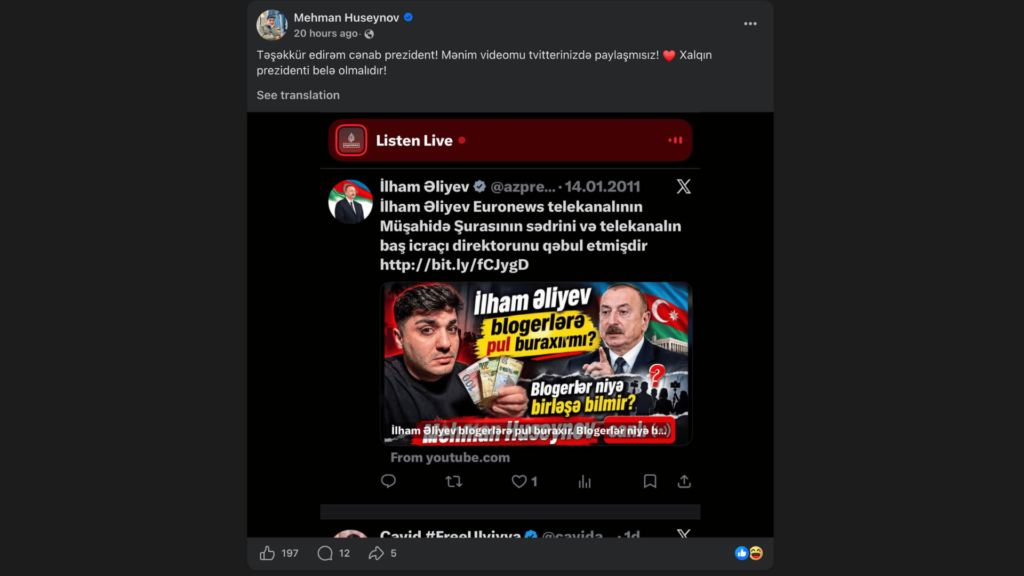
Blogger Mehman Huseynov was sentenced to two years in prison in 2017 on defamation charges. He was released in March 2019. Following the incident, Huseynov sarcastically “thanked” the president on Facebook for sharing a video featuring him: “Thank you, Mr President!”
Blogger Gabil Mammadov, who lives abroad, has been convicted in absentia in Azerbaijan. The Baku Court of Serious Crimes sentenced him to 16 years in prison.
What does “cyberattack” mean?
In the past two months, the Azerbaijani authorities have reported cyberattacks for the second time. On 13 October, more than 100 government websites came under attack. At the time, the State Service for Special Communication and Information Security said when the attack began, which systems it targeted and that its impact had been limited. The agency blamed an unnamed “foreign hacker group”. However, the pro-Iranian group 313 Team, which is believed to operate in Iraq, claimed responsibility. Its members said they had acted in protest against the ban on wearing hijabs in schools.
The statement about the attack on the president’s accounts, however, provided no similar details.
Previous cyberattacks on social media accounts in Azerbaijan have mainly targeted independent media outlets. According to the Committee to Protect Journalists, an international press freedom organisation, almost all Azerbaijani-language posts disappeared from Meydan TV’s Facebook page in June 2020. In August this year, eight independent Azerbaijani media outlets operating in exile issued a joint statement. They said a series of coordinated copyright infringement complaints had led to the suspension of several of their Facebook and Instagram accounts.
This time, the incident affected the president’s own account. It remains unclear who changed the links and why they chose opposition videos as the new destinations. Bitly has not disclosed who owned the accounts it suspended.
Interference with Ilham Aliyev’s X account