

'Anti-religious campaigns in USSR ran parallel to fight against American jazz' — second article by Azerbaijani historian






Religion in Soviet Azerbaijan — Part 2
The 20th Congress of the Communist Party of the Soviet Union, held in February 1956, became a major event in the country’s political and social life. At a closed session on 25 February, the “secret” speech by General Secretary Nikita Khrushchev, On the Cult of Personality and Its Consequences, caused a wide public reaction.
Foreign guests were not invited to the session. However, it proved impossible to conceal what had taken place. Notably, while the congress’s decisions condemned Stalin’s cult of personality, they also gave new momentum to atheist propaganda. By the late 1950s, the campaign against religion in the USSR was being carried out in parallel with a crackdown on American jazz and youth subcultures.
Jamil Hasanli is a well-known Azerbaijani historian, Doctor of Historical Sciences and professor.
He is publishing the series Religion in Soviet Azerbaijan: Between Allah and the KGB on his Facebook page.
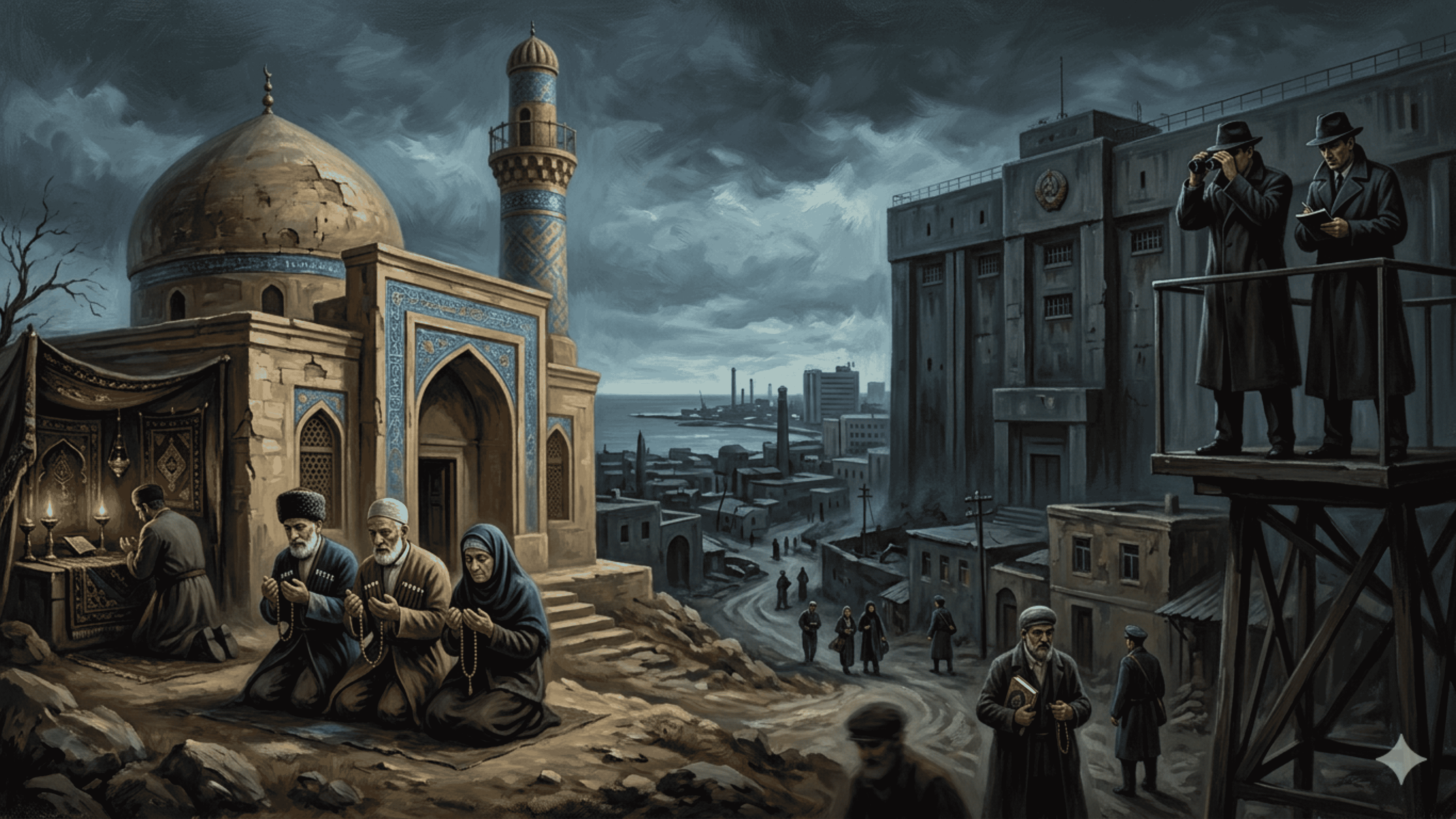
After the 20th Congress, one of the key tasks of the republic’s state security bodies remained the expansion of intelligence work within religious organisations operating in Azerbaijan and the monitoring of pilgrimage sites. To this end, the authorities conducted active agent operations among Muslim communities, as well as among Pentecostals, Subbotniks and Adventists.
In a 1956 report, the newly appointed KGB chairman, Fyodor Kopylov, expressed concern about growing activity during mourning events in the month of Muharram. According to his data, around 3,000 people gathered at the Taza Pir Mosque on the day of Ashura in 1956. He also described the participation of communists and Komsomol members in these rituals as alarming.
At the same time, Kopylov noted that the Spiritual Administration of Muslims of Transcaucasia was under the control of the state security bodies, and that “reliable” individuals had been placed within its seven-member leadership council. According to available information, no anti-Soviet actions were recorded either during religious ceremonies or pilgrimages. However, secret KGB agents were embedded among the small number of pilgrims travelling to Mecca and Mashhad.
By the late 1950s, KGB reports pointed to an increase in religious activity in the Nakhchivan Autonomous Republic. The head of the regional KGB, Mammad Alizade, reported a rise in religious influence and the opening of unofficial mosques. He also noted that a bust of Ataga (Seyidali Mir Abutalib oghlu Mirmovsuzade, who lived in Baku between 1883 and 1950, a disabled man to whom some Azerbaijanis attributed miraculous powers) had been produced in Baku and later transported to a mosque in the village of Nusnus in the Ordubad district. Operational measures established that the bust had been made and transported by Hamid Ismailov, born in 1934, who had graduated from a university in Baku.
At the same time, based on intelligence data, the KGB discovered that in the Julfa district of the Nakhchivan Autonomous Republic, a collective farm chairman — a member of the district party committee plenum and a deputy of the autonomous republic’s Supreme Soviet, M. Kasymov — had travelled with his family and relatives in a farm vehicle to visit the Ashabi-Kahf site. Despite the region’s border status and a high density of informants — 14 agents per KGB officer compared with an average of 11 across the republic — such cases could not be prevented.

As such cases became more frequent across Muslim republics, on 28 November 1958 the Central Committee of the Communist Party of the Soviet Union adopted a resolution On Measures to Halt Pilgrimages to Holy Sites. The document, which criticised such practices, mentioned the Azerbaijan SSR alongside a number of other Muslim republics. It noted that so-called “holy sites” were widespread in Azerbaijan. For example, in the settlement of Shuvelan, dozens of believers visited the “Ataga” shrine (Mir Movsum Agha) every day, while during religious rituals and holidays the number of pilgrims reached 400 to 600.
Similar sites operated in other regions, including the “Pir Seyid” mausoleum in the Mashtaga district, the “Imamzadeh” in Barda, as well as the “Ashabi-Kahf”, “Nusnus” and “Imamzadeh” sites in the Nakhchivan Autonomous Republic. Despite this, local party bodies failed to carry out explanatory work among the population aimed at closing so-called “holy sites”, stopping pilgrimages and eliminating illegally operating religious structures.
On 12 June 1958, the newspaper Kommunist published a detailed article by Asad Asadov, head of a group of lecturers at the Central Committee of the Communist Party of Azerbaijan, titled On Religion and Religious Survivals. It stated that “there are around 4,700 cultural and educational institutions in the republic, yet the state of scientific atheist propaganda within them is unsatisfactory”. Despite the adoption on 5 August 1958 of a resolution On Measures to Strengthen Scientific Atheist Propaganda in the Republic, it proved impossible to stop pilgrimages to “holy sites”. As a result, on 30 December 1958, the Central Committee of the Communist Party of Azerbaijan again brought the issue before its bureau.
By decision of the bureau, editorial offices of newspapers and magazines, the committee for radio and television, and publishing houses were instructed to expose those using “holy sites” for personal gain and organising pilgrimages. The resolution also stated that regional, city and district party organisations, together with the Council for Religious Affairs under the Council of Ministers of the Azerbaijan SSR, were required to report on the implementation of these measures by 20 May 1959. The Central Committee’s propaganda and agitation department was tasked with preparing a report for the CPSU Central Committee by 25 May 1959.
Alongside Muslim believers, representatives of Christian sects in the republic were also subjected to persecution by the security services. As early as 23 August 1957, KGB chairman Fyodor Kopylov sent a detailed report to Imam Mustafayev stating that Baptists in the village of Khilmilli in the Shamakhi district were holding underground gatherings. The report noted that the group was led by Vasily Mikhailov, a member of the Communist Party of the Soviet Union. However, despite the efforts of the party and the security bodies, the reforms under Khrushchev failed to halt the growth of religious influence in Soviet society, particularly in Muslim republics.
On 18 April 1959, the chairman of the USSR KGB, Alexander Shelepin, submitted a detailed report to the Presidium of the CPSU Central Committee titled On the Offensive Against Religious Survivals. It expressed concern about the participation of some scientists, artists and university professors in religious and church rituals, and proposed taking appropriate measures against them.
In 1959–1960, the Azerbaijan KGB prepared two major operations. The first, Operation “Surah Yasin”, was carried out on 26 December 1959 against Islam. The second, conducted in mid-June 1960, targeted youth subcultures, including Western-style fashion and jazz music.
In December 1959, the Central Committee of the Communist Party of Azerbaijan instructed the republic’s KGB to identify the source behind the distribution of the brochure Surah Yasin, which was secretly produced using makeshift methods in Arabic with Cyrillic transcription and circulated in Baku (see: report by KGB officer Akif Bagirov on preventive measures of the Azerbaijan SSR KGB, 7 January 1960).
The KGB immediately activated agents embedded in religious circles, codenamed “Polezny” and “Mammadov”. Soon, agent “Polezny” established that the brochures were being distributed by Mammadbagir Suleyman oglu, born in 1884, who received them from a shoemaker, Safareli Aliyev. Further investigation by the agent network revealed that Aliyev, in turn, obtained religious literature from a pensioner, Aslan Aliyev, who lived in Baku on Mugtadir Aydinbekov Street.
During an operation carried out on 26 December, all three were “accidentally” detained. It was established that the publication of the religious material had been organised by a Baku resident, Habib Dadash oglu Almazov, born in 1918, an employee of the Azneftsupply administration. As a result of operational measures, Almazov was detained while printing the Surah Yasin brochures using improvised equipment. Officers seized 22 completed copies along with the printing tools. He explained that he had begun this activity in September 1959 due to his family’s financial difficulties. After a “preventive conversation”, all four were released, although Almazov remained under KGB surveillance and monitoring for a prolonged period.
Religion in Soviet Azerbaijan — Part 2