Trial in Meydan TV case in Azerbaijan: 'Implement resolution, free press!'






Meydan TV court case
On 22 December, the Baku Court for Grave Crimes held another hearing in the Meydan TV case. Journalists standing trial as defendants staged a protest by singing a song in the courtroom.
As this was the first hearing since the court agreed on 12 December to examine the case on its merits at a preliminary session, the judge again clarified the defendants’ personal details. The court also asked whether they had any objections to their legal representation.
Each defendant said they had chosen their lawyers independently and had no objections to the defence provided.
A representative of the civil claimant and the injured party also took part in the hearing. Fatima Rza gizi Ahmedova, an employee of Baku’s Main Department of Local Revenues, confirmed her personal details.
On 6 December 2024, authorities detained Meydan TV staff members Ramin Deko (Jabrailzade), Aynur Ganbarova (Elgunesh), Aysel Umudova, Aytaj Ahmedova (Tapdyg), Khayala Agayeva, and Natig Javadli. Prosecutors charged them under Article 206.3.2 of the Criminal Code, which covers smuggling committed by a group acting in prior collusion. The investigation became known as the “Meydan TV case”.
Later, police also arrested journalists Shamshad Aga, Nurlan Libre, Fatima Movlamly, Ulviya Ali, and Ahmed Mukhtar in connection with the same case.
In August this year, prosecutors toughened the charges against the journalists and added new articles to the case.
Meydan TV says the arrests are linked to the outlet’s critical reporting.
- Meydan TV case trial begins in Azerbaijan as court rejects most defence motions
- Azerbaijan: Detained journalists report physical abuse
- Abzas Media verdict: 59.5 years in jail for speaking the truth
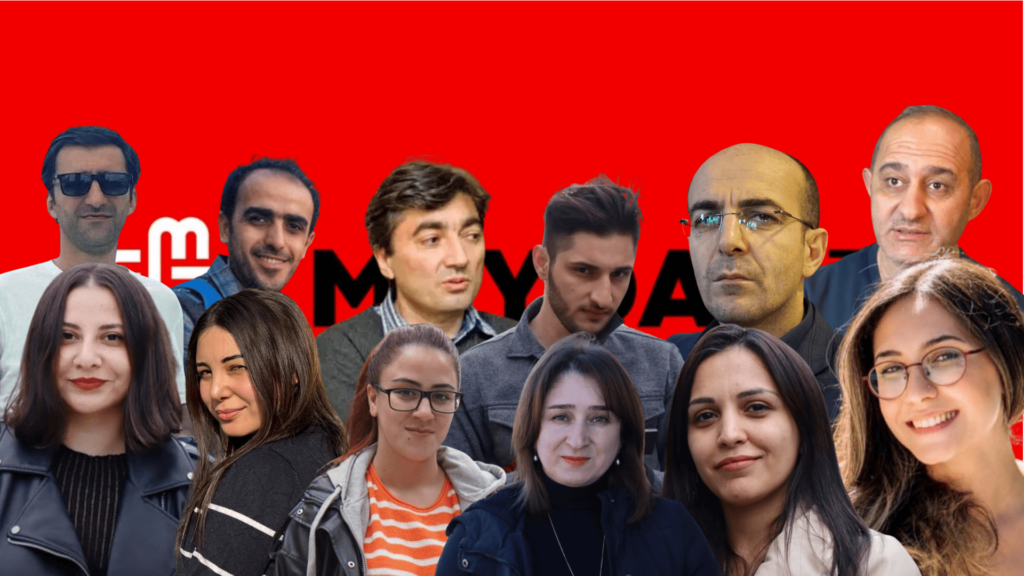
Bottom row: Ulviya Ali, Khayala Agayeva, Fatima Movlamly, Aynur Elgunesh, Aytaj Tapdyg, Aysel Umudova
Top row: Ramin Deko, Ahmed Mukhtar, Ulvi Tahirli, Nurlan Libre, Shamshad Aga, Natig Javadli
Brief summary of the court proceedings
At the previous hearing, a motion was approved to allow the defendants to leave the glass enclosure and sit next to their lawyers, but the judge said the courtroom lacked the conditions for this. In the current session, the defendants were given the choice to sit next to their lawyers or remain in the glass cage.
After confirming personal details, lawyer Zibeyda Sadygova spoke, renewing a request to allow media representatives to attend the hearings and permit audiovisual recording. She stressed that all the defendants are journalists and that the case has public significance.
The state prosecutor objected again, saying that no journalist had formally requested permission to record.
In response, Sadygova asked the court to allow journalists and others present in the courtroom to film. Her supporting lawyer, Nazim Musaev, noted that there are no rules requiring journalists to request permission in advance or register to record court proceedings.
Lawyer Rovshana Ragimli also supported the motion, stating:
“Don’t we constantly emphasise that we live in a democratic country and that the press is free? Then conditions should be created so journalists can record throughout the trial.”
Journalist Nurlan Libre requested that, if the motion was denied, attendees be granted at least three minutes to take photos and videos of the defendants.
In the end, the court rejected all these requests. The judge ruled that press representatives could freely be in the courtroom and take written notes, but recording was prohibited.
Meydan demands: ‘Return what was seized’
Aynur Elgunes renewed a motion she had submitted at the preliminary hearing but which the court had previously left unaddressed. She demanded the return of a state-issued disability benefit card and a card for displaced persons’ aid, which she has been barred from using for 13 months.
“What justification is there for investigating a card provided by the state? Other bank cards being checked might be understandable, but what smuggling could possibly be linked to this?” she asked.
The court decided to send a request to the relevant executive authority to examine the matter.
Lawyer Rovshana Ragimli noted that none of the defence lawyers had seen the document assessing the evidence in the case file, stressing that access to this document is crucial for building their defence.
“The lawyers will be given the opportunity to review this document,” the judge said.
Journalist Shamshad Aga then spoke, thanking those in the courtroom and the lawyers who continue to defend their rights amid a deteriorating human rights situation. He argued that the investigation violated procedural law and put forward several demands:
“Under Article 52.3 of the Criminal Procedure Code, all investigative actions must be immediately registered, or at the latest by the next working day, using forms specified by the relevant executive authorities together with the prosecution. All procedural decisions, as reporting documents, must use official forms with numbered pages.”
He noted that no such forms were included in the case file because investigative actions were not recorded on them.
“Therefore, the case file was compiled in violation of the law and is invalid. A trial cannot proceed on the basis of invalid documents.
Either present these forms to the court, immediately release us, or return the case to the preliminary investigation stage.”
The court rejected this motion. In response, Aga said:
“You yourselves openly violate the law and are conducting the trial using a stack of A4 sheets that have no legal force.”
His remarks were met with applause from the audience.
Journalist Ulviya Ali submitted a motion regarding two mobile phones and one laptop seized during a search, which contain photo and video archives of herself, her family, and her two cats. She requested that, even if the devices are not returned, the media files be copied to an external drive and handed to her family, noting that they could provide the drive themselves.
Journalist Fatima Movlamly filed a similar motion, saying that four phones and a non-working computer tower were taken during a search of her home.
“Of the phones seized at my house, only one belonged to me. My mother’s phone was taken from her bedroom and has not been returned. This is a gross violation of property rights,” she said.
The judge stated that after the examination of the physical evidence, the court would review the issue and make a final decision.
Female journalists performed a song.
After the motions were concluded, the judge announced the start of the trial phase and called the state prosecutor to the bench to read the operative part of the indictment.
During the reading, the prosecutor said the word “smuggling.” At that moment, Aytaj Tapdyg stood up and asked, “What did he say? Smuggling?” Following this, six female journalists facing charges in the case performed a song together.
They sang an adapted version of a song from the film Arshin Mal Alan, starting with the words:
Smuggler, show your goods,
Open up and reveal your wealth.
Show, show everything you have,
The people want to know.
Ah, what a beautiful country,
Everything is concentrated in one pair of hands,
Prisons everywhere, prisons, prisons, prisons.
If I could seize even a little freedom,
I would dance until I collapsed.
After the performance, the audience in the courtroom applauded loudly, which angered the judges. They warned that anyone clapping again would be removed from the courtroom.
At this point, Aynur Elgunes remarked, “They won’t let us write, so we sing.”
Incident at the end of the court hearing
The state prosecutor’s reading of the operative part of the indictment lasted over an hour. Lawyer Rovshana Ragimli noted that the hearing had already been going on for two and a half hours, that the defendants had been brought from afar, and were hungry, and she requested that the proceedings be adjourned for the day.
She pointed out that the prosecutor still had eight unread pages, which would take considerable time to go through.
The court rejected the lawyer’s request and continued the proceedings. At this point, Nurlan Libre, who was in the glass enclosure, addressed those in the courtroom:
“I demand that the government implement the European Parliament resolution calling for the release of journalists.”
He continued, chanting: “Implement the resolution, free the press!”
After this, officers from the Penitentiary Service entered the glass enclosure and forcibly removed the journalist. During his removal, one officer pressed on his neck, tilting his head to the side, while another twisted his arm.
The use of force against Nurlan Libre sparked protests among those present. After the incident, the judge announced the end of the hearing and scheduled the next session for 16 January.
Elbey Kerimli honoured during court hearing
After the hearing, Aytaj Tapdyg stood and called on those present to observe a moment of silence in memory of Elbey Kerimli, who was arrested in August 2023 after writing the word “Stalin” on a Heydar Aliyev monument and died under unclear circumstances in prison just days earlier, on 12 December, the anniversary of Aliyev’s death.
At that moment, the defendants and others in the courtroom stood to honor his memory with a minute of silence.
Meydan TV court case